A low light plant list optimized for bedrooms is not the same list as a general low light plant list, because a bedroom is not the same room as a living room. Bedrooms typically get less natural light than other rooms (closed doors, drawn curtains, sleep-mask darkness that adds another four to six hours of night), run drier in winter because heating vents push warm air through the space, and carry safety constraints (pets sleep here, kids might, and the plant on the nightstand cannot become a trip hazard at 2 a.m.). Low light houseplants for the bedroom need to clear all three filters — shade tolerance, dry-air tolerance, and placement safety — before they earn the slot.
This low light houseplant for bedroom page ranks eight species against bedroom-specific criteria instead of generic shade tolerance: light compensation point, humidity tolerance, toxicity to cats and dogs (per ASPCA’s database), watering frequency in low light (10 to 21 days versus 5 to 7 days in bright indirect), mature size for nightstand versus dresser versus floor, and how much the plant suffers if the reader forgets it for a long weekend. By the end of the page, the reader can pick one species, place it where it will not cause a problem, and skip the species that look low-light-tolerant on paper but fail in actual bedrooms — Calathea is the common one, and the failure mode is explained below.
For the broader low light species picture — what counts as low light, how to measure a room in two minutes, and the watering rule that kills most low light plants — read the cluster hub page on low light plants. If the plant is already yellowing rather than picking time, the cluster has a problem page at low-light yellow leaves. If pet safety is the gating filter (not sleep context), the cluster has a pet-safe-specific page at low light pet safe plants with ten ASPCA-confirmed species.
What Makes a Bedroom Different From Other Low-Light Rooms
Bedrooms are not just dimmer than other rooms; they are dimmer on a specific pattern that excludes some species and protects others. Three constraints stack against most houseplants in this room.
Hours of usable light run shorter than the same window in a living room. A north-facing or west-facing bedroom — and most are one or the other, because builders put the master on the quieter side of the lot — gets roughly 8 to 10 hours of usable light across a day, but 6 to 8 of those are below 50 foot-candles (too dim for most species to drive meaningful photosynthesis). That puts a bedroom 1.5 to 2x below the light integral of an equivalent-sized living room with the same exposure. The low light plants guide covers the foot-candle scale in detail; the practical takeaway is that a bedroom plant needs a lower light compensation point than a living-room plant — the threshold where photosynthesis breaks even with respiration — and that excludes most flowering species outright.
Humidity in winter drops below what humidity-loving plants tolerate. Bedrooms are usually closed-door spaces for 8 to 10 hours overnight, and forced-air heating systems push dry air through the room. Indoor humidity in a winter bedroom typically lands at 25 to 35% — well below the 50 to 60% threshold that Calathea, Boston Fern, and most tropical foliage species need to hold their leaves. The honest limitation: a Calathea that thrives in a 55% humidity greenhouse will drop leaves within four to six weeks in a 30% winter bedroom. That is why Calathea ranks low on this bedroom list despite being a strong shade-tolerant plant in other rooms.
Safety constraints are real and they change which mature sizes make the cut. A 36-inch floor plant next to a bed is a fall hazard when the reader reaches for a phone at 2 a.m. (the failure mode — bent stems, spilled soil, broken pot, plant on the floor). A tall narrow plant on a wobbly nightstand is the same hazard at smaller scale. Bedrooms need plants with stable, low centers of gravity OR plants on dressers and stands that are tall enough not to be tripped over. That is why the picks list below separates nightstand-size (under 14 inches mature), dresser-size (14 to 28 inches), and floor-size (over 28 inches) — each tier has its own safety profile.
The Air Quality and Sleep Claims: What’s Real and What’s Hype
The bedroom is where the wellness industry makes the most expansive claims about houseplants, and most of those claims do not survive contact with evidence. The split is clean: biophilic stress reduction is real (modest, replicated). Air purification is mostly marketing.
| Claim | Evidence strength | Honest take |
|---|---|---|
| Plants reduce perceived stress and improve sleep quality | Moderate — replicated across 12+ studies since 2018, effect size small to moderate | Real. Expect a modest reduction in self-reported stress and slightly better sleep onset, especially in people who already liked plants. Not a treatment for insomnia. |
| NASA Clean Air Study shows plants remove VOCs and purify the air | Strong in lab conditions, weak when extrapolated to real rooms | Technically true; functionally misleading. The NASA study used a sealed chamber with about 700 plants per square meter — that density is not what a reader’s bedroom looks like. To meaningfully filter VOCs from a real bedroom, the reader would need roughly 700 plants, not one on the nightstand. |
| Plants release oxygen at night (CAM photosynthesis) | True for a subset of species (Snake plant, ZZ plant, Aloe, Orchid, Bromeliad); effect on bedroom O2 levels is unmeasurable | The biology is correct — CAM plants do open their stomata at night. But a single Snake plant shifts the bedroom O2 concentration by parts per billion, which is below what a person can detect or benefit from. The framing of “oxygen at night” is honest botany dressed up as a sleep aid. |
| Some bedroom plants are toxic if pets chew them | Strong — ASPCA database is the reference | The trade-off disclosure that matters most: several popular low-light species (Pothos, Philodendron, Peace Lily, Snake plant mildly, Lily family severely for cats) are toxic if chewed. If a pet sleeps in the bedroom, use the cluster’s pet-safe picks instead. |
The honest takeaway: a low-light houseplant in the bedroom likely makes a small but real difference for mood and stress, will not meaningfully change the air chemistry, and may be a hazard if the reader has a pet that chews plants. Set the expectation at “calmer room, slightly better sleep onset” rather than “air purifier,” and the plant earns its slot honestly. Trade-off disclosure: the air-quality framing came from a NASA study that did not extrapolate to real rooms; wellness-industry writers did that extrapolation, and it stuck. The bedroom is one of the few rooms where the framing matters, because readers are choosing based on the claim.
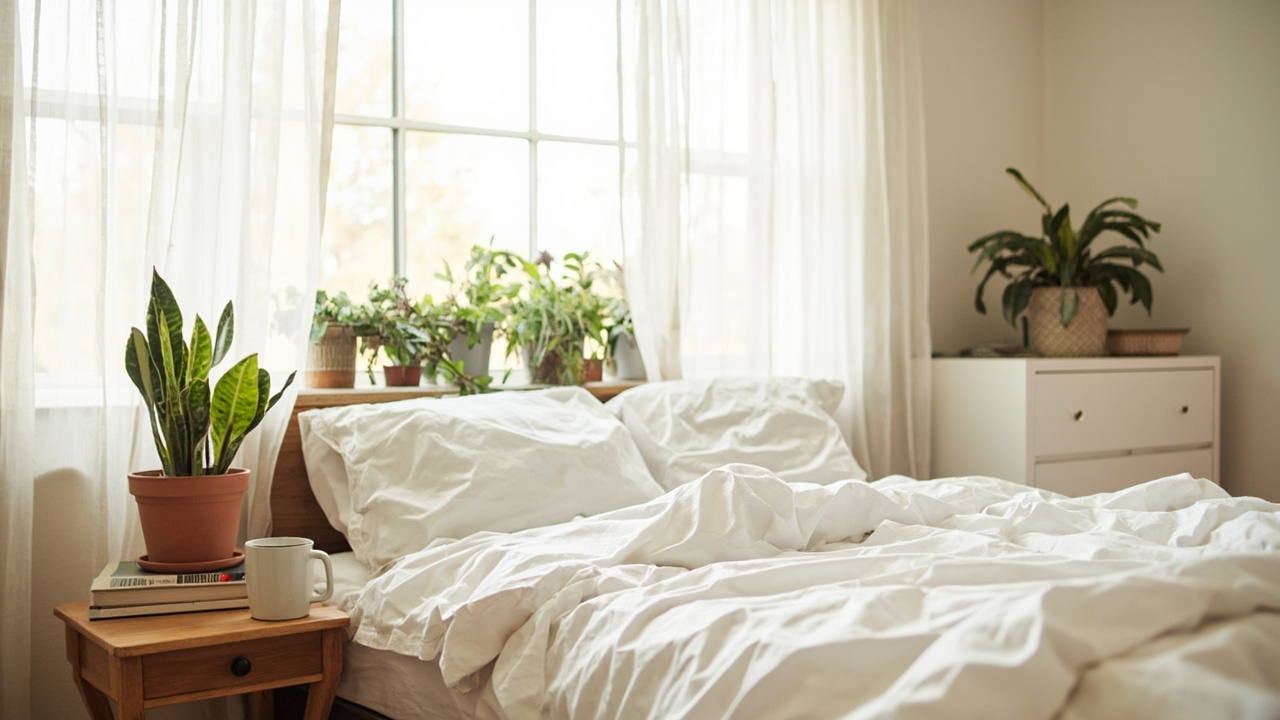
Bedroom Light: How to Read What You Actually Have
Bedrooms are usually read as darker than they actually are at the brightest moment of the day, because curtains are typically drawn during the day and windows are smaller than living-room windows. A quick three-step assessment separates “this room can take a Snake plant or ZZ plant” from “this room is too dark for any species without grow lights.”
- At the brightest time for the bedroom (typically 11 a.m. to 1 p.m. for north-facing, 9 a.m. to 10 a.m. for east-facing, 3 p.m. to 4 p.m. for west-facing), open the curtains fully. Note the brightest spot — usually a windowsill or the floor patch about 3 feet from the window.
- Do the shadow test from the cluster’s hub page: hold a hand 12 inches from a white wall at that brightest spot. A soft-edged shadow that you can tell is a hand but not crisp = medium light (250 to 1,000 foot-candles). A barely visible shadow = low light (50 to 250 foot-candles). No visible shadow = very low light, which most houseplants cannot survive indefinitely. The mechanism behind leggy growth covers what happens when a plant is below its compensation point.
- Repeat at two more times in one day — for example, 9 a.m. and 4 p.m. for a north-facing room. Use the brightest reading. A bedroom with drawn curtains that blocks the brightest noon reading is a different light environment from one with open curtains during the day, and the species that survive differ.
Predicted guidance based on the assessment: if the bedroom’s brightest spot reads low light (most north-facing bedrooms), the picks list below is the right set of candidates. If the brightest spot reads medium light (south-facing bedroom with sheer curtains, east-facing bedroom where morning sun lands on a windowsill), the picks list is overkill — most of the species below will grow faster than expected, and the bedroom will start to feel overplanted within a year. If the brightest spot reads very low light (interior bedroom with a frosted window or no direct window access), a single Snake plant or ZZ plant will survive but grow very slowly, and most other species will fail within six months.
The 8 Best Low-Light Bedroom Plants, Ranked
Eight low light houseplants earn the slot in a bedroom — ranked below against the bedroom-specific criteria, not generic shade tolerance. Each entry covers light range, watering frequency in low light, humidity tolerance, mature size, toxicity to cats and dogs, and the bedroom-specific failure mode to watch for. The species that almost make the list but fail one filter are named in the “near misses” section after the table.
| Rank | Species | Light range (foot-candles) | Watering in low light | Humidity tolerance | Mature size | Pet-safe (ASPCA)? |
|---|---|---|---|---|---|---|
| 1 | Snake plant (Dracaena trifasciata / Sansevieria trifasciata) | 25 to 500+ | Every 14 to 21 days | 25 to 60% | 12 to 48 inches | No — mildly toxic |
| 2 | ZZ plant (Zamioculcas zamiifolia) | 30 to 500+ | Every 14 to 21 days | 20 to 60% | 24 to 36 inches | No — mildly toxic |
| 3 | Pothos (Epipremnum aureum) | 50 to 500+ | Every 10 to 14 days | 40 to 60% | Trailing, 36 to 72 inches | No — toxic |
| 4 | Cast iron plant (Aspidistra elatior) | 25 to 250 | Every 14 to 21 days | 25 to 60% | 24 to 36 inches | No — mildly toxic |
| 5 | Peace lily (Spathiphyllum wallisii) | 50 to 500+ | Every 7 to 10 days (wilts when thirsty) | 40 to 60% | 24 to 36 inches | No — toxic |
| 6 | Philodendron heartleaf (Philodendron hederaceum) | 75 to 500+ | Every 10 to 14 days | 40 to 60% | Trailing, 24 to 60 inches | No — toxic |
| 7 | Chinese evergreen (Aglaonema commutatum) | 50 to 500+ | Every 10 to 14 days | 40 to 60% | 18 to 36 inches | No — toxic |
| 8 | Mass cane (Dracaena fragrans) | 75 to 500+ | Every 10 to 14 days | 30 to 60% | 36 to 96 inches (floor plant) | No — toxic |
Three observations from the table matter more than the rankings themselves.
No species in the top eight is pet-safe at ASPCA “non-toxic” level. Every Snake plant, ZZ plant, Pothos, Cast iron, Peace lily, Philodendron, Chinese evergreen, and Mass cane entry is mildly to severely toxic to cats and dogs if chewed. Within 24 hours of chewing, pets can show oral irritation (calcium oxalate-containing species), vomiting (saponin-containing species), or in the case of Lily family exposure in cats, acute kidney failure. If a pet sleeps in the bedroom, the reader should switch to the low light pet safe plants list — Parlor Palm, Spider plant, Boston Fern, Calathea (with caveats), African Violet, and Prayer plant are the substitutions that clear the toxicity filter. This is the single most important takeaway for pet households reading this page.
The Snake plant is the top pick because its failure mode is the gentlest. In low light (50 to 100 foot-candles), Snake plant pushes 1 to 2 new leaves per year versus 4 to 6 in bright indirect, and tolerates 14 to 21 days between waterings in winter. The substrate stays wet long enough that overwatering is the main risk, but the rhizome stores water in a way that recovers from one-off overwatering episodes that would rot Pothos or Peace lily. The mature size range (12 to 48 inches, depending on cultivar) covers nightstand, dresser, and small-floor placements. The trade-off is mild toxicity — not as severe as Peace lily (which causes oral pain on contact) but not pet-safe.
Peace lily and Philodendron are honest “I want flowers / trailing form” picks, not “low light pet-safe” picks. Peace lily signals its water needs by wilting dramatically — the helpful-leaf-drop trait — then recovers within hours after watering. The fail mode is that the dramatic wilt scares owners into overwatering, which rots the roots. Philodendron heartleaf is the trailing pick for shelves and hanging baskets; it tolerates being trimmed back hard and pushes new growth from the cut nodes within weeks. Neither clears the pet-safe filter.
Near-misses that almost made the list: Calathea (drops leaves in dry winter bedrooms, fails the humidity filter); Boston Fern (needs 50%+ humidity, fails the same way); Spider plant (passes every filter except low-light ceiling — does best at 100+ foot-candles, marginal in very low bedrooms); English Ivy (high humidity needs, plus invasive if it ever goes outside); Fiddle-leaf Fig (looks low-light-tolerant, is not — drops leaves below 200 foot-candles). The trade-off disclosure that is worth printing: Calathea’s failure mode in dry bedrooms is severe and fast — leaves crisp within three weeks. If the bedroom humidity is below 40% in winter, do not buy Calathea expecting it to work.
Where to Place Bedroom Plants (And Where Not To)
Placement in the bedroom is a safety question first and an aesthetic question second. A bedroom plant on the floor near the bed is a trip hazard at 2 a.m. — failing to account for that is a more common cause of plant death than any care mistake. Use this placement rule by size class.
- Nightstand plants (under 14 inches mature height): pick species with stable, low centers of gravity. Snake plant cultivars “Moonshine” and “Hahnii” stay under 12 inches and have broad-based rosettes that do not tip. Avoid tall narrow cultivars on standard nightstands — the failure mode is a bent stem when the reader reaches past the plant for a phone at night.
- Dresser plants (14 to 28 inches): Pothos trailing off the edge of a dresser, ZZ plant in a heavy ceramic pot, Mass cane in a 10-inch nursery pot — these clear the nightstand trip-hazard zone and add visual weight. Anchor tall pots with a small sand layer in the cachepot to lower the center of gravity.
- Floor plants (over 28 inches): only on stands wider than the pot, in rooms where the path between bed and door does not run through the plant zone. Mass cane, large Snake plant cultivars, and large Cast iron plants work — predict that floor plants near HVAC vents dry out twice as fast as corner placements, so plan to water on the shorter end of the species’ range (every 10 to 14 days versus 14 to 21).
- Humidifier zone placement: if the bedroom has a humidifier running in winter, place humidity-loving species (if any make the list — Boston Fern, Calathea) within 3 feet of the humidifier output. Otherwise, expect leaf-edges to crisp within four to six weeks.
The indoor humidity page covers the humidifier trade-off in detail — the practical reality is that 25 to 35% winter bedroom humidity cannot support a humidity-loving plant without one. If the reader is not running a humidifier, the picks list above is the right list; if they are, the pick list expands to include Boston Fern and Calathea.
When a Bedroom Plant Starts Struggling : Quick Triage
If the bedroom plant is yellowing, drooping, or dropping leaves, run the four-question diagnostic before changing the watering routine. The cluster has a dedicated page for this at low-light yellow leaves; the short triage here is the version to use in the moment.
- How many leaves are affected? One leaf or one stem = natural shedding, no fix needed. Multiple leaves within a few days = real problem.
- Stick a finger 1 inch into the soil. Is it wet below the surface? Wet soil + yellow leaves = overwatering (the most common cause in low light — let the top 2 inches dry before watering again). Dry soil + yellow leaves = either underwatering (rare in low light) or nutrient deficiency (more common; see below).
- When did you last fertilize? Over 6 months ago = likely nutrient deficiency (low-light plants grow slowly so they need less, but they still need some — half-strength balanced fertilizer once or twice during spring and summer growing season). Under 1 month ago = could be fertilizer burn; flush the soil with plain water and skip the next feeding.
- Are the leaves yellow all over or in patches? All over = watering or nutrient issue. In patches, or with brown spots or webbing on the underside = check for spider mites (different page). Mushy stem at the soil line = root rot, immediate repot required.
Predictive guidance for the next four to six weeks: a Snake plant whose watering routine is corrected after overwatering typically pushes a new leaf within six to eight weeks. A Peace lily that has been overwatered for a month typically takes two to three months to recover. A Mass cane that lost lower leaves from under-watering usually refills those nodes within one growing season if watering stabilizes. The honest limitation: yellow leaves do not turn green again; the plant grows new ones to replace them. A snake plant that lost three outer leaves will push three new ones in time, not regreen the lost leaves.
Turn PDF Bank Statements Into Workable Spreadsheets
Your bank statement is a mess of numbers, but your books shouldn't be. Use our converter to get Excel, CSV, or QBO files — ready for QuickBooks.