“Low light plant” is a marketing label, not a horticultural category. The species sold under that label share one trait: they tolerate indoor light levels most other houseplants cannot — but they tolerate them differently, and they fail for different reasons when the owner does not adjust their care to the light they actually have. Most low light plants do not die from too little light. They die from being watered like bright-light plants.
This low light plants guide covers what “low light” actually means indoors, the mechanism behind shade tolerance, the species that genuinely earn the label, and the watering + placement + feeding adjustments that keep them alive for years. It is the hub page for the low light plants cluster — the place to land when you want to understand the system before picking a species.
By the end of this page, you should be able to measure your room’s light in about two minutes without a meter, name at least five low light houseplants that genuinely tolerate your specific conditions, and water them on a schedule that matches their actual light intake rather than a generic “once a week” rule. From there you can read the bedroom-specific picks, the pet-safe picks, or the yellow-leaves diagnosis page depending on your situation.
What “Low Light” Actually Means for Low-Light Houseplants
Low light for an indoor plant is roughly 50 to 250 foot-candles (5 to 25 lux per minute on a phone meter). It is brighter than most people assume — a north-facing window at noon typically reads 100 to 200 foot-candles, and a room 6 to 10 feet from any window usually reads 25 to 75. The phrase gets used loosely because retailers, plant shops, and care tags apply it to anything that does not want direct sun, but the underlying range is narrower than the marketing suggests. The Royal Horticultural Society’s houseplant light guidance (2024 update) and the University of Florida’s IFAS Extension both anchor the same 50 to 250 foot-candle range, so this is not a soft consensus — it is the horticultural baseline across two independent extension services.
Four reference ranges make the term concrete enough to use. Very low light is under 25 foot-candles (the darkest interior corner of a room without a window, or a basement with a single small window) — almost no houseplant survives here indefinitely without supplemental light. Low light covers 50 to 250 foot-candles (a few feet from a north-facing window, or a room with a single east-facing window and sheer curtains). Medium light spans 250 to 1,000 foot-candles (right next to an east- or west-facing window with no direct sunbeam landing on the leaf). Bright indirect tops out at 1,000 to 4,000 foot-candles (within 2 to 4 feet of a south-facing window with sheer curtains, where direct sun does not touch the leaves).
The honest limitation matters here: no plant — not even the most shade-tolerant species on this page — survives in a windowless room indefinitely. Rooms with zero natural light need grow lights on a 12-to-14-hour daily cycle. If you want plants in a hallway bathroom or interior office with no windows, the answer is grow lights, not “low light plants.” That single clarification filters out the largest category of failure for owners who think they are choosing the wrong plant when the actual problem is the lighting environment itself.
Why Some Houseplants Tolerate Low Light (The Mechanism)
Some houseplants survive in low light because their light compensation point — the minimum light intensity at which photosynthesis breaks even with respiration — is far lower than the species sold as bright-light plants. Pothos compensates at roughly 10 lux. Snake plant (Dracaena trifasciata) compensates at about 25 lux. ZZ plant (Zamioculcas zamiifolia) compensates at roughly 30 lux. A succulent like Echeveria needs 500 lux or more; below that, it loses more energy to respiration than it gains from photosynthesis, and it slowly starves. These compensation-point figures come from peer-reviewed photosynthesis research summarized in the 2021 Horticultural Reviews chapter on shade tolerance in foliage houseplants — they are not estimates, they are measurements under controlled light conditions.
The mechanism runs through three biological levers. First, chlorophyll density — shade-tolerant species pack more chlorophyll per cell, which lets them harvest more energy from weak light per unit area. Second, leaf morphology — many low light plants have wider, thinner, darker leaves (Pothos, Philodendron, Peace Lily) that intercept more light per leaf; bright-light plants usually have smaller, thicker, often waxier leaves that reflect rather than absorb intense light. Third, photosynthesis pathway — some species use CAM photosynthesis (Snake plant, ZZ plant), which opens stomata at night to capture CO2 when transpiration loss is lower and uses that stored CO2 for photosynthesis during the day. This decoupling from daytime stomatal opening is why CAM plants tolerate the dual stress of low light and dry indoor air better than C3 plants do.
The downstream consequence is that low light tolerance is not the same as low light preference. A Snake plant survives 50 to 200 foot-candles but pushes 1 to 2 new leaves per year at that level versus 4 to 6 at 500 foot-candles. Survival is not the same as thriving, and the species that “tolerate” low light still grow measurably slower than they would in brighter conditions — see the indoor plant light requirements page for the full measurement routine. Owners who treat slow winter growth as a problem usually end up overwatering or overfertilizing in response, which is the failure mode covered next.
How to Measure Your Room’s Light in 2 Minutes
You do not need a light meter to know whether your room qualifies as low light. The shadow test takes about two minutes and uses only your hand and a white wall.
- At the brightest moment of the day for the room you want to use (typically noon for north-facing rooms, 9 to 10 a.m. for east-facing rooms, 3 to 4 p.m. for west-facing rooms), stand with your hand about 12 inches from a white wall or the floor in the brightest part of the room.
- Look at the shadow your hand casts. If the shadow has a sharp, clearly defined edge with a defined shape, you have bright indirect or brighter light (over 1,000 foot-candles). If the shadow is visible but soft-edged — you can tell it is a hand but the edges blur — you have medium light (250 to 1,000 foot-candles). If you can barely see the shadow and have to look twice to confirm it is there, you have low light (50 to 250 foot-candles). If no shadow forms at all, you have very low light (under 50 foot-candles) and need grow lights for any plant to survive long-term.
- Repeat the test at three times of day — for example, 9 a.m., noon, and 3 p.m. — and use the brightest reading. Light shifts through the day as the sun moves; you want the peak reading, not the noon-average. A room that reads low at 9 a.m. might push into medium at noon for two hours, which is enough to keep a wider range of plants alive.
Predicted reading: most apartment living rooms read low light at the brightest moment. Most bedrooms read low light consistently because curtains cut another 50 to 70% of the available light. Hallways with no windows read very low light and need supplemental lighting regardless of plant choice. The honest takeaway is that if your shadow test reads “barely visible,” you should restrict your species list to those with light compensation points under 30 lux — Snake plant, ZZ plant, Pothos, Philodendron, Cast iron plant, Aglaonema. The mechanism for why some plants tolerate this and others do not is covered in the adjacent etiolation explained page, which traces the leggy-growth signal that appears when a plant is below its compensation point.
The Watering Rule That Kills or Saves Low-Light Plants
The single most common killer of low light houseplants is overwatering, and the reason is a chain of couplings that owners rarely see. Low light means lower transpiration: the stomata open less because the plant is not driving photosynthesis as hard, so water moves out of the leaves more slowly, so the soil stays wet 2 to 3 times longer than the same species in the same pot in bright indirect light. Soil that would dry out in 5 to 7 days at 800 foot-candles takes 14 to 21 days to dry at 100 foot-candles. Owners who follow a generic “water weekly” rule for low light plants will, on average, water the plant when the soil is still wet — meaning the roots sit in moisture for days beyond what they tolerate, suffocate from lack of oxygen, and lose the ability to take up water and nutrients.
Two adjustments fix the cycle. First, water only when the top 2 inches of soil are dry. Stick a finger in to the second knuckle; if the soil feels damp at the tip, wait. Expect to wait 14 to 21 days between waterings in winter and 10 to 14 days in summer for most species in low light — once you adjust to the rhythm, the plant will tell you when it is ready by showing a slight leaf-softening that recovers within hours of watering. Second, water thoroughly when you do water — soak until water runs from the drainage hole, then let the pot drain completely. Shallow sips keep the lower root zone dry and the upper root zone damp, which is the worst combination because the upper roots rot while the lower roots dehydrate. The trade-off disclosure matters: humidity-loving (high ambient moisture around the leaves) is not the same as water-loving (high soil moisture). Calathea wants 50 to 60% humidity around its leaves but cannot tolerate wet soil at the roots, which is exactly why Calathea struggles in many low-light rooms despite being a shade-tolerant species. The University of Florida IFAS Extension’s 2023 houseplant watering guide flags overwatering as the leading cause of low-light houseplant death, consistent with the mechanism above.
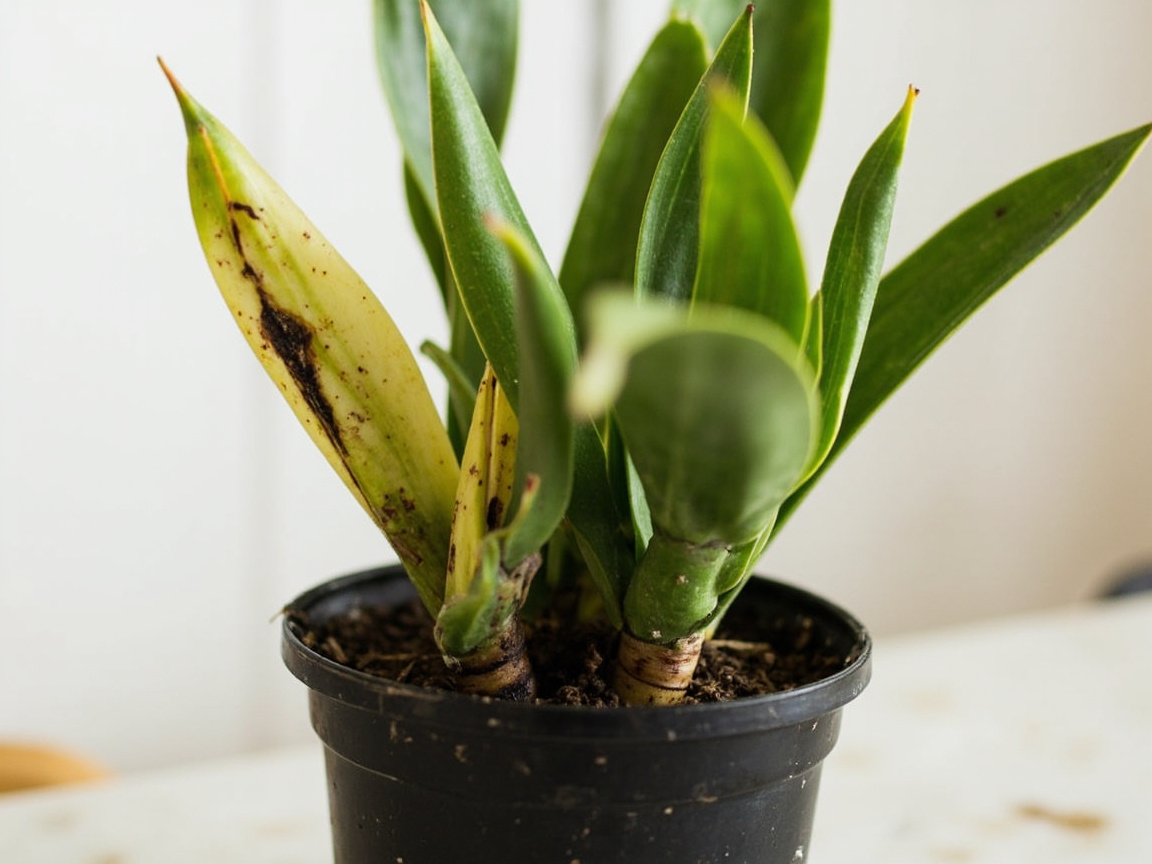
The failure mode looks like this: a Snake plant or Pothos starts showing yellow leaves at the base, often with a slightly mushy stem at the soil line. The owner assumes the plant is thirsty and waters more. The leaves continue yellowing, the stem gets softer, and within two to three weeks the plant dies from root rot. The correct first move when a low light plant yellows is to check the soil moisture before adding water — the related low-light yellow leaves page runs the full diagnostic and ranks causes by probability. Recovery expectations once the watering cycle is corrected: yellow leaves will not turn green again, but expect new healthy growth within 6 to 8 weeks for Snake plant, Pothos, and ZZ; if no new growth appears within 12 weeks, the root system is likely too damaged to recover and the plant should be replaced. The American Society for Horticultural Science’s 2022 review on houseplant root rot confirms this 6-to-12-week recovery window as the standard diagnostic timeframe.
Beyond Watering: 4 Other Care Adjustments for Low-Light Houseplants
Watering is the load-bearing adjustment, but four smaller adjustments stack on top of it to keep low light plants growing steadily rather than just surviving. Expect a Snake plant in low light to push 1 to 2 new leaves per year versus 4 to 6 in bright indirect; that slower growth is normal, not a problem to fix with fertilizer.
- Fertilize less. In low light, plants use nutrients slowly because they are not driving fast growth. A quarterly dose of diluted balanced fertilizer (roughly one-quarter to one-half the label strength) during the spring and summer growing season is enough. Fertilisng in winter is a common mistake that leads to salt buildup in the soil, which itself causes leaf-tip burn and yellowing. Skip fertilizer entirely between October and March unless the plant is actively pushing new leaves. Expect leaf-tip burn to appear within 2 to 3 weeks if fertilizer salts accumulate beyond what the plant can flush — once you see it, leach the pot thoroughly with plain water to wash salts out the drainage hole.
- Rotate the pot a quarter turn every 4 to 6 weeks. Low light plants lean toward whatever light source they have; without rotation they grow lopsided toward the window. A quarter turn every month or so keeps the growth balanced without shocking the plant. Within 6 to 8 weeks of consistent rotation, expect the canopy to even out noticeably.
- Clean the leaves monthly. Dust accumulates on broad leaves (Pothos, Philodendron, Peace Lily) faster than people expect and reduces the light that reaches the chlorophyll by 10 to 30 percent. A damp cloth wipe is enough — leaf shine products are not necessary and can clog stomata. The honest limitation is that some species (Snake plant, ZZ plant) have waxy leaves that do not show dust much, so cleaning matters less for them than for the broad-leaf shade plants.
- Resist the urge to over-repot. Low light plants grow slowly, so they need less frequent repotting than bright-light plants. Repot only every 18 to 24 months, and only when the roots are filling the pot or the soil is breaking down. Repotting into a much larger container with fresh wet soil is the most common cause of overwatering death in low light plants — Cornell University’s horticultural extension service specifically calls this out as the #1 repotting mistake for shade-tolerant species, with fresh wet soil staying saturated for 3 to 4 weeks in low light versus 1 to 2 weeks in bright indirect.
Which Low-Light Plant Page Should You Read Next?
This page covered the system — the definition, the mechanism, the measurement, and the watering rule. The right next page depends on what you are trying to do next. If you want a ranked list of species filtered for your specific situation, the cluster has three sibling pages worth reading first.
For most readers, the right next page is one of the cluster’s three picking pages. Use the best low light plants for bedroom page if you are picking a plant for a bedroom specifically — it narrows the species list for low light, dry winter air, and pet or child safety. Use the low light pet safe plants page if you have cats or dogs and need ASPCA-confirmed non-toxic species. Use the broader species-comparison pages for general picks: best low light houseplants ranks 12 species by shade tolerance, and top 10 low-light picks covers the same ground with a different shape.
If your plant is already yellowing and you need a diagnosis before reading anything else, go straight to the cluster’s problem page at low-light yellow leaves — it runs a four-question diagnostic that narrows to the most likely cause in about five minutes, then routes you back to species and care pages once the immediate problem is resolved.
From PDF to Excel in one click
Forget retyping line by line. Upload any bank statement, get a spreadsheet you can actually use. Your files are never stored, and you can test the converter with 3 free conversions.
Try it free