Begonias need bright indirect light — it is the single most important factor for keeping these plants healthy indoors. Too much direct sun scorches their leaves within hours. Too little light fades their famous colors and turns compact growth into a stretched, leggy mess. Finding the right spot is not complicated, but it does require understanding what “bright indirect light” actually means in a real home.
The good news: once you learn to read your begonia’s signals, the plant tells you exactly what it needs. New leaves that are smaller and paler than older ones mean the light is too low. Brown, papery patches on the leaves closest to the window mean it is too high. A begonia in the right light produces steady new growth, holds its color, and keeps a compact shape without any intervention.
This guide covers what bright indirect light means in practical terms, how to find the right spot by window direction, how to read your plant’s signals, and what to do when natural light is not enough.
What Begonias Need: Defining Bright Indirect Light
Bright indirect light means the plant receives strong ambient light but no direct sun rays hitting the leaves. In measurable terms, that is roughly 200 to 400 foot-candles for most indoor begonias. You do not need a light meter to find it — use the reading test: if you can comfortably read a book at the plant’s location at midday without turning on a lamp, the light is in the right range.
Direct sun through glass is more intense than direct sun outdoors because the glass magnifies and traps heat. A south-facing window in July can deliver 2,000 to 3,000 foot-candles at noon — enough to destroy begonia leaves in a single afternoon. The fix is simple: move the plant a few feet back from the window, or hang a sheer curtain to filter the light. The goal is to let the plant see the sky without seeing the sun.
Window Direction Guide for Begonias
Not all windows deliver the same light, and the differences matter more than most people realize.
East Windows (the sweet spot)
An east-facing window delivers gentle morning sun that rarely exceeds 400 to 600 foot-candles. For most indoor begonias — rex, rhizomatous, and cane types — this is the ideal location. The light is strong enough for vivid color and compact growth, but soft enough that you do not need to filter it. Place the pot on the windowsill or within 2 to 3 feet of it.
South and West Windows (needs filtering)
A south-facing window is the brightest spot in most homes, delivering 1,500 to 3,000 foot-candles at midday in summer. That is far too much for begonias. If a south window is your only option, place the plant 4 to 6 feet back from the glass, or use a sheer curtain to cut the light by 50 to 70 percent. West windows deliver harsh afternoon sun that is even more intense than south — the same filtering applies. The trade-off: a begonia behind a curtain grows more slowly and may produce less vivid color, but it will not burn.
North Windows (usually too dim)
A north-facing window in the Northern Hemisphere delivers only 50 to 150 foot-candles — enough to keep a begonia alive but not enough for it to thrive. Leaves will be pale, growth will be slow, and rex types will lose their dramatic color patterns entirely. If a north window is your only option, a simple LED grow light on a timer for 10 to 12 hours a day makes a noticeable difference within 2 to 3 weeks.
Signs Your Begonia Is Getting Too Much Light
Light damage shows up fast — sometimes within a single day of being moved to a brighter spot. The most common symptom is brown, papery patches on the leaves closest to the window. These burns do not heal; the damaged tissue is dead. The leaf may eventually drop, or you can trim the burned portion if it is unsightly.
Chronic overexposure looks different: the entire plant takes on a washed-out, faded appearance. Rex begonias lose their metallic sheen and turn flat green. Cane types produce long, thin internodes as they stretch away from the harsh light. If you see these signs, move the plant farther from the window or add a curtain. For severe cases where yellowing has already started, our article on begonia yellow leaves diagnosis helps distinguish light damage from other causes.
Signs Your Begonia Is Not Getting Enough Light
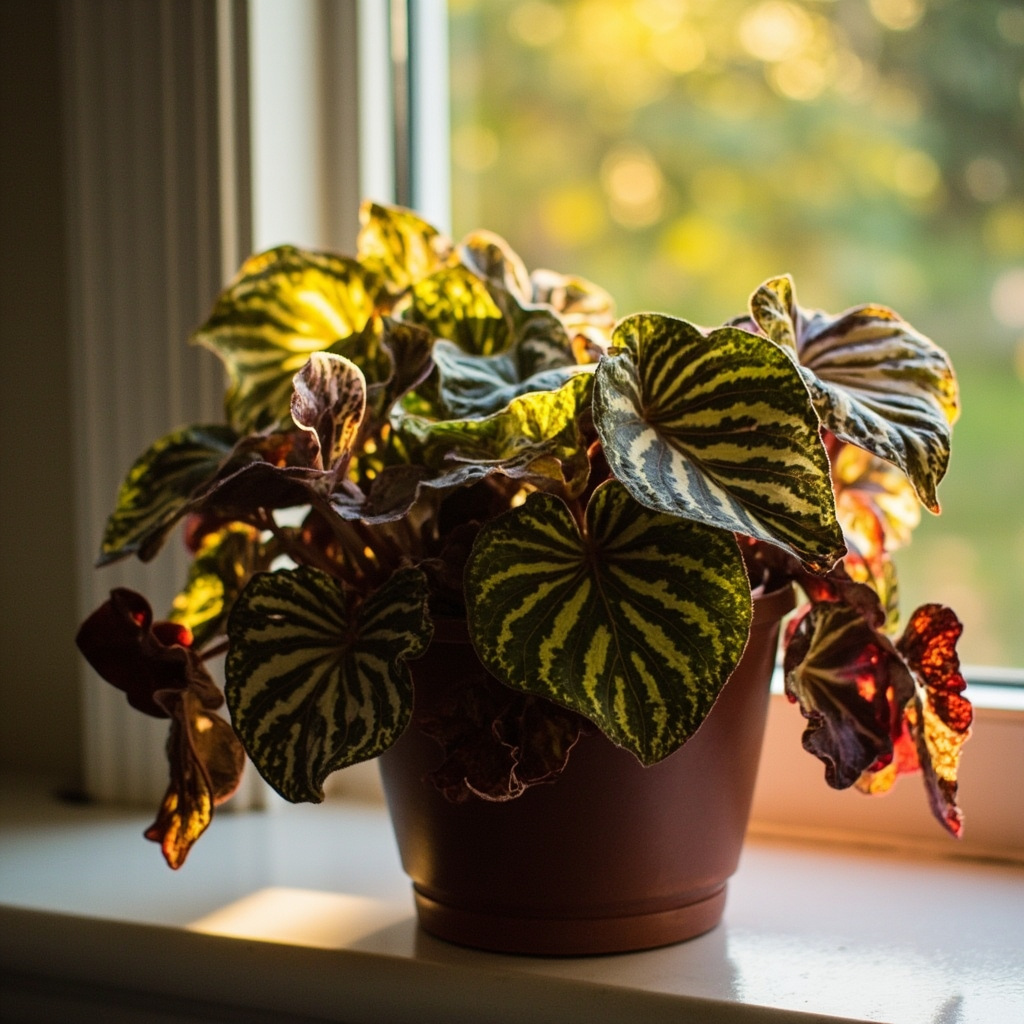
Insufficient light is slower to show but just as damaging over time. The first sign is usually smaller new leaves — each new leaf emerges slightly smaller than the one before it. In rex begonias, the bold color patterns fade to plain green because the plant produces less of the pigments that create those colors when light is scarce. Cane types stretch toward the window, producing long, thin stems with wide gaps between leaves (etiolation).
If you notice your begolia leaning heavily toward the light source, rotate the pot 90 degrees every week to keep growth even. A plant that has been in low light for months should be moved gradually — shift it a foot closer to the window each week rather than moving it all at once. A sudden jump from a dim corner to a bright windowsill can shock the plant and cause leaf drop. For a full breakdown of which begonias tolerate which light levels, see our begonia types and varieties guide.
Light Needs by Begonia Type
| Begonia Type | Ideal Light (foot-candles) | Best Window | Notes |
|---|---|---|---|
| Rex | 200–350 | East or filtered south | Fades in too much light; needs humidity above 50% |
| Rhizomatous | 150–350 | East or north with grow light | Tolerates lower light than rex; slower growth |
| Cane (Angel Wing) | 300–500 | East or bright south with curtain | Needs more light to avoid leggy growth |
| Wax (Fibrous) | 300–600 | East or south with curtain | Most light-tolerant; blooms best in bright light |
Using Grow Lights for Begonias
When natural light is not enough — a north-facing apartment, a basement grow room, or a dark winter — a simple LED grow light solves the problem. You do not need an expensive full-spectrum panel; a 10 to 15 watt LED bulb in a standard fixture works well for one to three plants.
Position the light 12 to 18 inches above the plant and run it for 10 to 12 hours per day. A simple outlet timer handles the schedule automatically. Look for improvement within 2 to 3 weeks: new leaves should be larger, color should intensify, and growth should be more compact. If the leaves start bleaching or developing brown edges, the light is too close — raise it by 3 to 4 inches. If the plant still stretches after 3 weeks, increase the duration by an hour or move the light closer.
From Bank Statement to QuickBooks-Ready File
That manual cleanup you just read about? This tool skips it. Turn your PDF into QBO for QuickBooks without storing your data anywhere.
Start Converting