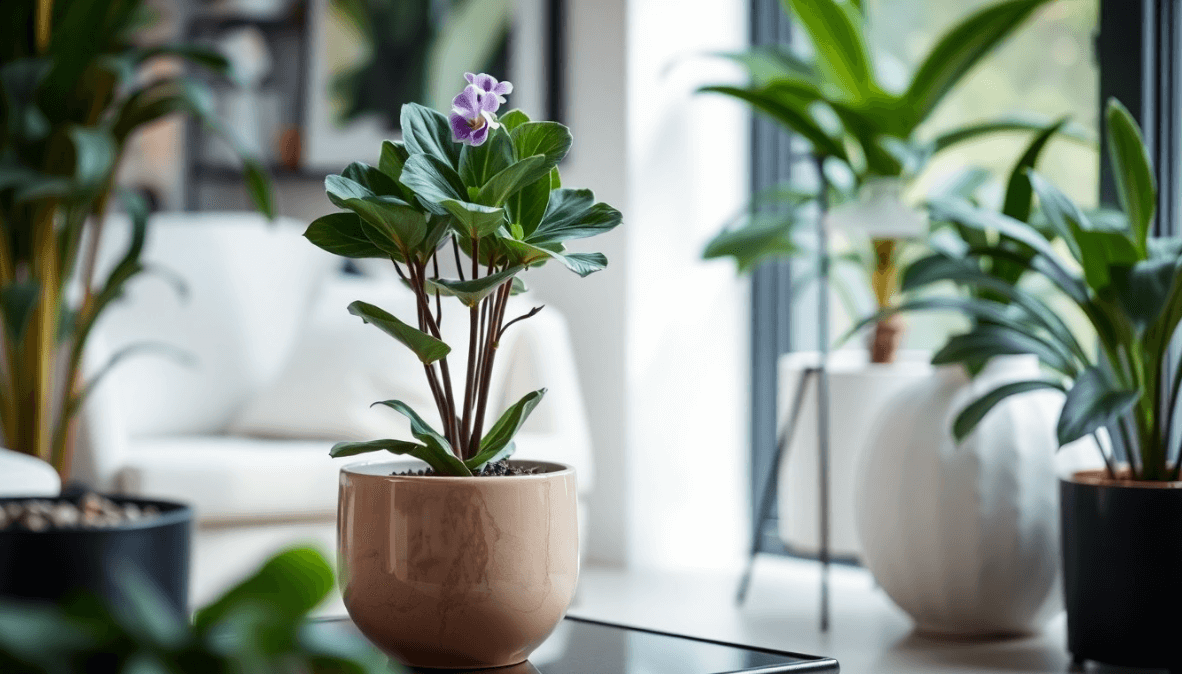

African violets need 10 to 12 hours of bright indirect light every day to bloom consistently. Less than that and the plant stretches, produces fewer flowers, and eventually stops blooming altogether. More than that, especially direct sun, and the leaves bleach or scorch.
This species is more light-sensitive than most common houseplants. A pothos tolerates a dim corner. A snake plant survives on a hallway table. An African violet in the same spot will grow dark, lush leaves but never flower. The good news is that the sweet spot, bright indirect light, is easy to find in most homes once you know which windows deliver it.
This guide covers the best window directions, the warning signs of too much and too little light, grow-light setups for darker rooms, and the weekly rotation habit that keeps the rosette symmetrical.
The Target: 10 to 12 Hours of Bright Indirect Light
Bright indirect light means the plant is in a well-lit room but the sun’s rays are not striking the leaves directly. The light is diffused by a curtain, reflected off a wall, or filtered through a nearby tree. Direct sun on African violet leaves causes scorch patches within hours on hot days.
The 10-to-12-hour duration matters because African violets are long-day bloomers. They initiate flower buds when the daily light period exceeds roughly 10 hours. Shorter days signal the plant to slow down, which is why many violets bloom less in winter even when the light looks adequate to the human eye.
The african violet care guide covers how light interacts with watering and feeding. This article focuses entirely on getting the light right.
Best Window Directions for African Violets
East-facing is the ideal window. The plant receives gentle morning sun for a few hours, which is bright but not hot, and indirect light for the rest of the day. Most African violets bloom reliably in an east window year-round.
North-facing works well in spring and summer when the days are long. In winter, especially above 35 degrees latitude, a north window may not provide enough intensity for blooming. If your violet stops flowering in winter in a north window, move it to an east spot or add a grow light.
South-facing delivers the most light but also the most risk. Place the plant at least three feet from the window or hang a sheer curtain to filter the direct rays. A south window with a sheer curtain is equivalent to a bright east window.
West-facing receives hot afternoon sun, which is the most likely to scorch leaves. Use a sheer curtain or place the plant to the side of the window where direct afternoon rays do not reach it.
Signs Your African Violet Is Getting Too Little Light
The first sign is leaf stretch. The leaf stems elongate, the spaces between leaves widen, and the rosette opens up into a loose, leggy shape instead of staying compact. The leaves themselves may turn darker green as they produce more chlorophyll to capture available light.
The second sign is a lack of flowers. The plant may look healthy and produce new leaves, but no bloom stems emerge. If your violet has not bloomed in three or four months and the leaves look dark and stretched, it almost certainly needs more light.
The fix is to move the plant closer to the window, to a brighter window, or to add a grow light for supplemental hours. African violets respond to improved light within four to six weeks with new flower buds.
Signs Your African Violet Is Getting Too Much Light
Too much light bleaches the leaves to a pale yellow-green, especially at the center of the rosette where the light is most concentrated. In more severe cases, brown scorch patches appear on the upper leaf surfaces. The leaves may also curl downward at the edges, a sun-avoidance posture.
If bleaching is caught early, moving the plant a foot or two back from the window or adding a thin curtain reverses the damage on new growth. Existing scorch marks are permanent, but they do not spread once the light is corrected.
For a full guide to browning, scorch, and other leaf damage patterns, see african violet leaves turning brown.
Using Grow Lights as a Reliable Backup
A household LED or fluorescent grow light solves the problem in rooms with weak natural light. A full-spectrum white LED panel or T5 fluorescent tube positioned 8 to 12 inches above the plant provides the right intensity without heat damage.
Run the grow light for 10 to 12 hours on a timer. Combine it with whatever natural light the room receives. If the room gets 6 hours of indirect light from a north window, the grow light needs to run for only 4 to 6 additional hours to reach the 10-hour minimum.
LED grow lights are preferable for African violets because they produce little heat and can be placed close to the plant without risk of leaf burn. A 10-to-15-watt LED panel is sufficient for one or two plants.
The Weekly Rotation Habit
African violets are strongly phototropic. The leaves lean toward the light source within days, which produces a lopsided rosette. Rotate the pot a quarter turn each week so all sides of the plant receive equal light. This is the single easiest habit that improves the plant’s appearance and bloom symmetry.
If your violet has already leaned, rotate it so the bare side faces the window. It will straighten within two to three weeks. Severe lean can be corrected by repotting the plant slightly deeper, burying the elongated lower stem so the rosette sits at soil level.
What to Do If Your Room Has Almost No Natural Light
An interior room, a basement apartment, or a north-facing studio in winter can still grow African violets with a dedicated grow-light setup. Use a full-spectrum LED panel rated for houseplants, position it 8 to 10 inches above the foliage, and run it for 12 hours daily on a timer.
Without any natural light, the grow light becomes the sole source, so consistency matters. Do not skip days. A 12-hour on, 12-hour off cycle mimics a long summer day and keeps the bloom cycle active. Pair this with the african violet watering guide schedule, because plants under grow lights in dry indoor air may need slightly more frequent watering.
Violets grown entirely under artificial light often bloom more reliably than those in inconsistent natural light, because the duration and intensity are controlled. The trade-off is a slightly higher electricity cost and the need to remember the weekly rotation.
From Bank Statement to QuickBooks-Ready File
That manual cleanup you just read about? This tool skips it. Turn your PDF into QBO for QuickBooks without storing your data anywhere.
Start Converting