An aeroponic system is one of the most efficient ways to grow plants without soil, but it is also one of the most sensitive. Because the roots hang in open air and depend on a fine mist delivered at regular intervals, even a short interruption in misting, a clogged nozzle, or a nutrient imbalance can shift a healthy root system into decline within hours. When something looks wrong — browning tips, wilting leaves, slow growth — the question is almost always the same: is this the roots, the pump, the misters, or the nutrients?
Aeroponic troubleshooting is the practice of reading those symptoms quickly and matching them to the part of the system that produced them. The good news is that aeroponic failures are highly predictable. They fall into a small number of mechanical, biological, and chemical categories, and most can be diagnosed without specialized tools. The goal of this guide is to help you identify the most likely cause of an aeroponic problem, understand whether it needs immediate action or routine attention, and know when to step in yourself versus when to replace a component.
If you are still building confidence in how an aeroponic system is supposed to work in normal conditions, the beginner overview of aeroponic systems is a useful foundation. This page assumes that baseline and focuses on what changes when something starts to go wrong.
How to read an aeroponic problem before you act
The first move in aeroponic troubleshooting is to slow down and observe. Most growers reach for the nutrient bottle or the cleaning brush before they have actually identified the symptom, and that is how a small mechanical issue turns into a chemical one. A better order of operations is to look at the roots first, then the mist, then the nutrient solution, and only then the pump and timers.
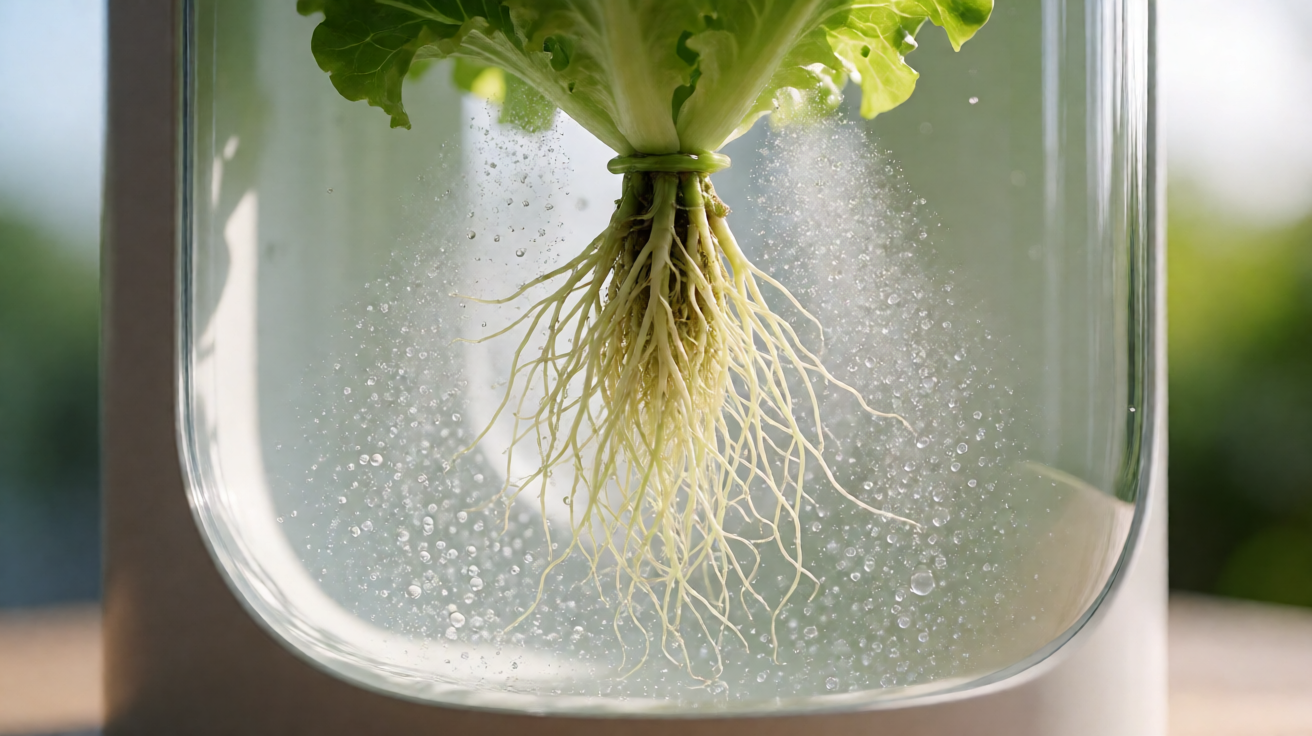
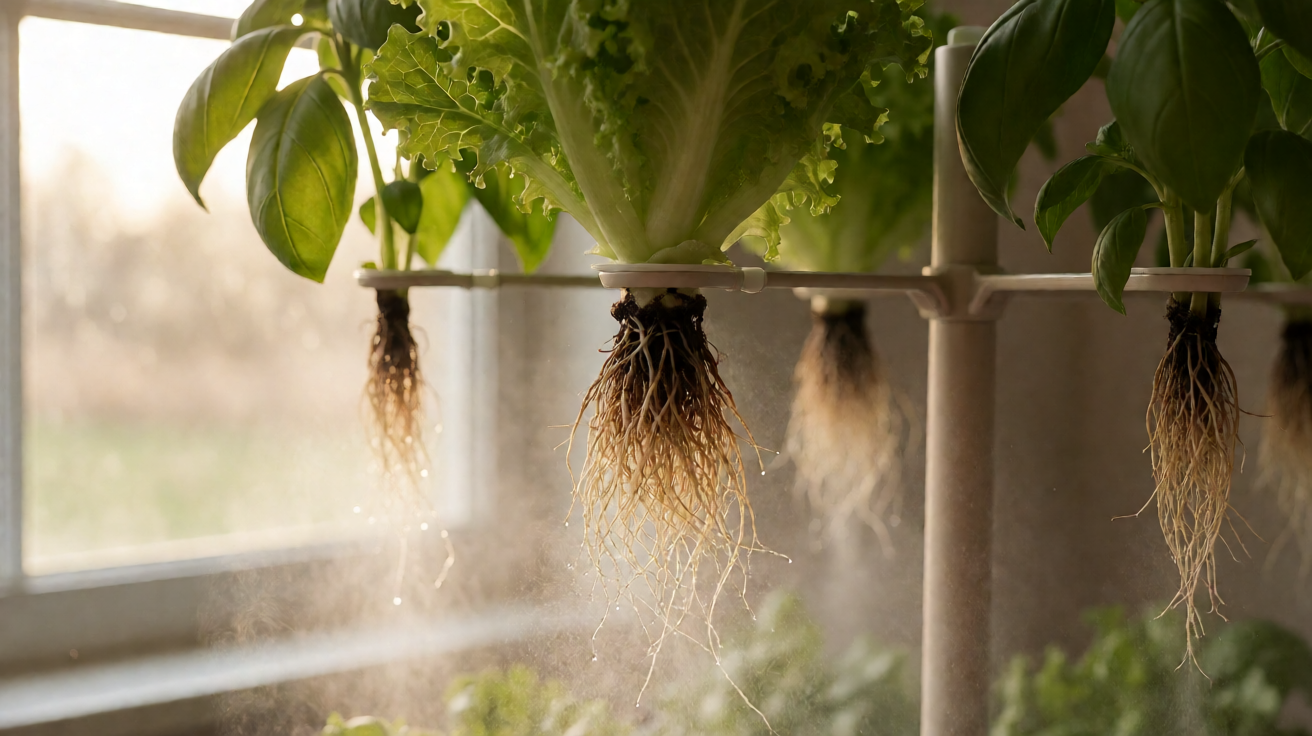
Roots should be pale, firm, and slightly fuzzy with new white tips. Leaves should be turgid, evenly colored, and growing on a steady cadence. When one of these signals drifts, it is usually pointing to a specific failure mode rather than a vague “something is off.” Match the symptom to the system part that controls it, and the diagnosis usually narrows to a single category within a few minutes.
Three quick checks will rule out the most common false alarms. First, confirm the mist cycle is actually running by watching a mister for a full on/off cycle. Second, lift the lid and smell the root chamber — a sour, swampy, or rotten odor is a strong signal, while a neutral, clean smell is reassuring. Third, look at the solution reservoir and recent leaf color in the same glance. If the leaves are yellowing from the bottom up and the reservoir is clear, the problem is usually not the nutrients; it is the roots.
Root symptoms and what they point to
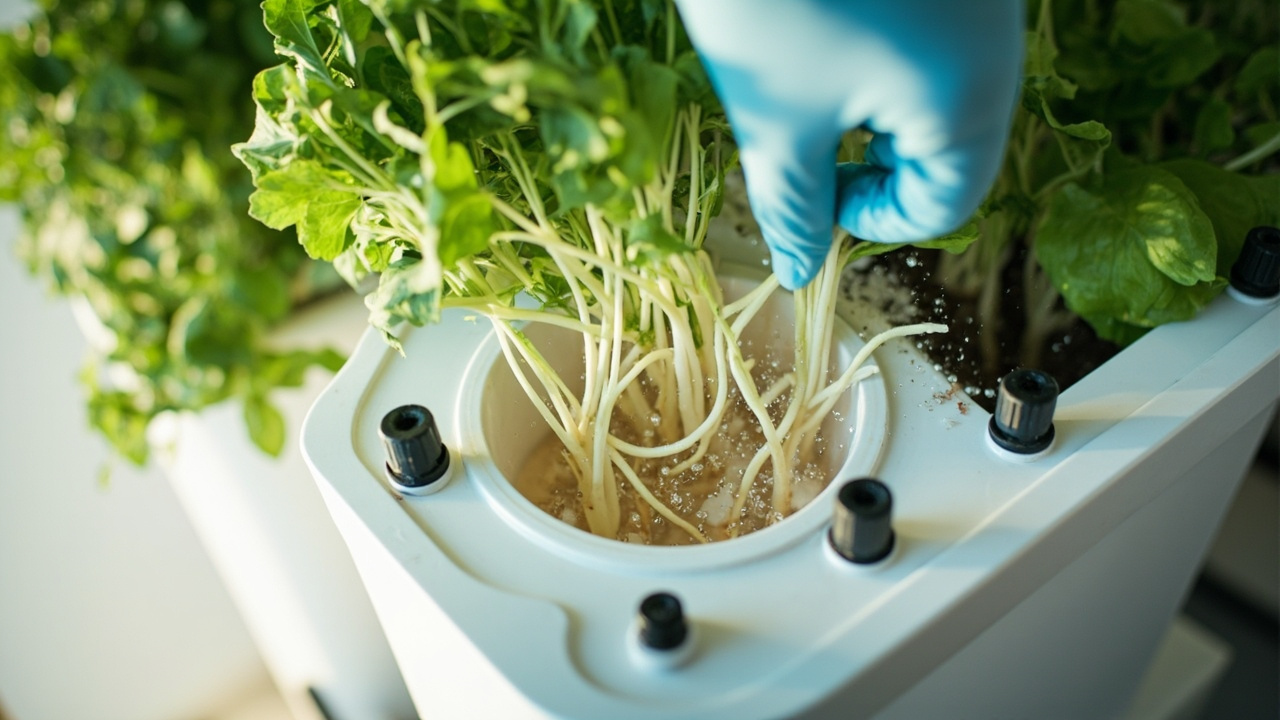
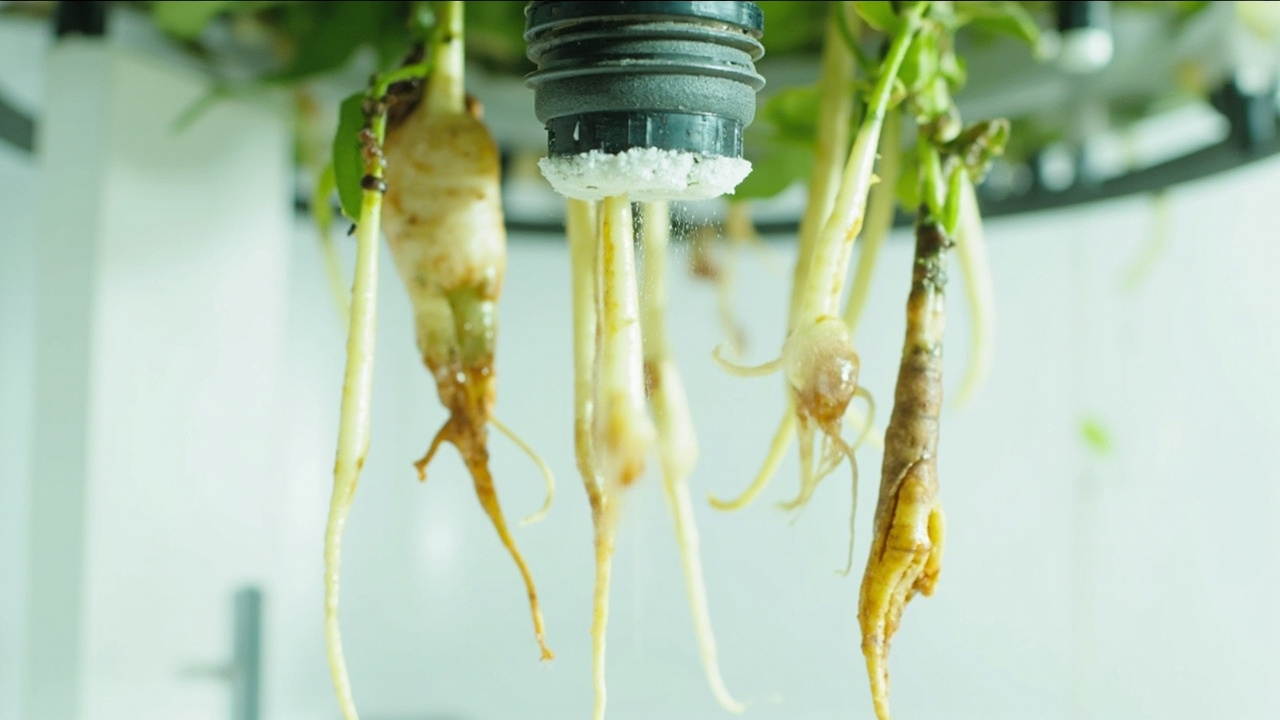
Roots are the most honest indicator in any aeroponic system, and they are the first place problems show up because they have no soil to buffer mistakes. Healthy aeroponic roots are white to cream, with visible fine hairs and bright growing tips. Anything darker, slimier, or mushier is a symptom worth taking seriously.
Browning and slimy root tips
When the very ends of the roots turn brown and feel slick, the cause is almost always a misting or oxygen problem rather than a nutrient problem. Roots that sit in standing water, receive mist that is too coarse, or go through cycles that are too long start to suffocate and decay at the growing tip first. The next layer up, the white root, is still alive for a time, which is why the symptom appears at the tips rather than the whole root.
Check the misting cycle length and the droplet size before changing anything else. Roots that are just slightly starved of oxygen will often recover on their own once the cycle is corrected. Roots that have been wet for extended periods and smell sour need a different response and are a sign to inspect the reservoir and drainage as well.
Yellow, mushy, or foul-smelling roots
Yellowing across the full length of the root, combined with a soft texture and a sour or rotten odor, is the classic signature of root rot. Aeroponic root rot is almost always a secondary infection that takes hold once roots have already been stressed by low oxygen, high reservoir temperature, or organic debris in the chamber. The pathogens that cause it are present in most environments; they only become a problem when conditions invite them in.
Root rot is one of the cases where diagnosis is the easy part and treatment is the work. This page is built around identifying root rot confidently; the actual recovery procedure, including reservoir cleaning and reset steps, lives in the aeroponics maintenance guide. If you have confirmed rot, the next move is to stop the system, remove the affected plants, and treat the chamber — not to keep misting and hope the symptoms clear.
Stunted, dry, or papery roots
Roots that look thin, dry, and slightly papery, with very few fine hairs, usually point to the opposite problem: the roots are not getting enough water. This is most often a misting failure, not a nutrient deficiency. If the roots look thirsty rather than drowned, the issue is almost always upstream of the plant — in the pump, the nozzles, or the timer — and not in the solution itself.
Misting failures and what they look like from the leaf
Leaves are the second-fastest signal in an aeroponic system, and they are usually the first thing a grower notices. The trick is to read leaf symptoms as clues to the root environment, not as a problem with the leaf itself. A wilting plant in an aeroponic system is almost never thirsty in the way a soil-grown plant is; it is usually suffocating, drying out, or starving because the root environment has failed.
Wilting in a fully misted, healthy system is rare. When you see it, the most common causes are a clogged misting nozzle reducing water to that plant, a pump that has lost pressure, or a timer that has stopped cycling. Wilt that appears on a single plant while the rest of the chamber looks fine is a strong sign that the issue is local to that plant’s nozzle or root zone, not the whole system.
Leaf yellowing, also called chlorosis, follows a different pattern depending on where it starts. Yellowing at the bottom of the plant on older leaves usually points to a mobile nutrient issue — most often nitrogen — and is one of the few cases where the solution itself is the cause. Yellowing at the top of the plant on new growth is more often an immobile nutrient issue or a root health problem, and the fix is usually upstream in the root zone. If the yellowing is uniform across the whole plant and the leaves are also soft and droopy, the answer is usually in the misting system rather than the bottle.
Mineral buildup around the misting nozzles is one of the most common and most preventable causes of misting failure. Hard water and concentrated nutrients leave white, crusty deposits on nozzle tips, and even a small ring of buildup can change droplet size or stop flow entirely. If you can see white residue on the nozzles, that is enough reason to suspect the misting system is the source of the symptom, even if the leaves look like a nutrient problem.
Pump, timer, and pressure problems
The pump and timer are the mechanical heart of an aeroponic system, and they fail in a small number of predictable ways. Most aeroponic problems that look biological are actually mechanical when you trace them back far enough, which is why pump and timer checks belong early in any diagnostic flow.
A pump that has lost pressure is one of the most common silent failures. The pump may still run, the timer may still cycle, and the system may even produce visible mist, but the droplet size has shifted larger, the throw distance is shorter, and the roots are no longer getting the fine fog they need. Plants under low-pressure mist tend to look slowly thirsty rather than dramatically wilted, and the symptom often shows up first as slower growth rather than acute damage.
Timers fail in two main ways: they stop cycling entirely, or they cycle on the wrong schedule. A timer that has stopped is usually obvious once you watch for a full cycle. A timer that cycles too long leaves the roots wet and oxygen-starved; a timer that cycles too short leaves the roots dry. Both produce root symptoms first and leaf symptoms second, which is why they are best diagnosed by looking at the roots rather than the timer display.
Clogged spray nozzles are the third major mechanical cause and the easiest to overlook. Even one partially clogged nozzle in a multi-mister chamber can leave a section of the root zone dry while the rest of the system looks fine. If the wilt or slow growth is local to a single plant or a single side of the chamber, misters are the first place to look, before you change any nutrients or assume a disease.
Nutrient and solution issues
Nutrient problems in aeroponic systems are real, but they are usually the result of other failures rather than the cause of them. Reservoir temperature, pH drift, concentration mistakes, and depleted solution all show up as leaf symptoms, and they are worth diagnosing on their own terms once the mechanical system has been ruled out.
Nutrient deficiencies in aeroponic systems tend to be either broad and uniform — caused by a depleted or imbalanced solution — or patterned in the specific ways that mobile and immobile nutrients behave. A general pale green color across older leaves, with the rest of the plant still growing, is a typical mobile nutrient pattern. A general yellowing or distortion on new growth, with older leaves still healthy, is a typical immobile nutrient pattern. The pattern tells you whether the solution is depleted, imbalanced, or simply at the wrong pH to be absorbed.
Reservoir temperature matters more in aeroponic systems than in most other growing methods because the roots are exposed to the solution continuously. A reservoir that runs above roughly 72°F (22°C) holds less dissolved oxygen and encourages the pathogens that cause root rot. A reservoir that runs too cold slows root metabolism and nutrient uptake. If you are seeing root and leaf symptoms together, the reservoir temperature is one of the first environmental variables to check.
Chlorosis in an aeroponic system is not always a nutrient problem, and treating it as one without checking the roots is a common mistake. A plant with chlorosis and healthy, white roots is a nutrient issue. A plant with chlorosis and brown, soft roots is a root health issue, and adding more nutrients will only make it worse. The diagnosis here is genuinely useful: the symptoms look similar at the leaf, but the appropriate response is opposite.
When to fix, when to clean, and when to replace
The final layer of aeroponic troubleshooting is deciding what kind of action the diagnosis calls for. Not every problem is the same kind of problem, and one of the most useful things a diagnostic flow can do is sort issues into the right response category before you start changing things.
Routine maintenance covers the small, predictable issues that show up in any running system: mineral buildup on nozzles, slow pH drift in the reservoir, and the gradual depletion of nutrient solution. These are not failures, and treating them as emergencies usually creates real problems. A weekly check of nozzle cleanliness, reservoir level, pH, and EC is the right cadence for most home and small-scale systems.
Immediate action is reserved for the cases where the system is actively damaging the plants: confirmed root rot, a failed pump that has stopped cycling entirely, a clogged manifold that has left a section of the root zone dry, or a reservoir that has soured. In each of these cases, the next step is to stop, isolate, and reset the system rather than to keep misting. The full reset procedure, including the order in which to clean the chamber, replace the solution, and reintroduce plants, is covered in the aeroponics maintenance guide.
Replacement is the right call when a component has reached the end of its useful life rather than the end of a maintenance cycle. Pumps that have lost pressure and cannot be restored by cleaning, timers that have stopped cycling reliably, and nozzles that have scaled beyond cleaning are all candidates for replacement rather than repair. The economics of aeroponic systems favor replacement over repair for most small parts, because the cost of a missed failure is usually a lost crop. If a component is showing the same symptom twice in a season, it is usually cheaper to replace it than to keep responding to it.
For a clearer picture of the system these troubleshooting steps apply to, including the trade-offs that lead growers to choose aeroponics in the first place, the overview of aeroponic system advantages is a useful companion. And if the underlying question is whether the system is the right fit for the plants you are growing, the guide to the best plants for aeroponics can help confirm whether the crop itself is well matched to the method.
Closing the diagnostic loop
Effective aeroponic troubleshooting is mostly about reading the system in the right order. Roots first, because they reflect the actual environment the plant is in. Mist and mechanical components second, because they are the most common source of the symptoms the roots are showing. Nutrient solution third, because it is usually the downstream effect of a mechanical or environmental issue rather than the cause. Treatment is a separate step that belongs in the maintenance workflow, and it works best when the diagnosis has already been done.
The outcome you are aiming for is the ability to look at a struggling aeroponic system and answer two questions with confidence: what is the most likely cause, and is this an immediate-action situation or a routine one. Once you can sort problems into those categories, the rest of the response — whether that means cleaning a nozzle, replacing a pump, or moving into the full maintenance reset — follows naturally. The maintenance guide handles the “how to fix it” part; the role of this page is to make sure the “what is wrong” part is solid before any fix begins.
Turn That PDF Into a Spreadsheet in Minutes
You've seen how to do it manually — now let the tool handle the heavy lifting. Upload your bank statement and get Excel, CSV, or QBO in a few clicks.
Try It Free