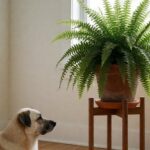
Calathea humidity is the single biggest reason a Calathea fails indoors, and the failure almost always shows up on the leaves before the roots: edges that crisp and brown, leaves that curl inward at night and never fully uncurl in the morning, new growth that comes in already damaged. Get the humidity right and most of the other Calathea problems that gardeners blame on watering, soil, or fertilizer quietly go away. Get it wrong and no amount of perfect watering will save the plant.
The target humidity for a Calathea is 50% to 60% relative humidity as a floor, with 60% to 70% being the range where most varieties will push new growth without complaint. Sensitive cultivars like Calathea orbifolia and Calathea white fusion do best at 65% to 75%. Anything below 40% for more than a few days will start to show damage, and anything below 30% will damage new leaves before they finish unfurling.
This page covers how to measure the humidity in the actual room your Calathea lives in, the practical ways to raise it without turning your living space into a greenhouse, and the failure mode you’ll hit if you pick the wrong method for your home.
What Humidity Actually Means for a Calathea
Humidity is the amount of water vapor suspended in the air, expressed as a percentage of the maximum the air can hold at that temperature. Warmer air holds more water than cooler air, which is why a 60% reading at 75°F / 24°C carries more actual moisture than a 60% reading at 65°F / 18°C. Calathea evolved in the understory of tropical rainforests where daytime humidity routinely runs 70% to 90% and rarely drops below 60% even at night.
The reason humidity matters more for Calathea than for most common houseplants is the leaf structure. Calathea leaves are thin, broad, and have a high surface-area-to-volume ratio, which means they lose water to dry air faster than a succulent, a snake plant, or a ZZ. The plant also has a small joint at the base of each petiole called the pulvinus that drives the daily leaf movement — when the air is dry, the pulvinus can’t keep the leaf fully extended and the leaf curls to reduce surface area.
To check whether your home is in range, buy a cheap hygrometer (a digital one with min/max memory is best) and place it at leaf height next to the Calathea, not at ceiling height where the air is warmer and drier. Read it for 48 hours including at least one full night. If the daytime low drops below 45% or the overnight low drops below 50%, the air is too dry for an unmitigated Calathea.
How to Raise Humidity Around a Calathea
There are four practical methods, and they don’t all work equally well. Pick one that fits your room, not one that’s “supposed to” work.
Humidifier (the most reliable method)
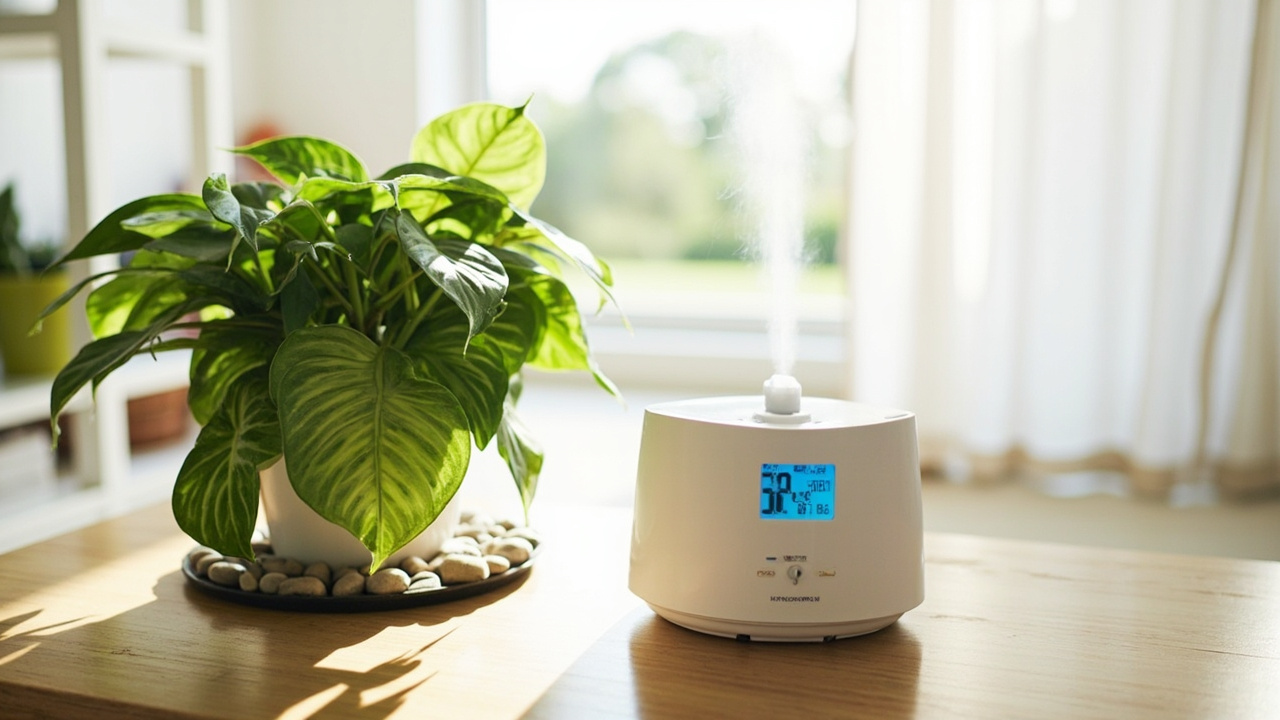
A cool-mist ultrasonic humidifier set to 60% and placed within 3 to 5 feet of the Calathea is the only method that actually delivers consistent humidity in a normal home. Run it on a hygrometer-controlled setting (many modern units have a built-in humidistat) so the unit cycles off when the target is reached. Expect the water tank to empty every 24 to 48 hours depending on tank size, and refill with distilled or filtered water if your tap water is hard to avoid mineral dust on the leaves.
Trade-off: humidifiers are loud on the highest setting, need daily refilling, and can cause mold on nearby walls if you over-humidify a small room. A unit with a humidistat solves the over-humidify problem automatically.
Pebble Tray (works for a single plant, marginal otherwise)
Fill a shallow tray with pebbles, add water until it sits just below the top of the pebbles, and set the Calathea pot on top so the bottom of the pot is above the water line. As the water evaporates it raises humidity in a small bubble of air around the plant. This works in a small radius — about 6 to 12 inches — and the effect drops off fast outside that radius.
The trade-off: a pebble tray raises humidity around the pot by maybe 5 to 10 percentage points in a normally dry room, which is rarely enough on its own. It also requires weekly cleaning to prevent algae and mosquitoes, and if the water level rises above the pebbles the pot will wick water from the bottom and keep the soil too wet.
Grouping Plants Together (helpful, not sufficient)
Clustering humidity-loving plants so they share transpiration moisture raises the local humidity by 5 to 15 points within the grouping, depending on how many plants and how dense the foliage. This works as a supplement to a humidifier or as a maintenance method in a room that’s already in the 50% range.
The trade-off: in a dry room (below 40%), grouping alone won’t get a Calathea to 60%. You’ll see less new growth damage than a solo plant in the same room, but you’ll still see some.
Misting (mostly theater, with one useful side effect)
Misting a Calathea’s leaves with room-temperature water raises the humidity immediately around the foliage for about 10 to 15 minutes, then the effect is gone. Long-term humidity is not meaningfully changed by misting because the water volume is too small to keep a room-sized air mass elevated. What misting does do is rinse dust off the leaves, which lets them transpire more efficiently and indirectly helps the plant use the humidity that is in the air.
The trade-off: misting in a room with poor air circulation can leave water sitting on the leaves long enough to invite fungal leaf spot, especially on Calathea orbifolia and white fusion which have thinner cuticles. If you mist, do it in the morning so the leaves dry by evening, and don’t mist if your humidity is already above 65%.
The Right Humidity Range for Different Calathea Varieties
Not all Calathea varieties want the same humidity. The thinner-leaved cultivars are more sensitive than the thicker-leaved ones, and a single humidity target across all varieties will either over-humidify the tough ones or under-humidify the sensitive ones. If your Calathea is showing crispy edges or stunted new growth, the Calathea leaf curling diagnostic walks through the cause-and-effect, and the watering guide covers the second most common cause of the same symptoms.
Calathea Orbifolia and White Fusion (65% to 75%)
These two are the most humidity-sensitive varieties commonly sold. Their leaves are thin and the variegation on white fusion is particularly prone to crisping at the edges. If you have these cultivars, plan on a humidifier running 12 to 16 hours a day during winter, not just a pebble tray.
Calathea Medallion, Rattlesnake, and Peacock (50% to 60%)
These are the workhorses of the Calathea genus and will tolerate the lower end of the Calathea humidity range without significant damage. 50% is the floor; below that, expect to see edge crisping within 2 to 3 weeks.
Calathea Lancifolia and Roseopicta (50% to 65%)
Slightly more forgiving than the orbifolia types but still want a humidifier if your winter indoor humidity drops below 45%. A hygrometer reading of 55% is the practical target for a mixed Calathea collection.
Signs Your Calathea’s Humidity Is Wrong
Humidity stress shows up on the leaves first, and the pattern tells you which direction the problem is going.
Too Dry (most common indoor problem)
Leaf edges turn brown and crispy, starting at the tip and moving back along the edge. New leaves come in smaller than the previous batch and may emerge already partially curled or with brown edges. The plant stops producing new rolls of leaves during the growing season (a healthy Calathea should push a new leaf every 4 to 8 weeks in spring and summer). The fix is to add a humidifier or move the plant to a more humid room like a bright bathroom with a window.
Too Humid (less common, but happens)
Leaves develop dark brown or black spots with a yellow halo — this is fungal leaf spot, and it thrives in stagnant air above 80% humidity. The fix is to reduce humidity, improve air circulation with a small fan running 4 to 6 hours a day, and remove affected leaves so the fungal spores don’t spread. A Calathea in a closed terrarium can hit this range and should be vented daily.
Seasonal Humidity Changes and What to Do About Them
Indoor humidity drops sharply in winter when the heating system runs — most homes drop to 25% to 35% relative humidity once the furnace is on, which is well below the Calathea’s tolerance floor. Summer is easier if you don’t run air conditioning constantly, but AC also strips humidity from the air.
The simplest seasonal adjustment is to run the humidifier more hours in winter (16 to 24 hours a day is normal for a furnace-heated room) and less in summer (8 to 12 hours, or off entirely in humid climates). Set the humidistat to your target — 60% for a mixed Calathea collection — and let the unit cycle automatically.
Grouping Calathea together for the winter in a single bright room with a humidifier is more efficient than trying to humidify a whole house. A 4-foot by 6-foot area with 6 to 8 Calatheas and one humidifier is easier to maintain than scattered plants across a 1,200-square-foot apartment.
Quick Humidity Checklist
Use this to confirm your Calathea is in the right humidity before chasing other variables:
1. A hygrometer at leaf height reads 50% to 60% (or 65% to 75% for orbifolia and white fusion) during the day and never drops below 45% overnight.
2. New leaves come in fully unfurled with no brown edges within 48 hours of opening.
3. The plant is pushing a new leaf every 4 to 8 weeks during spring and summer.
4. No dark spots with yellow halos on the leaves (sign of over-humidity + stagnant air).
If all four are true, the humidity is dialed in. If edges are crisping or new growth is stunted, the humidity is the first thing to fix before changing watering, soil, or fertilizer. Most Calathea failures that look like watering or soil problems are actually humidity problems wearing a different mask, and the fix is almost always the same: get a hygrometer, get a humidifier, and verify the room is actually at the humidity you think it is.
Turn That PDF Into a Spreadsheet in Minutes
You've seen how to do it manually — now let the tool handle the heavy lifting. Upload your bank statement and get Excel, CSV, or QBO in a few clicks.