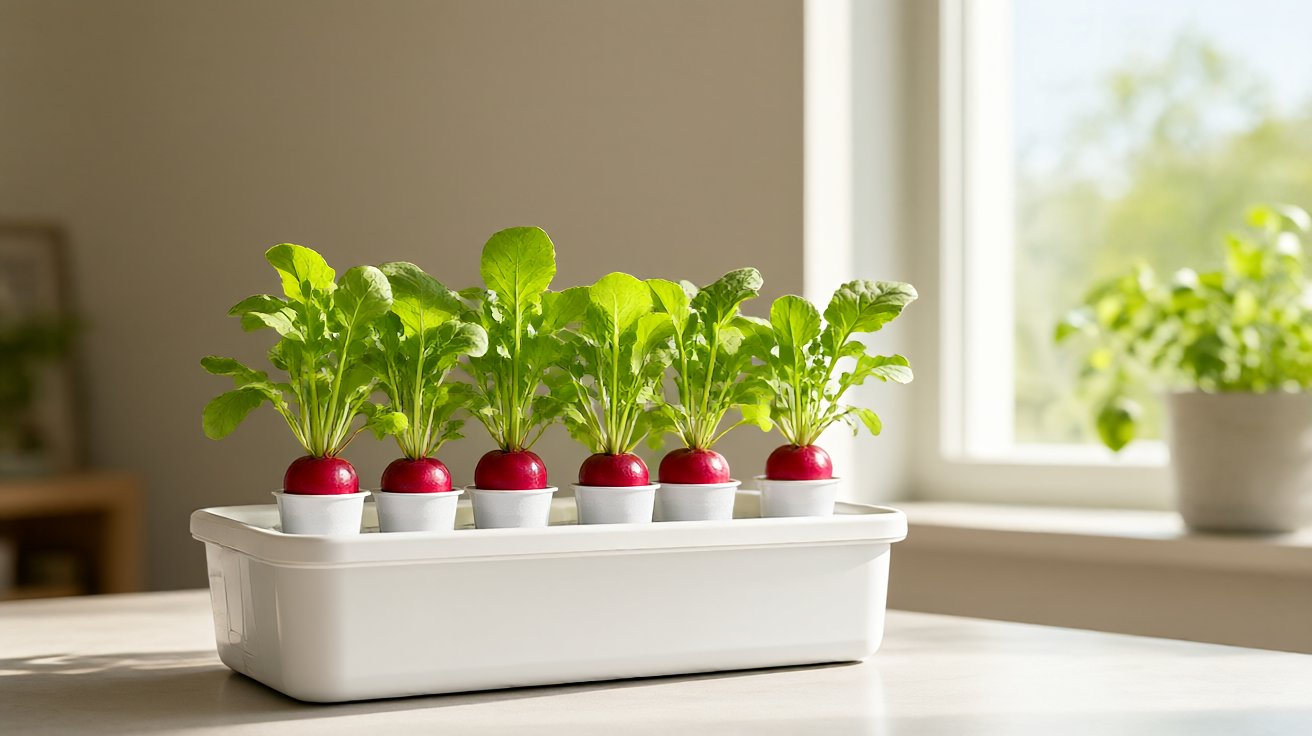

The radish you eat is not a root. It is a swollen hypocotyl, the section of stem between the seed leaves and the true roots, and it swells only when the plant has three things at once: a shallow, cool reservoir, an uninterrupted supply of water, and a taproot with somewhere to go. Miss the third and you get a green top with a string attached. Miss the second and the plant checks its own growth, and a checked radish turns hot, tough and pithy instead of crisp.
Most hydroponic radish advice copies a nutrient table that never contained radish in the first place. The widely circulated optimum EC and pH table from Oklahoma State University Extension lists twenty-eight crops and radish is not one of them, so the numbers floating around online are borrowed from other crops and applied by feel. This guide replaces that guess with a measured dose-response and covers the two numbers that decide the crop.
What Hydroponic Radish Needs Before You Start
Radish (Raphanus sativus) is a member of the Brassicaceae family, and it is the fastest crop in the hydroponic series. University of Massachusetts Amherst Extension puts maturity at 21 to 28 days under ideal conditions and 40 to 50 days in cold weather, so the whole crop fits inside a month of attention if you get the temperature right.
That temperature band is the first thing to settle, because it governs everything else. Radishes grow their best quality and their best root shape at moderate temperatures between 10 and 18 C in intermediate to short day lengths. Above that band two separate problems start, and they are not the same problem. The heat problem makes the root woody. The day-length problem makes the plant forget it is a radish at all.
Days matter as much as degrees. Long days of 15 hours combined with warm temperatures induce seed-stalk formation, and once the plant builds a flower stalk the root stops being worth eating. University of Maryland Extension makes the same point in the opposite direction: a radish that has had its growth checked becomes hot, tough and pithy.
Three Numbers That Decide the Crop
Keep these three separate in your head, because they are usually blended into a single unhelpful advice about keeping the water clean. Temperature sets the pace of the whole plant. Day length decides whether the plant spends its energy on a swollen stem or on a flower. Root space decides whether the energy has anywhere to go.
Getting the temperature wrong is the expensive mistake because it cannot be corrected once the plant has committed. Adjusting the day length is impossible indoors without a blackout curtain, so treat it as a fixed constraint. Root space you can fix before you transplant, and you should.
The Nutrient Band: Why More Feed Makes a Smaller Radish
Here is the counterintuitive part of this crop, and it is measured rather than argued. A controlled study by Christopher J. Currey at Iowa State University grew the cultivars Crunchy King and Red Castle across six nitrogen concentrations, from 0 to 500 ppm, using 15-5-15 Cal-Mag fertilizer and flood tables held at 68 F with a target daily light integral of 12 mol per square meter per day.
The largest root diameters appeared between 200 and 300 ppm nitrogen, which corresponds to an EC of 1.52 to 2.28 mS/cm. Above 300 ppm the radishes got smaller. Not bigger leaves with a smaller root. Smaller radishes. The study also measured the fertilizer concentrations as conductivity steps of 0.76, 1.52, 2.28, 3.04 and 3.80 mS/cm, so you can read the effect directly off your meter.
Push the concentration past the point where the root can drink, and you get osmotic stress: the root works harder to pull water in and puts less of it into swelling. That is the mechanism, and it is why an over-fed radish looks like a nutrient deficiency from the top of the plant down.
The same shape of answer appears in the peer-reviewed work on radish at Meijo University, where an EC-based control method held the solution at roughly 0.7 to 0.8 dS/m with pH adjusted to 5.5 to 6.0 every two to three days, and about 800 mg of nitrate per plant was enough for a cold-season crop in deep water culture. Two different methods, two different absolute numbers, and the same conclusion: this crop runs on a narrow band, and the way to hold it is measurement rather than a recipe.
What the Missing Table Means for You
Oklahoma State University Extension’s guide to electrical conductivity and pH in hydroponics is the reference most growers reach for first, and its crop table covers asparagus through tomato. Radish is absent. So is any other radish entry in the university extension tables reviewed for this guide, which is an honest gap rather than a secret.
What that means practically is that any figure you have seen for hydroponic radish EC is either borrowed from a neighbouring crop or sourced from a vendor who measured their own system and published it as a universal constant. The Iowa State dose-response is the more useful anchor because it was run on radish, with a defined nitrogen series, at a defined light and temperature.
Holding that band week to week is the practical skill, and the routine for topping up and changing solution across systems is set out in the weekly hydroponic feeding rhythm. The meter work is worth doing once with calibrating your EC and pH meters before you trust a reading.
| Growth stage | EC (mS/cm) | pH | What the number is doing |
|---|---|---|---|
| Germination, days 1 to 5 | 0.4 to 0.8 | 6.0 to 6.5 | Taproot establishing, cotyledons opening |
| Seedling, days 6 to 14 | 0.8 to 1.2 | 6.0 to 6.5 | Leaves building, root beginning to swell |
| Root swelling, days 15 to 25 | 1.2 to 1.8 | 6.0 to 6.5 | Steady feed, bulb filling out |
| Approaching harvest, days 26 to 30 | 1.6 to 2.3 | 6.0 to 6.5 | Upper end of the measured range |
Read that last row against the Iowa State result and notice where the ceiling comes from. The measured peak in root diameter sits at 1.52 to 2.28 mS/cm, so creeping toward 2.3 at the end of a crop is defensible and going past it is not. The lower stages matter too: a radish that starts at full strength is not a strong radish, it is a stressed one with a small root and a large leaf.
Which System Grows a Swelling Root
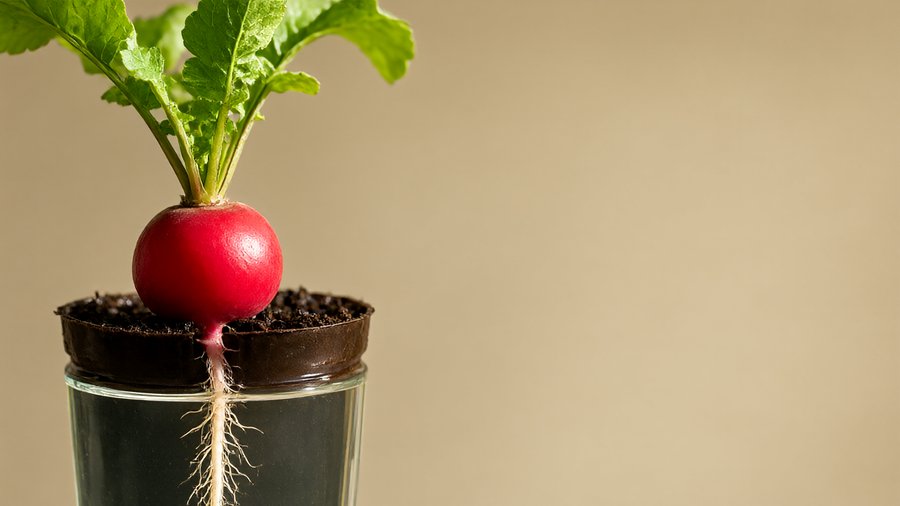
Radish is unusual among hydroponic crops because the part you harvest does not hang down into the water. The swollen hypocotyl has to sit at or just above the medium line while the fine roots below it drink. That single geometry decides the system question, and it is why the crop behaves differently from every other one in this series.
Deep water culture in a net pot works, and so do nutrient film technique channels with a wide enough profile for the root shoulder, and media beds with a shallow bed of perlite or coir. What does not work well is a passive Kratky setup, and the reason is structural rather than chemical. In Kratky the net cup hangs in air above a falling water line, so the swollen section of stem has nothing to press against and the taproot swings free in unsaturated air.
A root that never touches a medium and never touches water does not swell, it just hangs there and tapers. This is why you will see advice to use a media bed for radish even when a net pot would be easier, and why the small grow towers that work for lettuce produce forked, undersized radishes.
Comparing the options against each other is worth doing before you buy anything, and the six hydroponic system types sets out the cost and failure mode of each. If you want the mechanism behind each one rather than the shopping list, how each system moves water explains where the root zone sits in every case, which is the number that actually decides this crop.
The Container Rule
Use a net pot at least 7.5 cm across so the root shoulder has room to widen before it reaches the water line, and space the pots far enough apart that neighbouring leaves stop touching. In a tower, the working rule is one radish per pod, because a pod sized for a lettuce leaf has no room for a root shoulder that wants to swell to 2.5 cm across.
The wider question of which crops suit which system is covered in best plants for hydroponics, which rates radish as a fast but demanding crop. The honest reason is the root space above.
One more container decision matters more than the rest. Choose a variety bred for small round roots, not a daikon. Daikon taproots reach 20 to 30 cm and will tangle in any basket system you can build at home, and the crop needs root depth that a domestic setup cannot give it.
Sowing Radish: Direct Seed, Never Transplant
University of Massachusetts Amherst Extension states plainly that transplanting radish is not recommended, and the reason is visible in the harvest. The taproot is the crop. Disturb it and you get a forked root with two thin arms where one round bulb should be, which is exactly the misshapen result that hydroponic radish is criticised for.
Sow directly into the medium and thin in place. University of Maryland Extension gives the home-scale numbers as 1 to 2 inches apart in the row and 1/4 to 1/2 inch deep, thinning seedlings to 2 to 4 inches apart. The commercial figure from UMass is tighter, at 0.75 to 1 inch in the row for 12 to 15 plants per foot of row.
The Government of Newfoundland and Labrador puts the seed depth at 0.5 to 1 cm and adds the detail most guides skip: planting deeper than 2 cm produces elongated roots. Deeper sowing is what makes a radish long instead of round, so the depth of the seed decides the shape of the harvest before the plant has done anything else.
Expect emergence in 3 to 4 days at soil temperatures of 18 to 30 C, which is warmer than the growing temperature you will want afterwards. Germination likes warmth and maturity likes cool, and a radish sown in a cold reservoir germinates slowly and unevenly, which is where the forked and misshapen crop usually starts. Warm the medium for the first week, then cool the system for the remaining three.
Water Temperature: The Number That Decides the Whole Crop
Reservoir temperature is the control that separates a good radish from a string of green tops. The crop wants 10 to 18 C, and it wants that number maintained rather than averaged, because a warm afternoon in an uninsulated reservoir during a 25-day cycle is enough to set the whole crop off course.
University of Missouri Extension lists the water quality parameters that matter in a soilless system, including dissolved oxygen above 6 ppm and boron below 0.5 ppm in the source water. Warm water carries less dissolved oxygen, which is one of the reasons a warm reservoir hits a radish twice: less oxygen for the root to respire with, and more heat at the root zone.
Compare your reservoir reading against the wider crop table in the reservoir temperature matrix by crop, which is worth reading even if you never grow anything but radish, because it shows how narrow this crop’s window sits next to the leafy greens you already grow.
The general hydroponic figure of 72 to 75 F water temperature from Oklahoma State University Extension is a system-wide optimum for a mixed crop, not a radish figure. Applying it to radish means running the reservoir about 8 C above where this crop performs best, for the entire cycle. For radish specifically, cool the reservoir below the general recommendation and hold it there, and the difference shows in the root within two weeks.
Spacing and Root Depth: Where the Bulb Comes From
Spacing is the third lever, and it is the one most home setups get wrong because a crowded channel looks productive. Government of Newfoundland and Labrador sets a plant stand of 40 to 50 per meter of row with rows 20 to 30 cm apart, which is close to the UMass figure of 12 to 15 plants per foot of row. Those are field figures for a soil crop with a taproot that can push aside soil.
| Crop | Days to harvest | Spacing basis | What crowding costs you |
|---|---|---|---|
| Radish | 25 to 30 | 0.75 to 1 inch in the row | Tapered, bulb-less roots |
| Storage radish | 50 to 60 | 2 to 4 inches | Misshapen roots |
| Lettuce | 45 to 60 from seed | 8 to 10 inches of canopy | Small heads, low head weight |
| Spinach | 40 to 50 from seed | 6 to 8 inch centres | Smaller leaf mass per plant |
| Microgreens | 6 to 10 | Broadcast in a dense layer | Trapped moisture and mould at the base |
The two radish rows sit far apart because they are different crops with the same name. A table radish is a 25 to 30 day crop sized for a net cup, while a storage radish is a 50 to 60 day crop that needs 2 to 4 inches of room to build a root worth harvesting. Nothing in the seed packet tells you that, which is why the two get confused.
Read the radish row against the lettuce row and the difference in what sets the spacing is clear. Lettuce spacing is set by the mature head, and a butterhead or looser-leaf type needs roughly 8 to 10 inches of canopy space to build a full head. Radish spacing is set by the width of the swollen organ, not by any leaf above it.
That is why the radish number looks so much tighter, and why a radish channel that looks dangerously crowded by lettuce standards can still produce a round root if the sites are not closer than 0.75 to 1 inch. The spinach and microgreens rows come from the same source set, with the 40 to 50 day spinach cycle set out in the hydroponic spinach guide.
Crowding does not raise yield in either crop, it changes the shape of what you get. The plant spacing guide puts it plainly for leafy greens: every extra plant you fit past the density number costs you head size, not just head count. A deep water culture bucket at 3 to 4 plants per square foot produces full heads, while the same bucket crowded to 8 per square foot produces a lot of small ones.
For radish the same arithmetic shows up in the root, and it is the reason a tapered, string-shaped radish is a spacing problem dressed up as a nutrient problem.
In a net pot or a channel, the root has nowhere to push aside. When the shoulder of one radish presses against the shoulder of its neighbour, both taper. You get a pointed, elongated root that a grower will look at and blame on the nutrient mix, when the actual cause is that two taproots are occupying the same 5 cm of space.
Where spacing is genuinely tight, the way to get a round root is to increase the number of plants per channel and shorten the crop, not to squeeze the same count into a smaller volume. University of Wisconsin-Madison Extension notes that spring radishes can be harvested 20 to 25 days after seeding, which is fast enough to make a dense succession planting work, and sowing every 10 to 14 days keeps the harvest coming without a dense stand sitting long enough to crowd itself.
The arithmetic for spacing in a home system is worth checking against the general rules in the plant spacing guide, which covers the calculations for net pots, channels and towers. For this crop the guidance is simpler: leave one hand’s width between net pots, and if you want more radishes per channel, add sites rather than tightening them. Crowding does not raise yield, it splits the same yield into smaller roots.
What Goes Wrong: Pithy Roots, Forked Roots, and Brown Heart
Radish has three characteristic failures, and each one traces back to a specific number rather than to bad luck. Pithiness and heat come from a growth check. Forking comes from transplanting or from crowding. Brown heart comes from boron, and it is the one most growers have never heard of.
The pithiness story is well documented. University of Maryland Extension states that the crop must be grown rapidly, in 23 to 28 days, with adequate moisture, and that when growth is checked the radish becomes hot, tough and pithy. University of Illinois Extension adds the detail that catches people out: the hotness results from the length of time the radish has grown rather than from its size.
A radish does not get hotter because it is big. It gets hotter because it is old. That is why a radish left in the ground past its window tastes like a different vegetable, and it is why the harvest date matters more than any other decision in the cycle.
Brown heart is a physiological disorder, an internal browning of the centre of the root that shows up on the cut face. In a 2019 study in Plant Physiology and Biochemistry, a team from the University of Tokyo dissected root tissue from two lines of Japanese radish and analysed 19 elements by mass spectrometry. Only boron correlated negatively with the severity of the browning.
The average boron concentration across the two cultivars was not significantly different. Cultivar resistance turned out to be a question of how efficiently each one moves boron into the root, not how much boron it absorbs in total.
The same paper records the threshold for the European small radish Raphanus sativus cv. Cherry Belle, which showed brown heart when root boron in dry matter fell below 28 micrograms per gram, with severity depending on that concentration. And a 2022 paper in Soil Science and Plant Nutrition demonstrated internal browning under boron deficiency alone, with no heat or drought stress present, which means you cannot blame it entirely on a hot week.
So the mechanism runs boron to cell wall. Boron is required to cross-link pectin chains in the cell wall, and where boron is locally depleted the wall loses integrity and the polyphenols in the tissue oxidise, which is what produces the brown colour. High temperature accelerates the same outcome, which is why the two risks compound.
The practical control sits upstream of all of this. University of Missouri Extension puts the acceptable boron limit in source water at 0.5 ppm, and if your water sits above that, a standard two-part fertiliser will not fix it, because boron does not move out of the root once it is in the wrong place. Test the water before you blame the feed, and check root tissue, not just leaf colour, because a radish can look perfect from the top while the centre of the root is already browning.

Harvesting: The Clock That Runs in Days
UMass puts the harvest at approximately 3 to 4 weeks after seeding, when roots are the size of a large marble, and warns that over-mature salad radishes become pithy or split. University of Illinois Extension is more precise about size: pull them when the roots are less than 1 inch in diameter, and get through the harvest quickly before heat, pithiness or seed stalks can begin.
That is a window of roughly three days on a 25-day crop. Miss it on the early side and you lose size. Miss it on the late side and you lose the vegetable. The comparison is worth making with the fast crop it most resembles on a timer, which is the hydroponic lettuce guide, where the harvest window is longer because the plant keeps growing after you take the first leaf.
One product comes from the same seed and is worth keeping distinct. Radish microgreens are the cotyledon stage harvested at 7 to 10 days with no root at all, while a radish grown to a swollen hypocotyl needs a full root system and the whole 25 days. Sow both if you want a continuous supply, but do not expect one system and one timing to produce both.
After harvest, UMass advises hydrocooling, bunching or topping, and holding at 32 F with 95 percent relative humidity in breathable packaging, where topped radishes keep 3 to 4 weeks. That storage figure is for topped roots in cold storage. A radish sitting on a kitchen counter in a warm room is pithy within days, and the clock does not stop because you brought it indoors.
The best time to judge the whole cycle is the first harvest, because it tells you which number was wrong. Radishes that came out small and hard were over-fed or crowded. Radishes that were pithy and hot were held too long or checked by a temperature swing. Radishes with a brown core were short of boron in a system that looked perfectly fed from the top. Cut one open before you plan the next sowing, and the answer is usually in the cross-section.
Sources and further reading
- Oklahoma State University Extension, “Electrical Conductivity and pH Guide for Hydroponics,” HLA-6722, for the nutrient solution pH of 5 to 6 that holds the root zone at 6 to 6.5, the general water temperature of 72 to 75 F, complete solution replacement every two weeks, daily pH and EC checks at the same time of day, and the crop table of 28 optimum EC and pH bands in which radish does not appear.
- University of Massachusetts Amherst Extension, New England Vegetable Management Guide, Radish, for maturity in 21 to 28 days under ideal conditions and 40 to 50 days in cold weather, preference for 50 to 65 F and intermediate to short day lengths, the anatomy of the harvested swollen hypocotyl, direct seeding with 0.75 to 1 inch in-row spacing for 12 to 15 plants per foot and rows 8 to 15 inches apart, harvest at 3 to 4 weeks when roots are the size of a large marble, and storage at 32 F and 95 percent relative humidity for 3 to 4 weeks.
- University of Maryland Extension, “Radishes, Rutabagas and Turnips,” for the requirement that the crop be grown rapidly in 23 to 28 days with adequate moisture, the effect of a growth check producing hot, tough and pithy roots, and the induction of seed-stalk formation by long days of 15 hours combined with warm temperatures.
- University of Illinois Extension, Radish, for the harvest point of less than 1 inch root diameter and the finding that hotness comes from the length of time the radish has grown rather than from its size.
- Government of Newfoundland and Labrador, Department of Fisheries and Aquaculture, AgriFoods Radish, for germination in 3 to 4 days at 18 to 30 C, the seed depth of 0.5 to 1 cm and the elongated roots produced below 2 cm, best root shape at 10 to 18 C, plant stands of 40 to 50 per meter of row with rows 20 to 30 cm apart, and the effect of long days on flowering.
- University of Missouri Extension, “Hydroponic Nutrient Solutions,” G6984, for the optimum source-water limits of boron below 0.5 ppm and dissolved oxygen above 6 ppm, and the general nutrient solution pH range of 5.5 to 7.
- Research by Christopher J. Currey, Iowa State University, published in Greenhouse Grower, for the nitrogen dose-response in hydroponic radish with 15-5-15 Cal-Mag, the largest root diameters between 200 and 300 ppm nitrogen at EC 1.52 to 2.28 mS/cm, smaller radishes above 300 ppm, and the study conditions of 68 F and 12 mol per square meter per day.
- Meijo University, Journal of the Japanese Society for Horticultural Science, for EC-based control of hydroponic radish at approximately 0.7 to 0.8 dS/m with pH adjusted to 5.5 to 6.0 every two to three days, and about 800 mg of nitrate per plant being sufficient for cold-season radish growth in deep water culture.
- Sotta, Bian, Peng, Hongkham, Kamiya, Niikura and Fujiwara, University of Tokyo, “Local boron concentrations in tuberous roots of Japanese radish negatively correlate with distribution of brown heart,” Plant Physiology and Biochemistry, 2019, for the finding that only boron correlated negatively with browning severity, the brown heart threshold of 28 micrograms per gram of boron in root dry matter for the cultivar Cherry Belle, and the acceleration of internal browning by high temperature.
- Soil Science and Plant Nutrition, 2022, for the demonstration that boron deficiency alone, without heat or drought stress, induces internal browning in Japanese radish.
- University of Wisconsin-Madison Extension, “Growing carrots, beets, radishes, and other root crops in the home garden,” A3686, for spring radish harvest at 20 to 25 days after seeding, the best flavour at 60 to 65 F with rapid growth and steady moisture, and the 10 to 14 day sowing interval.
Last reviewed on November 27, 2026