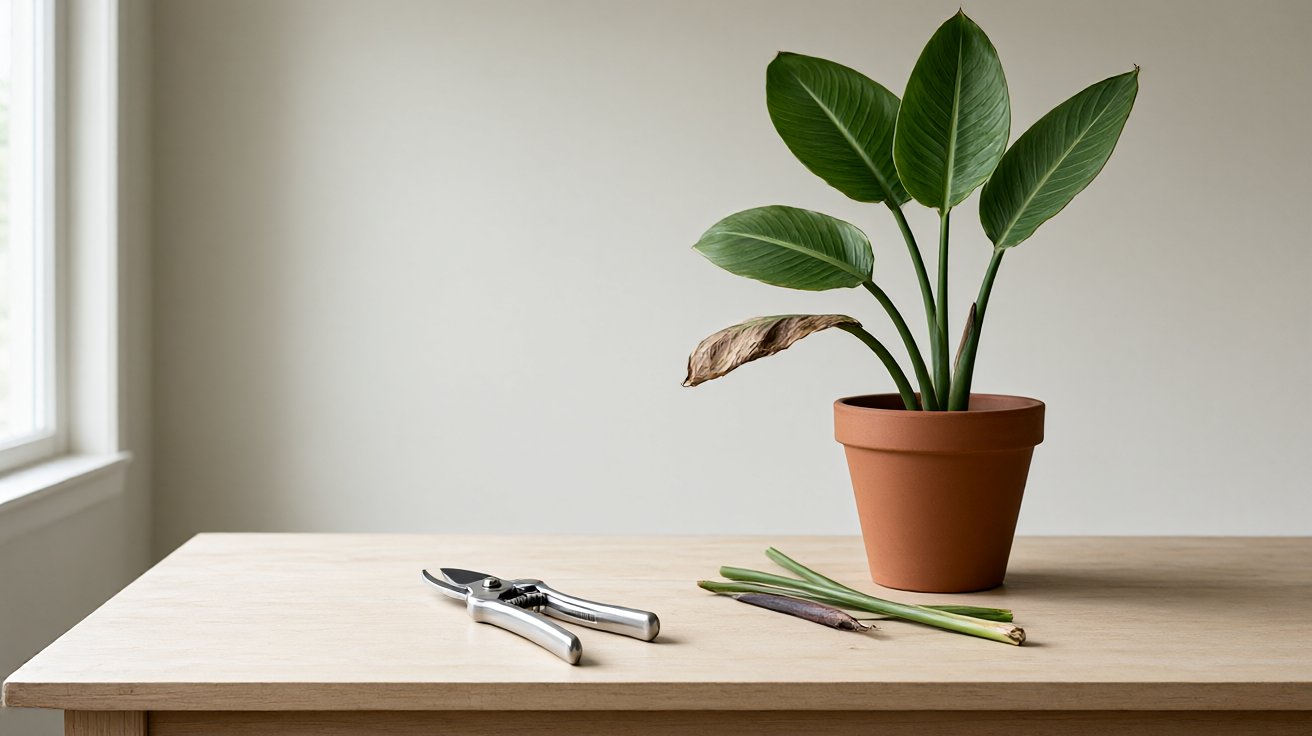

You cannot prune a bird of paradise shorter. That is the single most useful thing to know before you buy a plant that will end up 5 feet tall in a corner of your living room, and how big it actually gets is worth knowing before you buy, and it is the fact most growers learn the expensive way, by cutting leaves off a plant that leans right back toward the window within a month.
The reason a plant leans is that it reaches for light, not that it is crooked. The plant has no trunk to cut back. It grows from a crown at the base with fleshy roots, and it makes leaves, not branches. So the tools that control the size of a bird of paradise are a smaller pot, a quarter turn of the pot, and a plant tie.
There are real interventions available, and each one costs something different. Root restriction shortens the plant and makes it bloom sooner. Rotating keeps it upright and does not cost anything. Cutting back dead or torn leaves tidies the crown and changes nothing measurable. Staking rescues a leaning plant and buys you a season. Here is how each one works, and the order to try them in.
Why You Cannot Prune a Bird of Paradise Shorter
The structure explains the constraint. University of Wisconsin Extension describes the plant as slow-growing and clump-forming, with fleshy roots and leaves that emerge from a crown at the base, arising alternately so that each clump is somewhat flattened. NC State Extension lists the habit as clumping and multi-stemmed.
RHS guidance is that no pruning is required, and that the only cutting needed is to remove browning or tatty leaves at the base with a sharp pair of secateurs in spring, right down to the base, plus removing the whole flower stalk once each flower has faded.
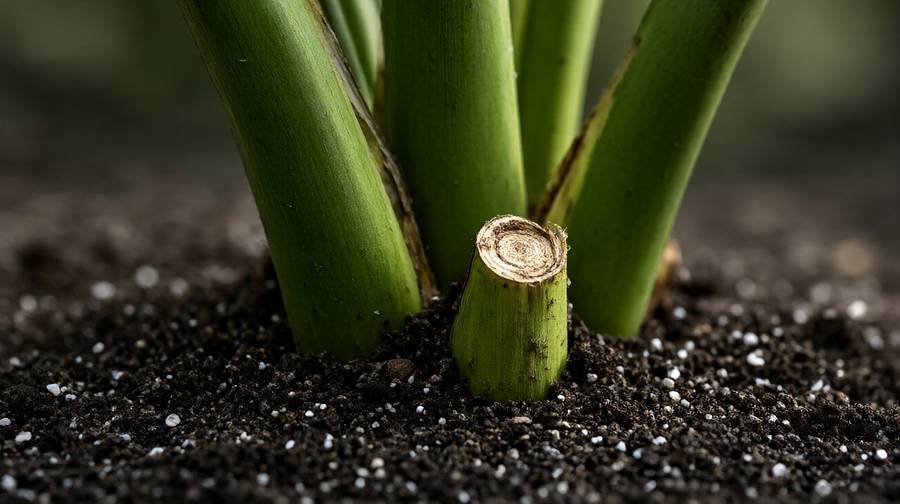
So the plant’s entire height is leaf stalks, each carrying a single blade. Cut a stalk at the base and the crown loses one leaf; it does not gain a shorter one.
A plant that has lost half its leaves is not shorter, it is a plant with half its photosynthetic capacity and half its light-gathering area, which is why it grows slower and flowers later. The height is a function of how many leaves the crown makes and how long each stalk gets, and neither responds to cutting.
Cutting a bird of paradise makes it smaller-looking, never smaller. Height comes from the crown and the root system, and neither is above the soil line. The interventions that do reduce the footprint are root restriction and light, and they are a different set of tools entirely.
| Method | What it changes | What it costs | Time to effect |
|---|---|---|---|
| Root restriction | Mature height and spread, genuinely | Blooms sooner; roots constrained | 1 to 2 years |
| Quarter turn at each watering | Upright habit over a season | Nothing | 3 to 6 months |
| Staking | Position while the crown rebalances | Tie must be loosened or removed | 4 to 8 weeks |
| Removing dead leaves | Appearance only | Lost photosynthetic area | Immediate, no size change |
| Repotting up one size | Makes the plant bigger | Blooming delayed | 1 to 2 years |
Method 1: Root Restriction in a Smaller Pot
This is the only method that genuinely changes the dimensions of the plant, and it is the method extension services recommend for a reason that has nothing to do with size. Plants bloom more profusely when pot-bound.
UF/IFAS states that plants seem to flower more freely under crowded conditions and are best left undisturbed. Wisconsin advises that once the plant is about 3 feet tall you should not be too anxious to repot it, and that replacing the top soil every year or so is enough instead.
The mechanism is a trade, and it is worth understanding before you use it. Constrained roots slow the growth of new leaves, so the plant stays shorter and narrower, and the plant will hold that size for years.
But the same crowding that limits growth forces the plant to put its remaining energy into reproduction rather than into more leaves, so a tightly potted bird of paradise flowers sooner. A plant held in a small pot is a short plant that blooms. A plant repotted into a large pot is a big plant that does not.
A bird of paradise in a pot 2 inches smaller than it wants will stay shorter and flower sooner than the same plant in a generous pot. If your goal is flowers on a small plant, this is the tool. If your goal is a big dramatic plant for a corner, do the opposite.
When to actually repot
There is a clear trigger. Wisconsin says repotting is necessary when the roots have cracked open the pot, and that early spring is the best time when it is necessary. In practice that means checking the pot wall every 7 to 10 days while you water. RHS advises repotting every couple of years in spring, after flowering, into a pot only slightly larger, using a peat-free loam-based compost with added grit.
Two points matter: repot after flowering rather than before, and step up by a small increment rather than a large one, because a big jump in pot size is a big jump in available root volume.
The same guidance gives you the annual job that replaces repotting. Every spring, remove the top 5 cm, about 2 inches, of compost and replace it with fresh mix, and do it every year rather than every 2 years if the plant is in a container. That is what keeps a plant in the same pot fed without giving it more room to spread.
Method 2: Rotation, the Free Fix for a Leaning Plant
Most leaning bird of paradise plants are leaning toward light, and the fix costs nothing at all. RHS publishes the habit as a standing instruction: turn the pot by a quarter each time you water, to keep the plant well-shaped and prevent it leaning towards the light.
Tie it to watering because that is a task you already do, and the quarter turn happens every 7 to 10 days in summer rather than as a separate job.
The mechanism is straightforward. The crown reorganises toward the brightest source, and because the plant grows from the base, that reorganising shows up as the whole clump tipping rather than as one stem angling. A plant that gets a quarter turn every week presents all of its sides to the light in turn, so no side becomes the fast side. A plant that does not rotate develops one heavy side and one thin side, and the heavy side is what pulls it over.
Quarter turn at every watering, and a leaning plant straightens itself over a season without a single cut. If the plant is already leaning badly, this is a correction over months, not days, so the heavy pot and the wider base below matter too.
Method 3: Staking, and Why It Is a Temporary Answer
Sometimes a plant is too far over for rotation alone, and it needs support while it rebuilds. The technique is standard across horticulture: a bamboo or metal stake pushed into the soil beside the leaning stem, the stem brought back toward vertical, and the two tied together with soft raffia or a plant tie, snug enough to hold position and loose enough not to cut into the stem as it thickens.
Extension guidance on this genus is thin, but the general horticultural rule is sound and worth stating precisely, because a tie that is too tight is a wound.
Two details decide whether staking helps or hurts, and both are about the 14 day window in which a new stalk thickens enough to cut a tie. First, the tie must not constrict the petiole, and a stalk that is 1 inch across will not tolerate a tie left on for 90 days. A bird of paradise stalk is thick and fleshy, and it is still thickening, so a tie left on for a season can cut into it and leave a permanent constriction groove.
Second, staking addresses the symptom. If the cause is a pot that is too narrow for a top-heavy plant, the stake is holding up a plant that is still growing heavier, and the moment the tie or stake fails, the plant falls further than before.
Stake the stem, tie it loosely, and treat the stake as scaffolding to be removed rather than a permanent fixture. Before you stake, check the two things that actually cause the lean: whether the pot is wide enough for the leaf mass, and whether the plant is receiving even light.
Method 4: Removing Dead and Torn Leaves
This is genuine maintenance and worth doing, but it belongs in its own category because of what it does and does not achieve. RHS describes the only required cutting: in spring, remove browning or tatty leaves at the base with a sharp pair of secateurs, cutting right down to the base, and remove the whole flower stalk once each flower has faded.
There is a second reason to do it, beyond tidiness. The plant’s leaves are large enough to block light from anything growing beside it, and a plant with 12 leaves in a corner is a plant that shades its own lower crown and its neighbours.
Removing the oldest damaged blades opens that up. NC State also notes, for the giant white species, that torn leaves should be removed, which matters for the big species because the tears in a 6 foot leaf are hard to ignore and easy to trim back cleanly.
Remove the dead and the torn, leave the healthy green, and understand that you have not made the plant shorter. A blade that is more than half brown, badly torn, or collapsing should go. A blade with a small brown tip and the rest of it green is still doing photosynthesis and stays.
Keeping a White Bird of Paradise Manageable
The giant white species needs this guidance more, and the reason is structural rather than horticultural. Strelitzia nicolai forms a single woody trunk with a crown of leaves at the top, so it does not respond to a cut in the way a clumping species does: removing leaves from the crown of a trunk-forming plant leaves bare trunk, and that bare section does not refill.
NC State lists the space to plant for Strelitzia nicolai as 6 to 12 feet, against 3 to 6 feet for Strelitzia reginae.
The available levers are therefore fewer. Note also that a third bird of paradise exists entirely outside this genus: the Mexican bird of paradise is a desert shrub, and a reader who bought it for a windowsill is in the wrong family entirely.
Root restriction still works, and it is the main one, though a trunk-forming plant held in a small pot becomes a small tree with a disproportionately heavy crown, which is exactly the top-heavy combination that tips. Rotation matters more here because the trunk makes the lean permanent, where a clumping plant can correct itself. And cutting is limited to the leaves, not the trunk.
For the giant species, the size lever is the pot and the light, and the plant itself should be treated as a small tree rather than a shrub that can be shaped. Its full care requirements are covered in our guide to white bird of paradise care, including the watering and feeding differences that come with its size.

A Season of Maintenance Tasks, With the Numbers
None of this is complicated, but it is easier to run as a calendar than as an intention. The intervals below are the published ones, and they fit into the watering rhythm you already keep.
| Task | When | What to use | Time it takes |
|---|---|---|---|
| Quarter turn | Every 7 to 10 days, at each watering | Your hands, the pot | 30 seconds |
| Remove spent flower stalks | After each flower fades | Sharp secateurs, cut at the base | 2 minutes |
| Remove dead or torn leaves | Spring, at the base of the crown | Sharp secateurs | 5 minutes |
| Top-dress the compost | Every spring, 5 cm of the surface | Fresh loam-based compost | 10 minutes |
| Check the roots | When you water, every 7 to 10 days | Your fingers, the pot wall | 1 minute |
| Repot | Spring, after flowering, only if roots crack the pot | A pot 2 inches wider than the old one | 30 minutes |
Six tasks and about 20 minutes of work across a whole season. The rotation and the root check ride along with watering, which means the two habits that matter most, even light and an accurate watering interval, are already covered by a task you were doing anyway.
Sources and further reading
The pruning, repotting and rotation guidance in this guide comes from extension services and horticultural institutions rather than from plant forums. Here is where the specifics come from:
Bird of Paradise, Strelitzia reginae, hort.extension.wisc.edu, University of Wisconsin Madison Extension.
How to grow strelitzia, rhs.org.uk, Royal Horticultural Society.
Strelitzia reginae (Bird of Paradise) plant profile and Strelitzia nicolai plant profile, plants.ces.ncsu.edu, NC State Extension Gardener Plant Toolbox.
Strelitzia reginae Bird of Paradise, publication FPS-563, ask.ifas.ufl.edu, University of Florida IFAS Extension.
Bird of Paradise, factsheet HGIC 1562, hgic.clemson.edu, Clemson Cooperative Extension Home and Garden Information Center.
Last reviewed on 24 November 2026. Updated as new evidence and extension guidance are checked.