
Hydroponic kale is the one crop where more feed does not mean more kale. Iowa State University ran kale across EC readings from 1.0 to 5.0 mS/cm and got the same fresh weight at every one of them. The only reading that failed was 0.5, where yield dropped and the newest leaves came up chlorotic and brittle because kale could not get enough sulfur to build protein. Kale’s nutrient concentration is a floor to stay above, not a dial to push.
That is the opposite of how a tomato crop behaves, and it is why most advice on this crop aims at the wrong problem. Kale (Brassica oleracea var. acephala) is a heavy nitrogen feeder dressed up to look like a light one, and the levers that move your harvest are nitrogen, light, and how much oxygen you spend money on. This guide covers those numbers, the system that suits kale’s stems, and the four mistakes that end more kale crops than any pest.
What Hydroponic Kale Needs From You
Four numbers decide whether the crop succeeds: nutrient concentration, nitrogen supply, light, and dissolved oxygen. Everything else, from reservoir size to variety, is a supporting decision.
Those four are not independent, and for kale they pull in opposite directions. Kale stops responding to extra EC almost immediately, so a stronger mix does not make a heavier plant. Extra nitrogen does. More light does, but through dry matter rather than leaf size, which is why a fresh-weight scale will tell you your kale did not respond when it plainly did. And extra oxygen buys nothing at all on this crop.
Set EC once to clear the floor, then spend your attention on nitrogen and light, where the returns actually are. That is the difference between growing kale and feeding it harder without reason.
| Parameter | Value for hydroponic kale | Source |
|---|---|---|
| Nutrient strength (EC) | 1.0 to 5.0 mS/cm gives equal yield; 0.5 fails | Iowa State University |
| Recommended home band | 1.8 to 2.2 mS/cm, target 2.0 | Reconciled from Iowa State and OSU |
| Solution pH | 5.5 to 6.0, target 5.8 | Iowa State University; UT Extension |
| Nitrogen, production | 175 to 200 ppm N | Cornell Controlled Environment Agriculture |
| Nitrogen, propagation | 125 ppm N | Cornell CEA |
| Light (DLI) | 20 to 22 mol per square meter per day, no saturation found | Currey and Yost, Iowa State |
| Seed germination | 70 to 75 F (21 to 24 C), reduced above 85 F | UT Extension |
| Transplant | 12 to 18 days after seeding, at 3 to 5 true leaves | UT Extension |
| Daytime air temperature | 65 to 75 F (18 to 24 C) | UT Extension |
| Dissolved oxygen | Enrichment above 5 mg/L gave no yield gain | HortScience, Ohio State |
| Harvest from transplant | About 4 weeks, then cut leaves for months | Iowa State; OSU |
| Storage | 35 to 38 F (2 to 3 C) at above 85% humidity | UT Extension |
The number to write on the wall is EC 2.0 and pH 5.8. Everything else on that table is a variable you manage.
The Nutrient Band: Why Kale Sits Above Lettuce
Most home growers read that leafy greens want a light feed, and they feed their kale the way they feed their lettuce. Kale is not a light feeder.
Cornell University groups kale with cabbage, spinach, Swiss chard, and mustard greens as a heavy feeder, at 175 to 200 ppm nitrogen for production. Lettuce, arugula, watercress, and spring mix sit in the light-feeder group at 125 to 150 ppm. Oklahoma State University Extension gives the same ranking in a different currency: cabbage runs 2.5 to 3.0 mS/cm and broccoli 2.8 to 3.5, against lettuce at 1.2 to 1.8. Kale is a brassica, and brassicas eat more than salad greens do.
Here is where the usual advice goes wrong. A heavy feeder usually shows it as a high EC requirement, and that is true for cabbage and broccoli. Kale is the exception: Iowa State University grew it at five EC readings from 1.0 to 5.0 mS/cm and the fresh weight was statistically identical at all five. Only the 0.5 reading failed, and it failed in a useful way.
So the practical consequence is a floor rather than a target. Stay above 1.0 mS/cm and sulfur is out of the danger zone. Everything above that buys very little in yield.
The 0.5 Failure: Sulfur, Not Nitrogen
At 0.5 mS/cm, kale yield fell and the newest leaves came up chlorotic and brittle while older leaves looked fine. That pattern is a sulfur shortage. Kale needs sulfur to synthesize methionine, the amino acid that builds leaf protein.
Sulfate availability determines methionine synthesis, which determines whether new kale leaves can build protein at all, which is why the failure shows on the youngest leaves first. A nitrogen shortage looks different: pale, thin leaves across the whole plant. If the newest kale leaves are yellow and brittle while the old ones are dark, you are looking at sulfur, not nitrogen.
EC and Nitrogen Are Different Dials
An EC meter reads total dissolved salts. It cannot tell you how much is nitrogen, how much potassium, how much sulfate. That matters for kale more than lettuce, because kale responds to nitrogen at a rate its EC will never show you.
Cornell puts kale production nitrogen at 175 to 200 ppm, and found seedling growth increasing with fertilizer up to 200 ppm. A two-part home mix reading 2.0 mS/cm could be carrying 120 ppm of nitrogen or 200, depending on the ratio you mixed. For kale that is the difference between a thin stand of leaves and a heavy one.
This is also why the mixed-system answer is a single number. Iowa State found arugula and pac choi want 1.0 to 2.0 and Swiss chard 2.0 to 2.5, so a reservoir holding several together is best served at about 2.0. Set EC to 2.0 to serve kale and its neighbours, then manage nitrogen with a separate fertilizer calculation rather than by pushing the whole mix.
For the weekly top-off and drain schedule that keeps a reservoir inside its band, see the hydroponic nutrient schedule. For where kale sits against the other crops in the best plants for hydroponics, the leafy greens tier gives it a 50 to 60 day figure to harvest.
| Crop | EC (mS/cm) | pH | Feed class |
|---|---|---|---|
| Kale | 1.0 to 5.0, no yield difference | 5.5 to 6.0 | Heavy feeder |
| Cabbage | 2.5 to 3.0 | 6.5 to 7.0 | Heavy feeder |
| Broccoli | 2.8 to 3.5 | 6.0 to 6.8 | Heavy feeder |
| Spinach | 1.8 to 2.3 | 6.0 to 7.0 | Heavy feeder |
Spinach and kale share a feed class and a temperature band, but they are not interchangeable. The hydroponic lettuce guide covers what lettuce does with the same three numbers.
The Final Week Nitrogen Switch
One more nitrogen result is worth acting on, from a 2025 study at Ohio State University. The researchers ran kale in nutrient film technique at EC 1.8 dS/m and pH 5.8, then swapped the feed for calcium nitrate only in the final week. Shoot fresh weight rose 28.5% and total fresh weight 22.9%, while fertilizer cost fell between 16.5% and 40.9%. One week of a single-salt feed at the end of the cycle paid for itself in yield and cost.
The trade-off is real. In the same trial, anthocyanins and vitamin C in the leaves fell while glucosinolates rose slightly, and kale is a glucosinolate crop. If you are growing for weight per channel, this is the best-documented lever in the guide.
One more result from that trial explains why you should not manage this crop by EC alone. Running EC-based management without extra nitrogen, total nitrogen depleted toward the end of the production cycle even though EC was held on target. An EC reading that stays steady is not proof that nitrogen is still in the solution.
Which System Fits Kale
Kale’s physical shape decides this more than any table does. Its stems are thick, its root mass is heavy, and UF/IFAS identifies the management of kale’s robust stems as the primary challenge for hydroponic systems. The crop is not difficult; the plant is just built differently from a lettuce head.
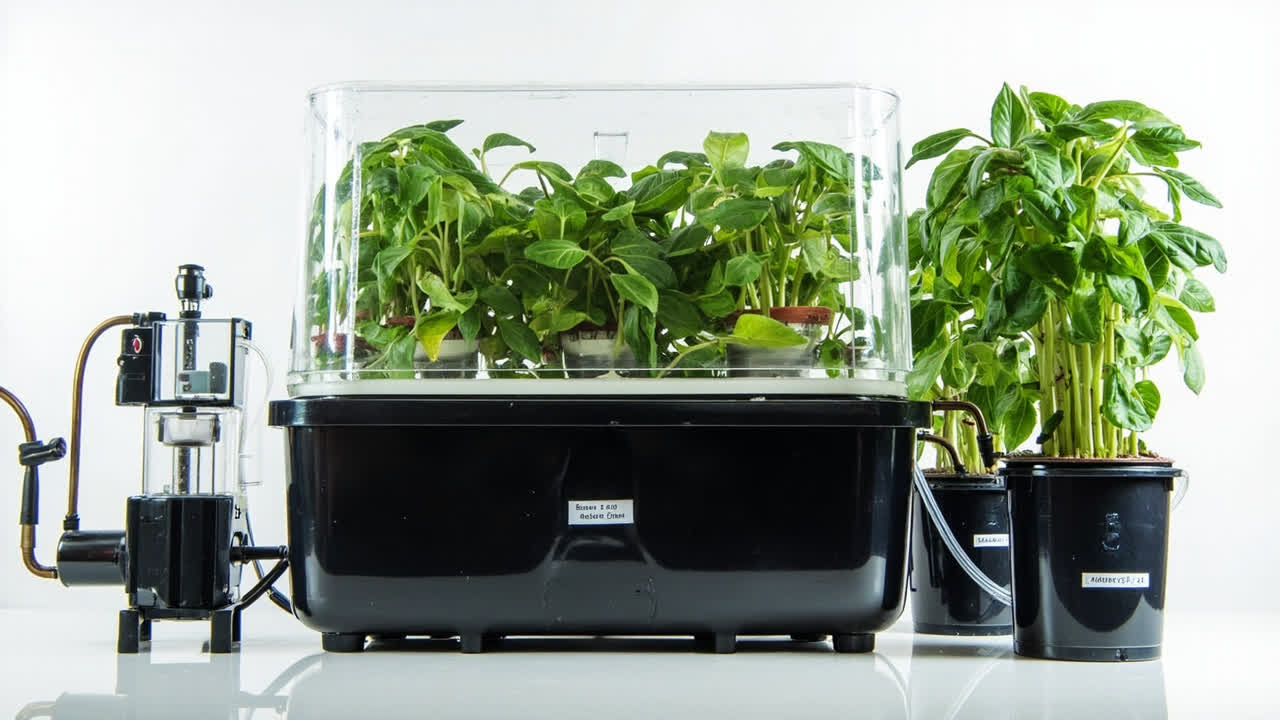
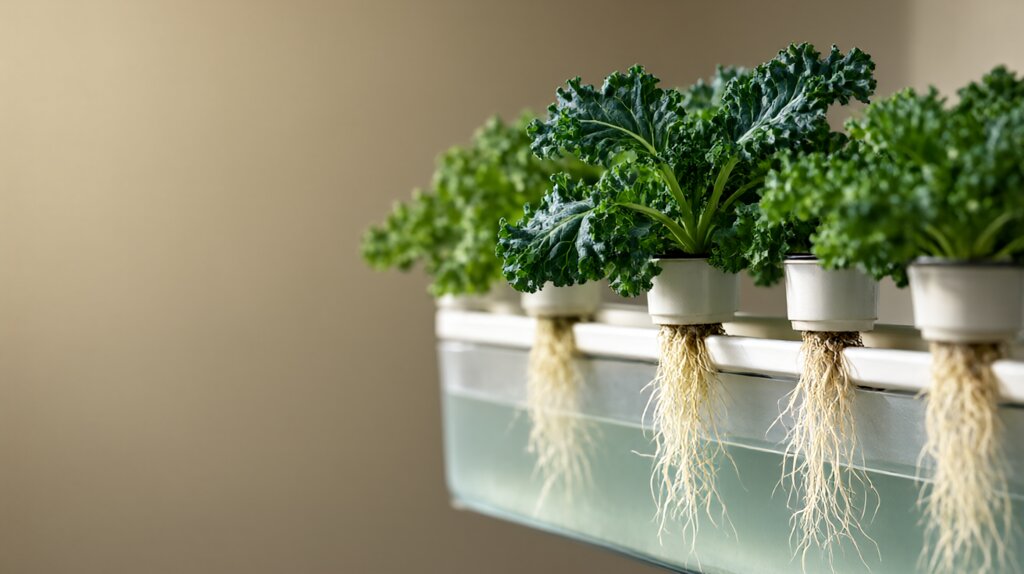
Nutrient film technique suits kale best of the recirculating systems, because the film has to reach the roots along the whole channel, and a thick kale crown sitting in a slow film will not pull it. Deep water culture suits it too, provided the crown stays above the solution line and the roots stay submerged. The comparison of the seven hydroponic systems covers which geometry suits which crop, and the types of hydroponic systems breaks each one down.
Aeroponics works well for kale too, but for a different reason than for lettuce. The site’s aeroponics guide already places kale with Swiss chard in the tier that runs 35 to 50 days to first harvest and then keeps producing for two to three months, rather than the 30 to 45 day single-cut lettuce pattern.
Spacing Inside the Channel
Kale takes more room per plant than lettuce, the opposite of what people expect from a leafy green. The Ohio State trial harvested twelve plants per channel, and the same group found kale fresh weight per plant fell by roughly a fifth when density in NFT rose from 20 to 30 plants per square meter, even as yield per square meter rose. Denser planting gives you more plants, not bigger leaves.
Work out your channel spacing from the plant size you actually want, not the seedling spacing on the seed packet. The plant spacing guide sets out how the crop families differ in the space they need once established.
Starting Kale From Seed: Germination Has a Ceiling
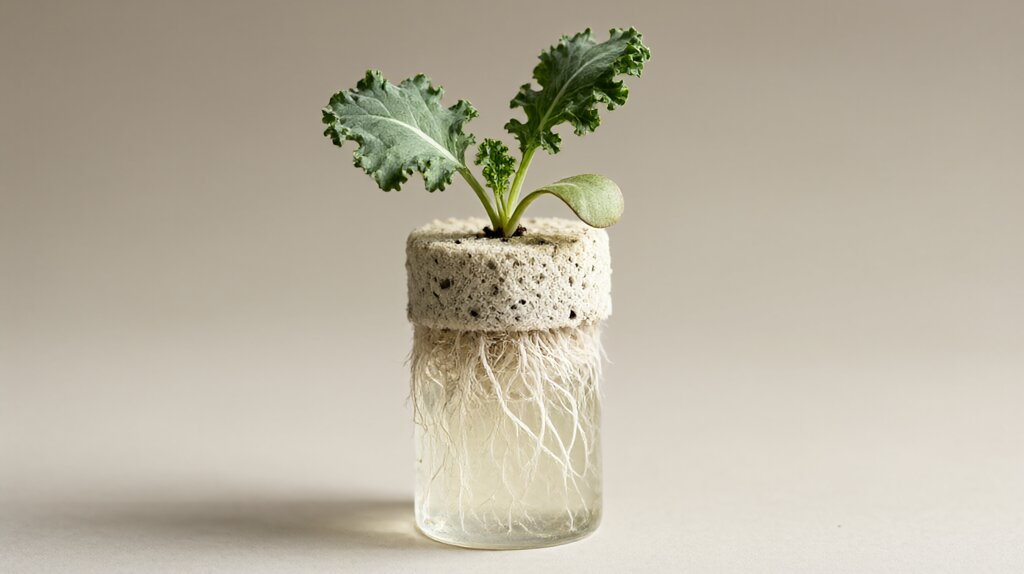
Kale germinates fast and unforgivingly. UT Extension puts germination at 24 to 48 hours, ideal around 70 to 75 F, and lists kale among the cool-season crops whose germination drops off above 85 F. That ceiling is not theoretical: a tray in direct summer sun crosses it in an afternoon, and weakly germinated kale comes up uneven and never catches up.
Seedlings are ready to move at 12 to 18 days from seeding, once they show three to five true leaves. One detail in that timeline is worth copying. UT Extension recommends germinating in a watered, shaded area and moving the tray under lights only as soon as germination occurs, rather than running a full light cycle on a wet tray. Give kale darkness and moisture for the first two days, then light.
Nitrogen is worth watching in propagation. Cornell sets it at 125 ppm for the heavy feeders, and Iowa State found seedling growth increasing with fertilizer up to 200 ppm. Propagation is the one phase where more nitrogen reliably does more, because the plant has no root system yet to hold a mature canopy.
The Light Question: Where Fresh Weight Lies to You
Light is where kale’s data behaves strangely, and the strange part is the useful part. In a 2019 study at Montana State University, kale grown for 28 days across daily light integrals from 8 to 14 mol per square meter per day showed no significant change in fresh weight, while lettuce over the same range went from 1.27 g to 4.33 g per plant. Read at face value, kale does not care about light and lettuce is the light-hungry one.
That is not what the data says. Kale dry weight over the same treatments rose in a straight line, from 0.188 g at 8 mol to 0.277 g at 14 mol, a 47% increase. Fresh weight stayed flat because the extra carbon went into tissue density rather than into water. Kale got heavier in dry matter while its fresh weight stood still, and only a scale that weighs the dried leaf can see it.
The follow-up work pushes the same line further. Currey and Yost at Iowa State grew kale across daily light integrals from about 2 to 22 mol and found no saturation for kale, pac choi, or Swiss chard. Their conclusion is that these are high light plants, in the 20 to 30 mol class, and very high above 30.
Light intensity and photoperiod together determine the daily light integral, which determines photosynthesis, which determines dry matter accumulation. For kale that keeps climbing to 22 mol even where fresh weight stalls, because the extra carbon goes into the leaf rather than into more water. Aiming kale at 20 to 22 mol per square meter per day is aiming it at a high-light crop, and the evidence says that is where the yield is.
For the temperature bands across every crop in one place, including the 60 to 70 F band kale shares with spinach, arugula, and bok choy, see the reservoir temperature matrix by crop.
The Oxygen Question: The Spend That Pays for Arugula, Not Kale
This is the one most growers will get wrong, because the general rule about hydroponic oxygen is correct for most crops and wrong for this one. The common advice is that more dissolved oxygen means more yield, so buy the better air pump or run the air stones longer. A 2025 study in HortScience tested that directly on kale and arugula side by side, running nutrient film systems at three dissolved-oxygen enrichment levels alongside a control.
Arugula responded strongly, with shoot fresh weight gains between 63% and 191%. Kale did not respond to elevated dissolved oxygen at all. The crop that rewarded the extra aeration was the peppery salad green, not the brassica.
The researchers concluded that standard air-pump aeration already meets kale’s respiratory demand, and that the enrichment carried more than 140% higher energy costs for no economic return, so they recommended against it for kale. That is a rare, useful finding: a technique that works on one crop and not another, measured side by side.
It makes physical sense: a kale leaf has a thick waxy cuticle and a lower gas exchange demand per gram of tissue than an arugula leaf, so the aeration rate that keeps arugula’s roots respiring comfortably already exceeds what kale needs. Spend your money on light for kale, not on oxygen.
The Four Mistakes That End Most Kale Harvests
The first mistake is feeding kale like lettuce. The crop is a heavy nitrogen feeder at 175 to 200 ppm for production, and mixing to the low end of a leafy-green band leaves it short of the nitrogen it is built to use. It will not look starved dramatically. It will be a thinner, lighter plant that you read as a light feeder and feed lightly again next cycle.
The second mistake is treating EC as the yield dial. You will spend your cycle pushing a number that Iowa State showed does not change kale yield at all, from 1.0 to 5.0. Nothing is wrong with 2.0 mS/cm. Going to 2.8 buys nothing, and the nitrogen you needed went unaddressed.
The third mistake is trusting a fresh-weight number. Kale dry weight keeps climbing with light where fresh weight has already stalled, so judging your lighting by the wet harvest means cutting light too early and never seeing the density being built.
The fourth mistake is germinating in summer heat. Kale germination degrades above 85 F, and a tray in direct sun crosses that in an afternoon. The loss is not recoverable, because uneven emergence produces uneven channels for the rest of the cycle.
Harvesting Kale: One Plant, Many Cuts
Kale is cut-and-come-again in a way lettuce is not. UT Extension notes that kale, mustard, and Swiss chard may be harvested multiple times by taking leaves rather than the whole plant, and the aeroponics guide on this site puts a single well-maintained kale plant at two to three months of leaf production. The site’s crop guide gives 50 to 60 days to harvest, in line with the Iowa State figure of about four weeks from transplant to a first cut.
Harvest from the outside in, and never take more than a third of the canopy at a time. Take the oldest mature leaves, leave the growing centre untouched, and the plant rebuilds from that centre. A centre that is removed is a plant that bolts or stalls.
Harvest in the cooler part of the day, which UT Extension recommends for all leafy crops, because a cut plant in afternoon heat loses water through the wound before it reaches your fridge. Storage is 35 to 38 F at above 85% humidity, which keeps leaves crisp for days rather than hours.

The Numbers That Decide a Kale Harvest
Kale is unusual in that nutrient concentration stops being interesting early. If you write one line on the wall, make it this: EC 2.0 mS/cm, pH 5.8, nitrogen at 175 to 200 ppm, DLI 20 to 22 mol per square meter per day. Everything else is a variable.
- Nitrogen is the dial, not EC. 175 to 200 ppm for production, 125 ppm in propagation.
- Judge light by dry matter, not fresh weight, because kale keeps building density where the wet harvest stalls.
- Standard aeration is enough. Dissolved oxygen above 5 mg/L bought kale nothing and cost over 140% more energy.
- Germinate at 70 to 75 F, never on a tray above 85 F, and transplant at 3 to 5 true leaves.
- Harvest at about 4 weeks, then take outer leaves and leave the centre growing.
One last thing worth doing, because it never shows up in a general guide: swapping to a calcium nitrate only feed for the final week of the cycle raised shoot fresh weight 28.5% and cut fertilizer cost 16.5% to 40.9%. It only makes sense once you already know how much nitrogen your kale has.
Last reviewed on November 20, 2026.
Sources and further reading
- Iowa State University Extension and Research, Greenhouse Product News (Currey, Yost, and Sporer), fertilizing specialty leafy greens in hydroponics: kale yield at EC 1.0 to 5.0 mS/cm, sulfur deficiency at 0.5, nitrogen rates.
- Iowa State University (Currey and Yost), managing the daily light integral for leafy greens: linear DLI response in kale, no saturation from 2 to 22 mol.
- Ohio State University, Frontiers in Plant Science (2025), nitrogen supplementation in hydroponic kale: calcium nitrate in the final week, 28.5% fresh weight gain.
- HortScience 60(10) 2025 (Qin and Ferrarezi, Ohio State University), managing dissolved oxygen in hydroponic kale and arugula: no yield response in kale.
- HortScience 54(12) 2019 (Baumbauer and colleagues, Montana State University), leaf lettuce yield and daily light integral: kale fresh weight flat, dry weight up 47%.
- Cornell University Controlled Environment Agriculture, a recipe for hydroponic success: heavy and light feeder nitrogen rates.
- Oklahoma State University Extension HLA-6722, electrical conductivity and pH guide for hydroponics: optimum EC and pH by crop.
- University of Tennessee Extension W 844-B (Bumgarner and Hochmuth), leafy crop production in small-scale soilless systems: germination, transplanting, temperature.
- University of Florida IFAS, HS1279, leafy greens in hydroponics and protected culture: kale types and stem management.
- University of Minnesota Extension, growing collards and kale in home gardens: Brassica botany and leaf production after frost.