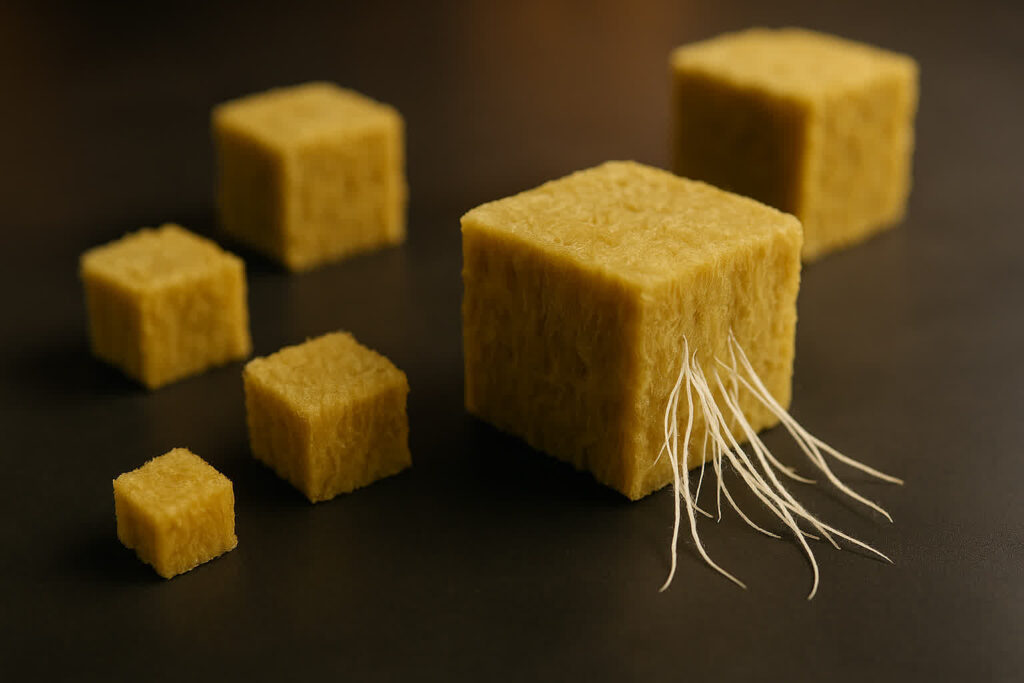

Rockwool for hydroponics is one of the most widely used growing media in soilless cultivation systems, and understanding its properties and limitations is essential for any home gardener building their first hydroponic setup. Rockwool — technically a mineral wool — is made from basalt rock and recycled industrial slag that is melted at approximately 3,000°F (1,650°C) and spun into fibers using high-pressure air streams, then compressed into usable forms like cubes, slabs, and granules. Its sterility, water retention, and excellent aeration properties made it a hydroponic standard from the 1970s onward.
Rockwool cubes and slabs are manufactured in precise dimensions that make them ideal for controlled-environment agriculture. Horticultural-grade rockwool differs from the insulation grade in its density, fiber orientation, and wetting agent content — horticultural versions are designed to absorb and retain water while maintaining air-filled porosity of 18–25%, which delivers oxygen directly to root tips. This air-to-water ratio is the key to rockwool’s effectiveness: roots never drown, nutrients are delivered efficiently, and the sterile medium eliminates soil-borne pathogens.
Why Rockwool Must Be Buffered Before Use
New, dry rockwool has a naturally high pH of 7.5–8.5, which is too alkaline for most hydroponic crops that prefer a root zone pH of 5.5–6.5. If you plant into unbuffered rockwool, the alkaline pH will lock out nutrients — particularly iron, manganese, and phosphorus — causing the same deficiency symptoms you would see in soil with improper pH. The buffering process prepares the rockwool to hold and release nutrient solution at the correct pH range.
Rockwool also contains residual industrial processing compounds that can affect initial nutrient balance. Proper buffering leaches these and establishes the correct starting pH so your nutrient solution doesn’t get skewed the moment you water your plants.
How to Prepare Rockwool for Hydroponics
Buffering rockwool is straightforward but requires patience — skipping steps is the most common cause of early crop failure in rockwool systems. Begin by thoroughly soaking the rockwool in pH-adjusted water at approximately 5.5 for a full 24 hours. Use a pH-down product (phosphoric acid is common) to bring your water to target. After the initial soak, drain the rockwool and repeat the process with fresh pH 5.5 water for another 12–24 hours if working with dense slabs or cubes larger than 3 inches.
After buffering, the rockwool should be allowed to equilibrate — meaning the pH stabilizes at the target range — before transplanting. Test the runoff water from squeezed rockwool with a pH meter or test strips. When the runoff consistently reads 5.5–6.5, the rockwool is ready. This process typically takes 1–3 days total depending on cube size and initial pH. Never plant into dry or unbuffered rockwool.
Types of Rockwool and When to Use Each
Rockwool is manufactured in three primary forms for horticulture, each serving a different stage of plant development. Propagation cubes range from 0.75-inch plugs (for seed starting and cuttings) up to 2-inch cubes (for transplanting seedlings). Cubes are the entry point for most hydroponic crops — basil, lettuce, and herbs typically start in 1-inch cubes and are transplanted to a larger medium within 10–21 days.
Slabs are compressed rockwool blocks typically measuring 3–4 inches tall × 6–12 inches wide × 36–48 inches long. Plants are transplanted onto slabs after the cube stage, with the cube placed directly on top of the slab so roots grow through into the larger volume. Slabs provide the root mass with more water reserves and stable nutrient delivery during the main vegetative and fruiting stages.
Granular or flock rockwool is used as a mixed media component or in flood-and-drain systems where loose material is preferable to rigid blocks. Granular rockwool has a higher air porosity than slabs but lower water-holding capacity, making it suitable for crops that prefer drier root conditions or for improving drainage in mixed-media containers.
EC and Nutrient Management in Rockwool
Rockwool is chemically inert — it has no inherent nutrient content of its own. This is both an advantage and a responsibility. The advantage is that you control exactly what nutrients your plants receive. The responsibility is that every element must come from your nutrient solution, and imbalances happen faster than in soil because rockwool has virtually no cation exchange capacity (CEC) to buffer fluctuations.
Electrical conductivity (EC) measures the total dissolved salts in your solution — essentially how nutrient-dense it is. For most leafy greens in rockwool, target an EC of 1.2–2.0 mS/cm. For fruiting crops like tomatoes and peppers, a higher EC of 2.5–4.0 mS/cm is typical. Monitor EC daily in recirculating systems and adjust with fresh nutrient solution as plants uptake water faster than nutrients, which concentrates the remaining solution over time.
pH management in rockwool requires checking both the incoming nutrient solution and the root zone runoff. The root zone pH in rockwool can drift from the reservoir pH due to plant root activity releasing or absorbing ions. Aim for pH 5.5–6.5 in the runoff, and if it drifts outside this range, adjust with pH up or down products at the reservoir.
Reusing Rockwool
Rockwool can technically be reused, but the labor and risk often outweigh the cost savings for home growers. After harvest, remove plant material and roots as thoroughly as possible by hand. Soak the slabs in a 1–2% hydrogen peroxide solution for 30 minutes to disinfect, then rinse thoroughly with pH-adjusted water. Allow to dry completely before storage to prevent mold.
Even with thorough cleaning, rockwool accumulates root exudates and salt residues that can affect subsequent crops. For professional operations, rockwool is typically replaced every 2–3 growing cycles. For home growers, the risk of pathogen carryover from diseased crops (fusarium, pythium) makes replacement the safer choice, especially for fruiting crops where yield matters. Learn more about hydroponic systems for beginners to determine which system works best with your chosen medium.
Comparing Rockwool to Other Growing Media
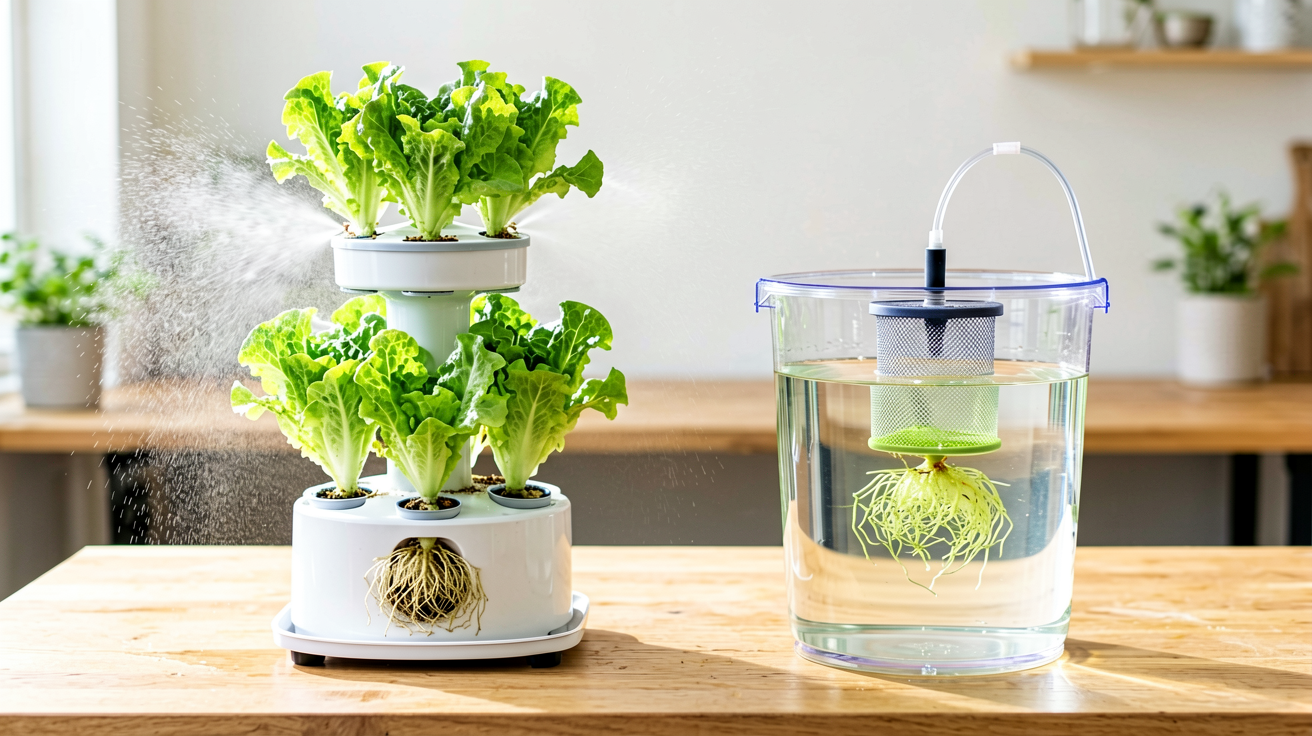
Rockwool’s two closest competitors in hydroponics are hydroton (expanded clay pebbles) and coco coir, each with distinct characteristics. Hydroton is pH-neutral, reusable for years, and provides excellent aeration, but it has no water-holding capacity — nutrient solution must be delivered more frequently or the medium dries out quickly. This makes hydroton ideal for recirculating systems like DWC and NFT but unsuitable for crops that need consistent moisture.
Coco coir — processed coconut husk fiber — holds water extremely well while maintaining good aeration, and has a natural pH of 5.5–6.8 without buffering. It also contains some natural potassium and sodium that requires rinsing and buffering before use. Coco coir has gained significant market share because it is renewable (unlike rockwool, which is not biodegradable), lighter to ship, and easier for beginners to manage without precise pH adjustment.
Rockwool remains the industry standard for commercial hydroponic tomato, cucumber, and pepper production because its precise water-holding and air-filled porosity can be engineered to exact crop specifications across large greenhouse operations. For home growers, rockwool excels in propagation and in systems where precise nutrient delivery and sterility outweigh the need for buffering capacity. For a full comparison across common hydroponic crops, see our guide to best plants for hydroponics.
Common Rockwool Problems and How to Avoid Them
Overwatering is the most common rockwool mistake, and it happens when the irrigation schedule doesn’t account for rockwool’s water retention. Because rockwool can hold 80–90% of its weight in water, roots sitting in saturated rockwool quickly develop hypoxia — oxygen starvation at the root zone — which invites pythium (root rot) and fusarium. The fix is adjusting drip or irrigation frequency so that the rockwool reaches field capacity (maximum water held after drainage) but is allowed to partially dry between waterings, typically indicated by a weight reduction of 20–30%.
Underwatering and salinity buildup also occur when rockwool dries out too much between irrigations. As water evaporates from the slab surface, salts concentrate at the edges and top, creating a high-EC zone that damages root tips. If you see white salt crusting on rockwool slab surfaces, flush thoroughly with pH-balanced water at 2–3 times the slab volume to leach accumulated salts.
Finally, physical compaction reduces rockwool’s lifespan and aeration. Once fibers compress — which can happen from repeated use, improper handling, or heavy crops — the air porosity drops below the 15% threshold needed for healthy root oxygenation. Compressed slabs should be replaced rather than reused.
Getting Started With Rockwool in Your Hydroponic System
If you’re building your first hydroponic system, rockwool is an excellent medium to learn with because it delivers predictable, consistent results when properly prepared. Start with 1-inch propagation cubes for seeds or cuttings — they are inexpensive, widely available, and forgiving of small timing errors during the seedling stage. Invest the time upfront to properly buffer your rockwool; this 1–3 day preparation step is the single most important thing you can do to set your first crop up for success.
For deeper guidance on choosing and building the right system for your goals, review our detailed overview of using rockwool for hydroponics and how it fits into your overall nutrient management strategy. Combine this with a solid understanding of nutrient solution formulation to ensure your plants receive everything they need at every growth stage.
Turn any PDF statement into a clean sheet
Skip the typos and the hours of copying. Our converter handles any bank statement format and outputs Excel, CSV, or QBO for QuickBooks. No file retention, free to try.
Convert your statement