You notice something on the newest leaves of your Dracaena Massangeana — small, water-soaked spots that are not matching the usual patterns of age-related yellowing or chemical burn. They are spreading. And they appeared after a humid week or after you watered from overhead. This might be Fusarium leaf spot, and understanding it now makes the difference between saving the plant and losing it.
Fusarium leaf spot is one of the most common fungal diseases affecting mass cane plants, particularly in warm, humid conditions. It is not a death sentence for the plant, but it does require prompt attention to prevent it from weakening the whole specimen over a growing season.
What Fusarium Leaf Spot Looks Like on a Mass Cane Plant
The symptoms of Fusarium leaf spot on a Dracaena Massangeana follow a recognisable pattern. Knowing exactly what it looks like helps you confirm it is not something else:
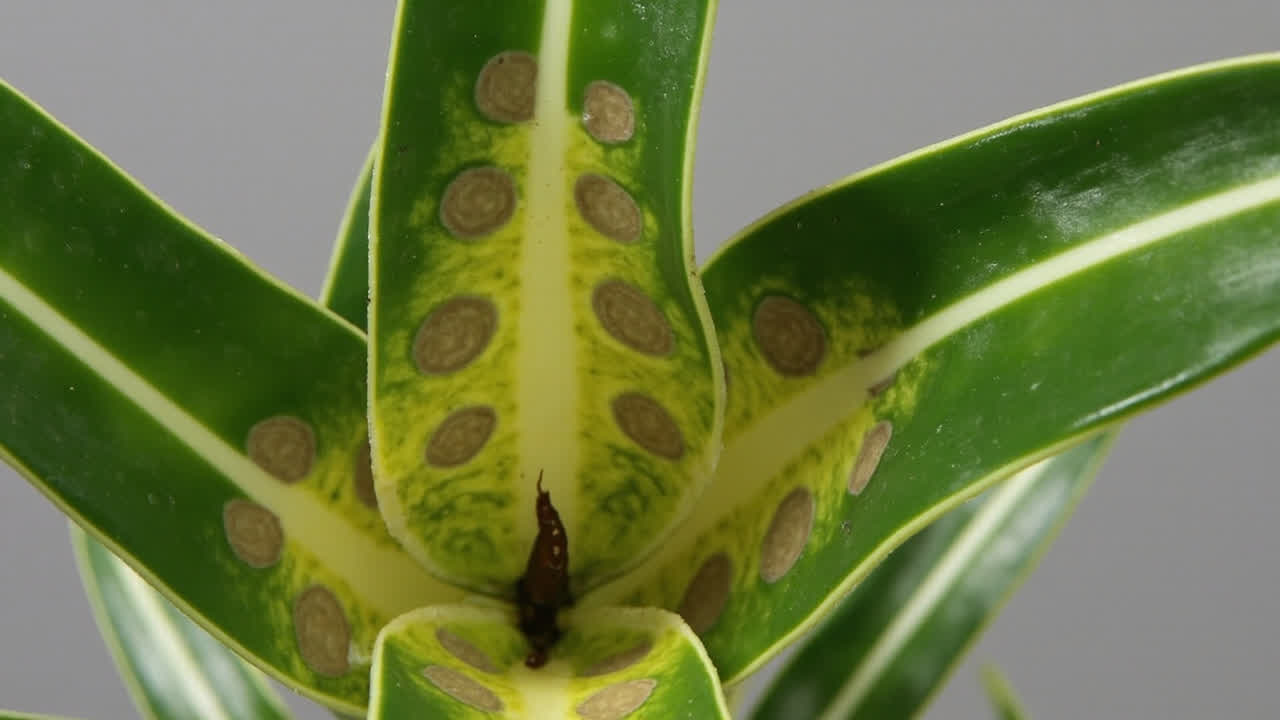
First signs: Small, slightly sunken, water-soaked spots appear on the younger, newer leaves — not the oldest leaves at the base, but the leaves in the upper and mid portions of the foliage rosette. The spots are typically one to five millimetres in diameter. They may be pale green, yellow, or almost transparent at first.
Progression: The spots expand and turn tan, brown, or reddish-brown. A characteristic yellow halo develops around each spot — this is one of the clearest visual indicators that separates Fusarium from other leaf damage. The centre of the spot may darken as fungal spores develop.
Spread pattern: The infection typically starts on one or two leaves and spreads to adjacent leaves through water splash, physical contact between leaves, or contaminated tools. If multiple young leaves show simultaneous or sequential spotting, Fusarium is the primary suspect.
Contrast with older leaf drop: Natural leaf senescence on a Dracaena Massangeana affects the lowest, oldest leaves and causes uniform yellowing and wilting without discrete spots. Fusarium spots are always discrete, raised or sunken, and surrounded by a defined discolouration halo.
What Causes Fusarium Leaf Spot on Mass Cane Plants
Fusarium leaf spot is caused by species in the genus Fusarium — primarily Fusarium oxysporum and related strains that are opportunistic pathogens of houseplants. These fungi are present in most soils and potting media at low levels. They become a problem when conditions allow them to colonise living leaf tissue.
The primary conditions that trigger Fusarium infection on mass cane plants:
Warm temperatures combined with high humidity. The ideal range for Fusarium development is 20 to 30°C with relative humidity above 70%. This is precisely the environment found in many homes during summer or in rooms with poor air circulation. Proper humidity and temperature management for Mass Cane keeps the leaf surface drier and the air too cool for sustained fungal growth — directly suppressing the conditions Fusarium needs.
Overhead watering that wets the foliage. When you water from above and the water lands on the leaves, it creates the exact surface moisture that Fusarium spores need to germinate and penetrate the leaf cuticle. Watering at soil level, close to the base, eliminates this pathway.
Wounds or physical damage to leaves. Fusarium can enter through damaged leaf tissue — from abrasion, insect feeding, bruising from shipping or transport, or cuts during pruning. Even minor damage creates an entry point.
Contaminated tools and pots. If you have used secateurs or scissors on an infected plant without sterilising them, the tool becomes a vector for spreading the spores to healthy plants. Reusing contaminated potting soil from a symptomatic plant also spreads the fungus.
Over-fertilising with nitrogen. Excessively nitrogen-rich fertiliser produces soft, fast-growing leaf tissue that is far more susceptible to Fusarium invasion. The new growth is more vulnerable and the cell walls are less structurally developed.
How to Distinguish Fusarium Leaf Spot From Other Leaf Problems
Several other conditions produce spots or discolouration on mass cane plant leaves. Here is how to rule them out:
Fusarium vs. bacterial leaf spot:
Bacterial leaf spot (typically Xanthomonas species) produces spots that are more irregular in shape, often with a wet, oily-looking margin, and without the pronounced yellow halo. Bacterial spots may also produce a sticky exudate. Fusarium spots are more regularly circular with a sharply defined halo.
Fusarium vs. fluoride or chemical burn:
Fluoride toxicity and salt burn from over-fertilising produce brown leaf tips and marginal burn rather than discrete circular spots. The burn pattern follows the leaf margins and tips, not the leaf surface. Chemical burn does not spread from leaf to leaf.
Fusarium vs. natural leaf aging:
As the oldest leaves on a Dracaena Massangeana senesce, they yellow uniformly and then dry out. There are no discrete spots, halos, or raised fungal structures. The leaf drops cleanly without spreading to other leaves.
How to Treat Fusarium Leaf Spot on Your Mass Cane Plant
Fusarium leaf spot is treatable, especially if caught early. Here is the step-by-step protocol:
Step 1 — Isolate the plant. Move the affected plant away from other Dracaena and houseplants to prevent spore spread through water splash or air circulation.
Step 2 — Remove all infected leaves. Using clean scissors or secateurs, cut each affected leaf off at the base, close to the main stem. Do not compost these leaves — dispose of them in the trash. Sterilise your cutting tool with rubbing alcohol between each cut to avoid spreading spores.
Step 3 — Improve air circulation. Move the plant to a position with better airflow — not a draught, but a location where air moves freely. If the room is stagnant, a small fan nearby on low speed makes a significant difference. Space plants so leaves do not overlap or touch.
Step 4 — Stop overhead watering. Switch to watering at the base of the plant, close to the soil surface. Use a narrow-spout watering can or a squeeze bottle to direct water exactly where it is needed without wetting the foliage. Water in the morning so any splashed water dries before evening.
Step 5 — Apply a fungicide. Use a copper-based fungicide or a broad-spectrum houseplant fungicide containing chlorothalonil or thiophanate-methyl. Apply as a foliar spray, covering both the top and undersides of all remaining leaves. Repeat every 7 to 14 days for three applications. Organic options include neem oil or a sulphur-based fungicide for mild cases.
Step 6 — Reduce humidity around the plant. Lower the relative humidity in the immediate area by increasing ventilation, moving the plant away from other plants, and ensuring the pot has adequate drainage so excess water evaporates rather than raising ambient moisture.
Within two to three weeks of starting treatment, you should see no new spots appearing. The infection will have stopped spreading if conditions have been corrected. Monitor the plant closely for six weeks — if new spots appear after apparent clearance, the infection may have been partially suppressed rather than fully eradicated and a second fungicide cycle is needed.
Preventing Fusarium Leaf Spot on Your Mass Cane Plant
Prevention is far more reliable than treatment for Fusarium. Integrate these habits into your routine:
Always water at soil level. Never wet the foliage of your Dracaena Massangeana. Use a long-spout watering can or a bottle with a narrow neck to deliver water directly to the soil surface around the base.
Space plants adequately. Overcrowding creates the stagnant, humid microclimate that Fusarium thrives in. Keep at least 15 cm of clear space around each mass cane plant’s foliage rosette.
Disinfect tools after every pruning session. Dip secateurs in isopropyl alcohol between plants and after cutting any plant showing signs of disease. This single habit prevents the majority of cross-contamination incidents in a houseplant collection.
Use clean soil and pots. Never reuse potting soil from a plant that showed disease symptoms. Use fresh, sterile potting mix when repotting. A well-draining soil for Mass Cane also reduces the ambient moisture retention that Fusarium depends on. Clean pots with a 10% bleach solution before reusing them.
Maintain balanced fertilisation. Avoid high-nitrogen fertilisers, especially in summer. Use a balanced houseplant fertiliser at half strength rather than full strength to avoid producing soft, vulnerable new growth.
For more on diagnosing problems with your mass cane plant, including other fungal and bacterial issues, see the common Mass Cane Plant pests and diseases guide. Proper humidity and temperature management for Mass Cane substantially reduces the conditions that allow Fusarium to establish — and prevents recurrence.
Fusarium leaf spot is manageable with the right habits. The combination of dry-leaf watering, clean tools, and good air circulation removes the three conditions Fusarium needs to colonise your Dracaena Massangeana — and keeps your plant spot-free through every growing season.
Turn That PDF Into a Spreadsheet in Minutes
You've seen how to do it manually — now let the tool handle the heavy lifting. Upload your bank statement and get Excel, CSV, or QBO in a few clicks.
Try It Free