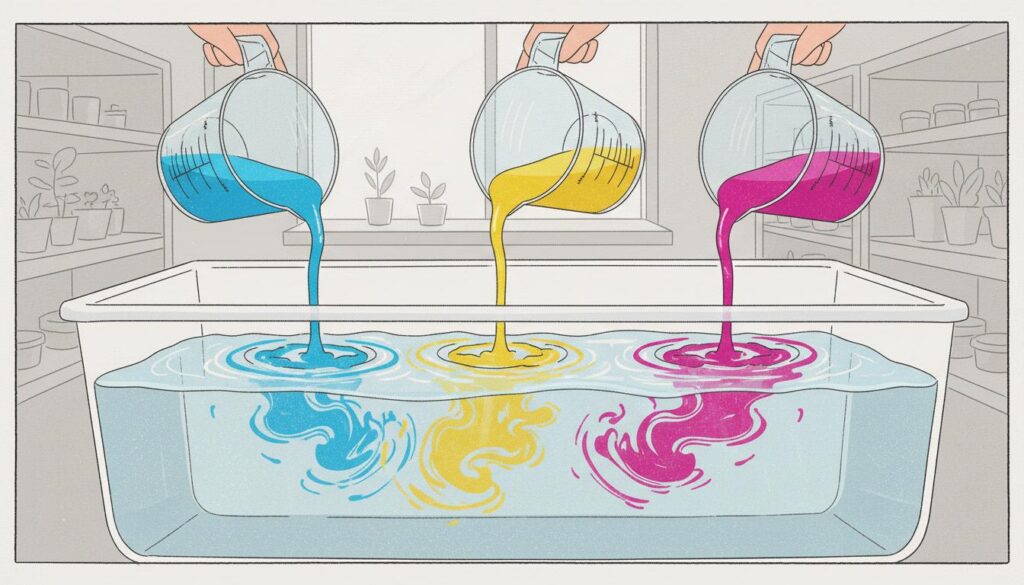

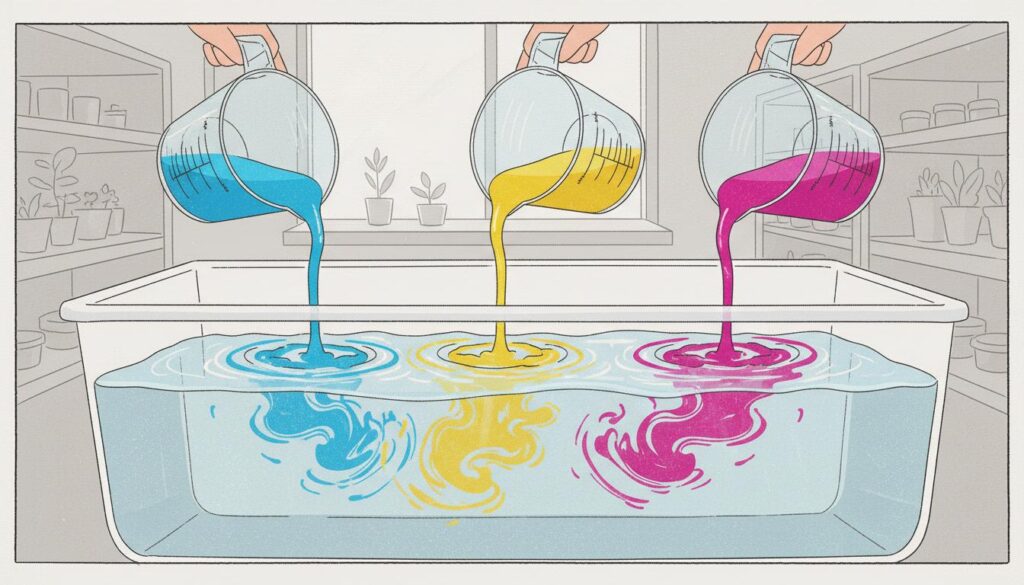
Understanding how to use General Hydroponics Flora Series in mixing order and ratios is critical for maintaining chemical stability in a hydroponic reservoir.
The Flora Series Mixing Protocol relies on the sequential dilution of components to prevent the irreversible bonding of concentrated mineral salts.
Failing to follow the specific addition order results in nutrient precipitation, a state where essential ions like calcium and phosphorus fall out of the solution and become unavailable to the plant.
This guide using the General Hydroponics Flora Series establishes the procedural sequence and volumetric proportions required to maintain a bioavailable environment for all growth stages.
How Reservoir Dynamics Change Your Nutrient Management Strategy
The efficacy of a mineral fertilizer system depends on how the solution interacts with the specific hydroponics farm environment and the delivery mechanism utilized.
In recirculating systems like Deep Water Culture (DWC) or Aeroponics, the solution is subject to rapid ion depletion and oxygenation, which can accelerate pH shifts.
In media-based systems such as Coco Coir or Rockwool, the primary control variable is the electrical conductivity (EC) of the runoff, as mineral salts can accumulate in the fibers and cause localized root burn.
System-Type Variable Modeling:
- Recirculating Systems: Prioritize stability; require lower initial EC targets to allow for concentration through evaporation.
- Drain-to-Waste Systems: Prioritize nutrient density; require 10-20% runoff volume to flush out unabsorbed minerals.
- High-Oxygen Systems (Aeroponics): High risk of mineral “flocking” clogging small emitters; requires 100% homogeneity.
Why Direct Mixing Causes Irreversible Nutrient Fallout
The most common failure in hydroponic management is the “concentrate collision.”
If FloraMicro (containing high calcium) and FloraBloom (containing high phosphorus and sulfur) are mixed together in a measuring cup before being added to water, they instantly form an insoluble solid called calcium phosphate.
This “cloudy water syndrome” cannot be fixed by stirring or adding acids. Once these minerals precipitate, they settle at the bottom of the reservoir as grit, leaving the water nutrient-deficient and potentially damaging pumps.
The Science Behind the Micro-First Mixing Sequence
The stability of the solution is maintained through the “Micro-First” rule of chelation protection.
FloraMicro contains the nitrogen and calcium base, alongside chelated micronutrients that are sensitive to the presence of other salts. By adding FloraMicro to the full volume of water first, you dilute the calcium ions sufficiently so they are separated by water molecules.
This creates a buffer that prevents them from reacting with the concentrated phosphorus and potassium found in the Grow and Bloom components.
The Mechanistic Progression:
- Cause: FloraMicro is introduced to the reservoir water and stirred.
- Process: Calcium and nitrogen ions are diluted and stabilized by the water volume.
- Effect: The addition of FloraGrow and FloraBloom no longer triggers a chemical bond between calcium and phosphorus.
- Consequence: The solution remains clear and fully bioavailable for root membrane absorption.
How Source Water Alkalinity Impacts Nutrient Bioavailability
The mineral content of your starting water determines whether the standard Flora Series can stabilize the pH or if a specialized component is required.
Water with high alkalinity (hardness) contains native calcium and carbonates that compete with the fertilizer’s chelated minerals.
When the water chemistry is unbalanced, you may observe issues such as mass cane leaves turning brown or necrotic spotting on foliage, which often indicates that the roots are struggling to process incompatible mineral loads.
Water Hardness Threshold Table
| Source Water PPM | Hardness Classification | Recommended Micro Component |
| 0 – 100 PPM | Soft / RO Water | Standard Micro + Cal-Mag |
| 100 – 200 PPM | Moderate | Standard Micro |
| 200+ PPM | Hard Water | FloraMicro Hardwater |
Precise Ratios and EC Targets for Every Growth Stage
To achieve specific growth outcomes, the ratio of the three components must shift to match the plant’s metabolic demands.
These operational benchmarks are particularly critical when managing high-demand crops, such as in hydroponic tomato farming, where precise EC levels dictate the success of the transition from vegetative growth to heavy fruiting.
Operational Ratios and EC Benchmarks
| Growth Stage | FloraMicro (ml/gal) | FloraGrow (ml/gal) | FloraBloom (ml/gal) | Target EC (mS/cm) | Target PPM (500) |
| Seedlings | 0.25 | 0.25 | 0.25 | 0.4 – 0.6 | 200 – 300 |
| Early Veg | 1.0 | 1.0 | 1.0 | 1.0 – 1.2 | 500 – 600 |
| Aggressive Veg | 3.0 | 2.0 | 1.0 | 1.6 – 2.0 | 800 – 1000 |
| Transition | 2.0 | 2.0 | 2.0 | 1.4 – 1.8 | 700 – 900 |
| Full Bloom | 1.0 | 2.0 | 3.0 | 1.8 – 2.4 | 900 – 1200 |
The Risk of Pushing High EC for Faster Growth
A common trade-off in nutrient management is between aggressive growth and plant health.
Increasing the concentration (higher EC) provides more raw materials for biomass, but it also increases the osmotic pressure at the root zone. If the EC is too high, the plant cannot pull water into its cells, leading to nutrient burn and leaf tip necrosis.
Maintaining a moderate, stable EC is generally superior to pushing maximum limits, as it provides a safety window against pH fluctuations and evaporation.
Predicting and Resolving Nutrient Imbalances
By monitoring the relationship between water consumption and EC, you can predict plant needs.
If the water level drops but the EC rises, your plants are drinking more water than nutrients, indicating the solution is too strong. If both drop, the plants are “hungry” and the ratio should be increased.
Troubleshooting Matrix
| Symptom | Probable Cause | Corrective Action |
| Milky Water | Sequence violation | Dump and remix; follow Micro-first rule |
| Yellowing Leaves | Iron/Calcium lockout | Adjust pH to 5.5–6.5; check Micro ratio |
| Burnt Leaf Tips | High salt concentration | Dilute reservoir with 20% fresh water |
| Stunted Growth | Nutrient fallout | Clean reservoir; check for bottom sediment |
Limits of the 3-Part Mineral System
The Flora Series is a high-purity, mineral-based system and has specific operational boundaries.
While some growers attempt to supplement their reservoirs with the benefits of worm castings or other organic teas, these additions often introduce biological variables and suspended solids that can disrupt the precision of a 3-part mineral system.
This protocol assumes a reservoir temperature between 65°F and 72°F. Temperatures above 75°F significantly reduce the solubility of oxygen and can trigger mineral instability.
Always calibrate pH and EC meters before making adjustments, and use protective gear when handling concentrated acids for pH management.
From Bank Statement to QuickBooks-Ready File
That manual cleanup you just read about? This tool skips it. Turn your PDF into QBO for QuickBooks without storing your data anywhere.
Start Converting