How to Increase Humidity for Houseplants: What Actually Works
Most homes in the United States and Southeast Asia maintain indoor relative humidity between 30% and 50% during normal daily life. During winter, when heating systems run constantly, that number can drop into the teens and low twenties. Tropical houseplants — the ones with large, thin leaves that make them so desirable — evolved in environments that regularly sit at 60%, 70%, or higher. That gap between your home and what your plant expects is the reason you are seeing crispy edges, slow growth, and leaves that never quite unfurl properly. The good news is that this is solvable. Raising the humidity around your houseplants is well within what a normal home can achieve, and you do not need a greenhouse to do it.
Before going further: the target relative humidity for most tropical houseplants sits between 50% and 70%. Anything in that range supports healthy growth, reduces pest pressure, and lets leaves develop the size and texture you bought the plant for. If you have a hygrometer — a small instrument that measures RH — check your space now. If you do not, the plant itself is telling you: browning leaf edges, leaf curling, and new leaves that emerge smaller than previous ones are all signals that humidity is a limiting factor right now.
Why Your Houseplants Struggle with Humidity Indoors
Tropical rainforests maintain remarkably consistent humidity because the dense canopy slows wind, transpiration from millions of leaves pumps moisture into the air continuously, and rainfall is frequent. The air inside a home replicates almost none of this. Forced-air heating and air conditioning both strip moisture from indoor air aggressively, and a single room with a ceiling fan or HVAC vent can have entirely different humidity levels than the room next to it. Plants placed near heat sources — radiators, heating vents, or electronics — experience the driest conditions of all.
The symptoms of low humidity are easy to misdiagnose. Crispy brown leaf edges often look like underwatering, so people water more, which then creates root rot conditions. Leaf curling can look like too much sun. Stunted new growth looks like nutrient deficiency. The underlying cause — air that is pulling moisture from leaves faster than the roots can replace it — gets missed entirely. A $15 hygrometer removes all the guesswork here and is the single best investment you can make before trying any humidity method.
Here is a quick reference for target ranges by plant category:
Plant Category
Ideal Relative Humidity
Examples
High-humidity tropicals
60–80%
Calathea, Maidenhair Fern, Selaginella
Mid-range tropicals
50–60%
Monstera, Philodendron, Pothos, Alocasia
Semi-tropical / adaptable
40–50%
Dracaena, Ficus elastica, Snake Plant
Succulents and cacti
30–40% (tolerates lower)
Aloe, Echeveria, Haworthia
How Indoor Humidity Actually Works
Understanding what humidity actually means in a closed room makes all the difference in choosing the right solution. Relative humidity is a percentage of how much moisture the air is holding compared to the maximum it could hold at that temperature. Warm air can hold significantly more moisture than cold air, which is why a room that feels comfortable to you at 72°F may still have air that is very dry for plants — and why the same room at 65°F can feel noticeably more humid.
Three processes move moisture around your home continuously. Transpiration is the process by which plants pull water up through their roots and release it as vapor through their leaves. A large Monstera deliciosa can transpire several hundred milliliters of water per day, which meaningfully contributes to the humidity of a small room if enough plants are grouped together. Evaporation from open water surfaces — a humidifier output, a cooking pot, a shower — adds moisture directly. Air movement redistributes that moisture throughout the room and, in the case of stagnant air, allows localized microclimates to form around individual leaves.
What this means practically: humidity is not uniform in a room. The air immediately surrounding a cluster of grouped plants will have measurably higher RH than the air near a heating vent five feet away. This is why plant groupings work — the collective transpiration of multiple plants creates a localized humidity zone that each individual plant benefits from. It is also why a single plant on its own, in a large room with good airflow, gets no meaningful benefit from a small pebble tray sitting nearby.
From PDF to Excel in one click
Forget retyping line by line. Upload any bank statement, get a spreadsheet you can actually use. Your files are never stored, and you can test the converter with 3 free conversions.
Methods to Raise Humidity: Ranked by What Actually Works
The Honest Effectiveness Ranking
1. Room humidifier (most effective)
A properly sized humidifier is the only passive method that genuinely changes the ambient humidity of a room to the 50–70% range that tropicals need. The math is straightforward: a humidifier adds moisture to the air faster than it escapes through ventilation, leakage, and absorption by surfaces. For a small to medium bedroom or office, a cool-mist ultrasonic humidifier with a 1–1.5 gallon tank run continuously will maintain 55–65% RH without effort. The key is choosing a model with an automatic humidity sensor so it turns off once the target RH is reached — running a humidifier in already-humid air creates condensation and mold risk.
What to look for: cool-mist ultrasonic units are quieter and safer around plants than warm-mist evaporative units. Look for a minimum output of 200–300 ml/hour for a small room, 500+ ml/hour for larger spaces. A hygrometer inside the room lets you verify the humidifier is actually reaching the target. Clean the tank weekly — standing water in a warm humidifier tank is a Legionella and mold risk in any living space.
2. Plant grouping (moderately effective)
Grouping six or more plants together creates a localized humidity environment through collective transpiration. This method works best in a room where the overall RH is not already extremely low — if the ambient RH is 20%, the plants cannot transpire enough to meaningfully offset that. Think of grouping as maintaining a higher baseline in an already-reasonable room, not correcting a severely dry environment.
The practical arrangement: place plants close enough that the canopies nearly touch. Cluster them on a humidity tray (more on this below) if possible. Position the group away from heating and cooling vents. In a small bathroom with good natural light, grouping tropicals near the shower — where humidity spikes during and after use — can provide a meaningful boost.
3. Humidity tray with fan assist (marginally effective)
A humidity tray is a shallow tray filled with pebbles or river stones, with water poured in until it sits just below — never touching — the bottom of the plant pots. The principle is that the exposed water surface evaporates and raises humidity immediately around the plant. In practice, without active airflow to carry that vapor away from the tray surface, the effect drops off sharply within a few inches of the tray itself. A small fan pointing across the tray surface roughly doubles the effective humidity contribution of the same tray. Without airflow, a humidity tray in a 200-square-foot room with 30% ambient RH will raise the local reading by perhaps 5–8% directly above the tray, and almost nothing two feet away.
Use humidity trays as a supplement, not a primary strategy. They are most useful for plants on windowsills where morning sun warms the pot and increases evaporation from the tray below.
4. Misting (surface effect only, fungal risk if done wrong)
Misting raises the humidity of a room by a functionally negligible amount — the total volume of water from a spray bottle is too small relative to the volume of a room. What misting does do is wet the leaf surface, which provides brief, superficial hydration and can reduce the visible symptoms of dry air temporarily. The critical risk: if leaves stay wet for more than a few hours, especially in still air or low light conditions, you create the exact environment that Botrytis (gray mold) and bacterial leaf spot pathogens need to establish. Never mist tropicals in the evening. If you mist at all, do it in the morning and ensure good air circulation so leaves dry within an hour.
The honest recommendation on misting: skip it. A humidifier accomplishes the same goal — raising ambient RH — without the leaf-wetness risk. If you enjoy the ritual, mist lightly and keep a small fan running afterward.
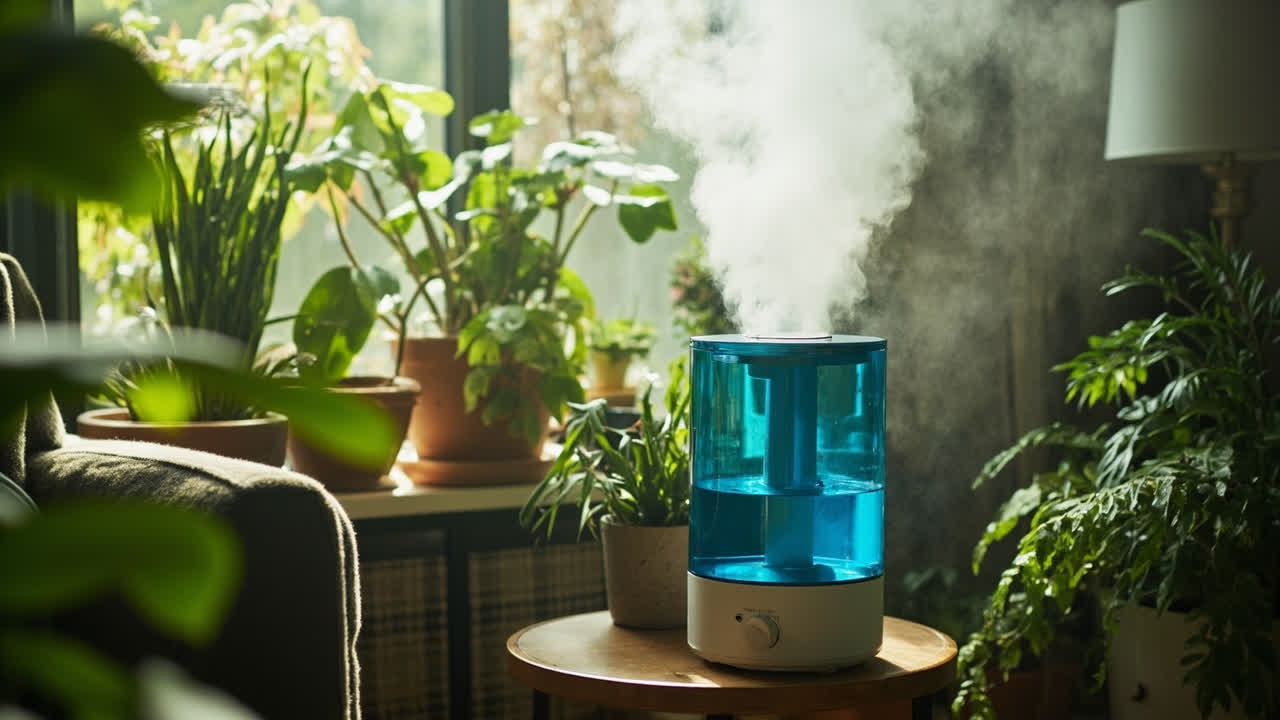
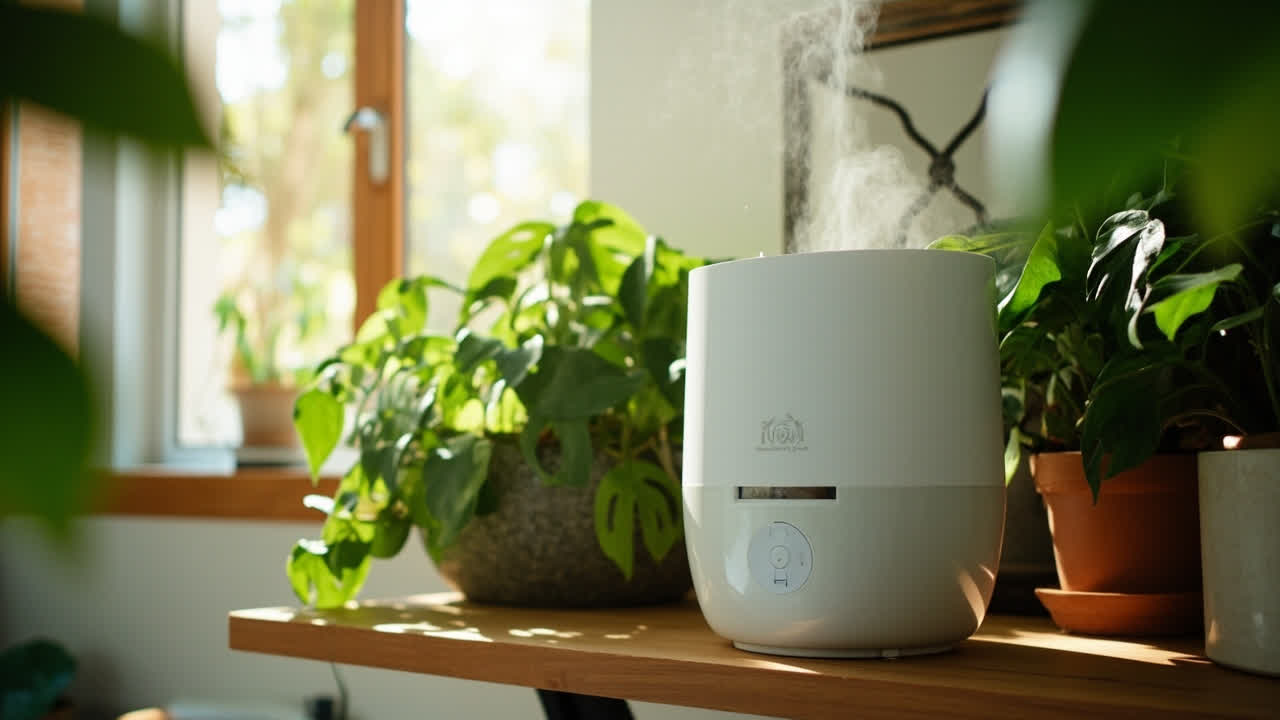
A cool-mist humidifier positioned near a cluster of tropical houseplants raises ambient relative humidity into the 50–70% range most tropical species need to thrive.
Your Plant-Specific Humidity Path
Not every plant needs a humidifier running at full capacity. Here is a practical decision framework based on what you are actually growing.
High-needs tropicals (Calathea, Maidenhair Fern, most Selaginella): Run a humidifier in the same room. These plants will show leaf edge browning and progressive decline at RH below 55%. They are not being dramatic — they are genuinely unable to maintain normal cellular function in dry air. If you cannot maintain 60%+ RH, consider whether these plants are the right choice for your space.
Mid-range tropicals (Monstera, Philodendron, Pothos, Alocasia): Grouping plus a humidity tray with a small fan is often sufficient. These plants tolerate 45–55% RH without major symptoms and will still grow well in that range. A humidifier becomes important if you are in a region with very cold, very dry winters, or if your heating system runs continuously.
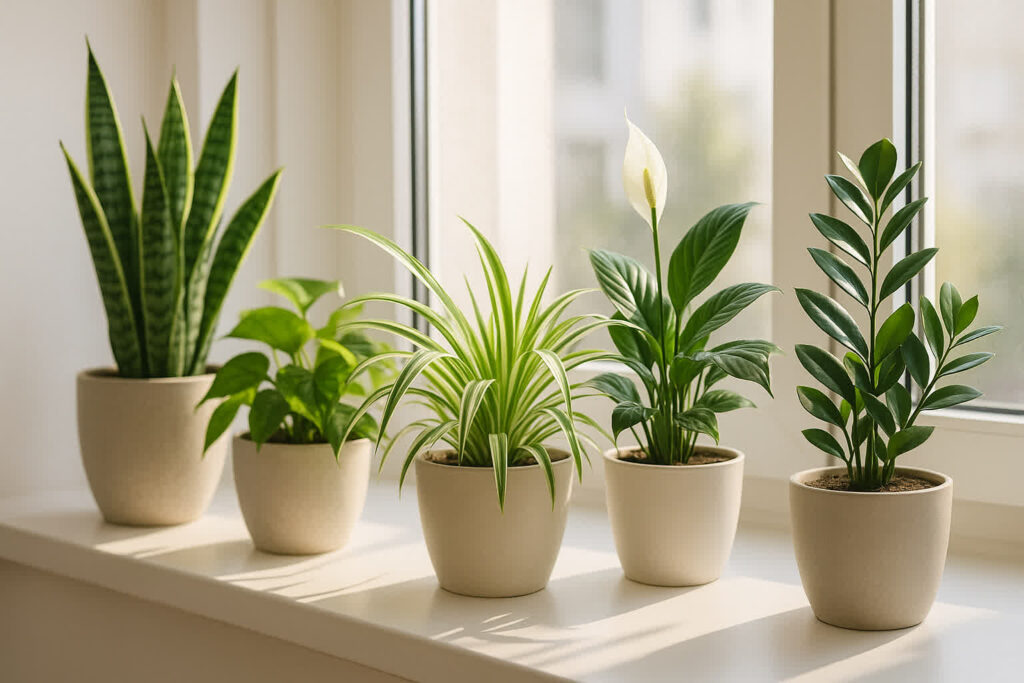
Drought-adapted plants (Snake Plant, ZZ plant, most cacti and succulents): Do not add humidity for these. They evolved in dry conditions and are more likely to suffer from excess moisture than to benefit from higher RH. Keep them away from grouping zones where their neighbors are being misted or tray-watered.
When to Use a Humidifier (and Which One)
A humidifier is worth it when you meet any two of these conditions: you grow high-humidity tropicals (Calathea, exotic Ferns, Alocasia), you live in a climate with significant seasonal heating, or you keep your thermostat set above 70°F during winter. For a single room — a bedroom or home office with 5–15 plants — a small ultrasonic cool-mist unit in the 1–2 gallon range will run for 24–48 hours between refills and maintain 50–60% RH with the door closed. For an open-plan living area with 20+ plants, you will want a larger unit, ideally with a built-in hygrostat that automatically cycles the unit on and off.
Placement matters. Set the humidifier on a high surface — a shelf or table — rather than the floor, so the mist falls through the air naturally and covers more horizontal area. Point it away from walls to prevent condensation and mold on surfaces. If the room has a ceiling fan running on low, this distributes the moisture evenly and is beneficial rather than counterproductive.
The Seasonal Reality: Winter vs. Summer Humidity
Most houseplant humidity problems are winter problems. Indoor RH in a heated home during a cold winter can drop to 15–25% in dry climates, and even in humid regions, forced-air heating pulls moisture out of recirculated air continuously. Once the heating season ends and outdoor temperatures moderate, ambient RH in most homes naturally climbs back toward 40–50% — enough that many mid-range tropicals do not need supplemental humidity at all from roughly April through October in the Northern Hemisphere.
Plan your humidity management around your heating season. Set up your humidifier in October before you turn the heat on for the first time. Run it through March or April. Store it cleaned and dry during the off-season. This approach — rather than running a humidifier year-round — is easier, healthier for your home, and more appropriate for plants that genuinely only need the extra moisture during the dry months.
What to Do Now
If you take only one action today: buy a hygrometer if you do not have one, and place it at plant height in the room where your tropicals live. Read the actual RH. That number tells you exactly how much work you need to do, and whether you need to act at all. Most people find their homes sit at 35–45% RH in normal daily life — sufficient for pothos and mid-range tropicals, insufficient for Calathea and maidenhair ferns.
From there, the decision is simple: if you are growing high-humidity tropicals and your RH is below 50%, a humidifier is the only honest solution. If you are growing mid-range tropicals and RH sits between 35% and 50%, start with plant grouping and a fan-assisted pebble tray. Everything else — mister bottles, decorative humidity trays without airflow, claims about water bowls on radiators — is either negligible or a fire hazard, and your plants deserve better than wishful thinking.
Samuel Aqualogi
Meet Samuel, a passionate gardening enthusiast and lifelong learner.
With a deep love for all things green, Samuel spends his days exploring the latest gardening trends and technologies.
Whether it's trying out new techniques or discovering innovative tools, he is always eager to enhance her gardening skills.
Join Samuel on her journey as he shares experiences, tips, and the joy of nurturing nature!