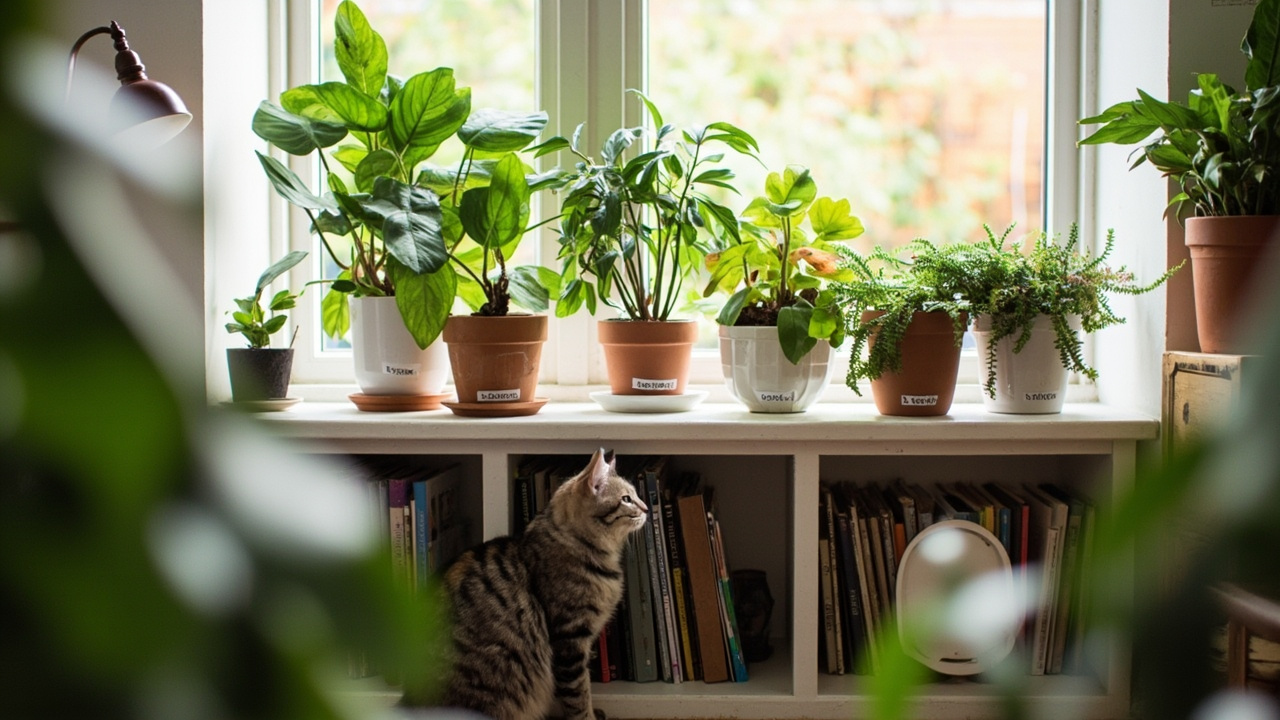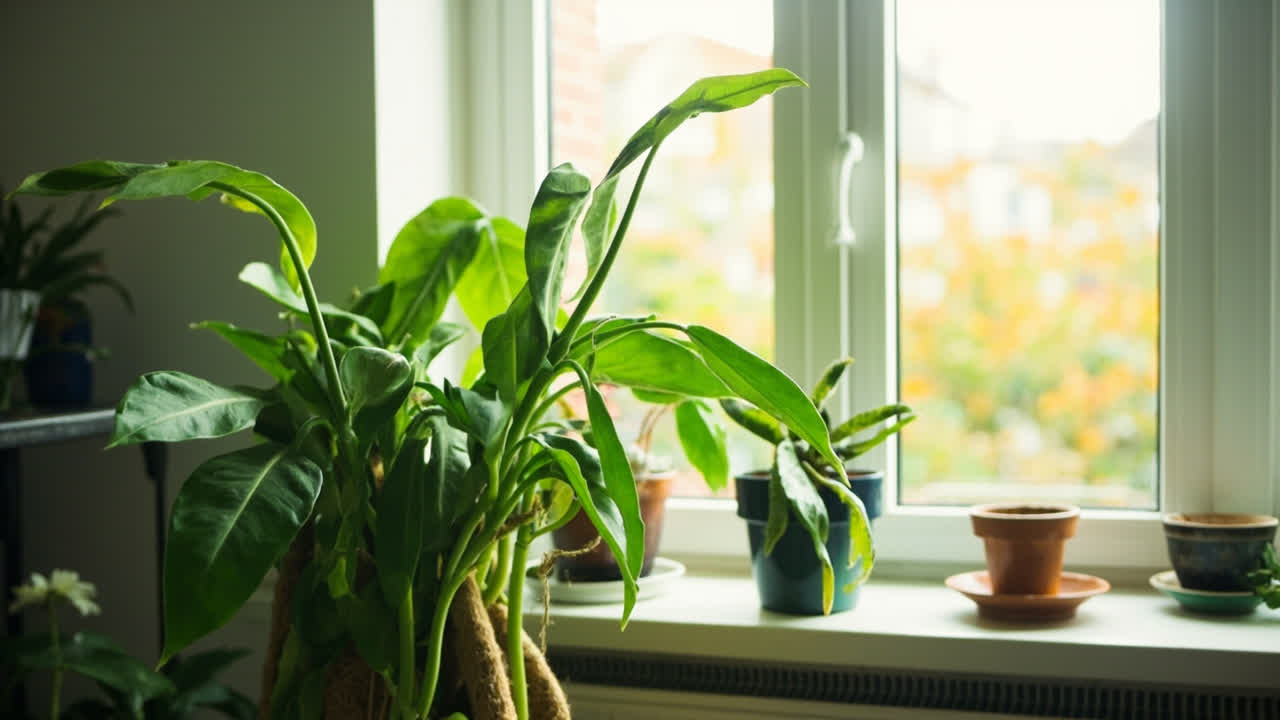

Bird of paradise evolved in the Eastern Cape of South Africa, not the Amazon. The leaves of Strelitzia reginae are built for 40 to 60 percent relative humidity with periodic dry-wind exposure. The leaves of Strelitzia nicolai, the larger tree-size species, evolved in coastal KwaZulu-Natal where the morning fog is a regular event and the afternoon humidity drops into the 40s by four in the afternoon. Neither species evolved in the 70 to 80 percent misted-air conditions that most houseplant humidity guides push. The advice to mist a bird of paradise daily is built on a rainforest myth. This plant is not from a rainforest.
Two failure modes follow when you treat Strelitzia like a Calathea or a Spathiphyllum. The first is brown leaf edges from air that is genuinely too dry, which is a real symptom and a real threshold. The second is over-misting in a closed room, which holds moisture against the leaf long enough to invite fungal leaf spot and crown rot. Both look like care. One is a humidity problem, the other is the humidity solution applied wrong.
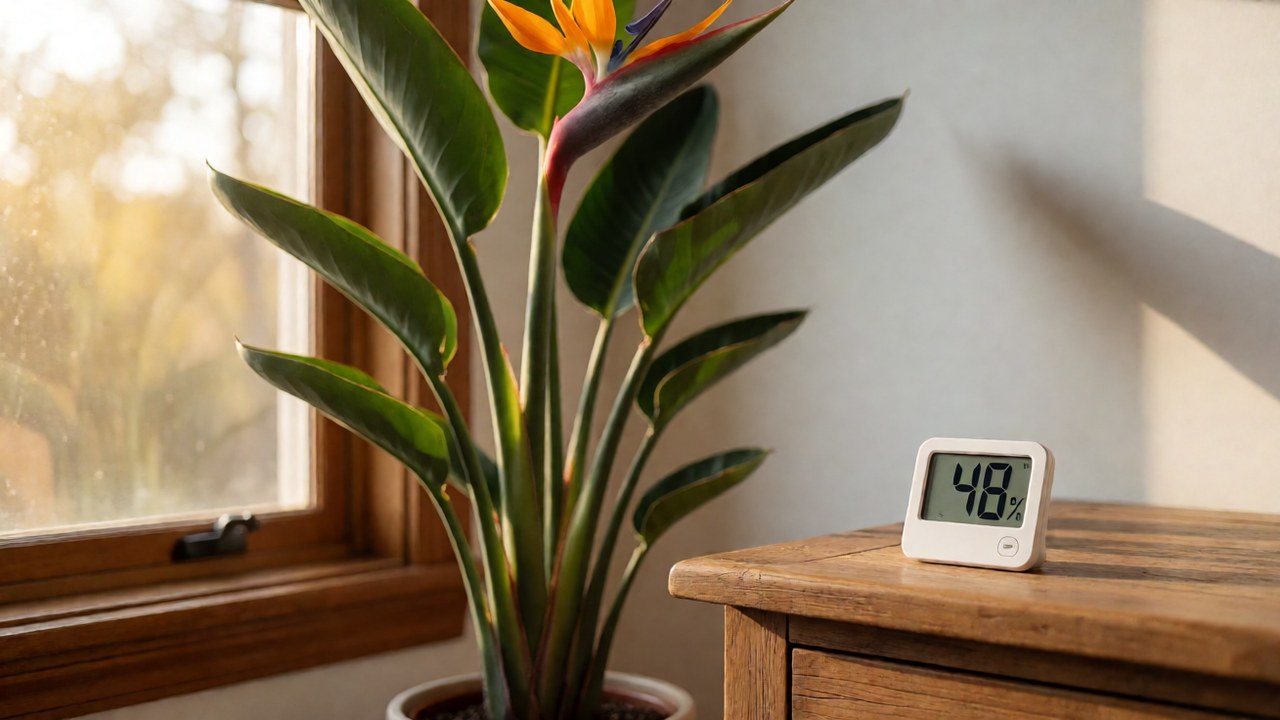
What most growers get wrong is reading the percentage on the hygrometer and not the leaf. A 35 percent reading at 75 degrees Fahrenheit is a different physiological event than a 35 percent reading at 65 degrees. The percentage is not the lever. The vapor pressure deficit at the leaf surface is the lever. Once you see the mechanism, the number to watch stops being humidity and starts being the gap between the leaf and the air.
What Humidity Actually Does to a Leaf
Every leaf has stomata, the small valve-like pores on the underside that open to let carbon dioxide in for photosynthesis. When the pores are open, water vapor moves out of the leaf. That water has to come from somewhere. It comes from the roots, up the xylem, into the leaf. The rate at which the leaf loses water depends on the difference between the water vapor pressure inside the leaf’s airspace and the water vapor pressure in the room. That difference is the vapor pressure deficit, or VPD. It is measured in kilopascals.
VPD is not the same as relative humidity. Two rooms at 50 percent relative humidity can have very different VPDs if the temperatures differ. A 75 degree room at 50 percent RH is a VPD of about 1.05 kPa, well within the comfort range for Strelitzia. A 65 degree room at 50 percent RH is a VPD of about 0.74 kPa, even more comfortable. The temperature matters because warm air holds more water vapor than cool air at the same relative humidity, and the leaf-to-air gradient widens with temperature.
The leaf-edge crisis threshold for Strelitzia reginae sits at VPD above roughly 1.2 kPa. Above that, the leaf pulls water out faster than the roots can replace it during the afternoon, and the cells at the leaf margin die first because they are farthest from the veins. The visible symptom is a thin brown rim along the leaf edge. Below the threshold, the leaf holds.
What the Numbers Look Like in a Real Home
Most homes in temperate North America and Europe run 30 to 50 percent RH in winter, when the heating system is on and the indoor air is dry. A 70 degree room at 30 percent RH is a VPD of about 1.55 kPa. That is above the threshold. The leaf edges will brown. A 70 degree room at 50 percent RH is a VPD of about 1.18 kPa, just at the threshold. A 70 degree room at 60 percent RH is a VPD of about 0.93 kPa, well below the threshold.
The conversion is mechanical. Take the room temperature in Celsius, look up the saturation vapor pressure at that temperature in any psychrometric table or a free online VPD calculator, multiply by one minus the relative humidity, and you have the VPD in kPa. The number is not magic. It is the size of the straw pulling water out of the leaf.
Strelitzia nicolai tolerates a slightly higher VPD than Strelitzia reginae because the nicolai leaves are larger and have a thicker cuticle, the waxy outer skin that slows non-stomatal water loss. Both species will show brown edges above VPD 1.2 kPa. The nicolai will simply take a few weeks longer to show the symptom, and the browning will be concentrated on the oldest leaves first.
Why Misting Usually Does Not Help
Misting a leaf with a spray bottle raises the relative humidity at the leaf surface for roughly ninety seconds. The droplet lands, evaporates, and the air reverts to room humidity in under two minutes. The leaf is not in a humid environment for long enough to change the VPD over the whole day. Misting is a feel-good ritual that has no measurable effect on a 1.2 kPa threshold problem.
What misting does do, especially in a closed room or a bathroom with no airflow, is hold a film of water against the leaf surface for ten to twenty minutes while the stomata are open. That is a fungal leaf spot invitation. Strelitzia is not particularly susceptible to fungal disease, but the conditions that misting creates (wet leaf surface, low airflow, moderate temperature) are the conditions that fungal pathogens need. If you mist, do it in the morning with a fan running, and accept that you are doing it for yourself, not for the plant.
What Actually Moves the VPD in the Right Direction
Three mechanisms work, ranked by effectiveness and cost. The first is a humidifier with a humidistat, set to maintain 50 percent RH in the room. This is the only device that holds a steady VPD through the day. The humidistat is non-negotiable. A humidifier running at full output without a humidistat will push the room past 70 percent RH and create the second failure mode (fungal leaf spot) the same way misting does.
The second is grouping the bird of paradise with two or three other large-leaved plants on a pebble tray filled with water. The transpiration from the group raises the local humidity within a foot of the plants by 5 to 10 percent, enough to nudge a 35 percent room into the 40s. This works in a small room and stops working the moment a door or window is open. The third is moving the plant into a bathroom with a shower used daily, if the bathroom has a window. The shower provides the humidity pulse, the window provides the airflow to clear the wet leaf surface.
What does not work: misting as a daily ritual, leaving a bowl of water near the plant (the evaporation rate from a bowl is too low to move a room’s VPD), or closing the plant in a glass terrarium. Strelitzia is a four-foot plant, not a terrarium subject.
Reading the Leaf Instead of the Hygrometer
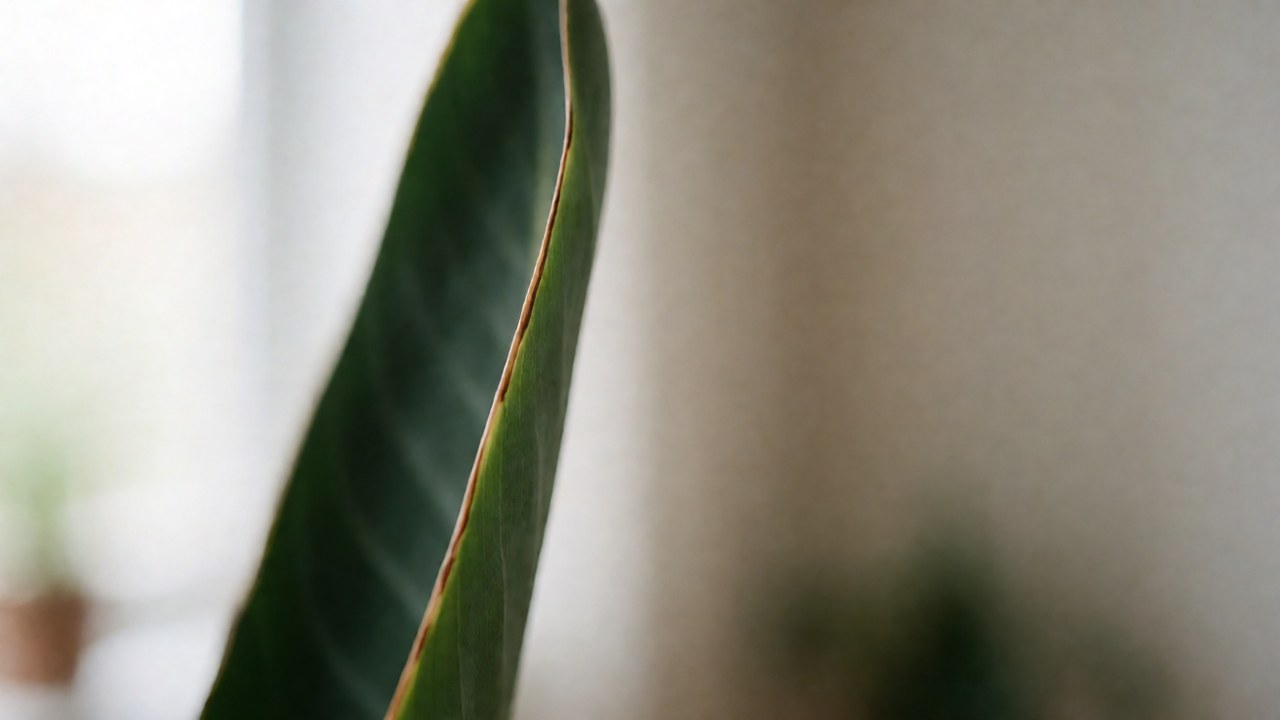
The leaf is the better sensor. A bird of paradise grown in VPD below 1.2 kPa will have leaves that are uniformly green, with edges that are sharp, clean, and slightly lighter green than the leaf interior. A bird of paradise grown in VPD above 1.2 kPa will have edges that are tan, paper-dry, and slightly curled inward. The browning is a rim, not a patch, and it is on the side of the leaf facing the air vent or the window, not the side facing the room interior.
If the browning is on the leaf tip only, with the rest of the edge clean, the cause is more likely uneven watering than humidity. If the browning is in patches in the middle of the leaf, the cause is more likely a fungal or bacterial issue from over-misting. If the browning is a uniform rim on every leaf, the cause is the VPD.
What to do when you see the rim. First, measure the room humidity and temperature at the same time of day, ideally mid-afternoon when the VPD is highest. Second, calculate the VPD using a free online calculator (the inputs are temperature in Celsius and relative humidity as a decimal). Third, if the VPD is above 1.2 kPa, raise the room humidity to bring it below 1.0 kPa. A 5 to 10 percent RH increase in a 70 degree room is enough to move from crisis to comfort.
What to Expect in the First Two Weeks of Changing the Air Around Your Bird of Paradise
New leaves that emerge after the VPD drops below 1.0 kPa will come in with clean edges. Existing leaves with brown rims will not heal. The dead cells at the edge do not regrow. The plant will continue to push new leaves from the central crown, and those leaves are the diagnostic.
If the indoor humidity is between 35 and 60 percent and the room temperature is between 65 and 75 degrees Fahrenheit, the leaf edges will hold. If a new leaf opens with a brown rim, the air is too dry, not the watering. The leaf will tell you which lever to pull next, and the lever is almost never the mister. The lever is the humidifier with a humidistat, the pebble tray with two or three large-leaved neighbors, or a different room.
Your bird of paradise isn’t dying. It is telling you the air is too dry, and now you have the number to act on.
Read also: why the leaf splits along the seam (a different mechanism, same plant), the temperature window that decides whether the leaf even opens, and the full indoor care guide for a Strelitzia that is now or will be one of your larger houseplants. For the watering rhythm that pairs with this humidity range, see how often to water bird of paradise. For the potting mix that keeps the root zone aerobic under this humidity, see soil and repotting for bird of paradise. If your plant is not flowering, see the seven reasons a Strelitzia won’t bloom. For the generalist read on brown leaf tips, see four causes and the test that tells them apart. For the full overview, see the complete bird of paradise care guide.
The plant remembers the Eastern Cape. Your apartment just needs to remind it.
Turn any PDF statement into a clean sheet
Skip the typos and the hours of copying. Our converter handles any bank statement format and outputs Excel, CSV, or QBO for QuickBooks. No file retention, free to try.
Convert your statement