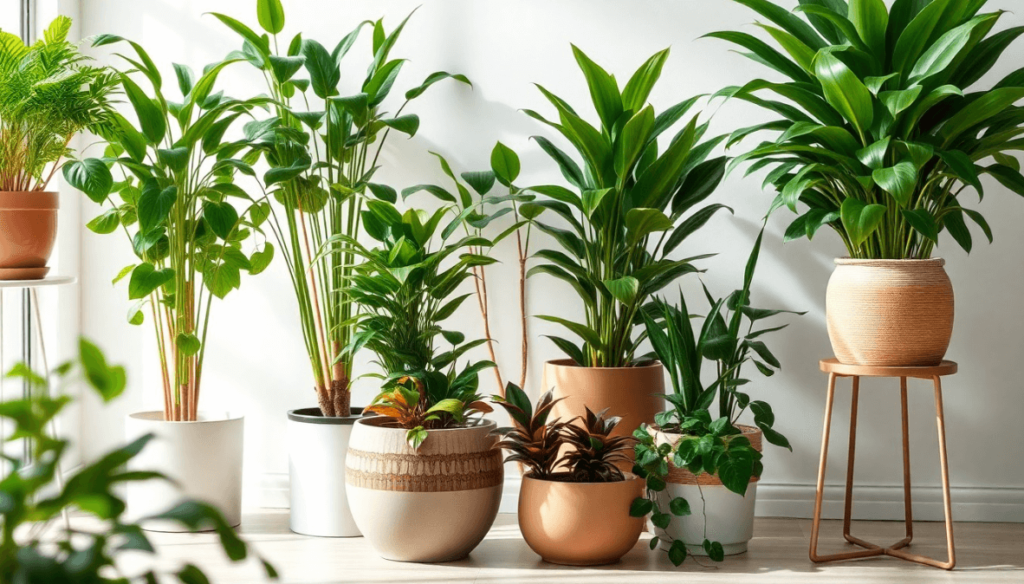

Low maintenance is not a personality trait of a plant. It is a measurable output of four variables: transpiration rate, growth rate, storage organs, and pot drainage. A slow plant in a free-draining pot can go two weeks between waterings and still look healthy. Choose on the variables, not on the label.
Two failure modes follow. The first is drowning a drought-tolerant plant in a pot that holds water, which kills more easy plants than neglect does. The second is buying a fast grower and then having it outgrow its pot within a season, which turns a low-effort plant into a repotting chore.
What Low Maintenance Actually Means in Days
Low maintenance gets sold as a feeling. It is easier to measure as an interval. Before you buy, decide the longest gap you can honestly leave between noticing a problem and doing something about it. For most people that is seven days. For a couple traveling regularly it is fourteen. For a forgetful household it might be three.
Each species then carries a care cost: the days between waterings in its light band, and the days it survives if you miss that schedule. Both numbers are downstream of transpiration. Work in days rather than adjectives and the shopping decision gets quick.
Here is the honest limit. No university extension service or government agriculture body publishes a tested neglect window for houseplant species. The figures below are reasoned from plant physiology and reported grower practice, so treat them as guidance ranges, not measured survival times. A plant in a low-humidity room in January uses more water than the same plant in a humid bathroom in September.
The Four Traits That Set the Care Bill
Every low maintenance claim traces back to mechanism. Four traits cover most of it, and each tells you something specific about the work ahead.
Transpiration rate
Transpiration is the plant pulling water from soil, moving it through the stem, and evaporating it out of leaf pores. That evaporation is the engine of water use. A plant with thick waxy cuticles, few leaves, or a low surface area to volume ratio loses far less water per day than a fine-leaved tropical with a large canopy.
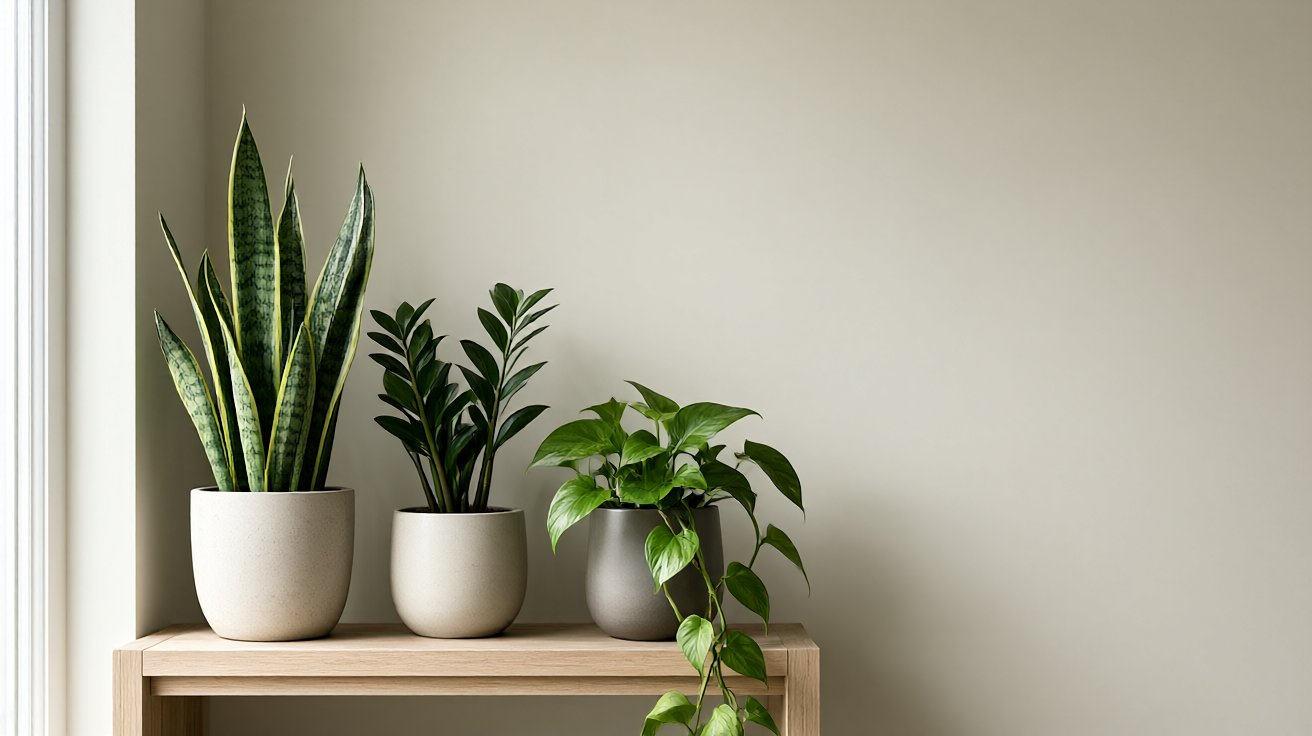
Snake plant Dracaena trifasciata and ZZ plant Zamioculcas zamiifolia are built this way. Waxy leaves and underground rhizomes let a ZZ plant lose a large share of its root moisture and still stand upright, while a Boston fern droops in two days.
Growth rate
Slow growth means fewer repotting and feeding cycles. A plant that adds 5 cm a year settles into its pot and stays there. A plant that doubles each season demands fresh soil, a larger container, and nutrient replacement on a schedule you have to track.
Growth rate determines repotting frequency, which means it determines how much of the year you spend moving soil instead of watering. This is where the label misleads most. Fast growers are often sold as easy, and for six months they are, because a vigorous plant forgives a missed watering.
By month eight the same plant may have roots circling the pot base and a soil volume that dries in four days instead of twelve. Fast and easy at the start, work-heavy later.
Storage organs
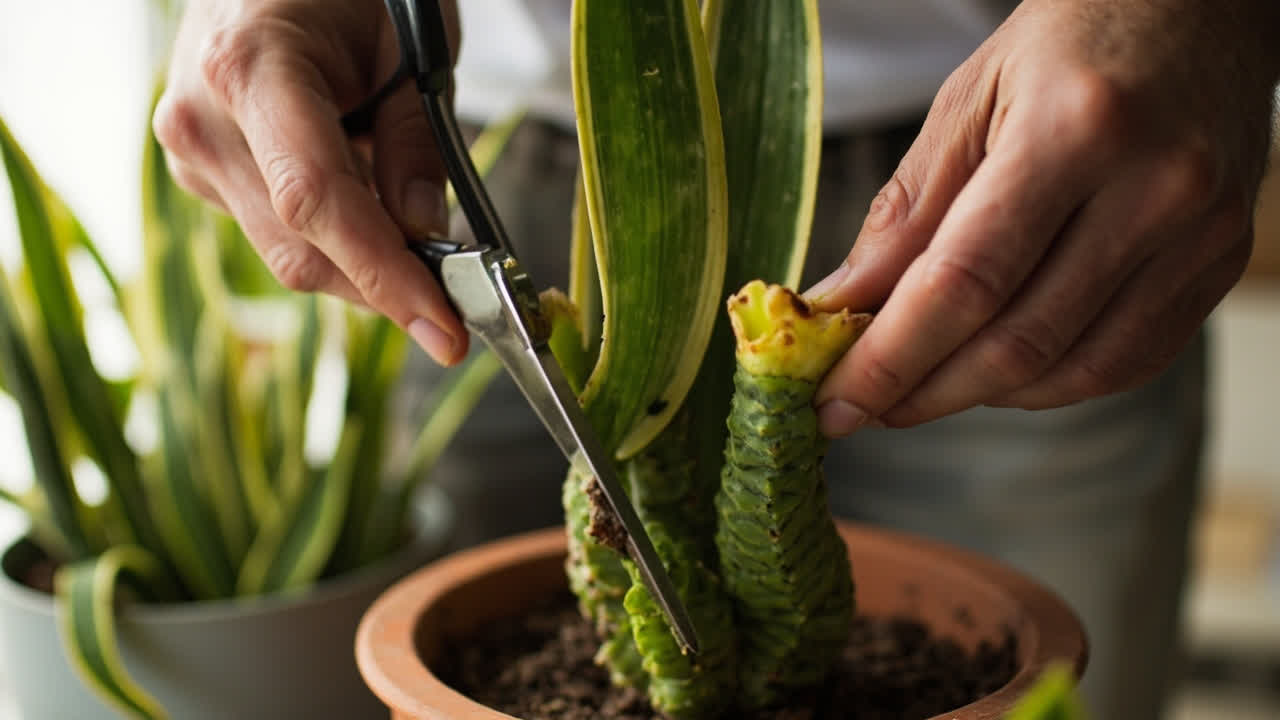
A rhizome, tuber, caudex, or succulent stem is a water buffer wired into the plant’s own plumbing. When soil moisture runs short, the organ releases stored water into the stem before the leaves show stress. That buffering is what creates a two-week tolerable neglect window rather than a five-day one.
Ponytail palm Beaucarnea recurvata stores water in its swollen trunk base. Jade plant Crassula ovata stores it in thick leaves. Haworthia Haworthiopsis attenuata stores it in its rosette of fat, pointed leaves.
Drainage
Pot drainage determines whether excess water leaves the root zone or sits there. Saturated soil displaces air, and roots need oxygen to take up water. When pore space fills and stays full, roots suffocate, rot takes hold, and a plant that survived three weeks of dryness dies in three days of excess moisture.
Drainage has a counterintuitive cost. A gritty, fast-draining mix dries the root zone evenly, but it also means you may need to water more often than the plant’s biology alone suggests. Pot size and substrate together set the real interval, not the species name.
Choosing by the Constraint You Actually Have
Most picking advice starts from the plant and works backward to your life. Start from your life instead. Three constraints cover most households, and each has a different shortlist.
If you have a dark corner
Dark corners are usually north-facing or blocked by a building, sitting well below 100 foot-candles, roughly 1,000 lux. Very few species thrive there, but several tolerate it, and tolerance is enough if the goal is survival rather than production.
A plant that tolerates low light survives there, it does not necessarily grow there. Low light also means a slower water use that stretches your watering window.
For genuinely dark spots, the low light plants guide covers placement in detail. Among the lowest-effort options, the ZZ plant and cast iron plant Aspidistra elatior hold their leaves without stretching for months. Snake plant does well too, and its vertical form works where a table is not possible.
If you travel for two weeks
A two-week absence rules out anything with fine leaves, thin stems, or a root ball that dries fast. You need a plant with a storage organ large enough to cover the trip, which is why ponytail palm and jade plant sit at the top of any travel list. Both hold their water in tissue that leaves the trunk or stems looking fine for weeks.
Two warnings. Do not leave the plant in a dark closed room for two weeks, because a plant recovering from drought still needs light to rebuild. Move it to a bright room first, and skip the fertilizer.
If you forget in short bursts
Forgetful households do best with a rhythm rather than a drought test. Spider plant Chlorophytum comosum and pothos Epipremnum aureum both forgive a skipped week, but both suffer under a monthly soak-and-dry cycle in a small pot. Set a fixed watering day and the care cost drops to under five minutes a week.
If you are still choosing, the beginner buying guide ranks plants by how forgiving they are of a forgetful owner, a different axis from hardiness in a nursery.
Care Cost at a Glance
Here is the shortlist with the numbers attached. Light band is in foot-candles and lux. Watering interval assumes a 15 cm pot with free-draining mix in the light band listed, in an interior room at roughly 45 percent relative humidity.
| Species | Light band (fc / lux) | Water every (days) | Neglect window (days) | How it still dies |
|---|---|---|---|---|
| Zamioculcas zamiifolia (ZZ plant) | 50 to 250 fc / 500 to 2,700 lux | 18 to 28 | 30 to 45 | Rot in undrained soil |
| Dracaena trifasciata (snake plant) | 50 to 500 fc / 500 to 5,400 lux | 16 to 30 | 30 to 60 | Root rot from wet feet |
| Beaucarnea recurvata (ponytail palm) | 150 to 800 fc / 1,600 to 8,600 lux | 14 to 24 | 25 to 40 | Shade causes stretched stems |
| Crassula ovata (jade plant) | 200 to 1,000 fc / 2,200 to 10,800 lux | 14 to 21 | 21 to 35 | Cold wet soil in winter |
| Haworthiopsis attenuata (haworthia) | 200 to 1,000 fc / 2,200 to 10,800 lux | 16 to 24 | 25 to 40 | Shrivel in deep shade |
| Aspidistra elatior (cast iron plant) | 50 to 200 fc / 500 to 2,200 lux | 10 to 18 | 14 to 24 | Overwatering in winter |
| Chlorophytum comosum (spider plant) | 100 to 500 fc / 1,000 to 5,400 lux | 7 to 12 | 10 to 18 | Brown tips from dry air |
| Epipremnum aureum (pothos) | 75 to 500 fc / 800 to 5,400 lux | 8 to 14 | 12 to 21 | Overwatering in low light |
Read the neglect window column as a ceiling, not a target. ZZ plant and snake plant have the widest gaps on the list, which makes them the safest buys for travel and for people who forget. Spider plant and pothos have the narrowest, so they need a routine you will actually keep. Per-species watering detail sits in the watering schedule by species reference.
What Happens When You Skip Watering
Plants do not die the moment soil dries. They run through a sequence, and knowing it lets you tell a recoverable deficit from a real problem.
Days one to three, the plant closes stomata and slows transpiration, so water use drops. Leaves stay firm, which is why most people never notice this stage.
Days four to ten, cell turgor falls in the oldest leaves first, usually the lower leaves on a rosette plant. A ZZ plant or snake plant barely shows this, since its storage organs are still releasing water. A spider plant droops and its leaf tips brown, because it has no buffer and transpires fast.
Days eleven to twenty, root function degrades. Fine root hairs die back and the plant cannot take up water even when you restore it. Leaves yellow from the bottom and new growth stalls. This is the point of no return for most species, and it is why a neglect window should never be treated as a target.
Drought-tolerant plants tolerate the early stages because storage organs buffer them, which is a reasoned inference from how rhizomes and succulent stems function, not a published field trial. Two weeks of dryness leaves a ZZ plant intact. The same two weeks leaves a fine-leaved tropical looking like a dried bouquet.
The Failure Mode That Kills Easy Plants
Overwatering is the least intuitive danger on this list, and it ends the most low maintenance plants. A drought-tolerant species in an undrained pot does not fail from thirst. It fails from excess water, because the pot holds water at the root, the soil goes anaerobic, and rot starts in fine roots that cannot survive without oxygen.
The trade-off is the whole story. A bigger pot holds more water and gives roots more room, so it feels generous, but it also delays drying. Moving a ZZ plant from a 12 cm pot to a 20 cm pot can push its watering interval from 18 days to 40.
Forty days of wet soil is a rot risk even for a plant that tolerates 30 days of neglect.
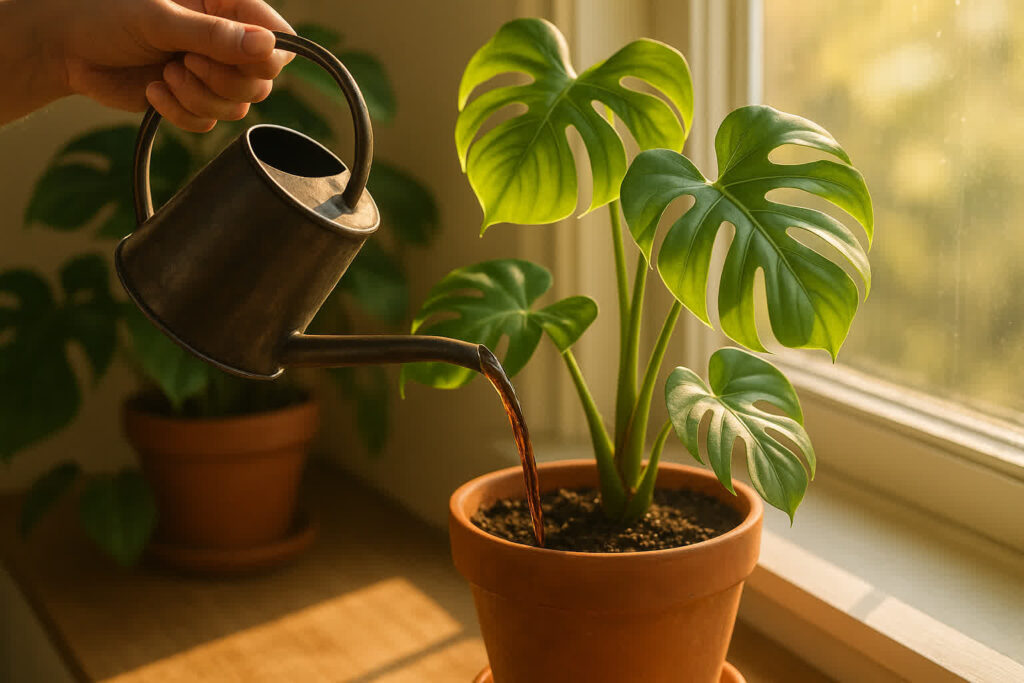
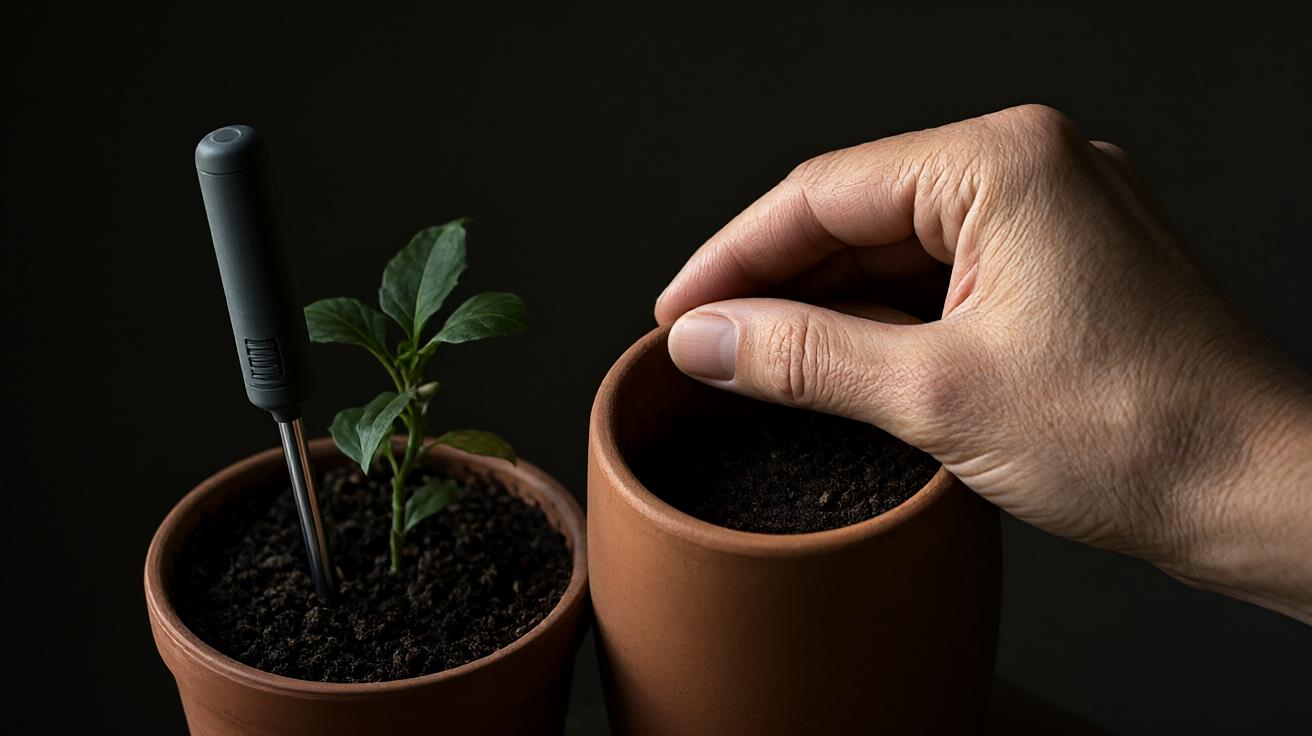
Three habits prevent the most common death. Water until water runs from the drainage hole, then stop. Empty the saucer or cachepot after ten minutes. And check that the pot has a drainage hole at all, because a decorative outer pot with no hole is a slow-motion rot device.
Light placement interacts with all of this. Light band determines how much water a plant moves in a day, which means it determines whether your interval is ten days or twenty. Getting placement right removes more care steps than any watering technique. The four-tier light framework gives you the bands and where to find them.
What to Expect in the First Two Months
In month one, most low maintenance plants lose a few lower leaves. That is a normal settling response to a change in light, not a failure. Leave it alone and do not adjust the schedule yet.
In month two, the rhythm should settle. Watering becomes predictable enough that you can go a week without thinking about it. If you find yourself checking daily, the usual cause is a pot too large for the root mass it holds.
Repotting is the exception to the calm. A genuinely low effort plant still needs repotting every two to four years, and a fast grower sooner. Slow growth means the root system fills the pot slowly, which is why the repotting bill is small.
Do not repot a plant that has not outgrown its container, because fresh wet soil around the same root mass creates the rot risk you worked to avoid.
Slow growers also need little fertilizer. An over-fed ZZ plant grows soft, weak new growth that attracts pests. Feed lightly in spring and not at all in winter.
The lowest-effort plant in your home is the one whose four traits match your actual habits, not the one with the friendliest marketing. Pick by days, check the drainage, and the watering can comes out less often than you expected.
Your plant isn’t dying. It is telling you which habit does not fit your week, and the four traits above tell you in advance which habits to avoid.
Last reviewed on 4 November 2026
Sources and further reading
Iowa State University Extension and Outreach, Horticulture and Home Pest News: interior plant light requirements and low light plant selections for the home environment.
University of Florida IFAS Extension, EDIS: soilless media and container drainage effects on root-zone oxygen and plant health.
United States Department of Agriculture, Agricultural Research Service: plant water relations and transpiration physiology research on container-grown ornamentals.
Missouri Botanical Garden Plant Finder, species profiles for Dracaena trifasciata, Zamioculcas zamiifolia, Crassula ovata and Beaucarnea recurvata.
From PDF to Excel in one click
Forget retyping line by line. Upload any bank statement, get a spreadsheet you can actually use. Your files are never stored, and you can test the converter with 3 free conversions.
Try it free