
An air layer with no roots at week 12 is not a lost cause. It is a diagnostic puzzle with five named failure modes, and the moss ball itself tells you which one you have. This page walks the diagnostic tree the seed Pillar summarizes in a paragraph, so you can pick the right next move.
If you wrapped an air layer 12 weeks ago on a rubber plant, fiddle leaf fig, or magnolia and the moss ball still shows only callus, the air layering procedure was almost certainly correct. Dormant cambium, dry sphagnum, shallow girdling, low light, and rotting moss each produce a different symptom pattern and each has a different fix. Unwrap, look at the moss ball and the cambium, and read the symptom against the checklist below.
Why an air layer has no roots at week 12
Five failure modes account for almost every stalled air layer at week 12: dormant cambium, dry sphagnum moss, shallow girdling, low light, and rotting moss. Each stalls the cambium’s push of adventitious roots through a different pathway: dormancy stops the cambium from being active, dry moss desiccates the callus, a shallow girdle lets the phloem carry sugar past the wound, low light starves the cambium of energy, and rot kills the cambium outright.
The seed Pillar walks the happy-path air layering procedure and names recovery in one paragraph. This page walks the failure-path decision tree at full depth, because a 12-week investment in vegetative propagation deserves a real diagnosis. The two pages share the same procedure, sphagnum moss, rooting hormone, and wrap, but the week 12 diagnostic is its own decision, and it is the one this URL owns.
Symptom checklist: what you see when you unwrap at week 12
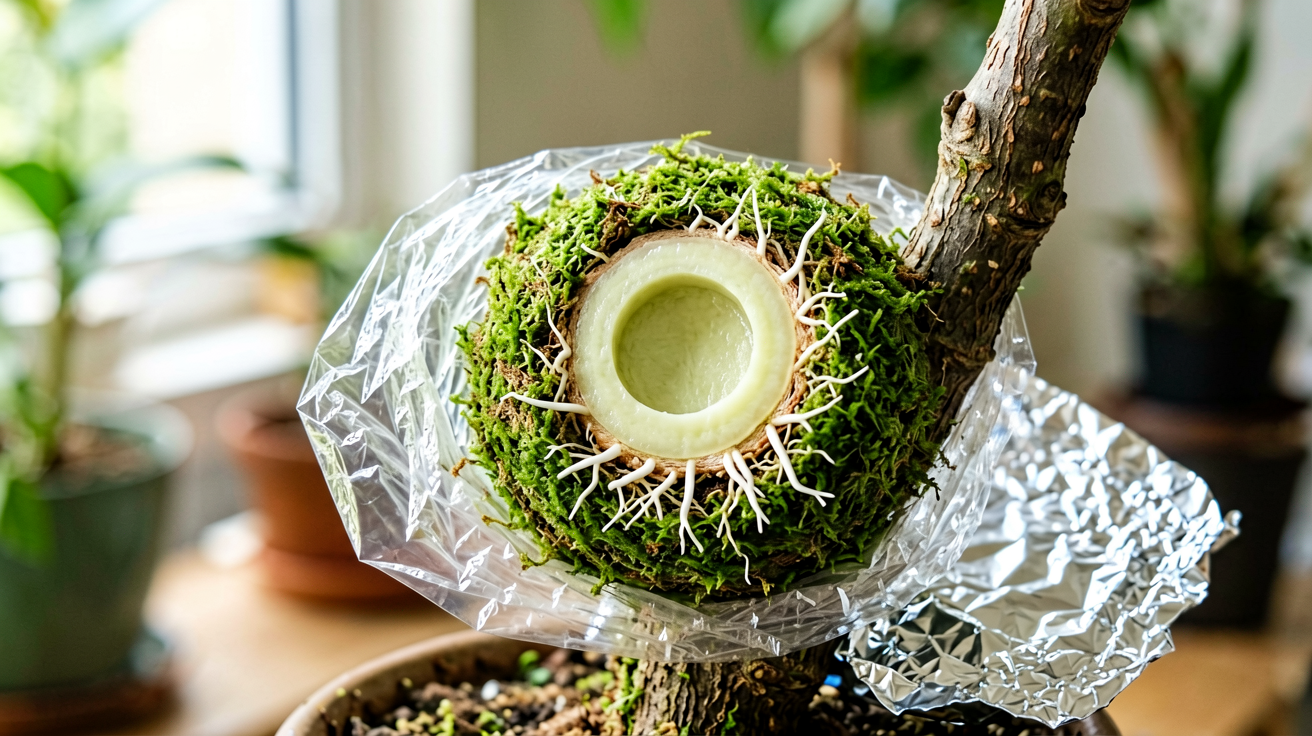
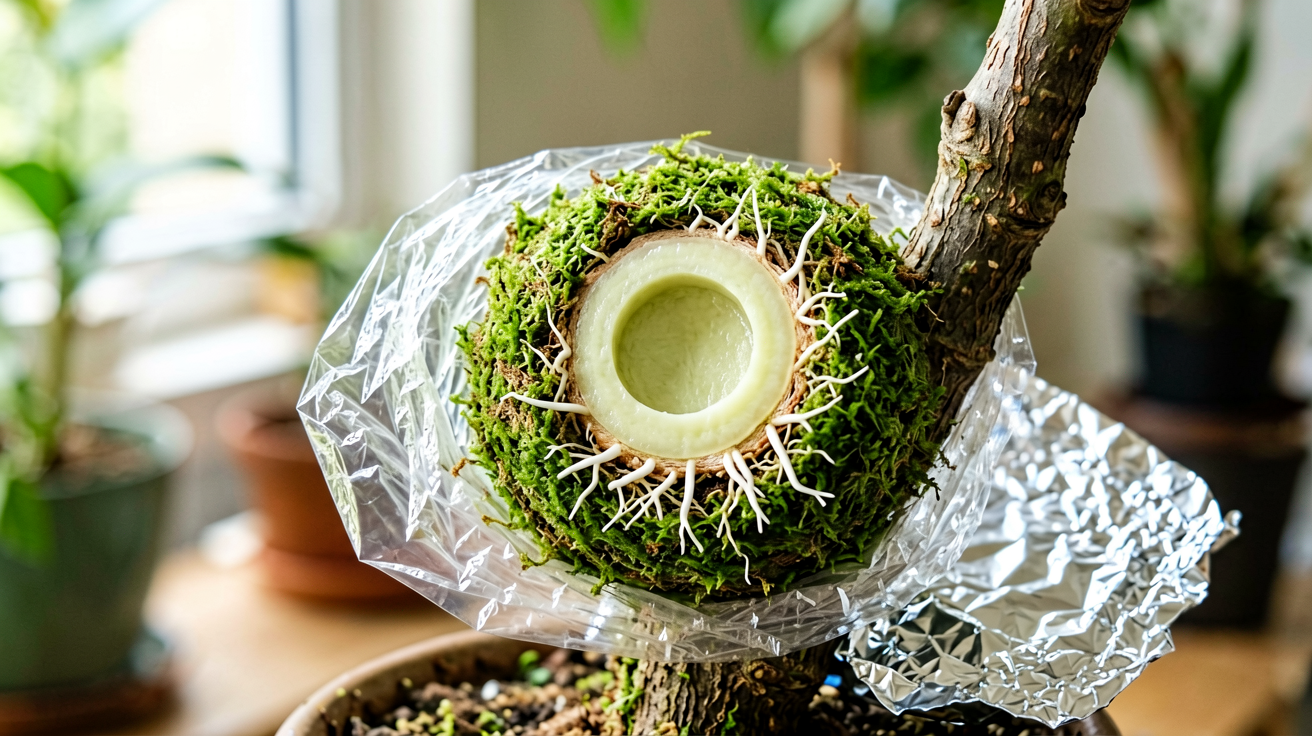
Unwrap the plastic and aluminum foil at week 12, peel back the sphagnum moss gently, and look at four things: the moss itself, the cambium ring under the girdle, the branch above the wound, and the air space inside the wrap. Each carries a symptom that maps to a failure mode: the moss tells you whether moisture held or rot set in, the cambium tells you whether the girdle was deep enough, the branch above the wound tells you whether the mother plant is still actively growing, and the air space tells you whether the wrap leaked.
Run through the four-symptom observation in this order, and write down what you see before you touch anything. The four observations together pin down the failure mode; one observation alone is ambiguous. A pale smooth callus with no root primordia could be dormant cambium or low light. A pale smooth callus AND dry light-colored moss is almost always dry sphagnum. A pale smooth callus AND shriveled cambium AND moss still wet is almost always dormant cambium or low light, not rot. Take all four observations, then read the symptom pattern against the next section.
From PDF to Excel in one click
Forget retyping line by line. Upload any bank statement, get a spreadsheet you can actually use. Your files are never stored, and you can test the converter with 3 free conversions.
Try it freeDormant cambium: when the mother plant wasn’t growing
The cambium is the thin ring of actively dividing cells just under the bark, between the bark and the xylem, and it only produces adventitious roots when the mother plant is in active growth. Active growth means warm temperatures (21 to 27°C / 70 to 80°F), bright indirect light, and visible new leaves pushing out at the branch tips. For indoor houseplants kept in a consistent room-temperature environment, the active growing window runs from early spring through late summer, the same window named in the air layering timing section. For outdoor ornamentals in temperate climates, including azalea, holly (Ilex), and camellia, late spring to early summer is the safe window. Air layering wrapped in late fall or winter almost always fails because the cambium is dormant and the moss ball stays cool enough to encourage rot instead of callus.
The symptom pattern for dormant cambium is distinctive: pale, smooth callus tissue forms a soft ring around the girdle, but no white root primordia push through it. No callusing advances into adventitious roots. The moss is still moist, the cambium is still pale and firm (not black or soft), and the branch above the wound has dropped no leaves and pushed no new growth. The mother plant is alive and waiting for spring. The cambium is alive and waiting for spring. Nothing is dead; nothing is dry; nothing is rotting. The layer is just paused on the same active-growth clock as the parent plant.
The recovery decision for dormant cambium is not to refresh the wound. Refresh will not restart inactive tissue. The recovery is to wait until the mother plant pushes new leaves at the branch tips, then refresh the girdle with a light cambium scrape and repack with fresh moist sphagnum moss. Expect the cambium to wake up within 2 weeks of refresh if the layer was dormant, not dead, and expect new white roots 6 to 8 weeks after that on a fast-rooting species like rubber plant. Slow-rooting species like magnolia and camellia can take another 12 weeks after a refresh; the dormant cambium only adds to the long baseline rooting window.
Dry sphagnum moss: when the moss ball lost moisture
Sphagnum moss has to stay damp for the entire 8 to 12 week rooting window. If it dries out at any point, the callus desiccates and the developing root primordia die before they can branch through the moss. The two most common ways the moss loses moisture are an airtight-wrap failure and an insufficient initial soak. An airtight-wrap failure shows up as a gap in the plastic wrap or cling film, a tear in the aluminum foil, or a slip where the wrap slid down the branch and exposed one side of the moss ball to ambient air. Secure the wrap with twist ties at both ends and the gap risk drops to near zero. An insufficient initial soak shows up as moss that was damp on the outside but dry in the center, which dries out within the first 4 weeks no matter how tight the wrap is.
The symptom pattern for dry sphagnum is the easiest to read: the moss is light tan instead of dark brown, the moss feels dry to the touch, the callus ring under the girdle is shriveled and pale, and the branch above the wound is fine. There are no white roots because the roots never had a chance to form. There is no rot because the wrap was too dry to grow bacteria. The cambium is alive but stalled. The fix is rehydrate, repack, rewrap, but only if the cambium is still alive. Touch the cambium gently with a fingertip. If it is pale green and firm, the tissue is alive; if it is brown and soft, the cambium is dead and no amount of moisture will recover it.
The recovery protocol for a dry moss ball with a live cambium is straightforward. Mist the existing moss lightly with water and let it absorb for 10 minutes, then refresh the wound with a light cambium scrape using a sharp knife or sterilized pruners, repack the moss ball with fresh damp sphagnum moss (soaked for 10 minutes and squeezed to damp-but-not-dripping), and rewrap with a fresh airtight plastic wrap plus aluminum foil. Secure both ends with new twist ties and check the wrap at week 4 and week 8 to confirm the moss is still damp. Expect new white roots 6 to 8 weeks after a refresh-rewrap on a fast-rooting species, longer on slow-rooting magnolia or camellia. If the cambium is brown and soft, the layer is dead and the recovery is cut below the wound and restart on a different branch following the seed Pillar’s procedure.
Shallow girdle: when the phloem carried sugar past the wound
The girdle has to interrupt the phloem, the layer just under the bark that carries sugar from the leaves down to the roots, without snapping the branch. The phloem is thin, and a girdle that only cuts through the outer bark leaves the phloem intact. The leaves continue to send sugar past the wound to the rest of the plant, and the cambium has no reason to push roots because nothing is asking it to. The single most preventable failure mode, a shallow girdle (sometimes called incomplete girdling), also produces one of the most distinctive symptom patterns: callus forms only on one side of the wound. For woody-stemmed species like Ficus elastica and semi-woody dracaena, a clean girdle that interrupts the phloem on all sides is the difference between a successful clone and a stalled layer.
The symptom pattern for a shallow girdle is uneven. The cambium ring under the girdle shows callus thickening on one side and bare wood on the other, or shows callus that wraps around the branch but is clearly thicker on the side where the girdle cut deepest. White roots, if any push at all, emerge only on the side where the phloem was interrupted. The moss may be moist or dry depending on the wrap, and the branch above the wound looks fine because the rest of the plant is still getting sugar. The failure is structural, not environmental, and no amount of moisture or light will fix it.
The recovery for a shallow girdle is a deeper second girdle above the first. Unwrap the moss ball, examine the cambium, and identify the side where the callus is thickest. That is the side where the original girdle cut deepest. Make a fresh girdle 5 to 7 cm (2 to 3 inches) above the original wound, cutting through the bark and into the cambium on all sides this time. Apply rooting hormone (IBA at 0.1 to 0.3 percent, also called indole-3-butyric acid) to the new wound, repack with fresh moist sphagnum moss, and rewrap. The original girdle will callus over on its own as part of normal wound healing, and the branch will root from the new, properly deep girdle. Expect new white roots 6 to 10 weeks after the second girdle on a fast-rooting species, with the original wound serving as a guide rather than a recovery site.
Low light during the rooting window: when the mother plant lost energy
Adventitious roots are not free. The cambium needs sugar from current photosynthesis to push roots through the callus, and the mother plant needs enough light to produce that sugar. A dim corner produces a stalled callus that never thickens, even when the moss is moist, the girdle is deep, and the cambium is active. Low light is the quietest failure mode because everything else looks right. The moss is damp. The girdle is clean. The cambium is pale green and firm. No roots push because the energy budget is negative.
The symptom pattern for low light is subtle but readable. The callus is small and pale, much smaller than the callus on a healthy layer at week 4. The moss is still wet because moisture was not the problem. The branch above the wound has dropped a leaf or two because the mother plant is conserving energy. No new leaf push has appeared above the wound. The mother plant is alive but not thriving. The recovery is not to refresh the layer. Instead, relocate the mother plant to a brighter spot and wait another 6 to 8 weeks without unwrapping.
The light requirement for an active air layer is bright indirect light, the same light that keeps a healthy rubber plant or fiddle leaf fig pushing new leaves at the branch tips. A north-facing window is too dim for most species during the rooting window. An east-facing window with direct morning sun works well, as does a south-facing window behind a sheer curtain, or a grow light on a 12-hour timer. The target is enough light that the mother plant is visibly pushing new growth above the wound; if no new leaves appear, the light is still too low even after a move. Expect new white roots 6 to 8 weeks after the move, and the first new leaf push on the branch above the wound 4 to 6 weeks after the move. The layer recovers without unwrapping, so leave the existing moss and wrap alone and check progress at the original week 18 to 20 mark.
Rotting moss ball: when bacteria killed the cambium
Bacterial rot is the only failure mode where refresh will not save the layer. The pathway is simple: a wrap that was not airtight held ambient air against the moss, the moss stayed wet for 12 weeks, and anaerobic bacteria colonized the damp environment. The bacteria killed the cambium ring under the girdle, then spread outward into the wood above and below. The branch above the rot may still be alive and pushing leaves because the rot has not yet reached the main vascular tissue, but the cambium under the girdle is dead. No refresh, no second girdle, no hormone treatment will restart dead tissue.
The symptom pattern for rot is unmistakable once you see it. The sphagnum moss is dark brown or black, soft to the touch, and smells sour or rotten. The cambium ring under the girdle is black or dark brown, soft instead of firm, and may weep liquid when pressed. The branch above the wound can look fine or can show leaf drop depending on how far the rot has spread. The wrap itself may show condensation droplets and a faint sour smell when first opened. If any one of those four cues is present (dark soft moss, dark soft cambium, sour smell, weeping wound), the diagnosis is rot, not dormancy or dry moss. Partial roots with a rotting moss ball is the worst-case pattern because the partial roots die alongside the cambium, leaving no path to recover the layer at all.
The recovery for rot is cut the branch below the rot, dispose of the sphagnum moss in the trash (not the compost), and start a fresh air layer on a different branch of the mother plant following the air layering procedure. Cut at least 5 cm (2 inches) below the visible rot line because bacterial colonization extends past the visible damage. Sterilize the pruners with isopropyl alcohol between cuts so you do not transfer the bacteria to the new wound. Let the cut branch callus over on its own; do not seal with pruning paint. The mother plant’s cambium is still alive above the cut and will heal in 3 to 4 weeks. Start the fresh air layer, and choose a branch with visible new leaf push so the cambium is verifiably active before you wrap.
The week 12 decision tree: refresh, restart, or accept the loss
Five failure modes collapse into three recovery paths at week 12. Dormant cambium, dry sphagnum moss, and low light respond to a refresh-rewrap with fresh moisture and adequate light. Shallow girdle responds to a deeper second girdle above the original wound. Rot responds to a cut below the rot line and a fresh air layer on a different branch. Accept the loss is the recovery path when the cambium is brown and soft under the girdle; dead tissue cannot be refreshed.
Read your symptom checklist against this decision rule. Pale callus + moist moss + firm cambrium + branch with new growth above = dormant cambium, refresh and wait for spring growth. Pale callus + dry moss + firm cambium = dry sphagnum, rehydrate-repack-rewrap, then follow the aftercare section for the refreshed layer. Small pale callus + moist moss + firm cambium + branch that has dropped leaves = low light, move the mother plant and wait. Uneven callus + bark partially intact on one side = shallow girdle, deeper second girdle above. Dark soft moss + dark soft cambium + sour smell = rot, cut below and restart on a fresh branch. Brown soft cambium under any symptom pattern = accept the loss, the cambium is dead.
Expect 6 to 12 weeks of additional work for any refresh path, on top of the 12 weeks already invested. A refreshed dormant layer takes 6 to 8 weeks to root after active growth resumes. A refreshed dry-moss layer takes 6 to 8 weeks on a fast-rooting species. A relocated low-light layer takes 6 to 8 weeks after the mother plant settles into the brighter spot. A deeper second-girdle layer takes 6 to 10 weeks. A restarted rot-recovery layer takes the full 8 to 12 weeks from a fresh wrap.
How to avoid a failed air layer next time
Each of the five failure modes has a named avoidable cause, and the prevention list reads as the diagnostic run in reverse. For dormant cambium, wrap during active growing only (early spring through late summer for indoor houseplants, late spring to early summer for outdoor ornamentals) and pick a branch with visible new leaf push at the tip before you girdle. For dry sphagnum, soak the moss for 10 minutes, wrap the plastic airtight with twist ties at both ends, add aluminum foil over the plastic to slow evaporation, and check at week 4 and week 8 to confirm the moss is still damp. For shallow girdle, cut through the bark and into the pale cambium on all sides of the branch with a sharp knife, and check that the bark ring comes away cleanly with no bark left attached. For low light, place the mother plant in bright indirect light for the full rooting window, ideally an east-facing window, and confirm the plant is pushing new growth before you wrap. For rot, seal the wrap airtight, sterilize the knife and pruners with isopropyl alcohol before each cut, and inspect at week 2 to confirm no condensation has built up inside.
For stubborn species like fiddle leaf fig (Ficus lyrata) and magnolia, choose a thicker branch (pencil-thick or larger) and apply rooting hormone at the standard IBA 0.1 to 0.3 percent concentration. Slow-rooting species respond to higher hormone concentrations and longer rooting windows. For fast-rooting species like rubber plant (Ficus elastica), schefflera, and dieffenbachia, skip the rooting hormone if you want to keep the procedure simple. The prevention list is the same five checks, applied before you wrap rather than after, and reading them in advance saves the 12-week diagnostic walk that brings readers to this page.
If your first air layer stalled at week 12 and you are about to wrap a second attempt, walk through the prevention list against the symptom pattern from your first attempt. A second wrap with the failure mode addressed has a 70 to 85 percent success rate across the same species, the same as a first wrap on a fresh species. The 12-week sunk cost bought the diagnosis that makes the second attempt reliable. After the cut, the mother plant often pushes a lateral shoot where the apical dominance was removed by the girdle, so even a failed air layer tends to leave the parent plant bushier than it started.