Thyme and rosemary share a Mediterranean heritage and a love of full sun, but they diverge sharply in growth habit, cold hardiness, and how forgiving they are of imperfect watering — and those differences determine which one thrives in your garden. Both are perennial woody-stem herbs that demand well-drained soil and full sun. But rosemary grows into a substantial upright shrub that can reach 1.2 metres tall and wide, while English thyme forms a low mat rarely exceeding 30 centimetres. That single difference in scale shapes everything from container choice to overwintering strategy.
This comparison walks you through five practical dimensions — growth habit, cold hardiness, water needs, culinary use, and the bottom-line verdict for common scenarios. Each section draws on the same growing conditions so you can make an apples-to-apples comparison rather than relying on generic descriptions that ignore how these herbs actually perform in home gardens.
The short version: if you have limited space, poor drainage, or a tendency to overwater, thyme is the safer bet. If you have room for a substantial shrub, live in a mild climate, and want a herb that produces abundant foliage for roasting and grilling, rosemary earns its footprint. Both are perennial Mediterranean herbs that attract pollinators when they flower, making them ornamental as well as functional. For the full care profile of each herb individually, see our thyme plant care complete guide.
Growth habit: upright shrub vs low mat, and what that means for your space
Rosemary (Salvia rosmarinus) is an upright shrub with a strong central woody structure. In the ground in a warm climate, it routinely reaches 90 to 120 centimetres tall and 60 to 90 centimetres wide within three to four years. Even in containers, rosemary develops a substantial trunk and branching structure that demands a pot of at least 30 centimetres in diameter. The upright growth habit means rosemary casts shade on neighbouring plants — position it behind lower herbs or give it its own space.
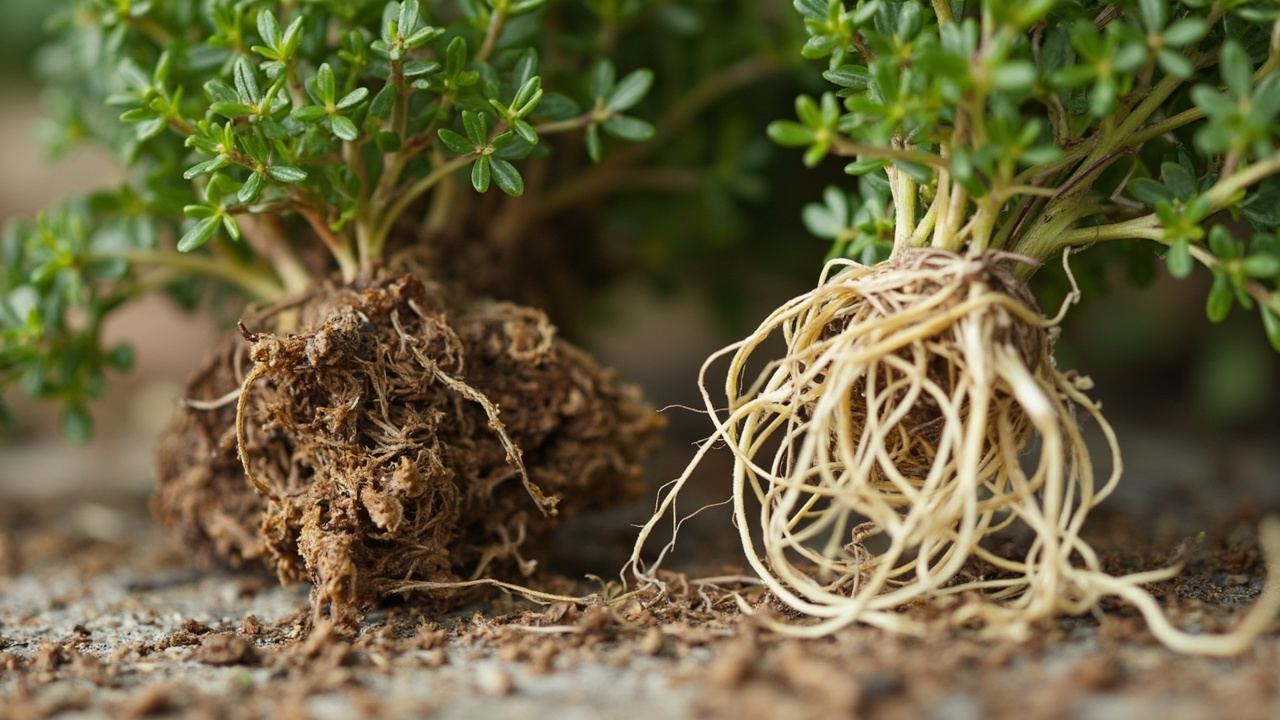
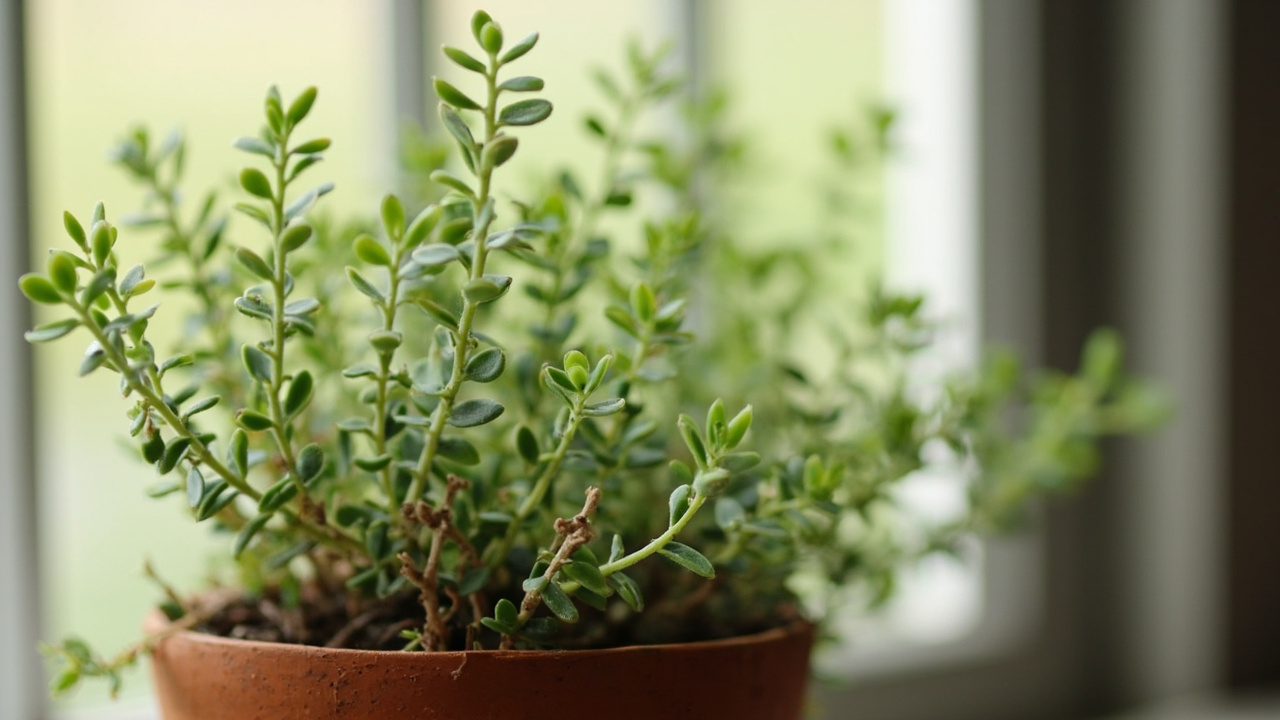
English thyme (Thymus vulgaris) forms a low, spreading mat of thin woody stems that root at the nodes where they contact soil. Mature clumps reach 20 to 30 centimetres tall and 40 to 60 centimetres wide, but the growth stays close to the ground and does not shade neighboring plants. Lemon thyme has a similar low habit, while creeping thyme (Thymus serpyllum) hugs the soil at 5 to 10 centimetres and works as edible ground cover between stepping stones. For small balconies, windowsills, and crowded herb beds, thyme’s compact footprint is a decisive advantage.
The growth rate difference matters too. Rosemary is slow to establish — the first year after transplant, it puts energy into root development and produces modest top growth. Thyme establishes faster and reaches a harvestable size within six to eight weeks from transplant. If you want a quick return on your effort, thyme delivers; if you are willing to wait for a long-term structural plant, rosemary rewards patience with decades of production.
Both herbs develop woody stems as they age, but the woodiness manifests differently. Rosemary’s main trunk becomes thick, gnarled, and eventually hollow in plants older than five years. Thyme’s woody base stays thin and tends to open up in the center after three to four years, which is when most gardeners turn to propagation — taking stem cuttings or division to start fresh plants. If thyme gets leggy before it gets woody, the cause is insufficient light rather than age — move it to full sun and prune back to compact growth. Neither herb resprouts reliably from old bare wood, so regular pruning to maintain green growth is essential for both.
Cold hardiness: which herb survives winter in your zone
Thyme is the more cold-hardy herb by a significant margin. English thyme survives winter in USDA zones 4 to 5 with snow cover, and established plants have been recorded surviving temperatures below -20 °C when insulated by mulch and snow. Without snow cover, thyme suffers crown damage below approximately -15 °C. In practice, thyme overwinters reliably in zones 5 and above with a simple layer of gravel or straw mulch over the root zone, and in zones 4 with additional protection.
Rosemary is considerably less cold-hardy. Most cultivars (including the common ‘Tuscan Blue’ and ‘Majorca Pink’) suffer stem dieback below -5 °C and crown death below -10 °C. Cold-hardy selections like ‘Arp’ and ‘Hill Hardy’ survive to approximately -15 °C with protection, but these are less widely available and often have a less intense flavor than standard cultivars. In zones 7 and below, rosemary typically requires container growing with indoor overwintering or heavy winter protection.
For gardeners in zones 5 to 7, this difference is decisive. Thyme stays in the ground year-round with minimal protection. Rosemary in zone 6 and below must come indoors for winter or be treated as an annual. Overwintering rosemary indoors is possible but challenging — it needs a cool, bright room with good air circulation, and the transition from outdoors to indoors often triggers leaf drop. Unlike fruit trees that require chill hours to break dormancy, both thyme and rosemary resume growth when temperatures warm — thyme from its dormant crown, rosemary from its woody stems. If your winters regularly drop below -5 °C, thyme is the lower-maintenance choice by a wide margin.
Both herbs suffer more from winter wet than from winter cold. A thyme plant in well-drained sandy loam survives -15 °C without damage; the same plant in moisture-retentive clay at -5 °C may die from root rot before the cold ever reaches the crown. The same applies to rosemary. If your soil is heavy, grow both herbs in raised beds or terracotta containers where you can control drainage, and the cold hardiness ratings above become much more reliable. For more on winter dieback patterns, see our thyme turning brown and dying guide.
Water needs and drought tolerance: which herb forgives neglect
Both herbs are drought-tolerant once established, but they differ in how they signal water stress and how quickly they decline with overwatering. Thyme tolerates dry periods well — its small, thick leaves reduce transpiration, and the low growth habit keeps the root zone cooler. But thyme is also unforgiving of saturated soil: root rot from overwatering is the number one killer of thyme, and the plant declines rapidly once the root zone stays wet for more than a few days. High humidity around the crown exacerbates rot in both herbs, which is why air circulation matters as much as drainage.
Rosemary has larger, needle-like leaves that lose moisture faster than thyme’s small foliage. In hot, dry conditions, rosemary shows water stress earlier — stems droop slightly and leaf colour shifts from deep green to grey-green. This visible signal gives you a warning before permanent damage occurs. Thyme, by contrast, often collapses suddenly from root rot with little above-ground warning, because the damage happens below the soil line first.
For gardeners who tend to overwater, rosemary is the more forgiving herb. It tolerates occasional overwatering better than thyme because its upright growth habit and deeper root system allow it to access oxygen even in moderately wet soil. For gardeners who underwater or travel frequently, thyme’s lower water demand and smaller leaf surface give it the edge — it bounces back from dry soil faster than rosemary recovers from wilting.
Water deeply but infrequently, letting the top 3 to 5 centimetres of soil dry between waterings. In containers, use unglazed terracotta rather than plastic — the porous walls wick away excess moisture and keep root conditions closer to the lean, well-drained environment both herbs prefer. In the ground, amend heavy soil with coarse sand and gravel before planting. If you are growing thyme on a windowsill indoors during winter, a grow light for 14 hours daily compensates for the short photoperiod and prevents the stretching that low light causes. For the full watering protocol, see our thyme light and watering guide.
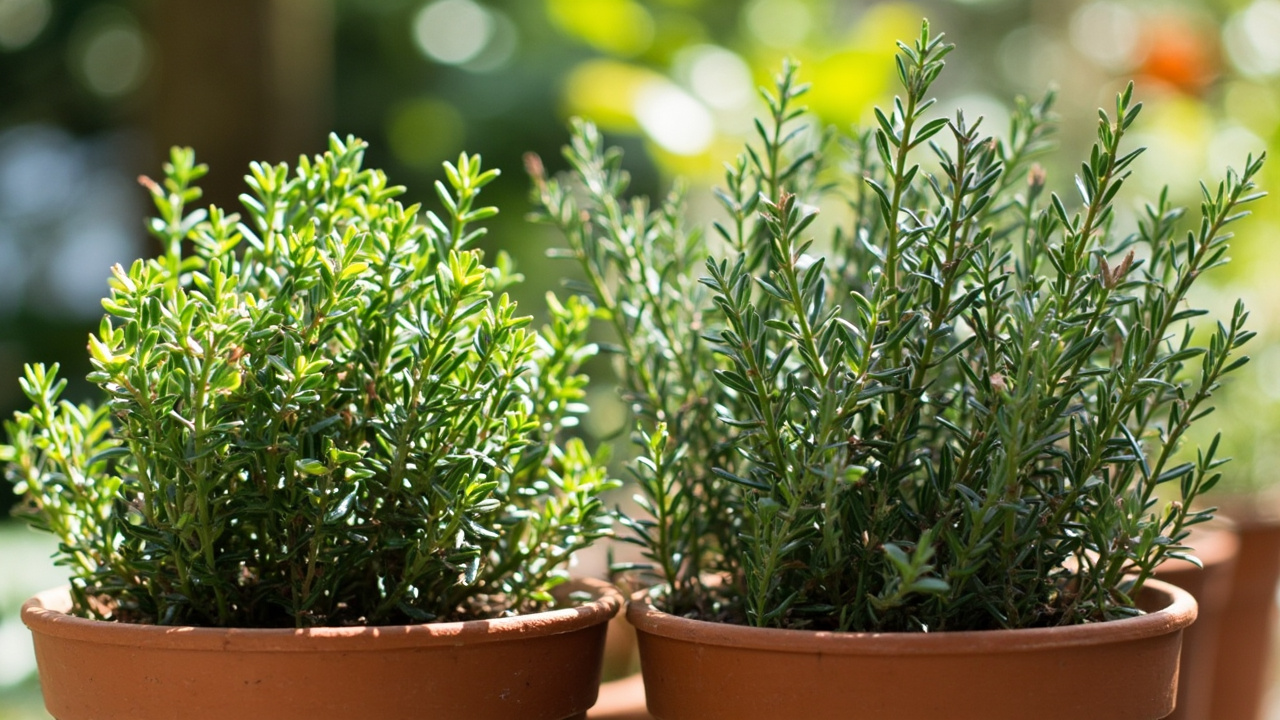
Culinary use and harvesting: flavor intensity, harvest window, and yield
Rosemary produces more harvestable foliage per plant than thyme — a single established rosemary bush yields enough sprigs for daily culinary use throughout the year. The flavor is piney, resinous, and assertive; a single sprig flavors an entire roast or stew. Rosemary’s essential oil (rich in 1,8-cineole and camphor) is more volatile than thyme’s, which means the flavor dissipates faster during cooking. Add rosemary early in the cooking process for infused flavor or as a finishing garnish for a sharper bite.
Thyme produces less bulk per plant but offers more subtle, versatile flavor. Its essential oil — dominated by thymol and carvacrol — has a warm, slightly minty character that complements poultry, fish, vegetables, and sauces without dominating them. The harvest window for thyme extends from spring through autumn, with peak essential oil concentration just before flowering. Regular harvesting for culinary use doubles as structural pruning because it removes apical dominance and forces the plant to branch.
Rosemary requires less frequent harvesting but harder pruning. Because the stems are thicker and more woody, you need secateurs rather than scissors, and you must be careful not to cut into bare old wood that will not resprout. Thyme’s thin stems are easy to harvest with scissors or by hand, and the plant responds to heavy cutting with dense new growth from the crown. The harvest window for both herbs peaks just before flowering when essential oil concentration is highest — drying the cuttings preserves flavor for winter use. For a cook who wants a few leaves at a time for weeknight meals, thyme is more practical; for batch cooking, roasting, and grilling, rosemary’s abundant foliage earns its space.
Both herbs dry well for winter use. Rosemary dries quickly in seven to ten days in a warm, airy room. Thyme takes longer — ten to fourteen days — and the small leaves shatter easily once dried. Freezing both herbs in olive oil preserves flavor better than drying, particularly for thyme. Neither herb needs fertilizer if planted in reasonably fertile compost-amended soil; over-feeding reduces essential oil concentration and flavor intensity. For the full harvesting technique and timing, see our thyme pruning and harvesting guide.
The verdict: which herb wins for five common growing scenarios
Small balcony or windowsill (container, limited space): thyme wins. Its compact mat growth fits pots as small as 15 centimetres in diameter, stays productive in a south-facing window, and does not outgrow its space. Rosemary needs a 30+ centimetre pot and quickly becomes rootbound in small containers.
Mild climate, ground planting, room for a shrub (zones 8-10): rosemary wins. In warm climates where winter temperatures stay above -5 °C, rosemary thrives outdoors year-round and grows into a substantial, productive shrub that produces abundant foliage for cooking. Thyme performs well too but earns less culinary value per square metre.
Cold winter climate (zones 4-6): thyme wins decisively. Thyme overwinters in the ground with minimal protection; rosemary must come indoors or be replaced annually. The overwintering challenge alone makes thyme the better long-term investment in cold climates.
Beginner gardener who overwaters: rosemary wins — slightly. Rosemary tolerates occasional overwatering better than thyme and gives visible wilting signals before permanent damage. But the real answer for overwatering-prone gardeners is to improve drainage first — in well-drained soil, both herbs thrive with minimal attention.
Kitchen garden with space for both: plant both. Thyme and rosemary complement each other in the kitchen and the garden. Plant rosemary at the back of the bed where its upright growth will not shade lower plants, and tuck thyme along the front as a living mulch that suppresses weeds and attracts pollinators and bee-friendly insects. Both demand the same full sun and lean, well-drained soil, so they thrive side by side without competing for resources. If your garden has a south-facing wall or fence, use it — the reflected heat creates a microclimate that benefits both Mediterranean herbs. For the full rosemary care profile, see our rosemary plant care guide.
Turn That PDF Into a Spreadsheet in Minutes
You've seen how to do it manually — now let the tool handle the heavy lifting. Upload your bank statement and get Excel, CSV, or QBO in a few clicks.
Try It Free