
A hydroponic system is not a plant in a jar of water. It is a controlled chemistry problem: the tank has to carry the right dissolved ions, at the right concentration, past roots that stay oxygenated, toward a light the plant can actually use. Get any one of those four wrong and the plant starves in a full tank. That is the whole mechanism, and it is why hydroponics rewards the grower who tracks numbers and punishes the one who doses by feel.
Two failure modes follow from that. The first is a solution that reads the right total on a meter but is quietly off on one ion, so the plant looks fine for three weeks and then sags. The second is an oxygen deficit: a reservoir that runs too warm or too still drops dissolved oxygen below what the roots can pull, and the roots rot even though the tank is full of water and full of food. From the outside, both look identical. Both read as “the plant is dying.” Neither is a fertilizer problem.
Most growers meet this the hard way: the plant looks weak, they add more nutrient, the meter climbs, and nothing improves, because the limit was never the food. The honest limit, up front, is that no reservoir can compensate for a system that is the wrong shape for the crop. You can dial a nutrient solution to perfection, but a waterlogged deep-water tank will drown a crop that wants dry root zones, and a fast flow-through will burn one that needs stillness. The system is chosen first; the numbers are tuned after. This piece walks the mechanism, then the control numbers, then the shape that fits.
The Reservoir Is a Chemistry Problem
The tank holds two things: water, and a dissolved mix of minerals. Those minerals are not fertilizer in the way a soil granule is. They are ionic, split into the charged forms a root can pull into the xylem. A typical leafy-greens solution carries nitrate and a little ammonium for nitrogen, phosphate, potassium, calcium, and magnesium, plus trace elements like iron, manganese, zinc, and copper in parts per million. The mix is tuned to an electrical conductivity, or EC, that a meter reads. For lettuce (Lactuca sativa), that is roughly 1.2 to 1.6 mS/cm; for a fruiting crop like basil (Ocimum basilicum), closer to 1.8 to 2.4.
The number is not the goal. It is a proxy for the total ionic load the roots will draw, and it drifts as the plant drinks. A tank starts high and falls, sometimes by half, over the life of a crop, because the plant is pulling the ions out faster than you replace them. That is why a reading that was fine at planting is wrong at harvest. The full picture of what a hydroponic farm is, and why that shape beats ground soil, is in what a hydroponic farm is; this piece is about the numbers that decide whether the shape actually works.
Nutrients Move as Ions, Not Granules
Put a solid granule in soil and the plant still has to wait for rain, or for you, to dissolve it. In a tank, everything is already dissolved, so the exchange is direct. The root pushes its own cations out across its surface and pulls in the anions it wants, through ion exchange at the root wall. That is why a tank reacts to a missing element within days, not weeks, and why overdoing one element quietly blocks another.
A tomato (Solanum lycopersicum) fed with too much calcium and phosphate will lock out magnesium. The leaves between the veins yellow while the veins stay green, and no amount of “more food” fixes it, because the extra food is the thing blocking the magnesium from getting in. A tank shows you that balance immediately. Soil hides it for a season, because the particles in the ground buffer and delay every mistake you make. The trade is the same, only the tank makes it visible now.
Why a Full Tank Can Still Kill a Plant
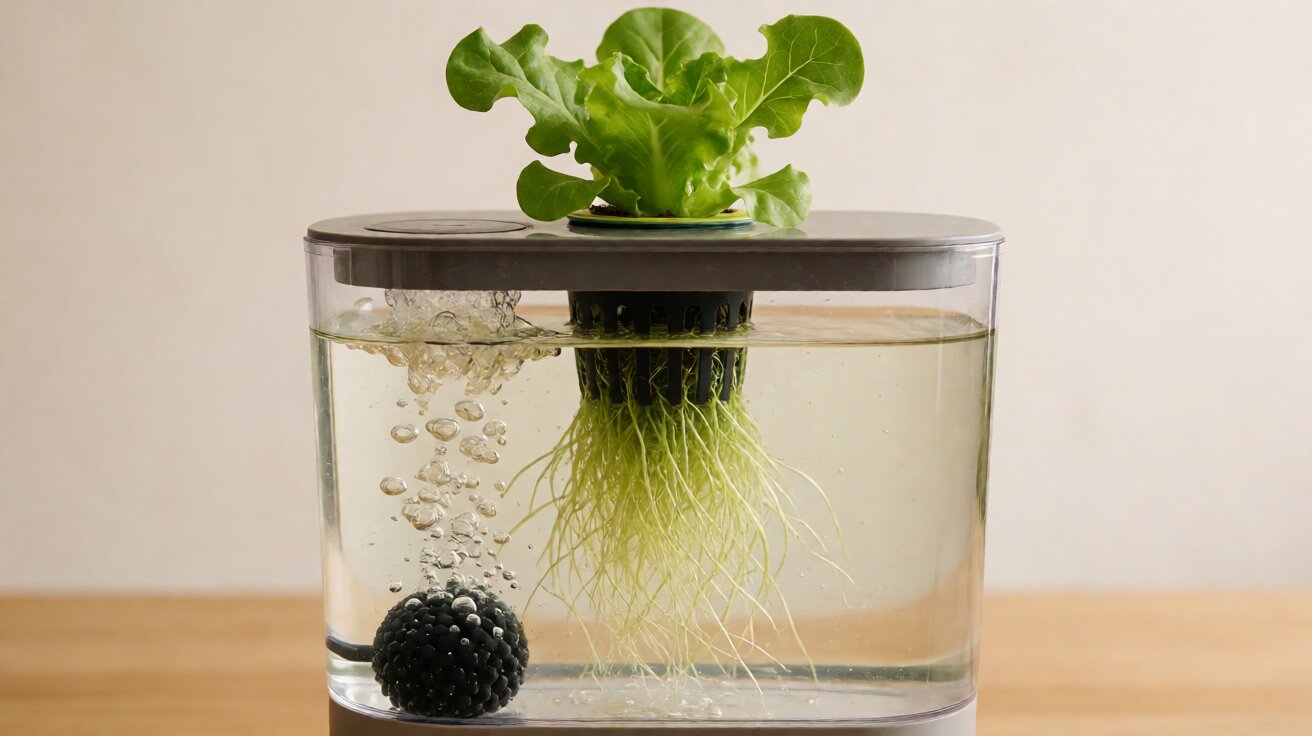
This is the counterintuitive part, and the one most new growers miss. A reservoir that is full of water and full of food can still kill a plant, because the food has to reach an oxygen-saturated root. A root sitting in still, warm water has almost no dissolved oxygen to pull; it slowly suffocates, the root tips turn brown, and the plant collapses from the bottom up. The water is not the problem. The oxygen in the water is.
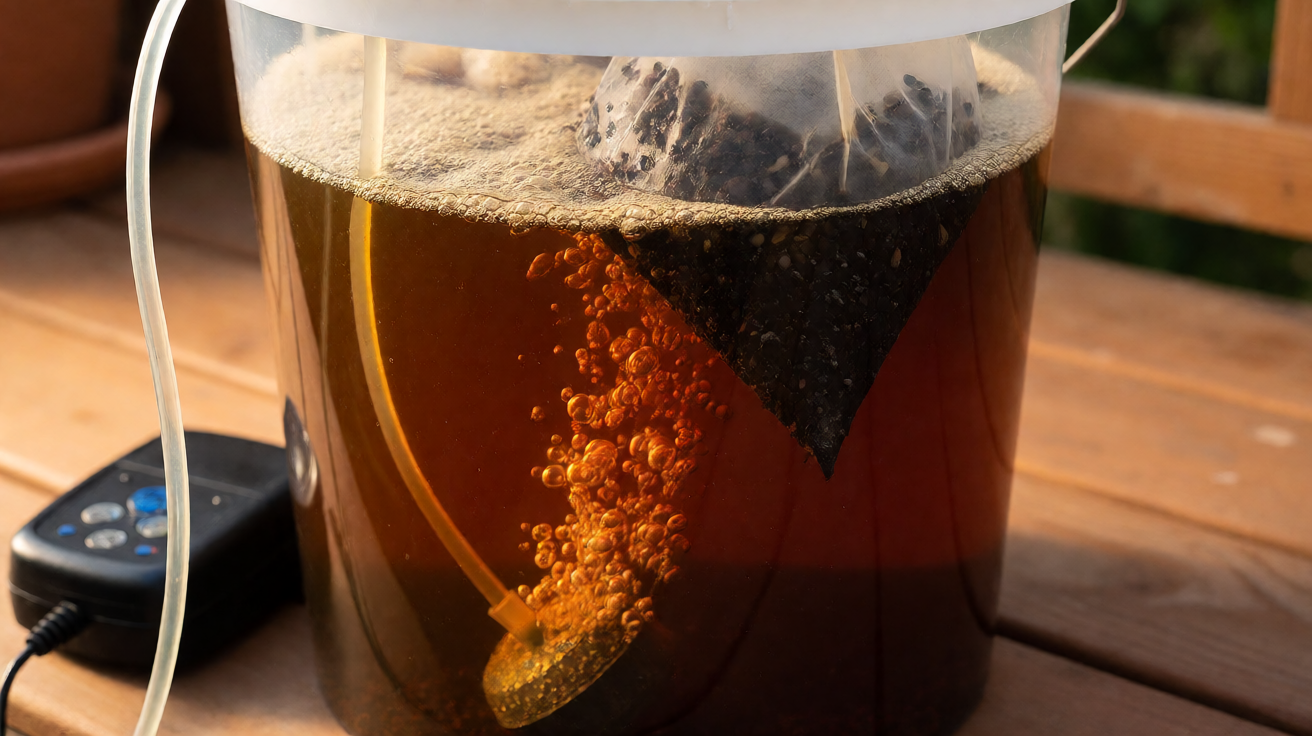
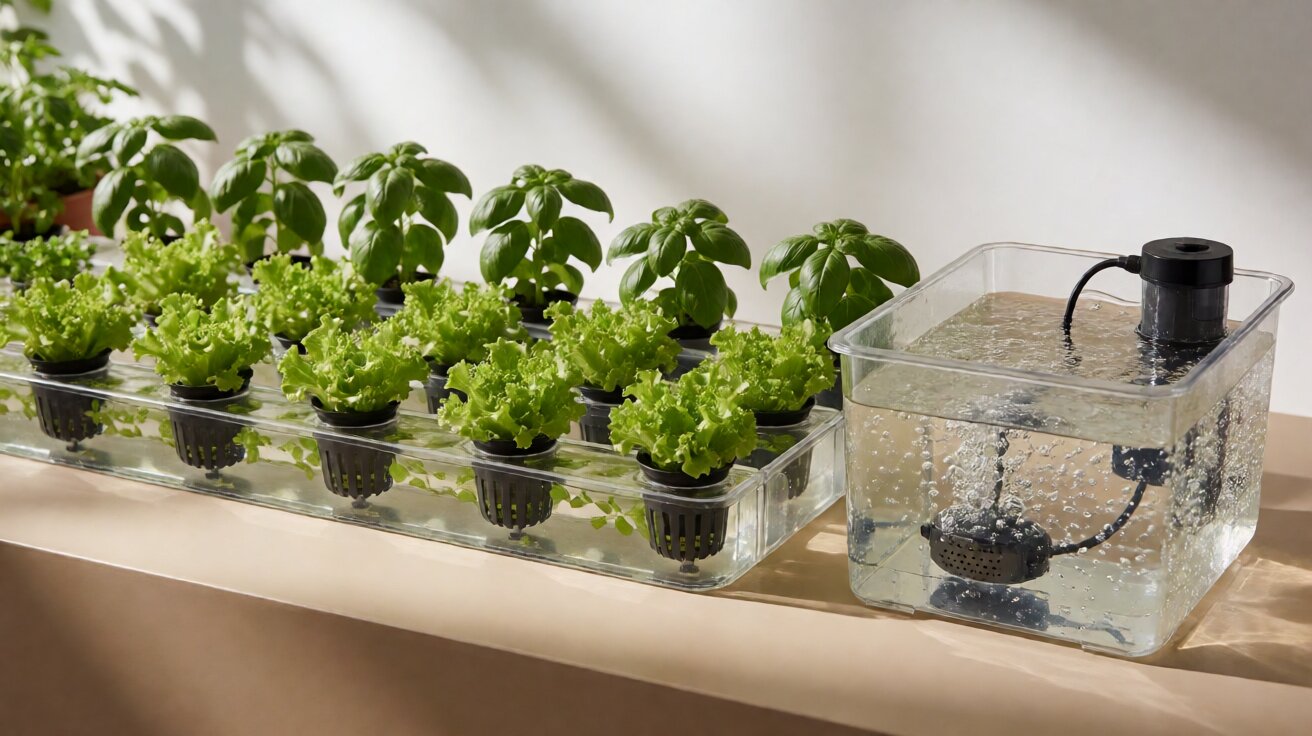
Aeration and turnover fix it: an air stone pushing bubbles through the tank, or a flow that keeps the root surface wet but never waterlogged. A deep-water system, a wick, and a misting tower each solve this same oxygen problem in a different physical way, which is exactly why the shape of the system matters before you ever touch the nutrient solution. Pick the shape to the crop’s oxygen tolerance, and the food you are already mixing will finally do what it was meant to do.
The Numbers You Actually Manage
Strip the gear away and a hydroponic grower is really running four numbers: EC, pH, water temperature, and dissolved oxygen. EC sets the total food load. pH, held near 5.5 to 6.5 for most crops, keeps the ions soluble so the roots can take them up; drift it too high and a calcium or iron lockout starts with no visible food shortage. Temperature, 18 to 22 Celsius, governs how much oxygen the water can hold and how hard the roots work. Dissolved oxygen is the one number the tank hides, the one that quietly decides whether the root stays healthy.
| Parameter | Working range | What it controls |
|---|---|---|
| EC | 1.2 to 2.4 mS/cm, by crop | Total nutrient load at the root |
| pH | 5.5 to 6.5 | Whether each ion is available to take up |
| Reservoir temperature | 18 to 22 C | How much oxygen the water holds, root activity |
| Dissolved oxygen | Keep it rising, never zero | Whether the root breathes or rots |
(You do not need to test the water every hour. You need to test it on the same day, every few days. A number checked on a schedule is a number that is checked at all; a number checked by hunch is not.) Walk the calibration method in our EC and pH calibration guide and the dose-by-crop schedule in the nutrient schedule.
Why Hydroponic Plants Grow Faster Than Soil Plants
Soil slows a plant down for two reasons, and hydroponics removes both. First, a soil root spends real energy searching, hunting for water and for minerals that sit centimeters away, uneven. A tank delivers everything to the root surface, so the plant puts that saved energy into growth instead of hunting. Second, soil holds water in a buffer that swings from too wet to too dry between your watering. A tank keeps the buffer constant, so the transpiration rate the plant runs is steadier, and a steadier plant puts more of that rate into the leaf and the stem.
That is the physics under the “grows faster” claim: less energy lost to hunting, and a vapor-pressure gap the plant can hold and use. It is not magic. It is waste, removed. The same gap is why a well-run tank of lettuce moves to harvest a full week before the same seed in a pot, and why a fast flow-through outgrows a still tank of the same crop. For the light side of that speed, the spectrum the crop actually needs, read the light spectrum guide.
Which System Changes Which Number
Every system is a different trade on those four numbers. The table is the short version of the types of hydroponic systems breakdown.
| System | Oxygen strategy | Water load | Best for |
|---|---|---|---|
| Kratky | Passive, one time | Very high | Leafy greens, no power, beginner |
| Deep-water (DWC) | Air stone, still | High | Lettuce, herbs, reliable fast growth |
| Thin-film (NFT) | Dry film, fast flow | Low | Fast greens, vertical stacks |
| Aeroponics | Mist, highest | Lowest | Maximum speed; needs power and attention |
A wick is the entry point: no pump, no electricity, the plant drinks by capillary action, and the water sits on the high side of the oxygen range, which is why it suits quiet leafy crops and a first grow. A deep-water tank trades a little more water for a bigger, simpler setup that a beginner can run reliably. A thin-film channel moves the water fast and thin to keep the roots dry and happy. An aeroponic tower mists the roots and gives the most oxygen of all, which is why it grows the fastest and why it also fails hardest without power. The trade-off between the two, and when one beats the other, is its own guide: aeroponics versus hydroponics. Match the system to the crop’s oxygen tolerance and the numbers hold; for the decision itself, see how to choose a hydroponic system.
The Mistakes That Ruin a Healthy System
Three mistakes will take down a system that reads perfectly on a meter. The first is treating EC like a knob to raise when a plant looks weak. A weak plant is rarely underfed; it is more often out of oxygen, off on pH, or the wrong crop in the wrong tank. Raising EC when the tank is already loaded just pushes the roots toward burn. The second is a reservoir that runs warm. Every degree above 22 costs dissolved oxygen, and a warm, still tank is where root rot starts even when the food is fine.
The third is the leak that only shows up at the root: a pump that clogs, a net cup that lets roots block the channel, an air stone too small for the tank. None of it appears on the EC reading, because the EC meter is watching the water, not the flow. The system fails at the part you are not watching. On the soil side of the comparison, the worm castings piece is the counterweight, showing what a living soil buffer gives you that a tank cannot. Start with a beginner build in how to start a hydroponic farm, and the four numbers become routine.
What to Expect Once the Numbers Hold
Run the four numbers on a schedule and the system stops being a mystery. A healthy tank, at the right EC and pH, with warm-but-not-hot water and moving oxygen, will show you it working: darker leaves, tighter new growth, and a white root that smells clean instead of the sour rot that means the oxygen is gone. Give a new system a week to settle, because the first flush of a reservoir is when the pH does its loudest drift. Then the daily check shrinks to two minutes.
The plant will tell you, in the leaves, whether the numbers are real. A healthy hydroponic plant never starves by accident; it starves because a number stopped being checked. Check the number tonight. The root will show you the difference by Friday.
Turn PDF Bank Statements Into Workable Spreadsheets
Your bank statement is a mess of numbers, but your books shouldn't be. Use our converter to get Excel, CSV, or QBO files — ready for QuickBooks.
Try It Free Now