A croton that put out red-orange-yellow leaves in the nursery is now pushing plain-green growth. Nothing seems wrong. The diagnosis is almost always light.
Below roughly 1500 lux for 12+ hours, the leaf defaults to chlorophyll-green survival mode. The lux floor is non-negotiable. Most named cultivars need 2000–2500 lux for full saturation. Mammy and Eleanor Roosevelt push to 3000+ lux.
Below the floor, green reversion takes 6–8 weeks. Above it, color develops in 4–6 weeks. An east window that reads 3500 lux in June can drop to 800 lux in January.
A grow light running 14 hours at 400 µmol/m²/s is the reliable fix for every window direction that fails the winter floor. The wrong move is diagnosing a green croton as “needs fertilizer.” Before adjusting anything else, measure the light.
The Lux Floor: Why 1500 Lux Is Where Color Starts
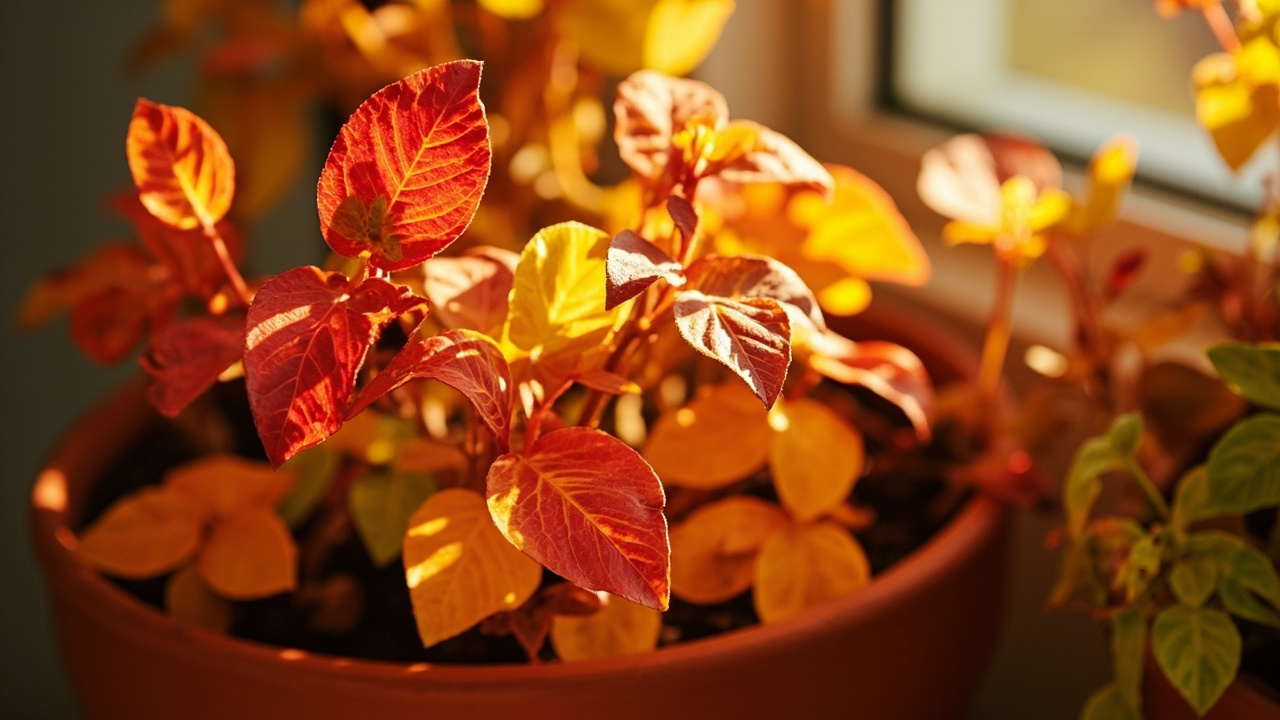
New croton leaves emerge soft and pale yellow-green. Over the next 10–15 days, three pigment families compete: chlorophyll (green), carotenoid (yellow-orange), and anthocyanin (red-purple). When photon flux clears roughly 1500 lux for 12+ hours, carotenoid and anthocyanin production accelerates. The leaf matures in full variegation.
Below that threshold, the chlorophyll machinery wins by default. The leaf hardens into plain green. The relationship is reliable enough to use as a diagnostic tool.
A croton in a window that reads 2500 lux for 14 hours a day will be 70–80% red-orange-yellow across new growth. The same cultivar at 1200 lux will put out 80–100% green leaves.
Houseplant Journal lists 400 foot-candles (approximately 4300 lux) as the target for full color. At 200 lux (typical indoor ambient), a croton produces zero color and begins etiolating within weeks.
The mechanism explains why fertilizer doesn’t fix color. Nitrogen pushes growth volume, not pigment expression. A dark-corner croton given extra nitrogen produces large, soft, uniformly green leaves.
For indoor plant light requirements across 40+ species, pigment intensity tracks cumulative daily light integral (DLI), not any single nutrient.
Cultivar Lux Tiers: Petra vs Gold Dust vs Mammy
Croton cultivars are not interchangeable on light tolerance. The named varieties fall into three tiers that matter when matching plant to room.
Tier 1 (1500+ lux): Petra and Gold Dust. These two reliably hold red-orange-yellow color at 1500–2000 lux. Petra has the broadest yellow-orange margins and is the most forgiving entry cultivar for east-facing windows.
Gold Dust stays smaller (under 18 inches / 45 cm) and splits its leaf surface roughly 50/50 green-and-yellow, so partial greening is harder to spot.
Tier 2 (2500+ lux): Eleanor Roosevelt and Norma. These need stronger light before the reds and deep oranges lock in. Below 2000 lux they grow but color unevenly — half the leaf red, half green. They suit south- or west-facing windows or a 400 µmol/m²/s grow light at 12 inches (30 cm).
Tier 3 (3000+ lux): Mammy and Twisty. Mammy’s narrow, twisted, solid-red leaves need sustained bright light; below 2500 lux it produces muddy brown-green streaks instead of the signature blood-red.
Twisty tolerates this tier but holds its corkscrew shape only above 2000 lux. These two cultivars need a south window in summer and grow lighting from September through March in most indoor homes above 35° latitude.
The practical rule: the thinner and more heavily pigmented the leaf, the higher the lux requirement. Thick leathery leaves (Petra, Gold Dust) = Tier 1. Thin, satiny leaves (Norma, Mammy) = Tier 2-3.
Window Direction and Seasonal Light Drop
An east-facing window in summer delivers 3000–5000 lux for 4–6 morning hours, then drops to 500–1000 lux for the rest of the day. The average across a 14-hour photoperiod is often 1800–2200 lux — enough for Petra or Gold Dust, marginal for Norma, and insufficient for Mammy.
A south-facing window in the same season clears 5000–10000 lux for 6–8 hours and averages 3500+ lux — sufficient for every tier. The drop between seasons is the trap.
November through February, east windows above 40° latitude average 800–1200 lux because the sun angle sits lower and daylight drops to 8–9 hours. A croton that held full color from May to September begins reverting to green in January.
West-facing windows deliver 2500–4000 lux in summer afternoons — strong enough for Tier 1 — but the afternoon heat load can push leaf temperature above 35°C (95°F) and cause sunburn on thinner-leaved cultivars.
South-facing windows carry the highest scorch risk in late spring and summer if the plant sits within 12 inches (30 cm) of the glass. North-facing windows deliver 500–1500 lux in every season.
Crotons do not color at north windows, and even Tier 1 cultivars will be 80–100% green within 8–10 weeks. The east-facing windows guide ranks 15 species that tolerate 800–1500 lux; Mammy and Twisty do not make that list.
Morning Sun vs Afternoon Scorch: The Exposure Trap
Crotons tolerate some direct sun. Morning sun through an east window for 2–4 hours is usually net-beneficial because the light is strong but the infrared heat load is moderate. Direct south-window sun between 11 AM and 3 PM in late spring and summer pushes leaf surface temperature past 38°C (100°F).
Sunburn on a croton shows as tan-to-white crispy patches on the upper leaf surface closest to the glass. Unlike low-light green reversion, sunburn damage is permanent on the affected leaf — the patch does not heal. The plant drops the burned leaf within 2–4 weeks if more than 40% of the surface is affected.
Prevention is cheaper than recovery: keep the plant 12–24 inches (30–60 cm) from south-facing glass, or use a sheer curtain to cut irradiance by 30–40%.
If a croton has been in low light and needs to move to a brighter window, temper it over 7–10 days. Start at 3 hours for 3 days, then 5 hours for 4 days, then full exposure. Crotons that go from a 500-lux corner to a 5000-lux south window overnight drop leaves within 48 hours.
Grow Lights for Croton: PPFD, Spectrum, and Distance
When windows can’t clear 2000 lux in winter, a full-spectrum LED grow light running 14 hours a day is the reliable fix. The metric that matters is PPFD at the croton canopy — not wattage and not lumens.
Croton needs 200–400 µmol/m²/s for 14 hours to hold color. That’s roughly a 30-watt LED at 12 inches (30 cm) or a 60-watt at 18 inches (45 cm). Spectrum matters. A 3000K–4000K warm-white-to-neutral-white LED with red peak around 660 nm drives pigment production most efficiently.
A 3:1 ratio of red-to-blue diodes is a practical window. Timer consistency matters more than intensity. A 14-hour fixed photoperiod (e.g., 7 AM to 9 PM) repeated daily is better than an inconsistent schedule.
Croton pigment production tracks DLI, and the plant needs 12–16 mol/m²/day to maintain full color. Running the light 12 hours instead of 14 drops the DLI by 15%. That drop can start green reversion within 4 weeks on the margin, especially for Tier 2 and 3 cultivars.
A simple outlet timer eliminates the inconsistency problem.
Color Fade and Green Reversion: Diagnosing Light Starvation
Croton color loss is progressive, and the sequence names the problem before a meter does. Stage 1: new leaves emerge paler yellow-green than the previous flush. Stage 2: the orange and red margins bleed toward yellow.
Stage 3: the leaf matures fully green with only a yellow midrib trace. Stage 4: lower leaves begin yellowing and dropping. The progression takes 3–5 weeks once lux drops below 2000.
Recovery reverses the same sequence in 4–6 weeks at 2500+ lux. New leaves return to full variegation first; old green leaves never re-color. A plant that has gone 80% green recovers its full-color look in 8–12 weeks.
The diagnostic difference between light starvation and nitrogen deficiency is leaf sequence. A nitrogen-starved croton yellows from the bottom up, old leaves first. A light-starved croton greens from the top down, new leaves first.
The fix is opposite: add light, not nitrogen. Nitrogen on a light-starved croton pushes fast, weak, all-green growth. The croton plant care guide walks the full light-water-humidity stack.
Source: the Royal Horticultural Society’s Codiaeum variegatum profile, which places full-color crotons at the bright-indirect tier above 1500 lux — the floor this article builds on.
From PDF to Excel in one click
Forget retyping line by line. Upload any bank statement, get a spreadsheet you can actually use. Your files are never stored, and you can test the converter with 3 free conversions.
Try it free