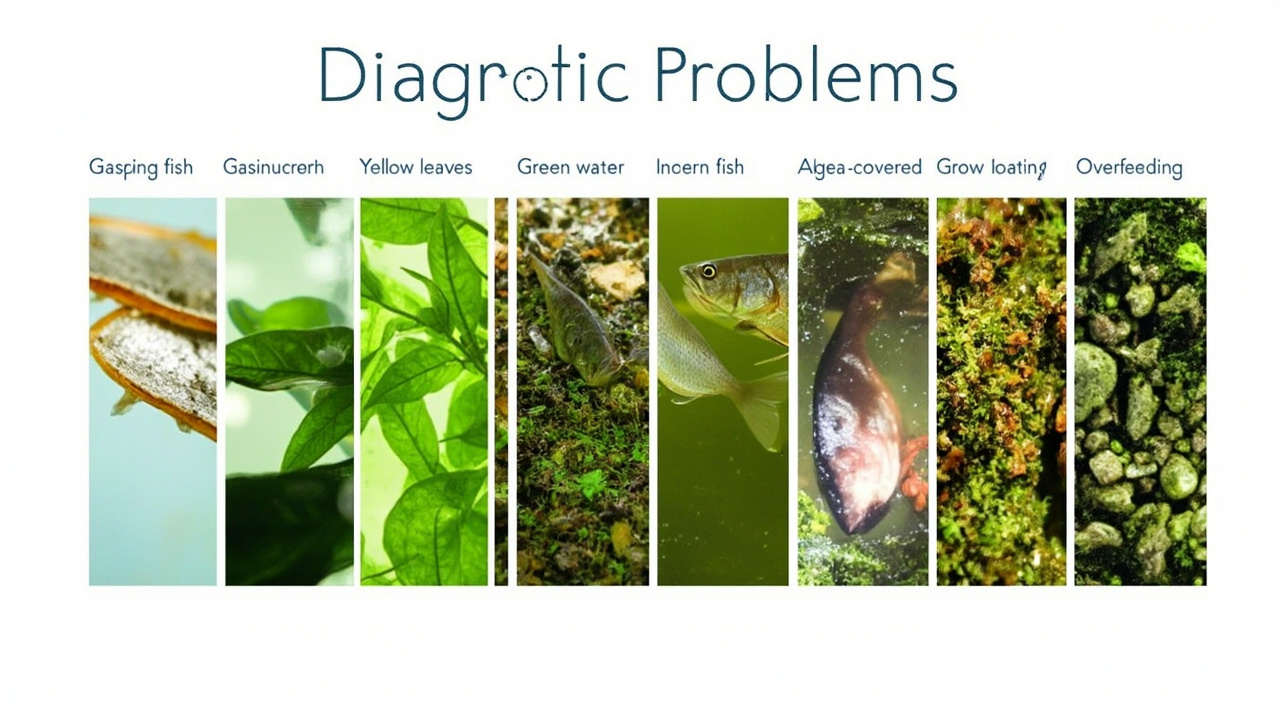

You acquired or built a small aquaponic system. It ran fine for days or weeks. Then something changed: fish gasped at the surface, plants yellowed, water turned green, or a fish floated to the top this morning. You need a diagnosis — not another explainer about what aquaponics is.
This page is organized by symptom. Skip to the matching H2. Each of the seven most common aquaponic failures has a measurement threshold that tells you whether to act now or to monitor for another day, followed by a 24-hour fix protocol. For the nitrogen-cycle science behind each failure, see the aquaponics fundamentals page.
Problems covered: ammonia spike, nitrite toxicity, iron chlorosis, pH crash/drift, algae bloom, pump failure, and the overfeeding cascade. If your symptom is not here and ammonia/nitrite are both below 0.5 ppm, check dissolved oxygen — warm water above 85 °F (29 °C) holds less DO than fish need, and the issue is aeration, not the biofilter.
Aquaponic System Symptom Diagnostic: Find Your Problem in 60 Seconds
Start here. The flow is: measure first, then act. Testing parameters before doing a water change or adding chemicals prevents you from masking the real cause with a fix that does not match the problem.
Step 1 — Test ammonia and nitrite right now. Use a liquid test kit, not paper strips. Record both numbers. Step 2 — If ammonia is ≥0.5 ppm or nitrite is ≥1.0 ppm, do a 25% water change immediately and come back to the matching problem section below after the water settles (1–2 hours). Step 3 — If ammonia and nitrite are both below 0.5 ppm but fish are still stressed, measure pH. pH below 6.2 stalls nitrification; pH above 7.5 makes ammonia more toxic. Step 4 — If ammonia, nitrite, and pH are all in range, measure the issue against the plant and algae sections below — the problem is likely iron, light, or feeding rate, not ammonia.
Ammonia Spike in Aquaponics: Fish Gasping, Red Gills, Sudden Death
An ammonia spike is the most common acute killer of aquaponic fish. Ammonia (NH3) directly burns gill tissue, reducing oxygen uptake. Fish gasp at the surface because their gills cannot extract oxygen even when dissolved oxygen in the water is adequate. The gills appear red or purple under light. At ≥2.0 ppm, most fish species lose consciousness within 12–24 hours and die within 24–48 hours unless removed.
The mechanism is almost always bioload exceeding biofilter capacity: overfeeding, a dead fish decomposing unnoticed, bacterial die-off from a pH crash or chlorine top-off, or stocking too many fish too soon. Any one of these adds ammonia faster than nitrifying bacteria can convert it. During the first 8 weeks of stocking, the biofilter is still scaling to the bioload — the smallest overfeeding can push ammonia above 0.5 ppm within 24 hours.
Immediate fix protocol: (1) If ammonia ≥2.0 ppm — move fish to a quarantine container with clean dechlorinated water matched to ±2 °F (±1 °C) of tank temperature. Do not skip this step. (2) Do a 50% water change on the system with dechlorinated water. (3) Add a dose of bacterial starter. (4) Stop feeding for 72 hours. (5) Test ammonia every 12 hours until below 0.5 ppm. Once ammonia has been below 0.5 ppm for 48 hours, reintroduce fish with standard acclimation. (6) Find the cause: did you overfeed? Is there a dead fish in the pump intake? Did you add untreated tap water? Fix the cause before restocking.
Nitrite Toxicity in Aquaponics: Brown-Blood Disease in Cycled Systems
Nitrite (NO2-) enters the fish bloodstream through the gills and binds to hemoglobin, converting it to methemoglobin — which cannot carry oxygen. The effect is called brown-blood disease because the blood literally turns chocolate-brown under the gills. The mechanism is hypoxia at the tissue level even when dissolved oxygen in the water is normal. Fish appear lethargic, breathe rapidly, and die without the bright red gills of ammonia poisoning.
Nitrite toxicity typically appears during weeks 3–5 of cycling, when Nitrosomonas (ammonia-to-nitrite) matures before Nitrobacter (nitrite-to-nitrate). This two-week colonization gap creates a temporary nitrite spike that is normal — tolerated at <1.0 ppm for hardy species, lethal above 1.0 ppm for sensitive species over 72+ hours. For species-specific tolerance thresholds, see the fish species ranked for hardness page.
Immediate fix protocol: (1) Add aquarium salt (NaCl) at 1 part per thousand — 1 gram per liter of system water, dissolved in a bucket first, then distributed. Chloride ions compete with nitrite for gill uptake, buying time while Nitrobacter mature. (2) Do a 25% water change. (3) Add bacterial starter. (4) Reduce feeding by 50% for 10 days. (5) Test nitrite every 48 hours — it should peak at week 4 and collapse to below 0.5 ppm by week 6 in a healthy cycling trajectory. If nitrite remains above 2.0 ppm for more than 10 days despite bacterial starter, the cycle may have stalled — refer to the How-To fishless cycling protocol for restart diagnostics.
Iron Chlorosis in Aquaponics: Yellow New Leaves, Green Veins
Iron chlorosis is the most common plant problem in expanded clay media systems. The symptom: new leaves emerge yellow with distinct green veins (interveinal chlorosis on new growth). The leaves become increasingly pale but do not wilt. The plant stops growing new shoots. Fruit set drops to zero. This is iron deficiency, not nitrogen deficiency — which would show on old growth first, not new.
The mechanism is pH-locked iron. In expanded clay systems above pH 6.8, iron (Fe2+) oxidizes to Fe3+ and precipitates as insoluble iron hydroxide on the surface of the clay media. Plant roots cannot uptake precipitated iron even though the media surface is visibly rust-stained. The fix is not more iron — it is chelated iron in a form that resists precipitation up to pH 7.5, and pH management to keep system pH between 6.4 and 7.0.
Immediate fix protocol: (1) Dose chelated iron (Fe-DTPA or Fe-EDDHA) at 2 mg/L of system water. Fe-DTPA is stable up to pH 7.5; Fe-EDDHA is stable up to pH 9.0 but costs more. (2) Test pH. If pH is above 7.0, buffer down with potassium bicarbonate at 1 tsp per 25 gallons over 12–24 hours (not all at once). (3) New growth appears green within 7–14 days. Existing yellow leaves do not recover — prune after healthy new shoots are 4+ inches long. (4) Repeat iron dosing monthly as a maintenance dose at 1 mg/L — expanded clay binds iron over time and periodic replenishment is normal, not a failure.
pH Drift and Crash in Aquaponics: The Downward Spiral
Nitrification produces acid: 1 proton (H+) for every ammonia molecule converted to nitrate. This acidifies system water by 0.2 pH units per week once the biofilter is mature. Below pH 6.5, bacterial replication slows. Below pH 6.2, nitrification stalls. Below pH 6.0, fish begin dying from combined acid stress and the inability of their blood to carry oxygen at low pH (acidosis). The failure mode is a downward spiral: acid kills bacteria, stalled bacteria let ammonia spike, ammonia kills fish, decomposing fish acidify the water further.
The fix is buffering, not adjusting. Buffering adds alkalinity (carbonate hardness, KH) that neutralizes acid without overshooting pH. Potassium bicarbonate (KHCO3) is the standard aquaponic buffer — it raises KH by 1 degree (17.9 ppm CaCO3 equivalent) per teaspoon per 25 gallons of system water. pH follows KH: raise KH, and pH rises gently over 12–24 hours without shocking the biofilter. Potassium hydroxide (KOH) acts faster but risks overshooting pH above 8.0 in a system with low KH, which kills fish faster than acidification.
Immediate fix protocol: (1) Measure KH. If KH is below 3 degrees (54 ppm CaCO3), the system has no buffering capacity left. Add potassium bicarbonate at 1 tsp per 25 gallons, dissolved in water first. (2) Retest pH in 12 hours. If pH remains below 6.2, add another 1 tsp per 25 gallons. (3) Repeat every 12 hours until pH reaches 6.6 — do not chase 7.0 in one day, the biofilter prefers slow correction. (4) If pH stays below 6.2 despite weekly buffering, add a permanent alkalinity source: a mesh bag of crushed coral or oyster shell in the sump tank or media bed. This dissolves slowly and maintains KH above 3 degrees indefinitely. (5) Expect weekly maintenance buffering of 0.5 to 1 tsp per 25 gallons — this is normal operation, not a failure.
Algae Bloom in Aquaponics: Green Water That Starves the Biofilter
Green water in aquaponics is a free-floating algae bloom (single-celled Chlorella-type). It appears when nitrate is above 80 ppm AND the tank receives more than 2 hours of direct sunlight per day on the water surface. The algae produce oxygen during daylight but consume dissolved oxygen at night — DO can crash from 6 mg/L at sunset to below 3 mg/L by dawn, stressing fish. Algae filaments also clog bell siphon flow, disrupting flood-and-drain timing.
The fix is source reduction, not algaecide. Algaecide kills algae, but the decomposition spike from dead algae is a massive ammonia addition that causes a worse crash than the bloom itself. Manual removal via microscreen works for string algae on surfaces. Free-floating green water is best treated at the source.
Immediate fix protocol: (1) Cover all tank surfaces that receive direct sunlight — opaque black plastic or canvas over the tank, secured at the edges. Zero light penetration crashes a bloom in 5–7 days. (2) Add fast-growing plants (lettuce, watercress, duckweed) to outcompete algae for nitrate. (3) If nitrate is above 100 ppm, do a 25% water change to drop it below 60 ppm. (4) Clean the pump intake and bell siphon of any algae filaments. (5) A UV sterilizer inline with the return pipe prevents recurrence but is not required if light and nitrate are controlled. Recurrence within 3 days of covering usually means either nitrates are still above 100 or there is a light leak you missed.
The Overfeeding Cascade in Aquaponics: Most Common Beginner Mistake
Overfeeding is the most common cause of the cascade failure pattern: fish are fed too much → uneaten food decays → ammonia spikes → beneficial bacteria in the biofilter are overwhelmed by organic load → nitrification stalls → ammonia and/or nitrite rise → fish die. A single overfeeding event in week 4–8 of stocking can restart the cycling clock because the bacterial die-off from the ammonia spike resets the biofilter maturity.
The mechanism is simple: uneaten food decays aerobically (consuming dissolved oxygen) and anaerobically (producing hydrogen sulfide). Both pathways spike ammonia and crash the biofilter. Fish can survive 5–7 days without food in a biofilter-mature system — a 72-hour feeding stop is safer than a single overfeeding in a cycling-scale system.
The fix is not chemicals. It is a 72-hour feeding stop, followed by a 50% permanent feed reduction. The fish will be hungry and behave as if starving (rapid surface swimming at feeding time) — this is normal and does not require corrective feeding. The standard feed rate is a pinch consumed within 2 minutes, once per day. Uneaten food after 5 minutes is the visual signal to reduce by half tomorrow. Once ammonia has been below 0.5 ppm for 2 weeks, increase feed by 20% increments weekly until uneaten food appears — that is the maximum feed rate, not the target. Stay below it. For the original daily feeding protocol, see the cluster How-To page.
Turn That PDF Into a Spreadsheet in Minutes
You've seen how to do it manually — now let the tool handle the heavy lifting. Upload your bank statement and get Excel, CSV, or QBO in a few clicks.
Try It Free