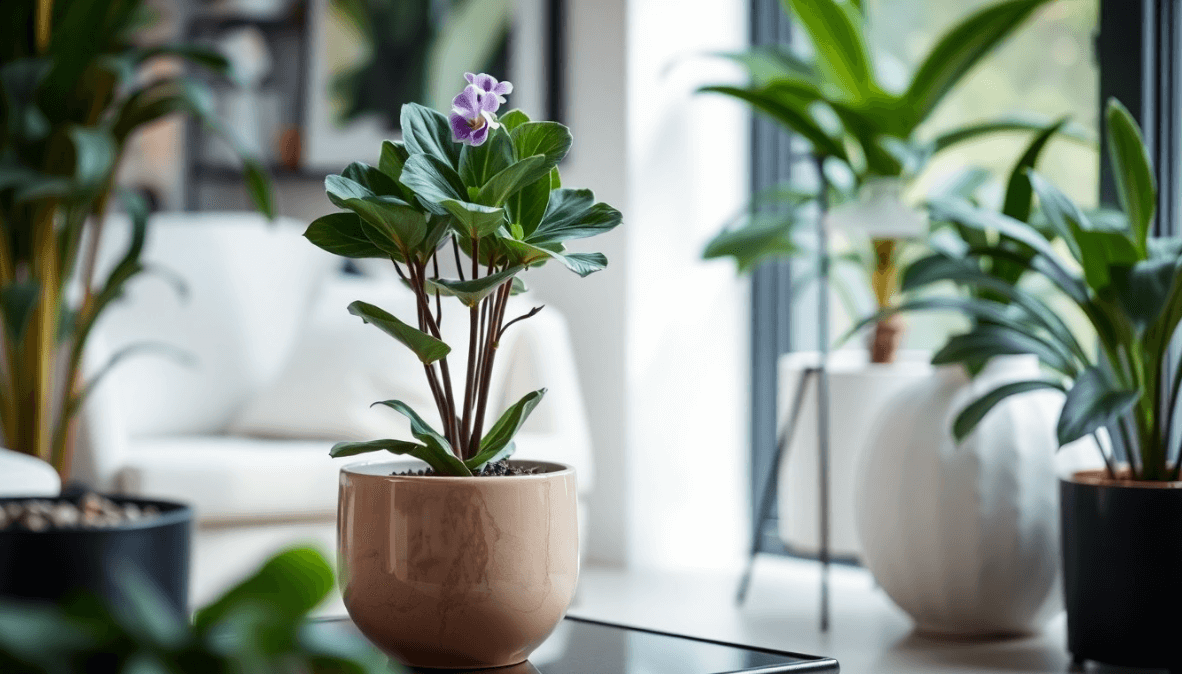

African violet care comes down to five things: bright indirect light, careful watering that keeps the leaves dry, a loose and slightly acidic soil mix, stable warmth, and light frequent feeding. Get those right and yours will bloom nearly year-round indoors.
African violets (Saintpaulia ionantha and their modern hybrids) are compact rosette plants native to the shaded, humid forest floors of Tanzania and Kenya. Their fuzzy leaves and clustered flower stalks evolved under forest canopy, which is why a sunbeam through a window or a dry radiator blasts them into decline so quickly. Once you match their native forest-floor conditions, the plant settles in and blooms in cycles of six to ten weeks with only short rests.
What Makes African Violets Different From Most Houseplants
Most flowering houseplants tolerate a missed watering or a drafty window. African violets will not. Their fine root system sits in a small volume of soil, the leaves absorb cold water like a sponge (and spot permanently when they do), and the crown rots if the soil stays wet for more than a few days. The good news is that the same sensitivity also makes them predictable: a change in leaf color, flower production, or stem length almost always traces back to one of the five core factors.
Compared to pothos, snake plant, or zz plant, African violets need more hands-on attention. Compared to orchids or bonsai, they are forgiving. They sit right in the middle, which is why they have stayed one of the most popular flowering houseplants for more than a century.
Light: Bright Indirect Is the Sweet Spot
African violets need 10 to 12 hours of bright indirect light per day for consistent blooming. Bright indirect sunlight through an east-facing window is ideal. A north window works in summer but may be too dim in winter. South and west windows are usable with a sheer curtain to filter direct sun.
Too little light produces long leaf stems, wide gaps between leaves, and few or no flowers. Too much direct light bleaches the leaves pale green or causes brown scorch patches. If your violet stretches toward the window, move it closer. If the leaves look washed out, pull it back.
Rotate the pot a quarter turn each week so the rosette grows evenly. African violets are phototropic and will lean toward the light source within days.
Natural window light fades in winter, and that is when most violets stop blooming. A simple fluorescent grow light or a full-spectrum LED panel set 20 to 30 cm (8 to 12 inches) above the foliage and run on a 12-hour timer restores the sunlight photoperiod the plant expects. Under lights, African violets often bloom continuously because the duration and intensity stay constant year-round. Use a light meter if you have one: aim for 8,000 to 12,000 lux at leaf level during the lit period, which is the same range as a shaded east-facing window in summer.
For a full breakdown of window direction, seasonal changes, and grow-light setups, see the african violet light requirements guide.
Watering: Keep the Soil Evenly Moist Without Wetting the Leaves
The single most common killer of African violets is water on the leaves. Cold droplets land on the fuzzy surface, leave permanent yellow or brown rings as they dry, and open the door to crown rot. The standard rule is to water from the bottom, not the top.
Fill the saucer beneath the pot with room-temperature water, let the soil wick it up through the drainage holes for 20 to 30 minutes, then pour off any water the plant did not absorb. The soil should feel like a wrung-out sponge: damp but never soggy. Once a week is a typical rhythm in average home conditions, faster in bright warm rooms and slower in cool ones.
Self-watering African violet pots take this one step further with a built-in wick and reservoir. Wick watering works well for people who forget or for a plant on a high shelf that is awkward to lift. If you use tap water and your municipality adds fluoride or chlorine, let the water sit in an open container overnight before using it, or switch to filtered or rainwater. African violets are sensitive to both, and the symptoms show up as leaf-edge burn first.
Overwatering signs mirror underwatering in early stages (drooping leaves), which makes the rhythm tricky at first. The reliable check is the weight of the pot: waterlogged soil feels heavy and cold, dry soil feels light. Lift the pot right after watering and again the next day to learn what ‘ready to water’ feels like in your specific pot size and mix.
Soil, Pot Size, and Repotting
African violets need a light, airy, slightly acidic soil that drains fast. Standard indoor potting mix is too heavy and stays wet too long. A working homemade mix is one part peat moss or coco coir, one part perlite or vermiculite, and one part coarse sand or fine pine bark. The peat holds moisture at the root zone without waterlogging, the perlite keeps air pockets open, and the pine bark or sand gives the roots something to grip.
Pot size matters more than most beginners expect. African violets bloom best when the roots are slightly crowded; the standard rule is a pot diameter about one-third the leaf-span diameter. A mature 25 cm (10 inch) plant is happy in a 9 cm (3.5 inch) pot. Move up only one pot size at a time when repotting. The drainage hole at the bottom of the pot is what makes bottom watering possible, so do not use a decorative cachepot without inner drainage.
Repot every 12 to 18 months, even if the plant has not outgrown its pot, because the peat in the mix breaks down and the drainage slows. Refresh the soil, shake the old mix off the root ball gently, and replant at the same depth. Burying the crown invites rot, and exposing the upper stem slows new growth. For a step-by-step walk-through, see how to repot an African violet.
Temperature, Humidity, and Feeding
The ideal temperature range is 65 to 75 °F (18 to 24 °C). Growth slows below 60 °F (15 °C) and crown rot risk rises below 50 °F (10 °C). Keep the plant away from cold drafts, heating vents, and air-conditioning outlets. A consistent spot is better than a perfect spot that changes with the seasons.
African violets prefer 40 to 60% relative humidity. Below 40%, leaf edges turn brown and flower buds may abort. A pebble tray filled with water placed beneath the pot helps, but only if the pot sits on the pebbles above the waterline, not in it. Grouping several plants together also raises the local humidity. Avoid misting, which wets the leaves and invites spotting.
A humidifier is the most reliable option in dry climates or during winter when indoor heating drops humidity below 30%. Run it on a low setting near the plants rather than pointing it directly at them. A digital humidity meter (hygrometer) costs a few dollars and removes the guessing.
Feed lightly and often rather than rarely and heavily. A balanced African violet fertilizer (look for a 14-12-14 or 8-8-8 NPK ratio) diluted to one-quarter strength and applied with every watering is a reliable schedule. Flush with plain water once a month to wash out accumulated salts; salt buildup shows up as a white crust on the soil surface and brown leaf tips.
Bloom-only formulas (high phosphorus, like 15-30-15) push flowers at the expense of leaves and are best used for a short 4 to 6 week boost rather than year-round. For a deeper look at feeding schedules, see the African violet fertilizing guide.
Common Problems and What They Signal
Yellowing lower leaves usually mean overwatering or a pot that is not draining. Remove the affected leaves at the base of the stem and let the soil dry to a barely-damp level before the next watering. If yellowing climbs upward and includes new growth, check the roots: a slimy black root ball signals root rot, which needs immediate surgery and a fresh soil mix.
Brown spots on leaves almost always trace back to cold water droplets. Trim the damaged leaves at the base and switch to bottom watering with room-temperature water. New growth should emerge clean.
Leaf curl, tight rosettes, and distorted new leaves are the classic signs of cyclamen mites, which are microscopic and almost impossible to see without magnification. Treat with a miticide labeled for African violets and isolate the plant. If the infestation is advanced, take healthy outer leaves for leaf propagation and start fresh.
Powdery white on leaves is powdery mildew, common in stagnant air or overcrowded shelves. Improve airflow and treat with a milk-water spray (1 part milk to 9 parts water) or a labeled fungicide.
No blooms almost always means insufficient light. Move the plant to a brighter spot or add a grow light for 12 hours a day. Over-fertilization with high-nitrogen fertilizer can also suppress blooming in favor of leaf growth.
White or brown mushy spots on the crown mean crown rot. If the crown is still firm on one side, you may be able to save the plant by cutting away the rot, dusting with cinnamon, and rerooting healthy leaves as cuttings. Once the entire crown is soft, the plant is not recoverable.
For a full diagnostic guide to browning, spotting, and leaf damage, see african violet leaves turning brown.
How to Keep African Violets Blooming Year-Round
Consistency is the formula. Keep the light source stable and long enough, 10 to 12 hours daily. Remove spent flower clusters by pinching them off at the base of the stem so the plant redirects energy to new blooms instead of seed production.
Rotate the pot weekly for even growth. Keep the temperature steady and the humidity in range. Feed regularly at low strength rather than occasionally at full strength.
If your violet stops blooming entirely, give it a rest period of six to eight weeks at slightly cooler temperatures, around 60 to 65 °F (15 to 18 °C), with reduced watering and no fertilizer. Then return it to bright light and resume feeding. Many violets respond with a fresh flush of flowers.
For variety selection when you are ready to expand the collection, see the African violet varieties guide; if a plant is beyond saving, how to save a dying African violet covers the rescue steps in order.
Turn PDF Bank Statements Into Workable Spreadsheets
Your bank statement is a mess of numbers, but your books shouldn't be. Use our converter to get Excel, CSV, or QBO files — ready for QuickBooks.
Try It Free Now