Calathea soil is the third leg of the indoor Calathea care stool, and it’s the one most new owners get wrong because standard houseplant potting mix is too dense for Calathea roots. A Calathea in standard potting soil will hold water too long, the roots will sit in moisture they can’t use, and within 4 to 8 weeks you’ll see yellow lower leaves and a plant that looks thirsty no matter how often you water. The fix is a chunky, fast-draining mix that holds moisture long enough for the roots to take what they need and lets excess drain away in seconds.
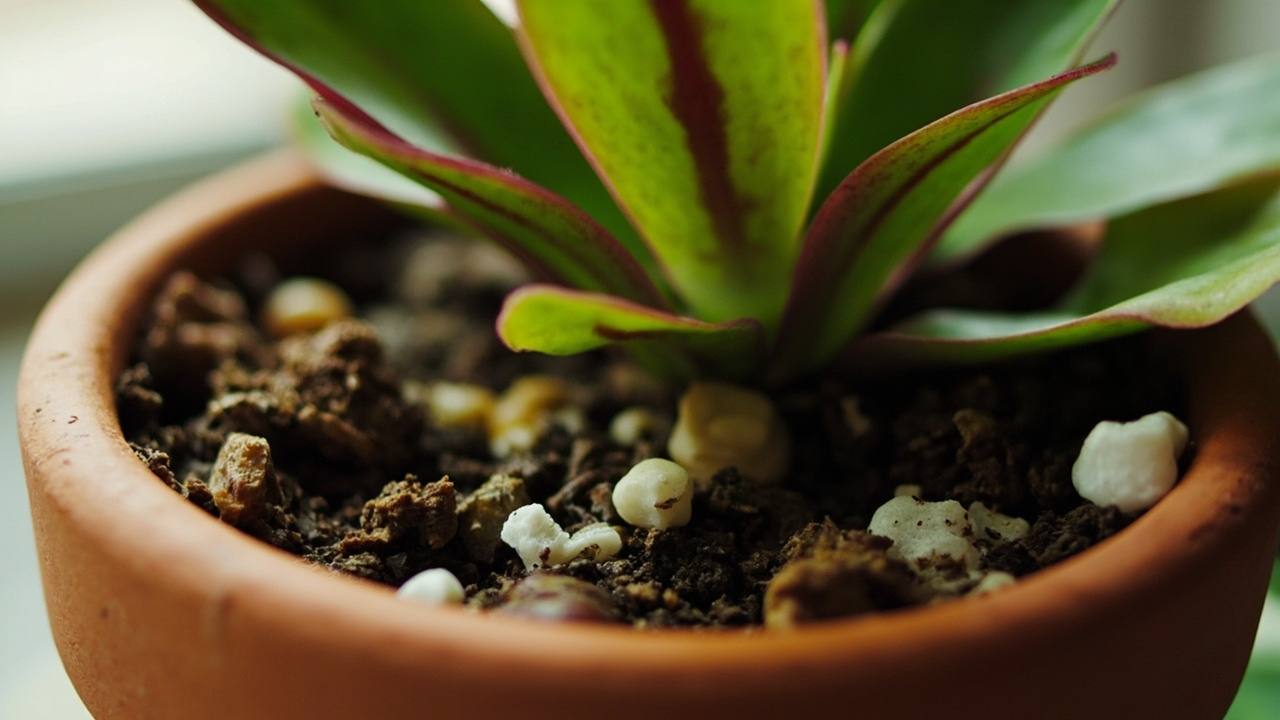
The right Calathea soil mix is roughly 50% high-quality potting soil, 25% perlite or pumice, 15% orchid bark or coco chips, and 10% worm castings or compost. The potting soil gives the mix structure and some nutrient base, the perlite or pumice creates air pockets that keep the mix from compacting, the orchid bark or coco chips create larger air channels and slowly break down to feed the soil microbiome, and the worm castings add slow-release nutrients that the Calathea can use without burning the roots.
This page covers what each component does, the ready-made mixes that come closest to the right texture, and the failure mode you’ll hit if you skip any of the three aeration components.
Why Standard Potting Soil Fails for Calathea
Standard houseplant potting soil is engineered for plants that tolerate — and often prefer — consistent moisture. It contains peat moss or coco coir for water retention, perlite for some aeration, and a slow-release fertilizer. The texture is fine and dense, which is right for a pothos, a peace lily, or a philodendron. It’s wrong for Calathea for one specific reason: the roots need oxygen as much as they need water, and dense soil holds more water than air.
Calathea roots are thin and rot fast in low-oxygen soil. The rot starts at the root tips, spreads up the root, and the first visible symptom is yellowing on the lower leaves. By the time the leaves show damage, the root system has already lost 30% to 50% of its mass to rot, and the plant is in a recovery window that lasts 2 to 4 weeks. The fix isn’t to water less — that just delays the problem — it’s to repot into a mix that gives the roots the air they need.
The right Calathea mix is what horticulturists call a “5-1-1” mix (5 parts bark, 1 part perlite, 1 part soil) or a “peat-based” mix with extra aeration. The exact ratio is less important than the texture: when you squeeze a handful of moist mix, it should hold together loosely but crumble easily when you poke it. If it stays in a tight ball, it’s too dense. If it falls apart immediately, it’s too coarse and won’t hold enough moisture.
The Four Components of a Calathea Soil Mix
Each component does a specific job. Skipping any one of them creates a failure mode that shows up within 4 to 8 weeks.
Potting Soil (50% of the mix)
A high-quality peat-based or coco-coir-based potting soil gives the mix its structure, its base nutrient content, and its water-holding capacity. Use a name brand like Miracle-Gro, FoxFarm, or Espoma rather than a discount store brand — the cheaper soils use coarser peat and don’t break down as evenly, which causes the mix to compact within 3 to 4 months instead of 6 to 8.
The trade-off: more than 50% potting soil and the mix becomes too dense. Less than 30% and the mix doesn’t hold enough moisture to bridge a 5 to 7 day watering cycle in summer.
Perlite or Pumice (25% of the mix)
Perlite is the white, lightweight volcanic glass that comes in almost every bag of potting soil. Pumice is the same idea but denser and heavier. Both create air pockets in the soil that roots can use, and both prevent the mix from compacting over time. Perlite is cheaper and easier to find; pumice is heavier (so the pot is more stable) and doesn’t float to the top when you water.
The trade-off: perlite is so light that it floats to the top of the pot after 6 to 12 months of watering, leaving a white crust on the soil surface. Pumice doesn’t do this. Either works functionally, but pumice looks better in the long run.
Orchid Bark or Coco Chips (15% of the mix)
Orchid bark (fir bark, sized for orchids) and coco chips are larger, chunkier materials that create the macro air channels in the mix. They also break down slowly over 12 to 18 months, feeding the soil microbiome as they decompose. The bark or chips should be roughly ½ inch / 1.5 cm pieces, not the fine dust that comes in cheap bags.
The trade-off: orchid bark attracts fungus gnats more than perlite does, because the bark stays moist longer. If fungus gnats are a recurring problem, reduce bark to 10% and increase perlite to 30%.
Worm Castings or Compost (10% of the mix)
Worm castings are worm-excreted organic matter and they’re the gentlest slow-release fertilizer for a Calathea. The nutrients are in a form the roots can take up without burning, and the castings also introduce beneficial microbes that compete with the fungi that cause root rot. Compost works similarly but is more variable in nutrient content depending on the source.
The trade-off: more than 15% worm castings and the mix holds too much water; less than 5% and the Calathea will need liquid fertilizer within 4 to 6 weeks of potting because the mix runs out of base nutrients.
Ready-Made Mixes That Work for Calathea
If you don’t want to mix your own, three off-the-shelf products come close to the right texture out of the bag, and one of them is sold specifically for Calathea.
Miracle-Gro Tropical Potting Mix (closest off-the-shelf option)
Miracle-Gro’s tropical mix is coarser than their standard houseplant soil and contains bark, perlite, and a slow-release fertilizer. It works for Calathea as-is for 4 to 6 months, after which you’ll want to repot with fresh mix or top-dress with worm castings because the bark breaks down and the mix compacts.
FoxFarm Ocean Forest Potting Soil (too dense alone, works as a base)
FoxFarm Ocean Forest is one of the most popular houseplant soils and it’s too rich and dense for Calathea straight from the bag. Cut it 50/50 with perlite and add 10% orchid bark by volume, and it’s a great Calathea mix. The nutrient content is high enough that you don’t need to add worm castings for the first 3 to 4 months.
Calathea-Specific Mixes (the boutique option)
Several small-batch soil companies sell “Calathea mix” or “prayer plant mix” pre-blended. These are typically the 5-1-1 or 4-2-1 formula with worm castings added. They’re more expensive ($15 to $25 per quart vs $5 to $10 for a generic mix you assemble yourself) but they save the trial-and-error of getting the ratios right.
How to Test Your Mix Before Potting
Before you put a Calathea into a new mix, do a quick drainage test. Fill a small nursery pot with the moistened mix, water it as you would the plant, and time how long it takes for water to drain from the bottom. The right Calathea mix drains in 3 to 8 seconds; if water sits on top for more than 10 seconds, the mix is too dense and needs more perlite or bark. If it drains in less than 2 seconds, the mix is too coarse and will dry out too fast between waterings.
After draining, squeeze a handful of the wet mix. It should hold together loosely but crumble when you poke it. If it forms a tight ball that holds its shape, it’s too dense. If it falls apart immediately, it’s too coarse.
When to Repot a Calathea
Calathea prefer to be slightly root-bound and don’t need annual repotting. The right time to repot is when roots are growing out of the drainage holes, when the soil is drying out in less than 3 days (the root mass is taking up most of the pot volume), or every 2 to 3 years as a refresh because the mix has broken down.
When you do repot, go up only one pot size — from a 6-inch to an 8-inch, not a 10-inch. A Calathea in a pot that’s too large will have soil that stays wet for too long because the roots can’t use the water fast enough, and the soil will compact in the empty zones. The 1-inch-up rule is a hard rule for Calathea.
Repot in spring or early summer when the plant is in active growth. Water the Calathea thoroughly 24 hours before repotting so the root mass holds together, and don’t fertilize for 4 to 6 weeks after repotting because the fresh mix has enough nutrients and the roots need time to recover from the disturbance.
Quick Soil Checklist
Use this to confirm your Calathea is in the right soil before chasing other variables:
1. The mix is 50% potting soil, 25% perlite or pumice, 15% orchid bark, 10% worm castings by volume (or an off-the-shelf Calathea-specific mix that matches this texture).
2. Water drains from the pot in 3 to 8 seconds, not faster and not slower.
3. The pot has drainage holes — Calathea should never sit in a pot without drainage, no exceptions.
4. The pot is only 1 inch larger in diameter than the previous one when repotting.
If all four are true, the soil is dialed in. The Calathea watering guide covers the matching frequency for this mix, and the fertilizer guide covers what to feed once the soil’s base nutrients are spent. If the plant is still yellowing in the lower leaves or showing root rot symptoms, double-check the watering frequency before assuming the soil is wrong — most Calathea that look like they have a soil problem actually have a watering problem made worse by soil that’s slightly too dense, and the fix is to repot into the right mix AND adjust the watering frequency at the same time. The two fixes are usually needed together.
From Bank Statement to QuickBooks-Ready File
That manual cleanup you just read about? This tool skips it. Turn your PDF into QBO for QuickBooks without storing your data anywhere.
Start Converting