
Propagating a money plant is one of the most reliable plant projects you can take on — it works consistently, it works quickly, and one healthy cutting becomes a new plant that looks after itself. If you’ve been intimidated by plant propagation, a money plant is the right place to start.
The Node: What Makes It Work
Money plant propagation depends on nodes — the small bumps on the stem where leaves attach. A node is where dormant growth tissue sits, and it’s the source of new roots and new vines when conditions are right. A cutting without a node won’t grow new roots. A cutting with one node can grow a whole plant.
Every cutting needs at least one node. More nodes means more root growth points and more new growth emerging once planted. A cutting with 3-4 nodes is more reliable than one with a single node — not because the single-node cutting can’t work, but because the more nodes, the more robust the new plant’s starting point.
Where to Cut
Cut 1/4 inch below a node. Don’t cut mid-vine between nodes. Leave a short stub of stem below the node — this becomes the root initiation zone. The cutting should have 2-3 leaves above the node and no leaves below it. If leaves are submerged in water, remove them or they’ll rot.
Water Propagation
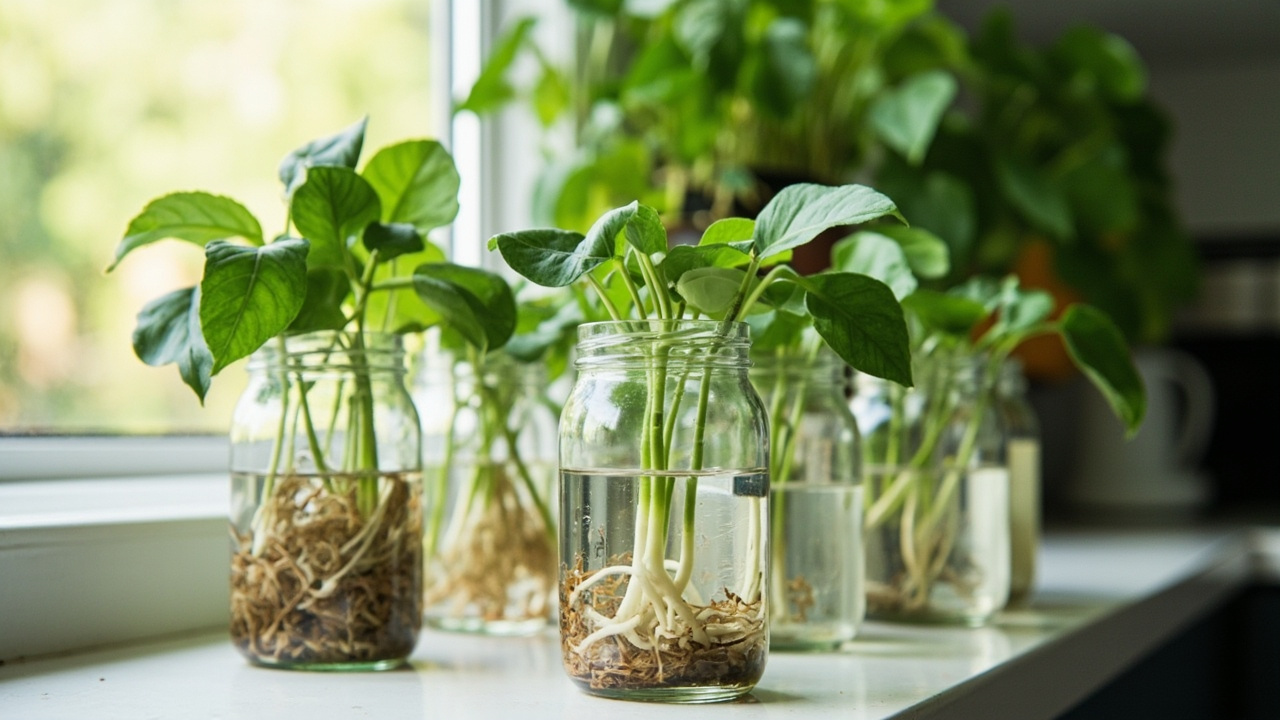
The most popular method because it’s satisfying and educational — you can watch the roots develop. Fill a glass or jar with water at room temperature. Place the cuttings in so the nodes are submerged but the leaves are not. Position the container in bright indirect light but not direct sun. Change the water every 3-4 days to prevent stagnation.
Roots appear within 1-2 weeks in warm conditions, slightly slower in cool conditions. Once roots are 2-3 inches long — not just tiny nubs, actual substantial root length — the cutting is ready to plant in soil. This typically takes 3-4 weeks total.
The main risk with water propagation: transplant shock when moving to soil. The roots that grew in water are adapted to dissolved oxygen and need to be replaced by soil roots. The transition is smoother if you plant the cutting while the root system is young, rather than waiting until the water roots are long and complex.
Water vs. Soil: Which Is Better
Soil propagation — planting cuttings directly into moist soil — works equally well and skips the transplant step entirely. The cuttings send roots directly into the medium where they’ll live. The tradeoff: you can’t see what’s happening underground, which some people find uncertain. The success rate is essentially the same for both methods.
Start with water propagation if you want to watch the process and for educational value. Move to direct soil propagation once you’re confident in the timing and conditions. The money plant care guide has the full baseline for keeping the parent plant healthy.
Soil Propagation Step by Step
Prepare a small pot — 3 or 4 inches — with the same soil mix you’d use for the parent plant. Moisten the soil until it’s damp throughout but not saturated. Make a small hole in the center. Insert the cutting so the node(s) are just below the soil surface. Firm the soil gently around the stem. Do not water for 5-7 days after planting — the cutting has no roots to absorb water yet and the soil needs to begin drying to prevent rot.
After the initial waiting period, water lightly. Then maintain normal money plant watering — water when the top inch is dry. Signs of successful rooting: the cutting maintains its firmness, doesn’t wilt further after initial expected wilting, and new growth appears at the vine tips within 3-5 weeks.
Propagation Timing
Money plants can be propagated year-round, but active growth season (spring through early fall) is most reliable. Cuttings taken in winter root more slowly and sometimes stall — the plant’s energy goes to survival rather than new root development. If you’re propagating in winter, be patient and don’t assume failure until 6-8 weeks have passed.
The Easiest Beginner Mistake
Removing too many leaves from the cutting. The cutting needs leaf surface area to photosynthesize and generate energy for root development. Removing all the leaves starves the cutting of the energy it needs to grow roots. Leave 2-3 leaves on each cutting — they’ll be slightly wilted after cutting, which is normal — and they support the rooting process.
The other common mistake: using blunt cutting tools. Always use sharp scissors or a knife. A crushed stem doesn’t take up water and is more vulnerable to rot. Clean, sharp cuts heal quickly and establish faster.
How Many Cuttings to Start
One cutting can grow into a full plant, but starting with 3-4 cuttings at once is more reliable and gives you backup plants. If some fail to root, you still have others. If all succeed, you have more plants than you know what to do with — which is the money plant’s way of telling you to give them to friends.
From Bank Statement to QuickBooks-Ready File
That manual cleanup you just read about? This tool skips it. Turn your PDF into QBO for QuickBooks without storing your data anywhere.
Start Converting