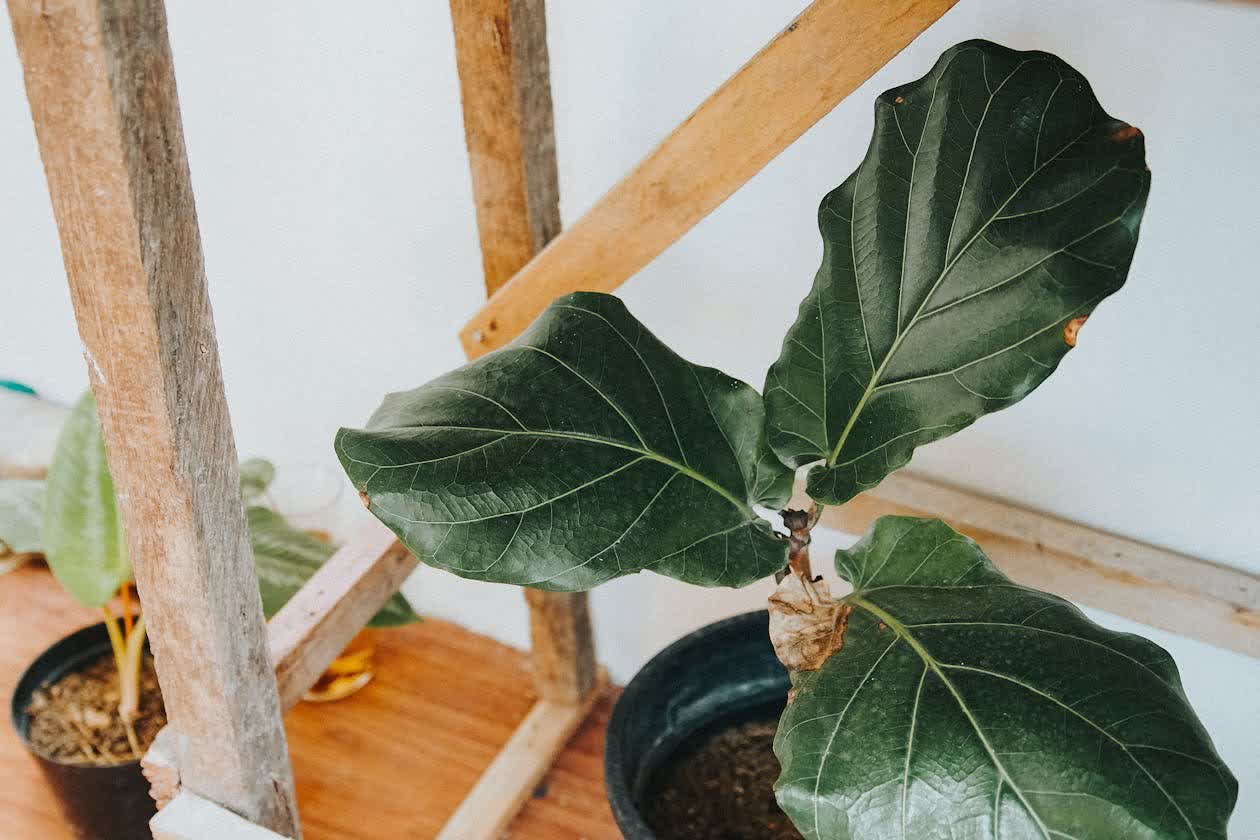

You’ve been checking your fiddle leaf fig during watering and something doesn’t look right. There are tiny dots on some of the leaves, or a sticky residue on the surface, or what looks like cotton wool where the petiole meets the stem. Before you assume it’s a watering issue, check for pests — fiddle leaf figs are a known target for several common houseplant insects.
The problem with pests on fiddle leaf figs is speed. Spider mite populations can explode from a few insects to a full infestation within a week. Scale can establish itself and cause significant damage before you’re even sure it’s there. Early identification is the difference between treating two leaves and treating the entire plant for months. For the full symptom range, fiddle leaf fig problems has the complete diagnosis guide.
Spider Mites on Fiddle Leaf Figs
Spider mites are the most common fiddle leaf fig pest and the most damaging if left untreated. They are tiny arachnids — usually about 1/50th of an inch — that live on the underside of leaves and feed by piercing leaf cells. They’re almost never visible to the naked eye until the damage is already significant.
How to Identify Spider Mites
The first sign is usually stippling — tiny yellow or bronze dots on the upper surface of the leaf, often clustered between the veins. As the infestation progresses, you may see fine webbing between the leaves and at the growing tips. In heavy infestations, the leaves look dusty or web-covered even when they haven’t accumulated actual dust.
The most reliable check: hold a white piece of paper under a suspect leaf and tap the leaf sharply. If you see tiny moving dots on the paper — red, brown, or green — those are spider mites. This takes 30 seconds and confirms the diagnosis definitively.
How to Treat Spider Mites
Spider mites hate humidity and running water. The first step is to take the plant to a sink or shower and spray it down with a strong stream of water — this physically removes many mites and clears the webbing. Do this outside or in a bathtub.
After the rinse, apply insecticidal soap according to the product instructions — spray all leaf surfaces, including the undersides, and the stems. The undersides are the critical surface. Repeat every 3-4 days for at least 2-3 weeks — spider mite eggs hatch on a 3-7 day cycle and you need to catch every generation.
Neem oil is also effective and has a slight systemic effect as the plant absorbs it. Apply with the same frequency as insecticidal soap. Raise the humidity around the plant while treating — a room humidifier or a pebble tray with water nearby makes conditions less favorable for mites without harming the plant. For more on humidity management, the fiddle leaf fig care guide covers the full environment picture.
Mealybugs on Fiddle Leaf Figs
Mealybugs are distinctive: small white to cream-colored insects about 1/10th inch long, with a waxy coating that makes them look cottony or fuzzy. They cluster in leaf axils — where the petiole meets the stem — and on the undersides of leaves along the veins.
How to Identify Mealybugs
The waxy coating is the identifier. Unlike other small insects that might appear on fiddle leaf figs, mealybugs have a visible cotton-like coating that protects their bodies. They move slowly and often stay in place once they’ve settled to feed. Look carefully at the leaf joints and the underside of the main veins.
A secondary sign is honeydew — a sticky, shiny residue secreted by mealybugs as they feed. If your fiddle leaf fig leaves feel sticky and there’s no other obvious cause, check the leaf joints for mealybugs.
How to Treat Mealybugs
For light infestations, dab each visible mealybug with a cotton swab dipped in 70% isopropyl alcohol. The alcohol dissolves their waxy coating on contact and kills them. Be thorough — every visible insect needs to be treated individually.
After the individual treatment, spray the whole plant with a dilute alcohol solution (1 part alcohol to 3 parts water) to catch anything you missed. Apply once a week for 3-4 weeks to catch hatching eggs.
For heavier infestations, insecticidal soap or neem oil applied as a foliar spray is more practical. Apply thoroughly to all leaf surfaces and stems, paying particular attention to the leaf axils where mealybugs hide. Repeat every 7-10 days for at least a month.
Scale on Fiddle Leaf Figs
Scale insects appear as small brown or tan domes — roughly 1/8th to 1/4th inch in diameter — that cling to stems and leaf surfaces. They’re often mistaken for part of the plant because their color blends with the bark of woody stems. They’re particularly common on the main trunk and older stems of fiddle leaf figs.
How to Identify Scale
Scale is distinctive in one specific way: it doesn’t move. Adult scale insects attach to a location on the plant and feed from that spot permanently. They’re not mobile the way spider mites or mealybugs are. If you see a bump on a stem that looks like part of the plant’s bark, try to scrape it off with a fingernail — if it’s scale, it will come away, often leaving a damaged spot underneath.
Soft scale (the type most common on fiddle leaf figs) produces honeydew, so sticky residue on the leaves near scale-infested stems is a secondary indicator.
How to Treat Scale
Scale’s waxy coating makes topical sprays less effective than on other pests. The most effective approach is manual removal: scrape off each scale insect with a thumbnail, soft toothbrush, or cotton swab. This is tedious but necessary for established scale.
After manual removal, spray with insecticidal soap or neem oil to kill the juvenile “crawlers” — the newly hatched scale insects that are still mobile before they establish their own protective coating. These are the ones most vulnerable to sprays. Apply the spray 7-10 days after manual removal to catch the hatching cycle.
For heavy infestations, pruning heavily infested stems is more practical than trying to salvage the tissue. Cut away the affected stems, treat the remaining plant with insecticidal soap, and dispose of the pruned material immediately.
Preventing Fiddle Leaf Fig Pest Problems
The single most effective prevention is inspection at every watering. Every time you water, take 30 seconds to check 2-3 leaves — the undersides and the leaf axils. This is the frequency that catches infestations early enough to treat without weeks of effort.
Quarantine new plants for 2 weeks before adding them to your plant collection. Most pest introductions come from bringing home a new infected plant. This costs you nothing but a separate shelf for two weeks.
Keep fiddle leaf figs healthy — a well-cared-for fiddle leaf fig in appropriate light with proper watering is less vulnerable to pest infestations and recovers from them faster.
If you’ve had pest problems before, a monthly wipe-down of the leaves with a damp cloth removes dust and any early insects before they can establish. It’s preventive, it’s free, and it also keeps the leaves looking better — so it’s worth doing anyway.
From Bank Statement to QuickBooks-Ready File
That manual cleanup you just read about? This tool skips it. Turn your PDF into QBO for QuickBooks without storing your data anywhere.
Start Converting