Light is the factor that most determines whether a fiddle leaf fig thrives or merely survives. Watering, humidity, and soil are important, but no amount of careful care in other areas compensates for insufficient light. Understanding exactly what kind of light fiddle leaf figs need — and how to recognize when they are not getting it — is the foundation of success with this plant.
What Fiddle Leaf Figs Need
Fiddle leaf figs are rainforest understory plants. In the wild, they receive filtered light through the forest canopy — bright but never direct. This means the ideal indoor position is bright indirect light: several hours of good light per day, diffused through a curtain or arriving from an angle rather than directly from a window.
The most reliable positions are east-facing windows, where the morning sun is gentle and the plant receives ambient light for most of the day. South or west-facing windows work if the plant is placed a few feet back from the glass or behind a sheer curtain that diffuses the direct rays. North-facing windows are generally too dark for fiddle leaf figs, particularly in winter.

Signs of Insufficient Light
A fiddle leaf fig in insufficient light grows slowly or not at all, produces small new leaves, and loses the deep green colour that makes it attractive. The leaves may become more uniformly green as the plant compensates for low light by producing more chlorophyll. The stems may become leggy — elongated with widely spaced leaves — as the plant reaches toward whatever light is available.
The most important sign: new growth is small, pale, or slow. A healthy fiddle leaf fig in good light produces a new leaf every three to four weeks during the growing season. If the plant has not produced a new leaf in two months or more, the light is likely the limiting factor.
Signs of Too Much Light
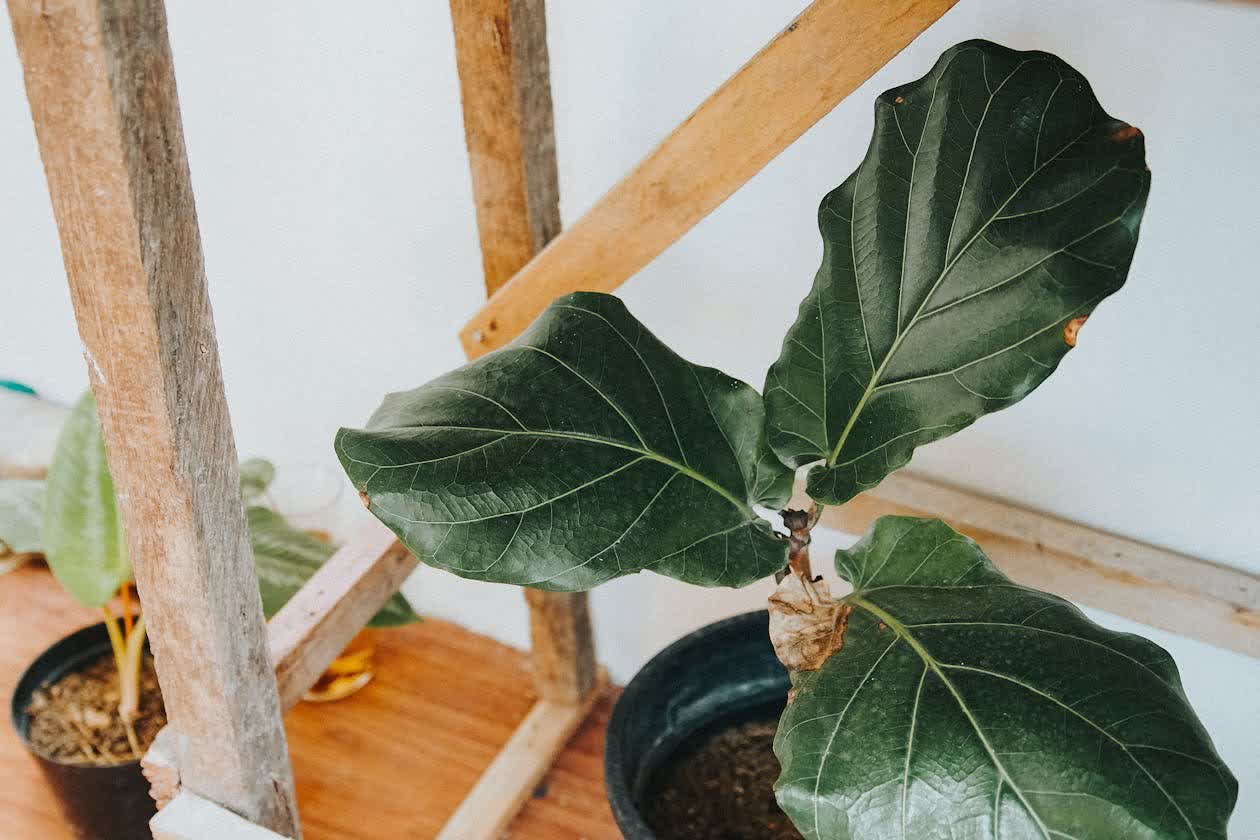
Direct afternoon sun — the kind that comes through west-facing windows in the afternoon — burns fiddle leaf fig leaves. The damage appears as large, dry, brown patches on the sun-facing side of the plant, often with a bleached appearance at the edges. The leaves on the side closest to the window will show the damage first and most severely.
If the leaves are warm to the touch in afternoon sun, the position is too bright. Move the plant back or filter the light with a curtain. The existing damaged leaves will not recover, but the plant will produce clean new growth once it is in a better position.
The Position Rule
Once you find a position where your fiddle leaf fig is growing well — producing new leaves regularly, maintaining deep green colour, no brown patches — do not move it. Fiddle leaf figs are famously sensitive to position changes. Even moving the plant a few feet across a room can trigger leaf drop. The leaves you see on a fiddle leaf fig are the result of conditions from several weeks ago, not today — the plant responds to changes slowly, and the lag makes it difficult to diagnose problems after the fact. Choose the position carefully, put the plant there, and leave it.
Growing Fiddle Leaf Figs in Low Light
If your space genuinely has insufficient natural light — a windowless room, a north-facing room without any other light sources — a fiddle leaf fig will not thrive without supplementation. LED grow lights positioned 12–18 inches above the plant for 10–12 hours per day can provide enough light for active growth. A standard reading lamp positioned close to the plant also helps. Without supplemental light, a fiddle leaf fig in a dark room will gradually decline.
Seasonal Light Changes
Light levels in a room change with the seasons. A fiddle leaf fig that is perfectly positioned in summer may be too dark in winter when the sun is lower and the days are shorter. Watch for a slowdown in growth in autumn and winter — this is normal, but if the plant stops producing new leaves entirely by mid-winter, the light may have dropped below the threshold the plant needs. Moving it to a brighter position for winter can make a meaningful difference.
Turn That PDF Into a Spreadsheet in Minutes
You've seen how to do it manually — now let the tool handle the heavy lifting. Upload your bank statement and get Excel, CSV, or QBO in a few clicks.
Try It Free