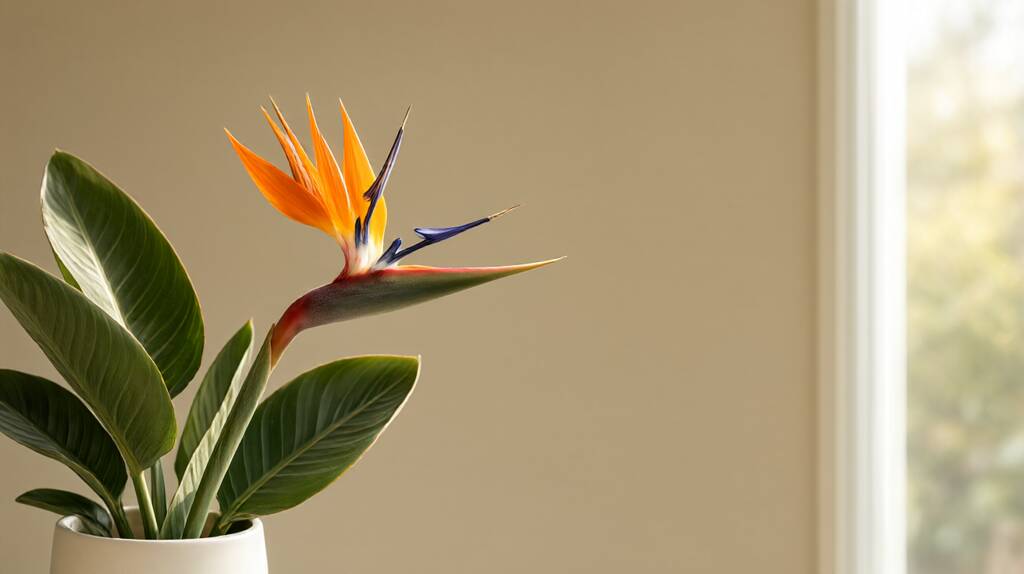

A bird of paradise does not need the same care in January as it does in July. The plant reads the season through day length and temperature, and its needs shift with them: more water and food in summer when it is growing, less in winter when it is resting. A care routine that ignores the season is not a routine. It is a guess, and the plant pays for the guess with yellow leaves, dropped buds, and a slow decline that looks like a disease but is actually a calendar problem.
Two failure modes follow. The first is feeding a resting plant in winter, which produces soft growth that collapses when spring arrives. The second is letting a growing plant go dry in summer, which aborts the flower buds that were forming on the rhizome. Both come from treating the plant as if every month were the same month.
Most growers also get the move wrong. They bring the plant inside too late in autumn, after a cold night has already damaged the roots, or put it outside too early in spring, before the nights are warm enough. The plant survives both errors, but it loses a season of growth each time.
The Annual Rhythm of a Bird of Paradise
Strelitzia reginae follows a subtropical rhythm. It grows actively when days are long and warm, and it rests when days are short and cool. In a temperate garden, that rhythm maps onto the seasons: growth from March through September, rest from October through February. The plant does not stop in winter, but it slows to a crawl, and the care it needs drops to match.
The rhythm is driven by two signals. Day length tells the plant when to grow. Temperature tells the plant how fast. A plant in a warm room with short days grows slowly. A plant in a cool room with long days grows slowly. Only when both signals say go does the plant hit its stride. This is why a bird of paradise in a south window in July can add a leaf a month, and the same plant in the same window in December can sit motionless for weeks.
The practical consequence is that care is not a fixed schedule. It is a response to the plant’s state, and the plant’s state follows the season. Water more when the plant is growing and the days are long. Water less when it is resting and the days are short. Feed when growth is active. Stop when it is not. The calendar is a reminder, not a rule.
The winter rest is not optional
A bird of paradise that is kept warm and fed through winter never fully rests, and a plant that never rests never flowers well. The winter rest of four to eight weeks at 10 to 15 degrees Celsius, with reduced watering and no feeding, is the trigger that sets the flower buds for the following spring. Skip the rest and you get a plant that grows leaves forever and never blooms.
Care is a response to the plant’s state, and the plant’s state follows the season.
Spring: Wake-Up and Feed
Spring is the restart. As the days lengthen and the soil warms, the plant comes out of rest and begins to push new growth. This is the moment to repot if needed, to resume feeding, and to move the plant to its summer position. Do all three in the same week, and the plant has the whole season to recover.
Resume feeding with a balanced 10-10-10 or 20-20-20 formula at half strength, every two weeks. Increase to full strength after the first new leaf appears. The first new leaf is the signal that the plant is out of rest and can use the nutrients. Feeding before that point wastes fertilizer and risks burning roots that are not yet active.
Watering increases in spring but not all at once. Start at once a week and move to twice a week as the days lengthen and the plant begins to transpire more. Check the soil before each watering: the top 5 centimeters should be dry. If they are not, wait. For the full watering method, including how to read the soil and when to skip, see our guide on how often to water bird of paradise.
The spring repotting window
If the plant is root-bound, repot in early spring, just before the growth flush. The plant will have the whole growing season to re-establish, and the disturbance is least damaging when the plant is waking up, not when it is resting. For the full repotting method, including pot size and soil mix, see our guide to bird of paradise soil and repotting.
Resume feeding only after the first new leaf appears in spring.
Summer: Peak Growth and Water
Summer is the plant’s productive season. Growth is fastest, water use is highest, and feeding is most important. A plant in full sun in July can use as much water in a day as it used in a week in January. The failure mode is underwatering a plant that is working hard, which shows as curling leaves and aborted buds.
Water when the top 5 centimeters of soil are dry, which in a bright, warm room means every four to seven days. In a hot, dry room or on a sunny balcony, it may mean every two to three days. The soil should never stay dry for long, but it should never stay wet either. Water thoroughly until it drains, then let the surface dry before watering again.
Feed every two weeks at full strength with a balanced fertilizer, or monthly with a slow-release granular formula. If you are chasing flowers, switch to a fertilizer higher in phosphorus and potassium in midsummer. If you are chasing leaves, keep the balanced formula. For the full feeding schedule and the fertilizer types that work, see our guide to bird of paradise fertilizer schedule.
Summer pests and heat
Spider mites and scale love a hot, dry summer room. Check the undersides of leaves weekly. If you see fine webbing or sticky residue, wash the leaves with a strong spray of water and treat with neem oil or insecticidal soap. Heat stress shows as bleached or scorched leaves; move the plant back from the glass or add a sheer curtain during the hottest hours.
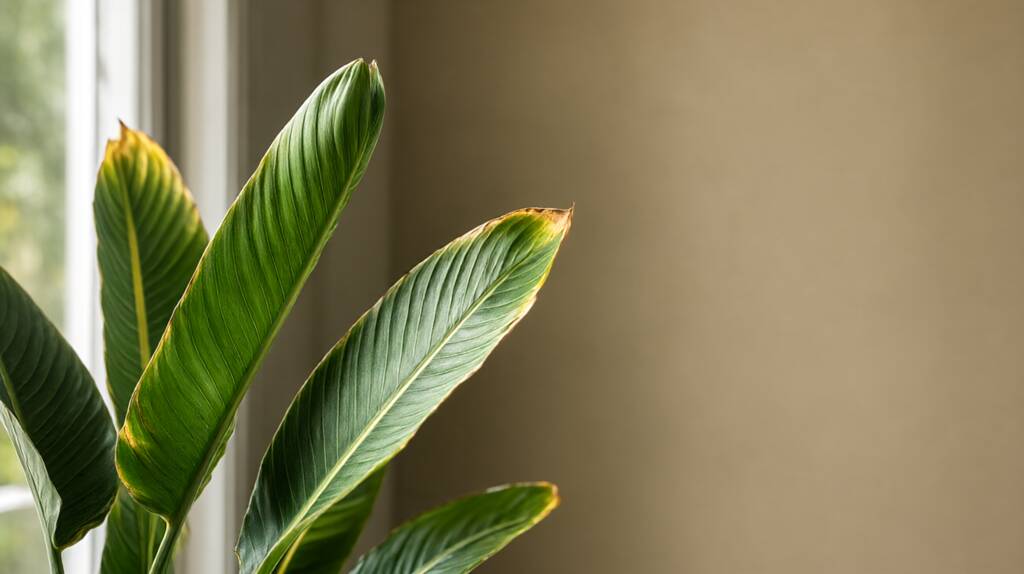
Summer is peak growth: water every four to seven days and feed every two weeks.
Autumn: Slow Down and Move In
Autumn is the transition. Growth slows as the days shorten, and the plant begins to prepare for rest. Feeding should taper: switch to half strength in early autumn and stop entirely by mid-autumn. Watering should taper too, from twice a week to once a week, then to once every ten days as the plant slows.
If the plant spent the summer outdoors, bring it inside before night temperatures drop below 10 degrees Celsius. Do not wait for a frost warning. A cold night damages the roots before it damages the leaves, and the damage is invisible until spring. Bring the plant in early, and give it a week in a bright, cool room to adjust before moving it to its winter spot.
Autumn is also the time to check for pests before bringing the plant indoors. Scale and mealybugs hide in the leaf bases and travel inside with the plant. Inspect thoroughly, and treat any infestation before the plant comes in. A pest problem that is minor outdoors becomes a major problem in a warm, dry winter room.
The autumn prune
Remove dead or damaged leaves in autumn, cutting at the base of the leaf stalk with a clean, sharp blade. Do not remove healthy leaves, even if they look tired. The plant needs every leaf it has for the winter rest. For the full pruning method, including how to remove dead leaves and manage size, see our guide to bird of paradise pruning and size control.
Bring the plant inside before nights drop below 10 degrees Celsius, and check for pests first.
Winter: Rest and Light
Winter is the rest period, and the care should match. Stop feeding entirely. Reduce watering to once every two to three weeks, and only when the soil is dry 5 centimeters down. The plant is not growing, so it is not using water, and wet soil in winter is the fastest way to rot the roots.
Light becomes the limiting factor in winter, even in a bright room. Day length drops to eight or nine hours, and the sun sits low. Move the plant to the brightest spot available, and consider a grow light if it is in a dim room. The plant will not grow much, but it needs enough light to maintain its leaves through the rest.
Temperature should be cool but not cold. The ideal winter rest is 10 to 15 degrees Celsius, which is cooler than most living rooms. A spare room, an enclosed porch, or a bright garage can work. If the plant must stay in a warm living room, it will not rest fully, and flowering the following spring will be reduced. For the full temperature tolerance breakdown, including what happens below 5 degrees, see our guide to bird of paradise temperature tolerance.
The winter humidity trap
Indoor heating drops humidity to 20 to 30 percent in winter, and a bird of paradise in a dry room loses leaf tips and edges. The fix is not misting, which does not raise ambient humidity. The fix is a humidifier, a pebble tray, or grouping plants together. For the full humidity method, including target ranges and how to measure, see our guide to bird of paradise humidity requirements.
Winter rest means no feed and water only every two to three weeks.
Monthly Checklist
| Month | Water | Feed | Move / action |
|---|---|---|---|
| January | Every 2-3 weeks | None | Brightest spot, rest mode |
| February | Every 2 weeks | None | Watch for first new leaf |
| March | Weekly | Half strength | Repot if root-bound |
| April | Weekly | Half strength | Move outdoors if nights above 12 C |
| May | 1-2x weekly | Full strength | Full sun, stake if needed |
| June | 2x weekly | Full strength | Peak growth, pest check |
| July | 2x weekly | Full strength | Heat stress watch |
| August | 2x weekly | Full strength | Switch to bloom formula if flowering |
| September | Weekly | Half strength | Taper feeding |
| October | Every 10 days | None | Bring indoors before 10 C nights |
| November | Every 2 weeks | None | Pest check, prune dead leaves |
| December | Every 2-3 weeks | None | Rest mode, bright light |
The schedule is a starting point, not a contract. The plant decides the pace; the calendar only reminds you to look.
Adjusting for Your Climate
The schedule above assumes a temperate climate with four distinct seasons. In a subtropical climate, the rhythm compresses: growth is nearly year-round, and the rest period is shorter and less pronounced. In a tropical climate, the plant grows continuously and the concept of a winter rest does not apply; instead, care follows the wet and dry seasons.
In a cold climate where the plant lives indoors year-round, the rhythm is driven by light and temperature rather than by outdoor weather. The plant still needs a rest period, but it comes from reducing watering and feeding in winter, not from moving the plant. The key is to give the plant a period of reduced care, even if the room is warm.
For indoor plants, the most important adjustment is light. A plant in a dim room in winter needs less water and no feed, regardless of the month. A plant under a grow light in winter may behave as if it were spring. Watch the plant, not the calendar, and adjust accordingly.
When to ignore the schedule
Ignore the schedule when the plant tells you to. A plant that is actively growing in January needs water and feed, even if the calendar says rest. A plant that is dormant in June needs less care, even if the calendar says peak growth. The schedule is a default; the plant is the authority. For the full cultivation method that underlies this schedule, see our growing guide for bird of paradise.
Adjust for your climate, and ignore the schedule when the plant tells you to.
From Schedule to the Rest of the Cluster
A schedule is only as good as the decisions behind it. Timing sets when to plant. Light sets where. Water and feed set the rhythm. Soil and repotting set the foundation. Temperature and humidity set the environment. Each has its own page, and each decision builds on the one before it. Start with timing, add light, then water, then feed, then soil. When something goes wrong, the common problems guide and the rescue guide are the next reads.
The plant remembers the rain forest. Your apartment just needs to remind it.
For planting timing by climate and season, see our guide on when to plant bird of paradise.
Key thresholds: 10-15 C winter rest, 12 C minimum, 4-8 week rest length, 5 cm dry test, 18-24 C room temp, 8-9 h winter day length, 2-3 week winter water, 2 week spring feed, 4-7 day summer water, 10 C bring-inside threshold.
The schedule is a starting point; the plant is the authority.
For the winter protocol and cold protection, see our guide to overwintering bird of paradise.
For pot size, material, and drainage, see our guide to bird of paradise container and pot selection.
Sources and further reading
- Royal Horticultural Society, Strelitzia reginae: cultivation and seasonal care notes.
- University of Florida IFAS Extension, Strelitzia reginae: culture and maintenance.
- North Carolina State Extension, Strelitzia reginae: plant profile and care requirements.
Last reviewed on 2026-11-24.