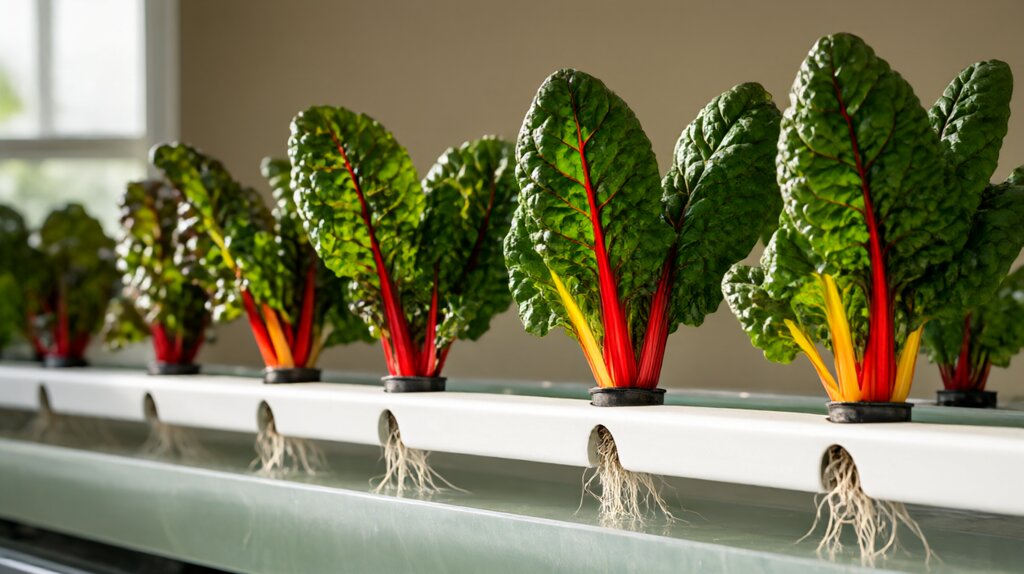

Hydroponic Swiss chard is the crop that stays productive when the rest of the garden is bolting. It tolerates more heat than arugula or bok choy, it cuts and comes back three or four times, and a single plant can feed you for two months if you harvest it right. The catch is that chard is a deep-rooted, wide plant that punishes crowding and overfeeding with the same tip burn you see on every other brassica and beet relative.
Swiss chard is a beet relative with thick, fleshy stems and a tolerance for warmth that most leafy greens do not have. Run it at 1.8 to 2.3 mS/cm EC, hold pH at 6.0 to 6.5, keep the reservoir between 18 and 20C, give 12 to 14 hours of light, and cut at 30 to 60 days. That is the whole recipe. Everything below is the reason each number exists.
What Hydroponic Swiss Chard Needs From You
Beta vulgaris subsp. cicla, sold as Swiss chard, chard, or silverbeet, is a cool-season beet relative with a long harvest window and a real tolerance for warmth. It wants a cool reservoir, a moderate feed with enough potassium for the stems, and room to spread. Give it those three things and it is one of the most productive crops in a home system. Crowd it or overfeed it and it will burn at the tips and bolt within six weeks.
- Temperature: 18 to 24C in the canopy for a productive crop, with the plant tolerating brief spikes above 27C better than arugula or bok choy. The reservoir band is 18 to 20C, cooler than the air because chard roots are sensitive to warm water even when the leaves look fine.
- Feed strength: 1.8 to 2.3 mS/cm EC, sitting above the band you would run for arugula or lettuce and below the band you would run for peppers or tomatoes.
- pH: 6.0 to 6.5, the window most leafy greens occupy, because a beet relative at a pH it cannot use stops taking up the iron and magnesium it needs for dark green leaves.
- Light: 12 to 14 hours a day, with chard tolerating up to 16 hours without the bitterness that hits arugula under the same light.
- Cycle: 30 to 40 days for baby chard, 50 to 60 days for full heads, with cut-and-come-again harvests extending a single plant for 8 to 10 weeks.
Swiss chard is a crop you size by space, not by tonnage. A single plant can fill a 30 cm gap and produce for two months, so the plan you make for chard is a spacing plan first and a feeding plan second.
The Nutrient Band: EC, pH, and the Potassium Problem
The EC Ceiling
The EC band for Swiss chard is a ceiling rather than a target. IGWorks lists chard at 1.8 to 2.3 mS/cm, and urbanhydrospace notes that leaf edges burn above 2.3 while growth slows below 0.8. The acquaponica guide puts the band at 1.5 to 2.4 mS/cm with the water at 18 to 20C. The practical read is that 1.8 to 2.3 is the band where the plant grows fast without burning the leaf edges.
That sits above hydroponic arugula, which peaks at 1.5 to 1.8 and punishes anything above it, and above hydroponic bok choy, which runs at 1.5 to 2.0. Swiss chard behaves like a medium to heavy feeder with a real ceiling: it uses more than the brassicas, but it does not want the strength you would give a fruiting crop. Push the EC past 2.5 and you buy tip burn and bitter stems, not size.
Swiss chard has a real ceiling, not a low target. The band is narrow because the plant changes chemistry when you push it, and that change arrives faster than the size gain you were hoping for.
Potassium Is What Makes the Stems Thick
Potassium drives stem thickness and color intensity in chard. A mix low in potassium produces thin, pale stems and leaves that look fine but lack the crispness you want. A mix at 150 to 200 ppm potassium gives the plant what it needs for thick, vivid stems without pushing the EC past the ceiling. If your nutrient stock is potassium-light, top up with a potassium sulfate source rather than running the stock at full strength.
For reference, the Salve University Bright Lights Swiss Chard Hydroponic Grow Guide (Anderson, 2023) targets pH 6.5 and runs a standard hydroponic nutrient mix, which lands inside the 6.0 to 6.5 band most home growers use. Oklahoma State University Extension publication HLA-6722 lists beets and chard relatives in the 1.8 to 2.2 mS/cm band, which matches the home-gardener consensus.
The Calcium Problem Nobody Warns You About
Tip burn on Swiss chard is almost always a calcium problem, and it is almost always caused by the grower, not the nutrient. Calcium moves with transpiration, so a plant in still air, high humidity, or warm water takes up less calcium even when the solution is rich in it. The leaf edges brown and curl because the new tissue cannot finish forming. The fix is airflow and temperature, not more calcium in the reservoir. Run a small fan, keep the reservoir cool, and the burn stops before it starts.
Tip burn is a transpiration problem, not a feeding problem. Add more calcium to a tank that the plant cannot move, and you have spent money on a problem you created with still air.
Which System Fits Swiss Chard
Deep Water Culture and Raft Systems
DWC and raft systems suit Swiss chard best. Chard has a deep, spreading root system that wants room, and a deep reservoir keeps the roots cool and stable. NFT works but the channel must be wide and deep enough to let the roots spread, and the plant outgrows a shallow channel within four weeks. If your system is shallow, plan on harvesting baby chard at 30 days instead of waiting for full heads.
Kratky, the passive method with no pump, also works for Swiss chard because the crop finishes before the reservoir runs dry. It is the lowest-effort option for a single plant on a windowsill, and it is the method most likely to fail if the water warms past 24C in a sunny spot.
Spacing Inside the System
Swiss chard is a wide plant. Space heads 25 to 30 cm apart, and do not crowd them to save space. A crowded system shades the lower leaves, traps humidity, and invites the tip burn you were trying to avoid. If you want more yield per system, grow baby chard at 15 to 20 cm spacing and cut at 30 days instead of waiting for full heads.
For a broader view of where chard sits among the crops worth growing, see best plants for hydroponics and hydroponic nutrient schedule for the weekly feeding rhythm that keeps the EC steady through the crop.
Starting Swiss Chard From Seed
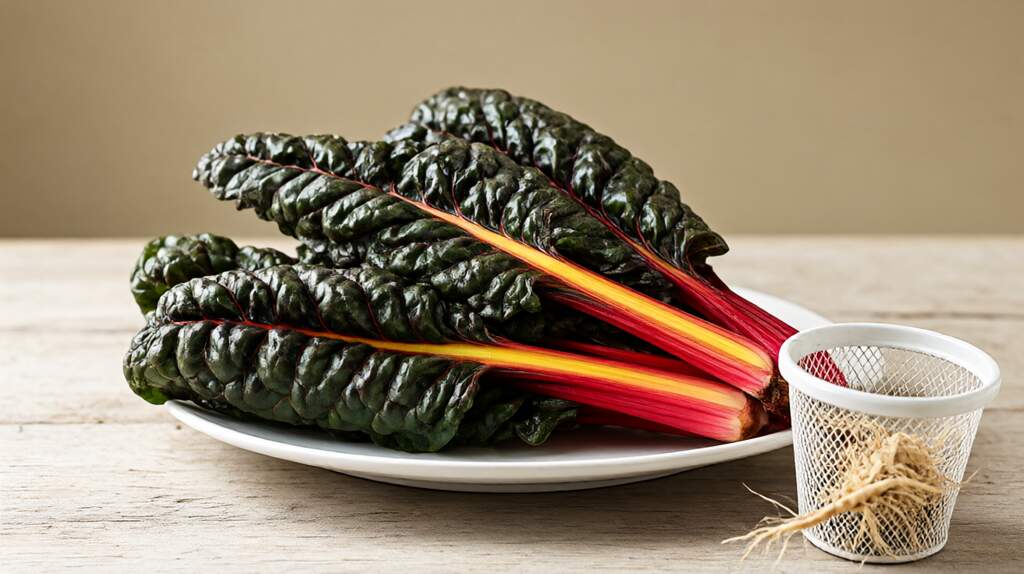
Germination is the easy part. Swiss chard seed sprouts in 5 to 7 days at 18 to 24C, and the only failure mode is temperature: seed held above 27C either fails to sprout or produces weak, stretched seedlings. Sow into rockwool or a coco plug, keep the cube moist but not waterlogged, and move the seedling to the system as soon as the first true leaf appears, usually 10 to 14 days after sowing.
Do not start Swiss chard in a warm spot and move it to a cool system. The seedling adapts to the temperature it germinates in, and a plant started at 27C will stall when it meets 18C water. Start it cool, or start it where it will finish.
Start Swiss chard where it will finish. The seedling remembers the temperature it germinated in, and a warm start is a stalled transplant.
The Light Question: Where Fresh Weight Lies to You
Swiss chard needs 12 to 14 hours of light a day, and it tolerates more light than most leafy greens without turning bitter. Below 10 hours the plant stretches and the stems stay thin. Above 16 hours the plant keeps growing but the leaves darken and the stems toughen, the same chemistry that makes arugula harsh when it is stressed. The sweet spot is 12 to 14 hours, and the difference between 12 and 14 is mostly size, not flavor.
If you are growing under LEDs, a PPFD of 150 to 250 micromoles per square meter per second is the band where Swiss chard grows fast without burning. Higher light pushes the plant toward flowering, and a chard that flowers is a chard you have already lost.
The Four Mistakes That End Most Swiss Chard Crops
- Warm water. A reservoir above 24C is the single biggest cause of bolting and poor quality. Swiss chard tolerates warm air better than arugula, but the roots do not. Keep the water below 22C, and chill it if your room runs warm.
- Tip burn from still air. Brown, curling leaf edges are calcium deficiency from poor transpiration, not a missing nutrient. Add airflow before you add calcium.
- Overfeeding. EC above 2.5 buys bitterness and burn, not size. Hold the band at 1.8 to 2.3 and let the plant grow at its own pace.
- Crowding. Heads spaced too close shade each other, trap humidity, and invite the tip burn you were trying to avoid. Give them 25 to 30 cm.
Most Swiss chard failures are temperature failures dressed up as feeding problems. Fix the water temperature first, and half the problems on this list never appear.
Harvesting Swiss Chard: Cut Early, Cut Often
Baby Swiss chard is ready at 30 days, full heads at 50 to 60 days. Cut the outer leaves first and leave the center growing, or cut the whole head at the base with a clean knife. The cut-and-come-again method gives you three or four harvests from a single plant over 8 to 10 weeks, and the regrowth is only slightly smaller and more bitter than the first cut.
Harvest before the plant bolts. Once the center elongates and the leaves tighten, the head is still edible but the flavor has shifted from mild to sharp. A bolting Swiss chard is a Swiss chard you should have cut a week ago.
The Numbers That Decide a Swiss Chard Harvest
- EC: 1.8 to 2.3 mS/cm, ceiling 2.5.
- pH: 6.0 to 6.5.
- Reservoir temperature: 18 to 20C.
- Air temperature: 18 to 24C, tolerating brief spikes above 27C.
- Light: 12 to 14 hours, PPFD 150 to 250.
- Potassium: 150 to 200 ppm.
- Spacing: 25 to 30 cm for full heads, 15 to 20 cm for baby.
- Cycle: 30 days baby, 50 to 60 days full head, 8 to 10 weeks cut-and-come-again.
Sources and further reading
- IGWorks, “Growing Hydroponic Swiss Chard”: EC 1.8 to 2.3 mS/cm, pH 5.5 to 6.8, leaf edges burn above 2.3.
- UrbanHydroSpace, “Hydroponic Swiss Chard: EC, Containers and Harvest Guide”: pH 5.5 to 6.8, working target 6.2 to 6.5, growth slows below 0.8.
- Acquaponica, “Chard in hydroponics: EC, pH, yield and complete guide”: EC 1.5 to 2.4 mS/cm, pH 6.0 to 6.5, water 18 to 20C.
- Salve University, “Bright Lights Swiss Chard Hydroponic Grow Guide” (Anderson, 2023): target pH 6.5, standard hydroponic nutrient mix.
- Oklahoma State University Extension, HLA-6722, “Hydroponic Vegetable Production”: beets and chard relatives 1.8 to 2.2 mS/cm.
- Hydroponic reservoir water temperature by crop for the per-crop temperature table.
- Hydroponic arugula, hydroponic bok choy, and hydroponic kale for the other cool-season crops.