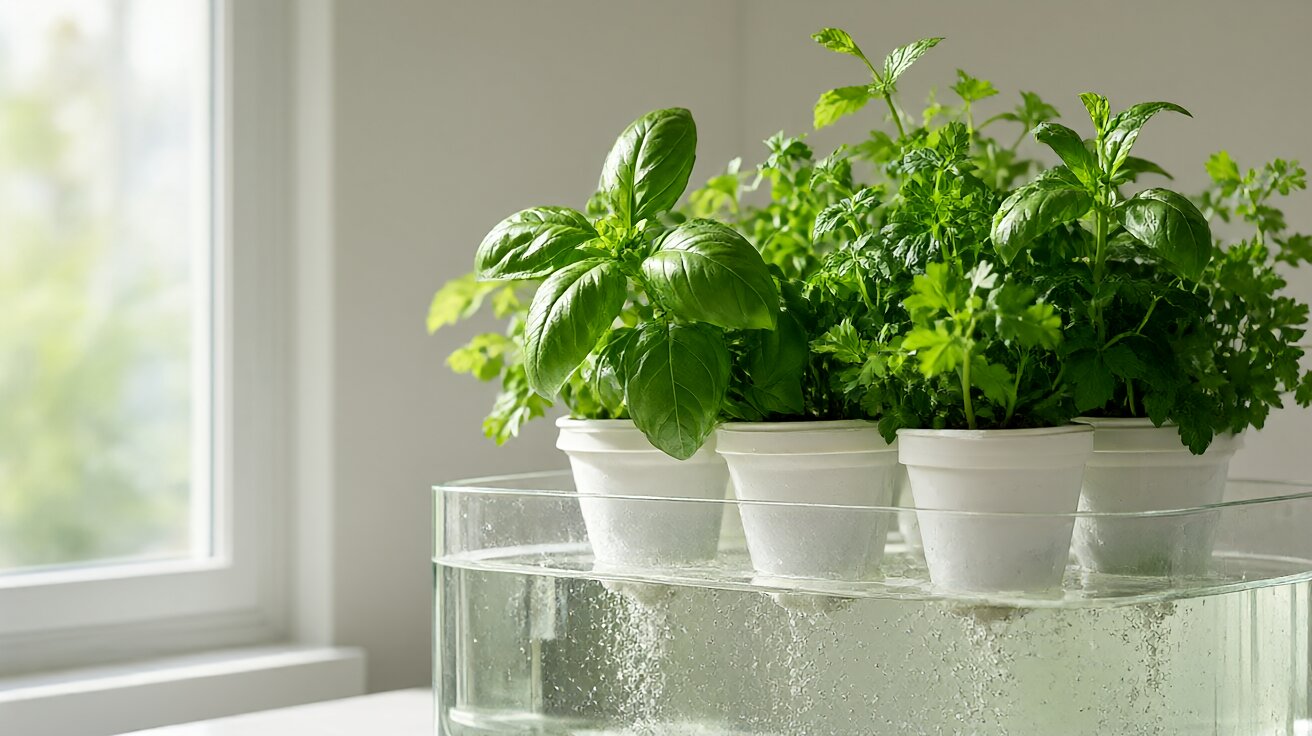

Hydroponic herbs need three numbers before anything else: nutrient solution at EC 1.0 to 1.6 mS/cm, pH between 5.5 and 6.0, and a reservoir held between 65 and 70 F (18 to 21 C). Get those right and a mixed herb crop will keep cutting for months off one bucket of solution. But there is a catch almost nobody writes down: the feed that grows the heaviest basil is not the feed that tastes best.
The reason sits in how a leafy herb spends its carbon. A basil plant with plenty of nitrogen pushes that carbon into leaf area, and the fraction held back as phenolic compounds and other antioxidants is what makes basil taste like basil. So a solution strong enough to push maximum leaf growth dilutes the very compounds you are growing the herb for. That trade-off is measurable, it runs opposite to what most feeding guides assume, and it reverses in the last three days before you cut.
What Hydroponic Herbs Ask of a Reservoir
A herb crop is a leafy crop with a short clock and a wide range of needs. Basil is vigorous and space-hungry, mint is so aggressive that expect it to take the light inside a single season if left unchecked, parsley is slow and wants a stronger feed than its neighbours, and cilantro and dill bolt out of a warm reservoir before you have made a meaningful harvest. A fruiting crop in the same room pulls the reservoir in a different direction entirely.
Kratky and deep water culture suit this crop class, because culinary herbs are shallow-rooted, fast, and small enough that one bucket carries several of them. The comparison of the seven hydroponic systems puts leafy greens and herbs in the DWC and Kratky column for exactly that reason, so the system choice is rarely the limiting factor, and the first ninety days of a new hydroponic system is worth reading before you buy expensive herbs.
Spacing follows the mature canopy: six to eight inches (15 to 20 cm) between centres for chives and small herbs, eight to twelve inches (20 to 30 cm) for basil and anything that branches. The spacing guide adds the rule that matters more than the table: seedlings go in once they carry three to four true leaves, because a root system that starts too small never catches up.
One reservoir means one EC, and these herbs would each prefer a different number: parsley wants EC 1.8 to 2.2 mS/cm, basil and sage 1.0 to 1.6, and the extension tables give no band for mint or cilantro at all.
The site’s own nutrient schedule resolves the conflict the way most growers do in practice: set the target to 1.2 mS/cm for a mixed reservoir and let the basil pull the others along. That number sits on the flavour side of the curve explained below. A fruiting crop in the same reservoir, such as hydroponic strawberries, reshapes every other number in the other direction.
Starting From Seed: Germination and Transplant
Basil germinates in about five to seven days when the medium sits at 70 to 75 F, and the medium temperature matters more than the air around it. A tray that drops to 50 F stunts the seedlings and blackens the leaves, and the damage carries into the transplant.
Parsley germinates slowly and unevenly, then rewards patience with a plant that produces for months. Cilantro and dill behave similarly and prefer to be sown where they grow, because their taproot dislikes disturbance. Mint is easiest from a rooted cutting, since the same vigorous root that makes it a problem in a bed makes it a fast start in a net pot.
Transplant timing is the same story in every case: three to four true leaves, roots washed clean of potting media, and a net pot with enough volume for the root mass. A basil seedling that starts in a two inch pot will still be a small basil in three months.
The Numbers by Crop
Not every herb has a published band, and a table that pretends otherwise is worse than no table. Here is what the sources actually carry.
| Herb | EC (mS/cm) | pH | What the source publishes |
|---|---|---|---|
| Basil (Ocimum basilicum) | 1.0 to 1.6 | 5.5 to 6.0 | Oklahoma State University Extension crop table |
| Sage (Salvia officinalis) | 1.0 to 1.6 | 5.5 to 6.5 | Oklahoma State University Extension crop table |
| Parsley (Petroselinum crispum) | 1.8 to 2.2 | 6.0 to 6.5 | Oklahoma State University Extension crop table |
| Cilantro (Coriandrum sativum) | No published band | Not published | Growth unchanged across EC 0.5 to 4.0 in an Iowa State trial |
| Dill (Anethum graveolens) | No published band | Not published | Growth unchanged across EC 0.5 to 4.0 in an Iowa State trial |
| Mint (Mentha spp.) | No published band | Not published | Not in the extension crop table; start at the basil band |
Two things fall out of that table. The general hydroponic guidance of pH 5.0 to 6.0 and EC 1.5 to 3 dS/m applies cleanly to basil and sage but sits awkwardly against parsley, and three of the six herbs in a typical mix have no published band at all, which means the mixed-reservoir number is a negotiated compromise rather than a published recommendation, and the crop to system picker is worth a look before you commit.

Why More Fertilizer Does Not Mean More Flavor
What the peer-reviewed numbers show
A 2022 study in Horticulturae put basil through five nutrient solution strengths from EC 0.5 to 5.0 dS/m. Yield peaked at EC 3.0 dS/m, while leaf total phenolic content and antioxidant capacity at EC 0.5 and 1.0 dS/m were significantly higher than at 3.0 and 5.0. The heaviest basil came from the strongest solution, and the best-tasting basil from the weakest one.
That is not a laboratory curiosity. It is the mechanism behind a widely reported kitchen result, that the most heavily fed basil is the blandest basil, and it explains why the extension tables put basil at 1.0 to 1.6 mS/cm rather than higher.
Why the home number sits lower
The trial ran in a plant factory under high-intensity electric light, where a strong solution pays off because that light converts extra nitrogen into extra leaf area. A kitchen windowsill cannot, and the easiest indoor herbs to grow are limited by light rather than by feed. So EC 3.0 dS/m is a ceiling figure from a different growing environment, not a target.
The Three-Day Finish Before Harvest
The same study ran a second experiment: basil grown at EC 3.0 dS/m for thirteen or fifteen days was switched to plain water or a low EC solution for three or five days before harvest, and those short low-strength treatments significantly increased leaf phenolic content and antioxidant capacity without reducing yield.
You do not sacrifice a harvest to get it. You simply stop feeding the plant hard in the last few days before you cut and let the carbon that was going into leaf area go into compounds instead.
How to run the finish
- Run your normal feeding strength until three to five days before you plan to cut a full harvest.
- Stop adding nutrient solution. Top up with plain water only, and keep the EC reading where it is rather than chasing a specific number.
- Do not change the pH target, the reservoir temperature, or the light during the finish. Those three stay constant so the only variable is feed strength.
- Cut the whole plant back hard on day three or day five, then resume feeding normally for the next flush.
Two honest caveats. The published work was done at plant factory light intensity, so whether a home crop shows the same magnitude of change is genuinely unknown. And the effect is a quality change, not a weight change, so it will never show up in a yield figure.
Light Is the Lever, Not the Feed
For three of the herbs in a typical mixed reservoir, feed strength is close to irrelevant. An Iowa State trial grew cilantro, dill, and parsley across EC 0.5 to 4.0 dS/m and found no growth response to the nutrient solution at all, then raised the daily light integral from about 7 to about 18 mol per square metre per day and fresh mass jumped by 21.0 g in cilantro, 17.1 g in dill, and 13.3 g in parsley.
What DLI means in a home setup
The working target for vegetables and herbs under electric light is 12 to 17 mol per square metre per day. Sixteen hours at roughly 250 micromoles per square metre per second delivers about 14.4 mol per day.
The reason this matters for herbs specifically is that light controls the oil, not just the leaf. A glasshouse trial found that a daily light integral of 5.3 mol reduced photosynthesis, leaf area, shoot fresh weight, and total essential oil concentration together.
Temperature, Bolting, and the Reservoir You Share
Basil has the narrowest temperature band of any crop on the site at 65 to 70 F, the same figure the reservoir temperature guide by crop lists for it. Above 72 F with low dissolved oxygen, Pythium root rot sets in within 48 hours.
Why cilantro bolts and what you can do about it
Cilantro bolts when soil temperature goes above 75 F, and direct-seeded cilantro runs eight to ten weeks before it bolts. In a raised bed you cannot cool the soil easily. In a reservoir you can, because the root zone is a bucket of water whose temperature you control, and holding the solution at 65 to 70 F buys you weeks of leaf harvest from the same plant.
That is the single biggest advantage a hydroponic reservoir has over a bed for this crop, and the argument for growing cilantro and basil separately if you can afford two buckets.
Fungus gnats show up most often in herb and microgreen setups because the medium stays damp, and the larva stage chews fine root hairs for eight to fourteen days before the damage shows as slow growth. Yellow sticky traps cut the adults and a BTI product in the reservoir kills the larvae. The pest and disease guide covers the other three that cause nearly every home infestation.
The Numbers That Decide a Hydroponic Herb Harvest
If you keep one page in the room with the system, keep these on it. Every number is a decision point, and each has a failure mode that shows up weeks later.
- EC 1.2 mS/cm for a mixed herb reservoir, 1.0 to 1.6 mS/cm for a basil and sage reservoir, 1.8 to 2.2 mS/cm for a parsley reservoir
- pH 5.5 to 6.0, with cilantro and parsley at the higher end of the general 5.0 to 6.0 guidance
- Reservoir 65 to 70 F for basil, and cooler than 75 F for cilantro to hold off bolting
- Light at 12 to 17 mol per square metre per day, which is roughly 16 hours at 250 micromoles per square metre per second
- Basil seeded at a medium temperature of 70 to 75 F, emerging in 5 to 7 days, transplanted at 3 to 4 true leaves
- Spacing 6 to 8 inches for chives and small herbs, 8 to 12 inches for basil and mint
- Three days of plain water, or five days at EC 0.5 mS/cm, before a full cut
- Harvest every 10 to 14 days on basil, cutting above the second true leaf pair, and never removing more than half the plant at once
- Expect the basil to set the reservoir appetite, the parsley to run short on salt, and the mint to take the light if you do not thin it
The number growers skip is the low feed finish, and it is the one that pays back the most per minute of effort. Stop feeding for three days before you cut and the plant that has been drinking hard for a month hands you back the flavour it was holding on to.
Last reviewed on November 17, 2026.
Sources and further reading
Per-crop EC and pH bands and the general pH and EC guidance come from Oklahoma State University Extension, Electrical Conductivity and pH Guide for Hydroponics. The yield and quality trade-off and the three-day and five-day low strength finishes come from Ren and colleagues, 2022, Horticulturae 8(3).
The finding that cilantro, dill, and parsley showed no growth response to nutrient solution strength, and the fresh mass gains from raising the daily light integral, come from Currey, Walters and Flax, 2019, Agronomy 9(7), Iowa State University. The daily light integral targets and the effect of low light on essential oil concentration are drawn from Dou and colleagues, 2018, HortScience 53(4). Basil germination and cold damage figures come from University of Illinois Extension, and the cilantro bolting temperature from Iowa State University Extension and Outreach.
- Oklahoma State University Extension, Electrical Conductivity and pH Guide for Hydroponics (Extension)
- Ren et al., 2022, Optimization of the Yield, Total Phenolic Content, and Antioxidant Capacity of Basil by Controlling the Electrical Conductivity of the Nutrient Solution, Horticulturae 8(3) (peer-reviewed)
- Currey, Walters and Flax, 2019, Nutrient Solution Strength Does Not Interact with the Daily Light Integral to Affect Hydroponic Cilantro, Dill, and Parsley Growth, Agronomy 9(7), Iowa State University (peer-reviewed)
- Dou et al., 2018, Responses of Sweet Basil to Different Daily Light Integrals, HortScience 53(4) (peer-reviewed)
- University of Illinois Extension, growing basil, germination and temperature guidance (Extension)
- Iowa State University Extension and Outreach, cilantro bolting and growing news release (Extension)