
Growing Medium Properties: Water Retention, Aeration, Porosity and CEC
The performance of any hydroponic growing medium is governed by a small set of measurable physical and chemical properties: total porosity, pore-size distribution, water-holding capacity, air-filled porosity, cation exchange capacity (CEC), electrical conductivity (EC), pH, and bulk density. No single medium is ideal for every system. The right choice depends on how irrigation frequency, root oxygen demand, and nutrient delivery interact. This article explains each property, the trade-offs between them, and how system type shifts the ideal balance. Every medium is ultimately a trade-off between water retention and aeration, and understanding that trade-off is the key to tuning a root zone.
Think of these properties as the dial settings on your root zone: once you know what each one does, tuning a medium for your crop becomes a decision instead of a guess. If you are just starting out, our guide on hydroponics for beginners lays the groundwork before you dive into media, and you can compare hydroponic growing media side by side once you know which properties matter most for your setup.
The Four Properties That Decide Medium Performance
Four properties dominate every medium decision: porosity, water-holding capacity, air-filled porosity, and CEC. Together they describe how much space exists for air and water, how much water is retained against gravity, how much air remains after drainage, and how well the medium holds nutrient cations for root uptake. EC, pH, bulk density, and structural stability modify these four but rarely override them. When growers compare hydroponic growing media, these four numbers are the ones that matter.
Porosity and Pore-Size Distribution
Porosity is the fraction of a medium’s total volume that is not solid material. It is usually expressed as a percentage. A medium with 60% porosity has 60% of its volume as void space that can be filled by air, water, or nutrient solution. Porosity alone does not tell you how the medium behaves, because voids come in different sizes. Two media can share the same total porosity yet perform very differently: one may drain freely while the other stays saturated. This is why pore-size distribution, not total porosity alone, drives real-world performance.
Pore-size distribution divides porosity into macropores, mesopores, and micropores. A medium with moderate porosity but a balanced pore-size distribution can be both moist and well aerated.
Macropores
Macropores (roughly larger than 0.08 mm) drain freely under gravity and hold air. Expanded clay is a good example of a medium whose large, interconnected pores keep drainage high; see how to clean and reuse clay pebbles for keeping those pores open over time.
Mesopores
Mesopores hold water against gravity but release it to roots. Capillary action, the rise of liquid in narrow spaces against gravity, is strongest in small pores, which is why fine media hold water longer than coarse media.
Micropores
Micropores hold water so tightly that roots cannot extract it. A medium with high total porosity but mostly micropores will be waterlogged and oxygen-poor.
Total porosity between 50% and 80% is common, but pore-size distribution matters more than the total. A medium at 60% porosity with balanced macropores and mesopores outperforms one at 75% porosity dominated by micropores.
Water-Holding Capacity vs Drainage
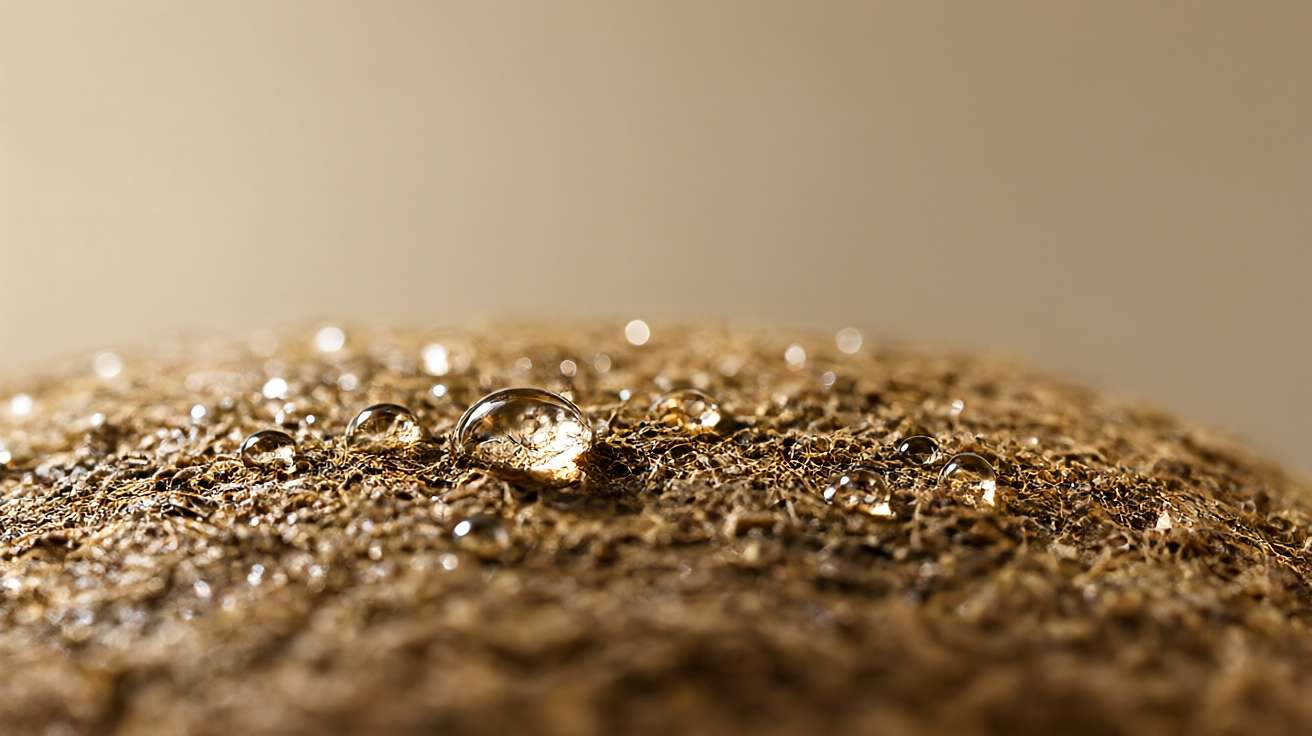
Water-holding capacity is the volume of water a medium retains after free drainage, often reported as a percentage of total volume. It determines how long roots can go between irrigations. Drainage is the speed and volume of water that exits the medium. These two are inversely related: a medium that holds more water drains less, and vice versa.
High water-holding capacity reduces irrigation frequency but increases the risk of waterlogging and poor aeration if overdone. Low water-holding capacity demands frequent irrigation but keeps the root zone oxygen-rich. The practical target is not maximum water retention but enough retention to bridge the gap between irrigations without starving roots of oxygen.
Air-Filled Porosity and Root Oxygen
Air-filled porosity is the percentage of total volume occupied by air after the medium has drained. It is the oxygen reservoir for roots. Root respiration consumes oxygen continuously; if air-filled porosity drops too low, roots suffocate, nutrient uptake collapses, and anaerobic pathogens multiply.
If air-filled porosity drops below 10%, the root zone becomes functionally anaerobic: root growth stalls, nutrient uptake collapses, and anaerobic pathogens such as Pythium multiply rapidly.
Most hydroponic crops need air-filled porosity above roughly 15-20% after drainage. Finer media and compacted media fall below this threshold quickly. Coarser media such as expanded clay and perlite maintain high air-filled porosity but may dry too fast. Oxygen diffusion in air is about 10,000 times faster than in water, which is why even a small air-filled fraction dramatically improves root health compared with a saturated medium.
To measure air-filled porosity at home, saturate the medium, let it drain freely for a set time, then weigh it. Compare the drained weight to the saturated and dry weights. The difference between saturated and drained volume, divided by total volume, estimates air-filled porosity. Consistency in method matters more than absolute precision.
CEC and Nutrient Retention
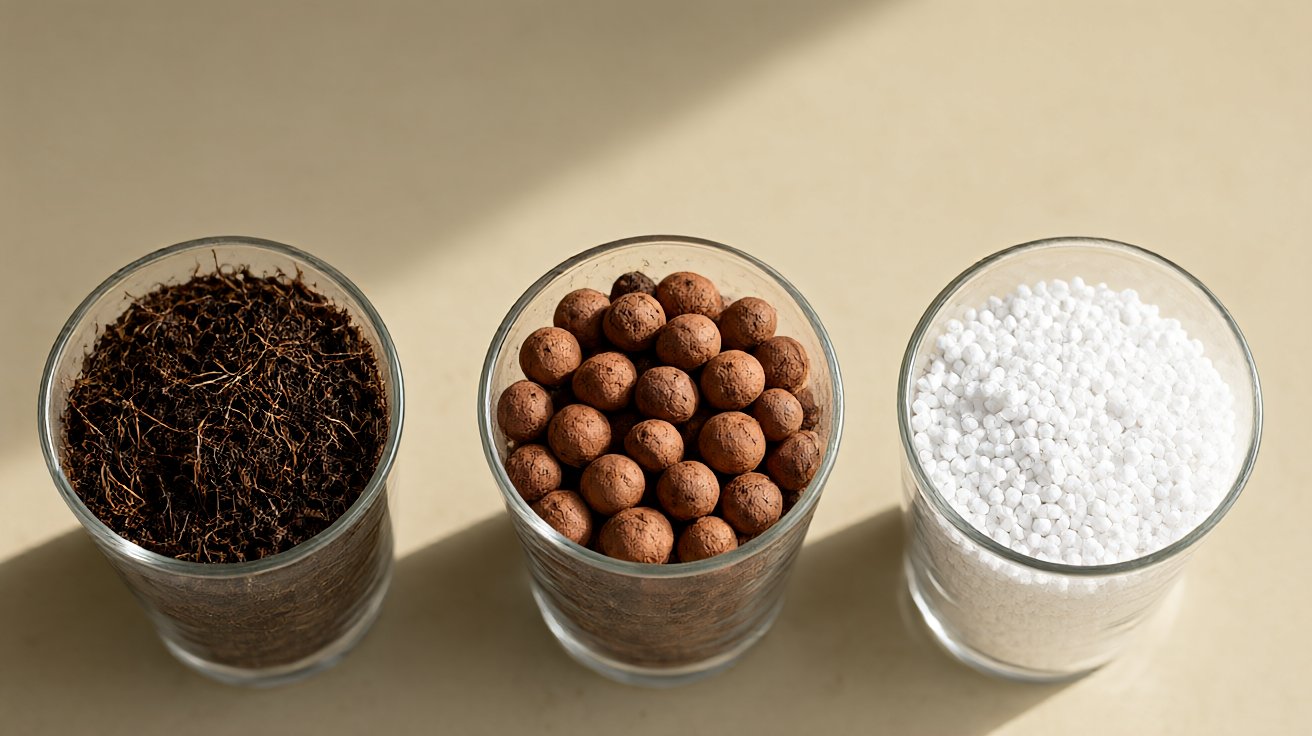
Cation exchange capacity (CEC) measures how many positively charged nutrient cations (potassium, calcium, magnesium, ammonium) a medium can adsorb and later release to roots. It is usually reported in milliequivalents per 100 grams (meq/100g) or per liter. High-CEC media such as coco coir and peat buffer nutrient fluctuations and reduce the frequency of nutrient solution changes. Low-CEC media such as rockwool, perlite, and clay pebbles are chemically inert and give the grower precise control over nutrient solution composition but demand consistent fertigation. CEC determines how much nutrient cation reserve the medium holds; higher CEC means more buffering capacity, which is why coco coir (40-120 meq/100g) needs less frequent feeding than perlite (1-5 meq/100g).
CEC is a double-edged property. A high-CEC medium can lock up nutrients or release stored salts later, complicating EC management. A low-CEC medium passes nutrients through quickly, which is ideal when the nutrient solution is carefully managed and monitored. Growers switching from high-CEC to low-CEC media often need to increase irrigation frequency and tighten nutrient-solution monitoring to avoid deficiency swings. Coco coir’s high CEC is both a strength and a burden, which is why preparation matters: see how to buffer coco coir before first use.
High CEC does not always mean a better medium. It buffers nutrients and reduces fertigation frequency but complicates EC control and can release stored salts. Low-CEC inert media give precise control when the nutrient solution is carefully managed.
EC and Soluble Salts
Electrical conductivity (EC) measures the concentration of dissolved salts in the medium or in the nutrient solution. High EC indicates high salt concentration, which can cause osmotic stress and nutrient lockout. Even inert media accumulate salts over time as water evaporates and leaves minerals behind.
Growers should measure EC of both the input nutrient solution and the runoff or drainage. A large gap between input and runoff EC signals salt buildup in the medium. Flushing with low-EC water or adjusting the nutrient solution restores balance. Media with high CEC complicate this picture because they store and slowly release ions.
pH and Buffering
pH measures acidity or alkalinity. Most hydroponic crops prefer a root-zone pH between 5.5 and 6.5. The medium’s own pH and its buffering capacity determine how much the root zone resists change. Peat and coco coir are naturally acidic and can depress pH. Limestone and some composts are alkaline. Inert media such as rockwool and perlite have little buffering capacity, so pH drifts with the nutrient solution.
Buffering is the medium’s ability to resist pH change when acids or bases are added. High buffering stabilizes pH but makes correction harder. Low buffering allows rapid adjustment. Matching medium pH to the target range before planting avoids chronic pH problems.
Bulk Density and Structural Stability
Bulk density is the dry mass of medium per unit volume, usually in grams per cubic centimeter. Low bulk density media such as perlite and peat are lightweight and easy to handle but can shift or float. High bulk density media such as sand and expanded clay are stable and anchor plants well but are heavy and can compact, reducing porosity over time.
Structural stability is the medium’s ability to maintain its pore structure under repeated wetting, drying, and root pressure. Organic media such as peat and coir decompose and lose structure. Inorganic media such as rockwool and clay maintain structure longer. Compaction from high bulk density or decomposition reduces both porosity and air-filled porosity, which is why medium replacement or refreshing is periodically needed.
Inorganic media such as rockwool and clay can be reused after cleaning, though performance declines with compaction. Organic media decompose and should be replaced or refreshed each cycle.
The Water Retention vs Aeration Trade-off (core Information Gain)
The Dial
The central design tension in any growing medium is the trade-off between water retention and aeration. Water and air compete for the same pore space. Increasing water-holding capacity necessarily reduces air-filled porosity at any given moisture level, and increasing aeration reduces water retention. This is not a flaw to eliminate but a balance to tune.
The trade-off has three practical levers. First, particle size: finer particles increase water retention and reduce aeration; coarser particles do the opposite. Second, irrigation frequency: a medium with low water retention can still support crops if irrigated often enough to keep moisture in the optimal range. Third, container geometry: deeper containers increase gravitational drainage and air-filled porosity, while shallow containers retain more water.
In practice, growers tune this balance by observing drainage time and root color. A medium that drains within seconds and leaves roots pale and dry is too coarse or too shallow. A medium that stays dark and wet for days with brown, sluggish roots is too fine or too deep. Adjusting particle blend and pot depth moves the medium toward the overlap zone without changing the crop or system.
System-Specific Balance
The optimal point depends on crop, climate, and system. Fast-growing leafy greens tolerate and prefer high moisture and frequent irrigation. Fruiting crops and woody plants need more aeration and tolerate drier cycles. Hot climates increase evapotranspiration and favor higher water retention. Cool, humid conditions favor higher aeration to prevent root rot. The grower’s job is not to maximize either property but to hold the medium in the overlap zone where both moisture and oxygen are adequate.
Blending a water-retentive medium such as coco coir with an aerating medium such as perlite is a standard way to shift the water retention vs aeration balance for a specific crop and system. Test small batches and measure drainage and moisture before scaling up.
Comparison of the Five Principal Media
| Medium | Water retention % | Air-filled porosity % | CEC (meq/100g) | pH range | Best for |
|---|---|---|---|---|---|
| Coco coir | 60-70 | 15-25 | 40-120 | 5.5-6.5 | balanced |
| LECA | 10-20 | 40-60 | 1-5 | 6.0-7.0 | drainage |
| Perlite | 5-10 | 35-45 | 1-5 | 6.5-7.5 | aeration |
| Vermiculite | 40-50 | 15-25 | 100-150 | 6.5-7.5 | water retention |
| Rockwool | 70-85 | 10-20 | 1-5 | 7.0-8.0 | NFT/drip |
The table summarizes typical property ranges; actual values vary with grade, density, and conditioning. Use it to narrow choices, then confirm with the crop and system in use.
How System Type Changes the Ideal Balance
System type is the strongest modifier of the ideal balance. In deep water culture and nutrient film technique, roots are bathed in nutrient solution or exposed to a thin film, so the medium’s job is mainly support and aeration; water retention matters less. In drip and ebb-and-flow systems, the medium must store enough water and nutrients between cycles, so water-holding capacity and CEC matter more. In wick systems, capillary action must move water upward against gravity, favoring fine, water-retentive media. In aeroponics, roots hang in air and the medium is minimal or absent.
For a fuller overview of configurations, see types of hydroponic systems. Matching medium properties to the system’s irrigation pattern is more important than chasing a universally best medium.
Last reviewed on 3 November 2026
Sources and further reading
- Oklahoma State University Extension – Soilless Growing Media
- Hydroponics Australia – growing media resources
- Royal Horticultural Society – soilless composts
From Bank Statement to QuickBooks-Ready File
That manual cleanup you just read about? This tool skips it. Turn your PDF into QBO for QuickBooks without storing your data anywhere.
Start Converting