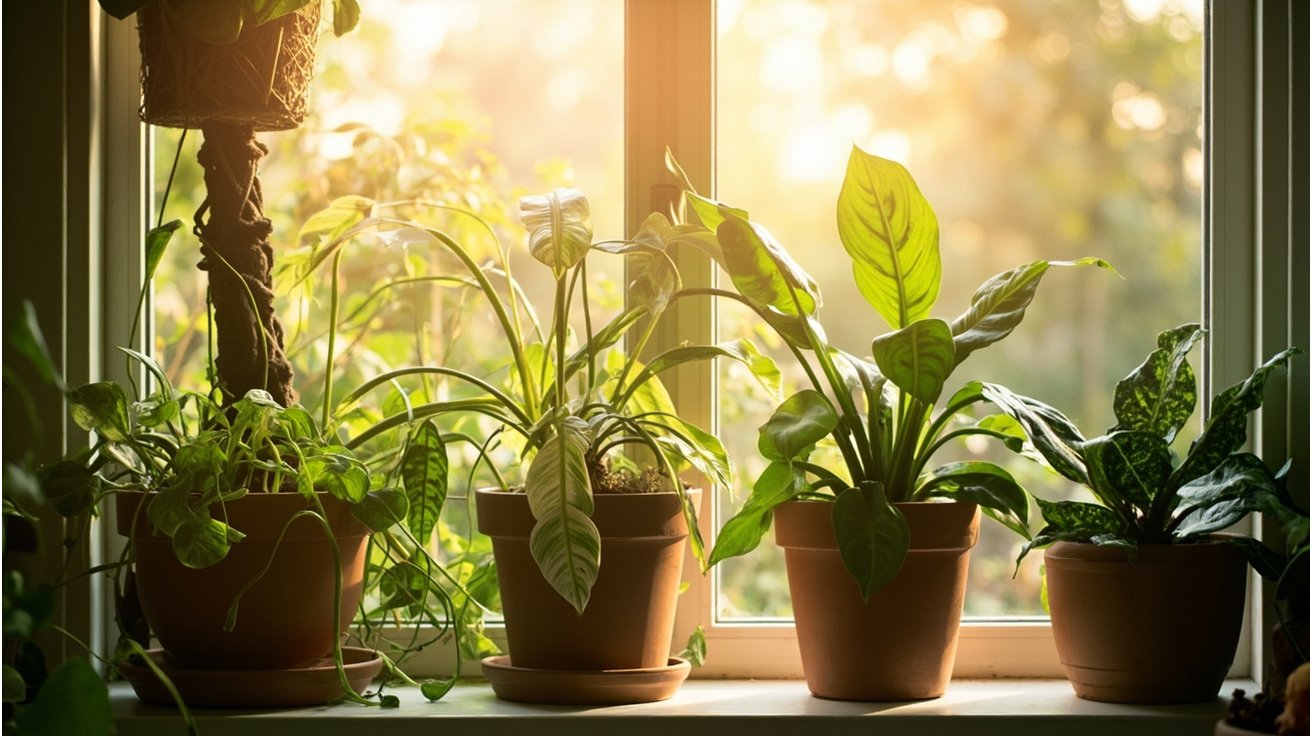

Houseplants are the one plant group where “less is more” is literally true. A tomato in full sun can burn through nutrients fast; a pothos in a north window barely touches them. The mistake most indoor growers make is not underfeeding. It is feeding on an outdoor schedule, in a small pot, under weak light, and wondering why the leaves brown and the soil crusts white. This article is about matching the feed to the plant’s actual appetite, which indoors is always smaller than you think.
Why houseplants need different feeding
Four indoor conditions change the nutrient math. Limited light is the big one. Photosynthesis drives growth, and growth drives nutrient demand. A plant under a 200-lumen LED for 8 hours is not building much tissue, so it does not need much nitrogen, phosphorus, or potassium. Feed it like a garden plant and the nutrients sit in the soil unused.
Slow growth follows from low light. Houseplants grow in months, not weeks. A fiddle-leaf fig might add six leaves a year. That tissue demand is tiny compared to a tomato plant that doubles in mass every two weeks. Nutrient need scales with growth rate, not with pot size.
Small pots concentrate everything. A 6-inch pot holds maybe a liter of soil. Outdoor soil is effectively infinite by comparison. Every fertilizer dose lands in a small volume, and salts accumulate fast because there is nowhere else for them to go.
No rain to leach. Outdoors, rainfall flushes excess salts down through the soil profile. Indoors, the only water is what you add, usually less than the plant needs to drain. Salts from fertilizer and tap water build up in the root zone with nothing to carry them away. That is why indoor salt buildup is a real, recurring problem and outdoor salt buildup is rare.
Together these mean one thing: houseplants need less fertilizer, applied more carefully, more often. The label rate on a bag of 10-10-10 is written for garden soil, not for a pot on a shelf. If you want to understand what the three numbers mean before adjusting them, see NPK ratio explained.
The “weekly weakly” rule
The rule is simple: dilute, frequent, consistent. Instead of a full-strength dose once a month, give one-quarter to one-eighth strength every week or every other week during active growth. The total nutrient delivered over a month is similar or lower, but the concentration at any moment is gentle.
Why this works: roots take up nutrients from the soil solution, and uptake is driven by concentration gradients. A big dose spikes the concentration, roots absorb more than they can use, and the rest sits in the soil as salt. A small dose keeps concentration in the uptake zone without overshooting, and frequent small doses match the slow, steady growth of an indoor plant.
Practical version: take the label’s recommended rate for a houseplant, divide by four, and apply it weekly. If the label says 1 teaspoon per gallon, use 1/4 teaspoon per gallon every week. If the plant is under low light or growing slowly, divide by eight instead. When in doubt, lean toward weaker. A hungry houseplant shows it; an overfed one shows it too, but by then the roots are already damaged.
Consistency matters more than precision. A slightly weak dose every week beats a strong dose whenever you remember. Plants do not store nutrients the way animals store fat; they use what is available now. Irregular feeding creates feast-and-famine cycles that stress roots.
Best ratios for houseplants
Three ratios cover most indoor plants:
- 3-1-2 (or close, like 20-10-20). Higher nitrogen relative to phosphorus and potassium. Good for foliage-heavy plants: pothos, philodendron, monstera, ferns, and most tropicals grown for leaves. Nitrogen drives leaf and stem growth, which is what these plants are doing indoors.
- 2-2-2 (balanced, like 10-10-10 diluted). Equal parts. A safe default for mixed collections and for plants you are not sure about. Nothing is over-supplied, nothing is missing. Dilute it and it works for almost anything.
- 10-10-10 diluted. The classic balanced formula, but only at reduced strength indoors. At full strength it is too hot for a pot. At one-quarter strength it is a fine all-purpose houseplant feed.
What to avoid: high-phosphorus “bloom booster” formulas for plants that are not blooming, and high-nitrogen lawn fertilizers for anything indoors. Lawn formulas are often 30-0-0 or 24-0-0, designed for fast outdoor growth in full sun. In a pot they burn roots and push weak, leggy growth.
If you are choosing a product for the first time, fertilizer buying guide: NPK what to know walks through label reading and form selection.
Liquid vs granular vs slow-release for indoor plants
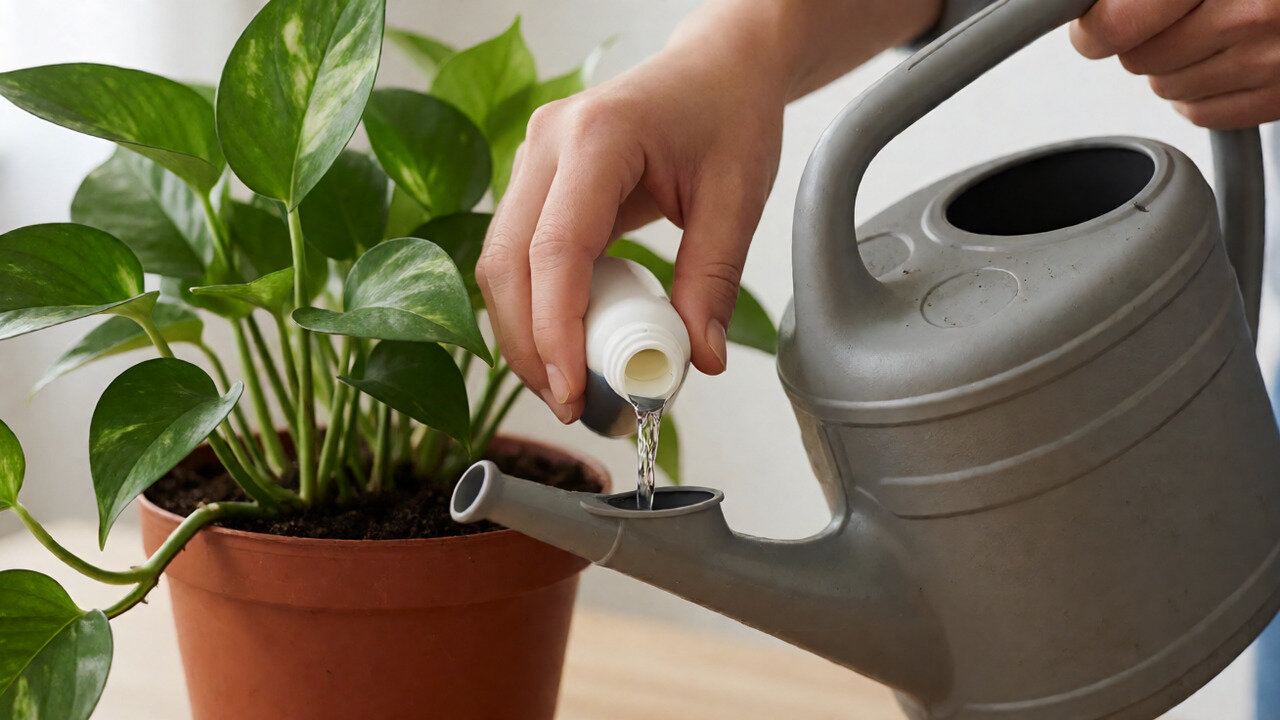
Liquid concentrates are the best fit for most houseplants. They dissolve fully, distribute evenly through the pot, and let you control strength precisely with each watering. That precision is what the weekly-weakly rule needs. You can also stop instantly: if a plant looks stressed, skip a week and the soil clears.
Granular dry fertilizers are harder to use indoors. They are designed to dissolve slowly in garden soil over weeks. In a pot they can sit as a crust on top, release unevenly, and burn roots if they contact them directly. If you use granules, mix them into the top inch of soil and water thoroughly, and never let them touch the stem.
Slow-release pellets (coated granules that release over months) are convenient but risky indoors. The release rate is tuned for outdoor temperatures and watering. In a warm, dry indoor room, release can spike; in a cool room, it can stall. You also cannot flush them out easily if salt builds up. They suit busy growers with stable conditions, not beginners learning a plant’s rhythm.
For a deeper comparison of release types, see slow-release vs quick-release fertilizer.
Salt buildup: the indoor-specific problem
Salt buildup is the signature indoor feeding problem. It shows up before you see it: a white or yellow crust on the soil surface or pot rim, brown crispy leaf tips, yellowing lower leaves, and wilting even when the soil is wet. The last sign is the dangerous one, because it looks like underwatering and tempts you to water more, which pushes more salt into the root zone.
The cause is simple. Fertilizer salts and tap-water minerals enter the pot faster than they leave. Tap water alone contributes: calcium, magnesium, and sodium build up over months. Add fertilizer and the load doubles. Hard water areas make this worse and faster.
Signs of over-fertilizing houseplants specifically: salt crust on the soil, brown leaf tips and margins, sudden leaf drop, stunted new growth, and in severe cases root browning. If you see two or more of these, stop feeding and flush.
Prevention: use the weekly-weakly rule, prefer rainwater or distilled water if your tap water is hard, and flush the soil every few months as routine maintenance, not just as rescue.
How to flush houseplant soil
Flushing means running a large volume of water through the pot to dissolve and carry out accumulated salts. Done right, it resets the root zone without repotting.
Steps:
- Take the plant to a sink or tub. Remove any decorative cache pot or saucer.
- Water slowly with room-temperature water until water runs freely from the drainage hole. Keep going until you have put through about twice the pot’s volume. A 6-inch pot holds roughly 1 liter of soil, so run 2 liters through.
- Let it drain fully. Do not let the pot sit in the runoff.
- Wait 30 minutes, then repeat once if the runoff was cloudy or the crust was heavy.
- Do not fertilize for two weeks after flushing. Let the plant recover in clean soil.
After flushing, the plant may look worse for a few days as roots adjust. That is normal. New growth should look cleaner within a week or two. If the plant is in a pot with no drainage hole, flushing is not possible without repotting; that is a reason to repot into a container with a hole.
Water quality interacts with all of this. Tap water minerals add to the salt load, and in hard-water areas they can be the main source. If your water leaves white deposits on a glass, it is contributing. Rainwater or distilled water eliminates that variable. See soil pH and nutrient availability for how water chemistry affects uptake.
Seasonal adjustments
Houseplants follow light, not the calendar, but the calendar is a good proxy. Active growth runs spring through summer: longer days, stronger light, warmer rooms. That is when the weekly-weakly rule applies in full. Feed weekly at quarter strength while the plant is pushing new leaves.
Fall and winter: days shorten, light drops, growth slows or stops. Cut fertilizer to one-quarter of the growing-season amount, or stop entirely for true dormancy. Many common houseplants, including succulents and some tropicals, barely grow in winter. Feeding them then is feeding a sleeping plant, and the unused nutrients become salt.
The transition is gradual. Do not flip from full schedule to zero overnight. Taper over two to three weeks in fall, and ramp back up over two to three weeks in spring as light returns. Watch the plant, not the date: new growth means feed, no new growth means hold.
Organic vs synthetic for houseplants
Both work indoors, with different tradeoffs. Synthetic liquid feeds are precise, fast-acting, and easy to dilute for the weekly-weakly rule. They also add salts, so flushing matters. Organic options, like fish emulsion or worm-casting tea, release nutrients more slowly and add microbial activity, but they smell, they can be inconsistent in strength, and they still add salts over time.
For small pots, precision usually wins: a synthetic liquid at known dilution is easier to control than an organic tea of unknown strength. For growers who prefer organic, dilute to the same quarter-strength level and flush on the same schedule. The salt buildup problem does not care whether the salt came from a synthetic or an organic source.
For a broader comparison of the two approaches, see NPK fertilizer vs compost and organic fertilizer: nourish your garden the natural way.
Last updated: October 28, 2026.
Sources
- University of Minnesota Extension, “Fertilizing Houseplants” (extension.umn.edu)
- Penn State Extension, “Houseplant Care” (extension.psu.edu)
- UF/IFAS, “Houseplant Fertilization” (edis.ifas.ufl.edu)
- NC State Extension, “Houseplants” (content.ces.ncsu.edu)
- Purdue Extension, “Houseplant Care” (extension.purdue.edu)
- Cornell Cooperative Extension, “Houseplants” (cce.cornell.edu)
The actual number is the decision.
Turn PDF Bank Statements Into Workable Spreadsheets
Your bank statement is a mess of numbers, but your books shouldn't be. Use our converter to get Excel, CSV, or QBO files — ready for QuickBooks.
Try It Free Now