
Potassium is the nutrient that controls water, and water controls everything else in a plant. Most garden guides describe potassium as the “strength” nutrient: stronger stems, better fruit, improved winter hardiness. That is true, but it is the result of something more specific happening at the cellular level. Potassium regulates how plants open and close their stomata, the tiny pores on leaves that manage water loss and carbon dioxide intake. When potassium is short, the plant cannot manage its own water, and the symptoms look like drought even in moist soil. This article explains the mechanism, shows how to read the deficiency pattern, and covers sources and timing.
Understanding potassium matters because it is the most commonly misdiagnosed nutrient in home gardens. Gardeners see wilting and browning and reach for more water or a fungicide, when the real fix is a mineral that costs pennies per application. Once you learn the marginal-scorch pattern and the stomatal mechanism behind it, potassium problems become easy to spot and easy to correct.
What potassium actually does inside a plant
Potassium is an ion (K+) that never becomes part of a permanent structure. Unlike nitrogen, which builds proteins, or phosphorus, which builds DNA and energy carriers, potassium works as a regulator and activator. It does not get incorporated into tissue. It moves freely in the plant sap, and that mobility is the key to its role.
The most important job is stomatal control. Each stoma is flanked by two guard cells. When potassium flows into those guard cells, water follows by osmosis, the cells swell, and the pore opens. When potassium leaves, the cells shrink and the pore closes. This is how a plant decides when to let carbon dioxide in for photosynthesis and when to close up to prevent water loss. A plant with adequate potassium can respond within minutes to changing light, temperature, and humidity. A plant short on potassium has sluggish or stuck stomata, so it either loses too much water or starves for carbon dioxide.
Beyond stomata, potassium activates more than sixty enzymes involved in photosynthesis, respiration, and protein synthesis. It also drives the loading and unloading of sugars in the phloem, which is why fruit quality, color, and sugar content depend heavily on potassium. Strong stems, winter hardiness, and disease resistance are downstream effects: better water regulation and sugar transport produce tougher, more resilient tissue. If you want the full picture of how potassium fits among the other nutrients, see the guide on essential nutrients for plants and gardens.
Potassium also maintains cell turgor, the internal water pressure that keeps leaves and stems rigid. When potassium is adequate, cells stay firm even under heat and wind. When it is short, tissue wilts faster and recovers slower, which is why potassium-deficient plants look tired in the afternoon sun even when the soil is wet. This turgor role is separate from the stomatal role but works alongside it: stomata manage water loss while turgor maintains structure.
How plants absorb potassium (and why soil type matters)
Plants take up potassium as the positively charged K+ ion. In soil, potassium is held on negatively charged clay and organic matter particles through cation exchange. The plant root releases hydrogen ions (H+) that swap places with K+ on those particle surfaces, freeing it for uptake. This is the same cation exchange process that governs calcium, magnesium, and other cations, which is why soil pH and nutrient availability matter so much: in very acidic or very alkaline soils, competing ions can lock potassium out of reach even when it is present.
Soil texture changes the story. Sandy soils hold very little potassium because they have low cation exchange capacity. Potassium leaches quickly with rain or irrigation, and deficiency can appear mid-season on sandy sites even after spring fertilization. Clay and loam soils hold potassium better but can fix it in forms that roots cannot access. High potassium can also compete with magnesium and calcium uptake, so more is not always better. A soil test is the only reliable way to know your starting level; see how to read a soil test report for interpreting the numbers.
Organic matter helps. Compost and well-rotted manure increase cation exchange capacity, so sandy soils amended with organic matter retain potassium longer. Mulching also reduces leaching by slowing water movement through the profile. On very sandy sites, splitting applications and using slow-release forms is the most reliable way to keep potassium available through the growing season.
Signs of potassium deficiency
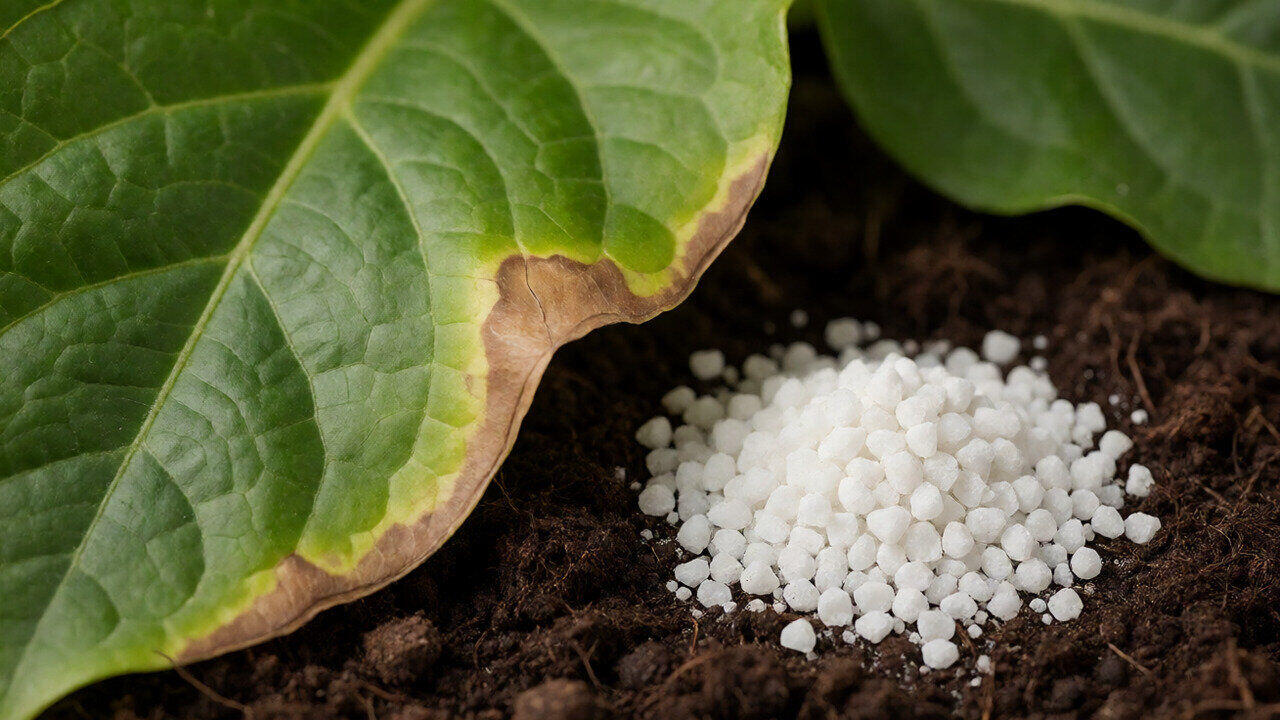
Potassium is mobile in the plant, so deficiency shows first on older leaves. The classic pattern is marginal scorch: the edges and tips of lower leaves turn yellow, then brown and dry, while the center of the leaf stays green longer. The scorch often forms a distinct band or V shape at the leaf tip. Stems may be weak or spindly, fruit may be small, misshapen, or poorly colored, and overall plant vigor drops. In severe cases, leaves drop early and the plant looks drought-stressed despite adequate water.
Because potassium moves freely, a deficiency can develop quickly during rapid growth or fruiting, when demand spikes. Heavy-feeding crops like tomatoes, potatoes, peppers, and fruit trees are the most common victims. Sandy soils and high-rainfall seasons increase risk.
Early signs are easy to miss. Slight yellowing at the leaf margins on lower leaves, a duller green overall, and slightly smaller fruit are the first hints. By the time dramatic scorch appears, the plant has already lost significant function. Checking lower leaves weekly during fruiting catches the problem before it costs yield. If you are unsure whether a symptom is deficiency or something else, review the broader NPK ratio chart for vegetable crops to see which nutrient each crop needs most.
Potassium deficiency vs drought vs disease (the diagnostic key)
This is where most gardeners go wrong. Potassium deficiency mimics drought stress because both cause wilting, leaf scorch, and poor fruit. The difference is in the pattern and the timing. Drought stress affects the whole plant uniformly and worsens through the day, recovering at night. Potassium deficiency starts on older leaves first, forms the marginal scorch band, and does not reverse with watering. If you water deeply and the plant still shows marginal browning on lower leaves within a few days, suspect potassium.
Disease is the other common misdiagnosis. Fungal leaf spots are usually round or irregular blotches scattered across the leaf, often with a halo or concentric rings, and they can appear on young leaves too. Potassium scorch is marginal and progressive from the edge inward, and it respects the leaf margin. Nutrient deficiency also tends to be symmetric across the plant, while disease often starts on one side or one branch.
The single most useful test is to check the leaf age and the edge pattern. Older leaves plus marginal scorch plus no improvement after watering points to potassium. If you are unsure, a soil test settles it. Guessing and adding potassium to a plant that is actually drought-stressed or diseased wastes money and can throw off the calcium-magnesium balance.
A quick field check helps too. Water a suspect plant deeply in the evening and inspect it the next morning. Drought-stressed plants recover overnight. Potassium-deficient plants still show marginal browning within a day or two because the damage is structural, not just water loss. Combine that observation with the leaf-age pattern and you can usually decide without a lab test, though a soil test remains the gold standard before large applications.
Why potassium matters most at fruiting and stress
Potassium demand peaks during fruit development and reproductive growth. Sugar loading into fruit requires potassium-driven transport in the phloem, so a shortfall during fruiting shows up as poor color, low sugar, and soft fruit that stores badly. This is why high-potassium or “bloom” fertilizers are marketed for the fruiting stage, though the timing matters more than the product name.
Stress is the second peak. Heat, drought, cold, and disease all increase potassium demand because the plant needs tighter stomatal control and stronger cell walls. Fall application helps harden plants for winter by improving cold tolerance and root storage. For fruiting crops, a side-dress or foliar application at early fruit set is usually the highest-value timing. For lawns and ornamentals, late summer to early fall is the window.
Foliar feeding can rescue a mid-season shortage faster than soil application because leaves absorb potassium directly. A dilute potassium sulfate spray during fruit set is a common rescue treatment. Soil applications take days to weeks to show effect, so match the method to the urgency. Either way, follow label rates and avoid spraying in full sun or high heat.
Where potassium comes from (sources)
Natural and synthetic sources differ in speed and salt content. Muriate of potash (potassium chloride) is the cheapest and most common synthetic source, high in potassium but also high in chloride, which can harm salt-sensitive crops like potatoes and some fruits. Sulfate of potash (potassium sulfate) costs more but adds sulfur and is gentler. Greensand and kelp meal are slow-release organic sources with low salt. Wood ash is a fast, free source but is very alkaline and can raise soil pH sharply, so use it sparingly and test pH first. Compost contributes modest potassium along with other nutrients and improves cation exchange capacity. For a comparison of organic and synthetic approaches, see NPK fertilizer vs compost.
If you are choosing a product, the label lists potassium as K2O, the oxide form, not elemental potassium. This is the same convention used for phosphorus as P2O5, and it means the number on the bag overstates the elemental potassium. Multiply the K2O percentage by 0.83 to get elemental K. For example, a 10-10-10 fertilizer contains 10 percent K2O, which is about 8.3 percent elemental potassium. The full explanation of the label convention is in NPK ratio explained.
When to apply potassium
Apply potassium based on soil test results and crop stage, not on a calendar. For annual vegetables, incorporate the base rate before planting if the test shows a deficit, then side-dress at fruit set. For perennials and fruit trees, apply in early spring or late summer to early fall. Avoid heavy applications on sandy soils in one dose; split applications reduce leaching. Release rate also matters: quick-release sources act fast but leach faster, while slow-release forms feed longer. The tradeoffs are covered in slow release vs quick release fertilizer. For the actual numbers, use fertilizer application rate math to convert a soil test recommendation into pounds per bed or per tree.
Do not apply potassium to a soil that already tests high. Excess potassium competes with magnesium and calcium and can induce deficiencies of those nutrients even when they are present. The goal is sufficiency, not abundance.
Keep records. Note the date, product, and rate for each application, and retest soil every two to three years. Potassium levels change slowly in most soils, so a consistent log prevents over-application and helps you connect yield or quality changes to nutrient timing. Pair that habit with the fertilizer buying guide when it is time to choose a new product.
Last updated: October 28, 2026.
Sources
- University of Minnesota Extension, “Potassium for Crop Production”
- Teagasc, “Potassium” (soil and crop nutrition)
- Penn State Extension, “Potassium in the Garden”
- Auburn University Extension, “Potassium Basics for Crop Production”
- Purdue University Extension, “Potassium Management for Crops”
- K+S, “Potassium Role in Plants”
The actual number is the decision.
Turn PDF Bank Statements Into Workable Spreadsheets
Your bank statement is a mess of numbers, but your books shouldn't be. Use our converter to get Excel, CSV, or QBO files — ready for QuickBooks.
Try It Free Now