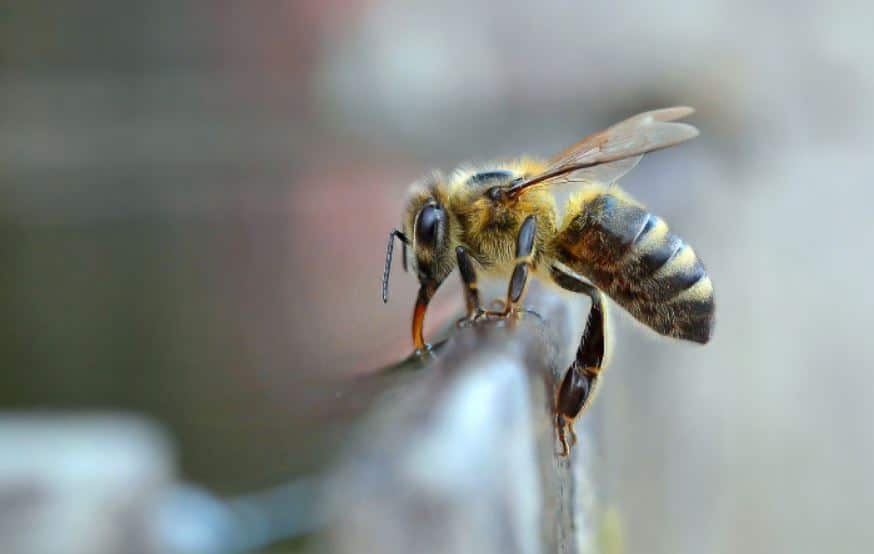
You’ve spotted a striped insect in your garden, and now you’re wondering: is it a bee—and if so, which kind? Whether you’re trying to identify a specific visitor or just want to understand the different bees that might be passing through your yard, knowing your local bee species makes it easier to garden in ways that support them. There are over 20,000 known species of bees worldwide, each with its own characteristics, habits, and role in pollinating the plants around you.
The majority of bee species are solitary, meaning they don’t live in large colonies. However, there are several species of social bees, including the honeybee and bumblebee, which live in large, organized colonies.
One of the most well-known bee species is the European honeybee. These bees are non-native to North America but have been introduced to the continent for their ability to produce honey and pollinate crops. Understanding the differences between bumblebees and honeybees is a good starting point if you’re new to garden bee identification.
Honeybees are social creatures that live in large colonies, with each colony consisting of up to 80,000 individual bees. They are very important pollinators and are responsible for the pollination of over 100 different crops worldwide.
Bumblebees are another type of social bee that are important pollinators. They are typically larger and furrier than honeybees and are known for their distinctive buzzing sound.
Bumblebees live in smaller colonies of up to 400 individual bees and are known for their ability to fly in colder weather conditions than other bee species.
There are also several species of solitary bees, including the mason bee and the leafcutter bee. These bees don’t form colonies and instead live independently. They are typically smaller and less familiar than social bee species but are still important pollinators of many crops.
In recent years, bee populations have been declining worldwide due to habitat loss, pesticide use, and climate change. This decline is concerning as bees play a crucial role in pollinating many crops that provide food for people and animals. Bees are essential to garden health in ways that go far beyond honey production.
It’s essential to protect and conserve bee populations and their habitats to ensure the continued health of ecosystems and agriculture.
Bees vs Wasps
Before discussing bees, it is essential to understand the determining characteristics of bees and wasps. These yellow and black insects can easily be mistaken for each other, but despite their close relationship, a few crucial factors distinguish them.
One simple way to remember the difference is that bees can only sting once before dying, whereas wasps can and do sting multiple times.
If you have ever encountered a paper wasp, yellowjacket, or hornet (all of which are different types of wasps), you would know that they can be vicious and aggressive, particularly if you or anything else comes close to their nest.
In contrast, bees try to evade confrontation with humans unless provoked.
Another way to distinguish between them is to inspect their bodies. Wasps generally have a slim waist with a smooth and slender body, whereas bees are rounder and hairier, with fuzz covering some or all of their bodies and legs.
Wasps have distinct black and bright yellow bands around their abdomens, while bees have a nondescript light brown or yellowish-brown color.
Of course, there are some exceptions, but these features can help you differentiate between bees and wasps at first glance. If you’re still unsure whether you’re looking at a bee or a wasp, our guide to honeybees versus yellow jackets breaks down the key differences in detail.
7 Bee Families You Should Know About
In the world of bees, there are seven prominent families. These include Colletidae, Melittidae, Apidae, Megachilidae, Stenotritidae, Andrenidae, and Halictidae.
Common Bees Families You Should Know
Common bees families:
The Colletidae family is believed to have 2,000 species that include cellophane bees or plasterer bees. These bees use their mouthparts to secrete substances that smooth their cell walls. The secretions then create a waterproof, cellophane-like lining.
The Melittidae family contains only roughly 200 species that are limited to Africa’s distribution.
The Apidae family is the largest group of bees encompassing at least 5,700 species. These bees can either live alone or in communities. Some popular back garden bees that people are familiar with are honeybees, bumblebees, and carpenter bees.
The Megachilidae family consists of around 3,000 mostly solitary bee species. This family is home to the largest bee known to man, Megachile pluto or Wallace’s giant bee. It also includes mason bees, carder bees, and leafcutter bees.
The Stenotritidae family is smaller, with only 21 species that are uniquely found in Australia.
The Andrenidae family comprises approximately 2,700 small, ground-nesting bees known as mining bees. They are usually solitary, and the family includes the tiniest bee species in the world, Perdita minima, which is less than 2mm long and found in the southwestern part of the United States.
The Halictidae family has 3,500 diverse species found globally. Some of these bees are known as sweat bees as they are attracted to sweat. These striking bees have a metallic appearance and come in various colors.
How To Identifying Different Types Of Bees
The bee’s color, shape, size, behavior, and habitat can help identify the species. Although it might seem challenging at first, careful observation can detect the unique characteristics of different bee species.
For example, the Wallace’s Giant Bee has the most oversized wingspan of 2.5 inches, and Perdita minima is the tiniest mining bee with a length of only 2mm.
Bees can have varying colors from brown or tan to metallic green or black, and some have white or yellow markings. Some bees could be hairier than others or have smooth, polished bodies.
Bees tend to nest in wood, hollow stems, reeds, or crevices in the ground, but not in hives. They seal their nests with specific materials like leaves or chewed-up wood. Some bore only one hole while others several.
Understanding the vast and intriguing world of bees instills a deeper appreciation for these insects, not only honeybees. Bees play a fascinating role in pollinating flowers across a wide range of plant species.
Common Types of Bees Found in Your Backyards and Gardens
Types Of Bees: Guide How To Identify
Bumblebee (genus Bombus)
Bumblebees, which also belong to the Apidae family, have variations in their appearane between males and females, with male bumblebees being more common in late summer and fall, while females are seen year-round.
True and cuckoo versions of both genders exist, with cuckoo bumblebees having short faces, hairy hind legs, and no pollen baskets.
The wing membranes of these bumblebees are dark-colored, with a V shape at the tail’s top where the coloring changes.
Thin black hairs can be seen at the end of their abdominal region.
Bumblebees are distinguished by their tail colors: white, red, and uniform. White-tailed bees have off-white to yellow tails, and uniform-tailed bees have tails that match the rest of their abdomen color.
The number of thick yellow bands on the abdomen’s banding can range from one to three depending on the species.
Some bumblebees are melanic, appearing entirely black or much darker than other bumblebees.
Honeybee (genus Apis)
Belonging to the Apidae family, honeybees have distinctly different appearances between males and females.
Female honeybees can be recognized by their six visible abdominal sections, while males have seven. Large, hairy eyes distinguish honeybees, with the eyes of males meeting at the top of their heads.
One can determine whether a bee is a honeybee by distinguishing the tibial spurs on the bee’s hind legs.
Honeybees do not possess tibial spurs, as they inhabit wax combs without the need to dig into their home.
The flattened segments on their hind legs are also a unique characteristic, and they surround the pollen press.
The shape of their mandibles, resembling that of a spoon, enables honeybees to feed their young.
Southeastern blueberry bee (Habropoda laboriosa)
The Southeastern blueberry bee, belonging to the family Apidae, is an exceptional pollinator of blueberries. Specifically, it is capable of buzz pollination, a behavior that only some bees exhibit, making it particularly efficient at pollinating southern rabbiteye blueberries.
Interestingly, these bees have co-evolved with native blueberries, leading to their bodies fitting perfectly within the bell-shaped blueberry flowers.
Comparable to small bumblebees, with hairy bodies and measuring half an inch long, these bees also feed on flowers such as trumpetflowers and clover.
The Southeastern blueberry bee is native to the southeastern United States and is most active from February to April. They tend to nest in the ground, especially near blueberry plants, and are solitary bees.
Squash bee (genera Peponapis and Xenoglossa)
The squash bee, from the family Apidae, is a native solitary bee that comes from two related genera, Peponapis and Xenoglossa. These bees are large and bulky, resembling bumblebees, but their coloring is similar to that of honeybees.
They have rounder faces and longer antennae in comparison to honeybees. Squash bees were once the primary pollinators of squashes and gourds, which were planted by indigenous peoples throughout the Americas, before Europeans introduced honeybees.
Male squash bees can be seen darting from squash flower to sex organ in the early morning in search of mates.
Females feed on squash, pumpkin, and gourd flowers, their only source of pollen.
They’re particularly excellent pollinators of zucchinis and butternuts, among other cucurbit varieties, and their thorough pollination contributes significantly to the yield of these crops.
Squash bees are solitary and live in nests dug in the soil. There is only one female bee per nest, making them a solitary species.
However, male squash bees sometimes spend the night inside closed flowers before resuming their search for mates the next day.
Hairy-footed flower bee (Anthophora plumipes)
Hairy-footed flower bees are from the family Apidae and are integral to the pollination of primrose, dead-nettle, comfrey, and lungwort flowers. These bees measure between 1.4 and 1.6 centimeters long.
The females bear a resemblance to bumblebees, except that they are smaller, black, and furry, with orange hairs on their hind legs.
The males of this species have rusted brown-colored bodies and cream-colored facial hair. Long and feathery orange hairs can be seen on their feet and middle legs.
These bees are often found to fall inside chimneys or hide in the cracks between bricks within the soft mortar. They also prefer to live in woodlands, parks, soft cliff faces, and soil.
Hairy-footed flower bees are most commonly observed between March and June.
Males tend to be more noticeable than females, emerging from their hibernation period slightly earlier.
Solitary bees that live in large and noisy groups while nesting, they fly in a fast and darting manner.
Ashy mining bee (Andrenidae cineraria)
Ashy mining bees belong to the family Andrenidae and are typically seen during springtime. They are most distinguishable through their black and grey coloring and are a solitary species.
Females are the same size as honeybees, with a shiny black abdomen that can appear blue in certain lights. Two distinct stripes of light gray hair can be seen at the top and bottom of their thorax, along with white hairs on their face.
Males are smaller than females and have less obvious markings. However, the lighter-colored hairs on the sides of their thorax regions are more apparent.
Ashy mining bees are often found in open and sunny locations close to sandy soil types. They prefer to feed on buttercups, blackthorn, hawthorn, and fruit trees.
Mason bee (genus Osmia)
The Megachilidae family refers to mason bees, named for their habit of using mud to create their nests. These nests can be found in small, dark cavities such as stone cracks and hollow stems or twigs, as well as in “native bee hotels” which are hung in residential gardens.
Mason bees are efficient and fast-flying, making them excellent pollinators. A type of mason bee called the blue orchard bee is known for its outstanding pollination skills in orchards.
Research has shown that about 400 female blue orchard bees are as effective as 10,000 honeybees when pollinating almonds!
Unlike honeybees, mason bees do not have pollen baskets on their legs. They instead carry pollen in hairs located on the underside of their abdomen.
The metallic bodies of mason bees are typically shades of dark blue, dull green, and black, with some species appearing red or rust-colored.
Adult mason bees are around half an inch long and show an enlarged hind area when carrying pollen.
Leafcutter bee (Megachile latreille)
Leafcutter bees, another member of the Megachilidae family, are similar in their nesting habits to mason bees.
Leafcutter bees use leaves to close their nest cavities, accomplishing this by cutting crescent-shaped or near-circular fragments between 1/4 inch to 1/2 inch from the leaves of different shrubs such as roses and lilacs.
These bees are black with white hairs covering the thorax and bottom of the abdomen. Many species have large heads with massive jaws to cut off leaves. Leafcutter bees fly at a rapid pace and carry pollen on their abdomens.
Studies have found that approximately 150 leafcutter bees working in greenhouses can pollinate the same number of plants as 3,000 honeybees!
Tawny mining bee (Andrenidae fulva)
Tawny mining bees come from the family Andrenidae and are commonly seen between March and May.
Females are similar in size to honeybees, with thick and reddish-orange-colored hair on their thorax, while their abdominal regions have long and dense layers of light orange hair. Their undersides, faces, and legs are black.
Males are thinner and smaller than their female counterparts, with a brown-colored coat of hair, and protruding jaws.
The males measure around 8 to 10 millimeters long, while the females measure 10 to 12 millimeters long.
These bees can thrive in a variety of habitats and are often found in gardens and parks with short and well-managed vegetation. They prefer to feed on buttercups, dandelions, maple, willow, fruit trees, and hawthorn.
Tawny mining bees make their nests late in the spring after the males have mated and died, and only one female bee inhabits each nest, making them a solitary species.
Ivy bees (genus Colletes)
Ivy bees are a type of plasterer bee or cellophane bee that belong to the family Colletidae. They are slightly larger than honey bees and can be recognized by their ginger-colored thorax regions.
Female ivy bees have a very thickly coated, hairy thorax and a broad, alternating banding of black and yellowish-orange on their abdomen.
Male ivy bees are slightly smaller than female ivy bees but look very similar. However, they can be hard to distinguish from other species of plasterer bees.
The best way to identify them is to note the time of year that you see these bees. Ivy bees are active later in the year, with males emerging in August and females in September.
They are commonly seen in urban areas, farmlands, coastal areas, and in heaths, and they particularly like ivy flowers and other late bloomers.
Males often become entangled in mating balls as they compete for females.
Yellow-faced bees (genus Hylaeus)
Yellow-faced bees belong to the family Colletidae, and there are more than 130 species of these bees in the United States. They are similar in appearance to small black wasps and have slender bodies with white or yellow markings on their legs, faces, and thorax.
These bees are unique in appearance as they do not have scopa like many other bees. Instead, they have special areas on their stomachs known as crops, where they store their food.
They tend to build their nests in existing tunnels, and females deposit a small amount of food from their crops with each egg.
Yellow-faced bees are a solitary species and are commonly found on carrot plants and Golden Alexanders, as well as swamp milkweed and common boneset, between May and September.
Furrow bees (genus Halictus)
Furrow bees belong to the family Halictidae, also known as sweat bees. These bees are attracted to human sweat and will walk calmly on your arm. They are small and relatively docile in nature and prefer to reside in areas without vegetation since they are a ground-dwelling species.
There are many colors of furrow bees, from all black to gold to metallic greens and blues, and even purple or gray. The abdominal region is distinctive, having pale bands of hair on its back end.
You can distinguish female furrow bees by their robust heads, which feature a genal tooth, a small spine located in the cheek area behind the eye.
Box-headed blood bee (Sphecodes monilicornis)
Box-headed blood bees belong to the family Halictidae, and they are medium to large bees. They are distinctive for their blood-red abdominal regions, earning them the colloquial name “blood bees.”
This species is cleptoparasitic, which means they use other bees’ provisions to feed their young; in this case, they use the provisions of other bees such as Halictus, Andrena, and Lasioglossum.
Females enter other bees’ nests, destroy any grub or eggs they find inside, and lay their eggs to replace the destroyed ones.
They have a slightly flattened antennal region compared to other species of blood bees.
Box-headed blood bees tend to be found near other furrow bees, such as orange-legged furrow bees, common furrow bees, bloomed furrow bees, and sharp-collared furrow bees, as they use the nests of these species as hosts.
Wool carder bees (Anthidium maculosum)
Wool carder bees belong to the family Megachilidae and are named after their habit of scraping hair off fuzzy leaves like lamb’s ears and mullein. They have a unique pattern on their bodies, with yellow spots down the sides of their abdomen, and they carry pollen on their abdomen.
Male wool carder bees are larger in size than females, and they have visible spikes at the ends of their abdominal area, where a sting would typically be (although males in this species lack stings).
Females are less hairy than males and have stings on their abdomen. Their main purpose is to collect wool fibers from plants and carry them back to their nests.
Wool carder bees are commonly found in woodlands, wetlands, riverbanks, and cliffs. They typically make their nests in existing holes, such as dead wood and hollow stems.
Pantaloon bees (Dasypoda hirtipes)
Pantaloon bees belong to the family Melittidae and are medium to large in size.
Female pantaloon bees have large orange pollen brushes on their hind legs, giving them the appearance of wearers of pantaloons. They are primarily golden-brown in color, with bands of the same color on their abdomen.
Male pantaloon bees have long, golden hairs and similar banding to females, but they do not have “pantaloons.” In the sun, the color of male pantaloon bees can fade to a silver-white color.
These bees are often found near the coast and in heaths because they like sandy soil. Their nests have a soil heap arranged in a fan shape and are visually different from other mining bees.
Pantaloon bees are found in large groups with one female each, and they prefer flowers in the aster family, such as ragwort, oxtongue, and cat’s ear.
Carpenter bees (genus Xylocopa)
Carpenter bees belong to the family Megachilidae and are the largest native bees in the United States. They thrive in a range of conditions, including tropical and subtropical climates, and are common in eastern North America.
These bees have a black and hairless abdominal region, while the males may have short hair patches on their abdomen and a yellow or white face. Female carpenter bees have black faces.
They can be recognized by their nearly perfectly round nests, which they create by drilling tiny holes into wood, hence their name.
Although carpenter bees are important pollinators, they can be considered pests because of the damage they do to wooden surfaces in homes and yards.
Carpenter bees are sometimes mistaken for bumblebees and can range in color from black to green or purplish.
How to Identify the Bees in Your Garden
Now that you know more about the different types of bees you might encounter, here are some practical tips to help you identify the bees in your garden:
Start with the basics: Is the bee rounder and hairier, or slim and smooth? Honeybees and bumblebees are fuzzy and robust; wasps tend to be sleeker with a narrow waist.
Watch the behavior: Solitary bees like mason bees and leafcutter bees nest in small cavities or the ground. If you see bees going in and out of holes in wood or hollow stems, you’re likely looking at a solitary species.
Notice the timing: Ivy bees appear late in the year (August–September), while most other solitary bees are most active from spring through early summer.
Look at color patterns: Metallic bees like sweat bees (Halictidae) catch the light differently than dull-colored honeybees. Box-headed blood bees have distinctive red abdomens that set them apart.
Check for pollen baskets: Honeybees and bumblebees carry pollen in hairy baskets on their hind legs. Many solitary bees carry pollen on their abdomens instead.
If you want to encourage more of the beneficial bees you’ve identified to visit and stay in your garden, our guide to attracting bees to your garden covers the flowers, habitats, and practices that make your outdoor space more welcoming.
Type Of Bee Guide
Bees are fascinating insects that play a crucial role in our ecosystem as pollinators. There are over 20,000 species of bees worldwide, divided into four main types: bumblebees, honeybees, carpenter bees, and solitary bees.
Bumblebees are social bees that live in colonies and are often recognized by their large size and furry bodies. They play an important role in pollinating fruits and vegetables, and their buzzing is a familiar sound in gardens and fields.
Honeybees, on the other hand, are the most well-known bee species, famous for making honey and living in hives. They are also social insects and provide vital pollination services to crops, fruits, and plants.
Carpenter bees are solitary and known for their ability to bore into wood. They play a role in pollinating some plants, although they are also considered pests in some situations.
Solitary bees are a diverse group of bees that, as the name suggests, live alone rather than in colonies. They are important pollinators of many plants, although they are often overlooked due to their small size and solitary lifestyle.
Overall, all types of bees are important pollinators that help maintain ecosystems and support our food supply chain.
From PDF to Excel in one click
Forget retyping line by line. Upload any bank statement, get a spreadsheet you can actually use. Your files are never stored, and you can test the converter with 3 free conversions.
Meet Samuel, a passionate gardening enthusiast and lifelong learner.
With a deep love for all things green, Samuel spends his days exploring the latest gardening trends and technologies.
Whether it's trying out new techniques or discovering innovative tools, he is always eager to enhance her gardening skills.
Join Samuel on her journey as he shares experiences, tips, and the joy of nurturing nature!