
Perlite is a volcanic glass that pops open when heated, producing a lightweight, porous particle riddled with tiny air pockets. Those pockets are the whole reason perlite earns a place in a potting mix: they create physical air space inside the root zone while still holding a modest film of water on the particle surface. Expanded perlite is not a fertilizer, not a soil, and not a water-retention amendment in the way coco coir or peat is. It is a structure modifier. Add it and the mix becomes lighter, drains faster, and resists compaction. Leave it out and a heavy mix can suffocate roots within a few watering cycles.
The question is not whether perlite is good. It is what perlite actually does, how much of it a mix needs, and where the limits are. Most gardening advice treats perlite as a generic drainage additive. That framing is incomplete and sometimes harmful, because the same particle that improves aeration also holds water, and the balance between those two effects depends on particle size, mix ratio, and the plant in the pot.
What Perlite Is and Where It Comes From
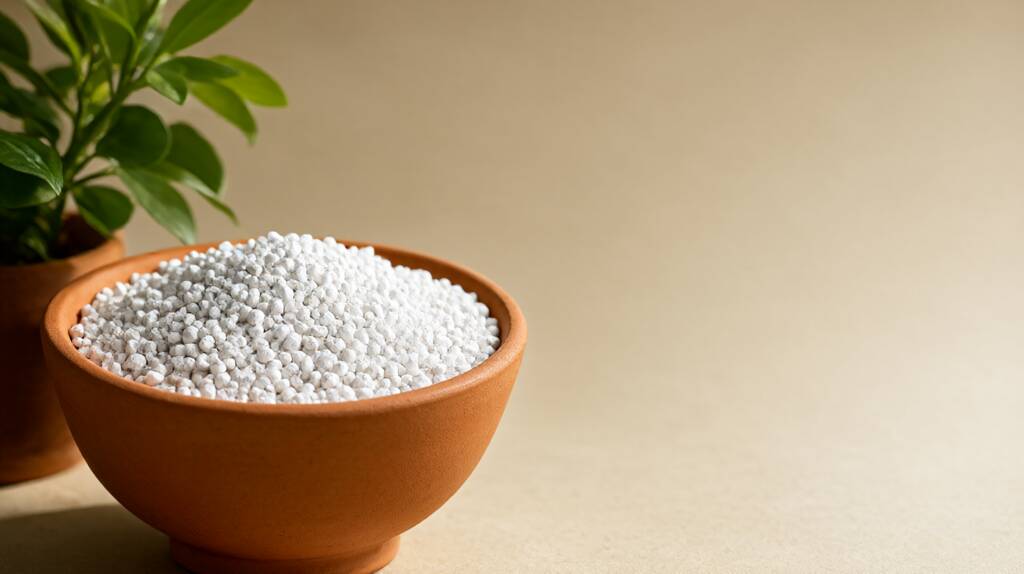
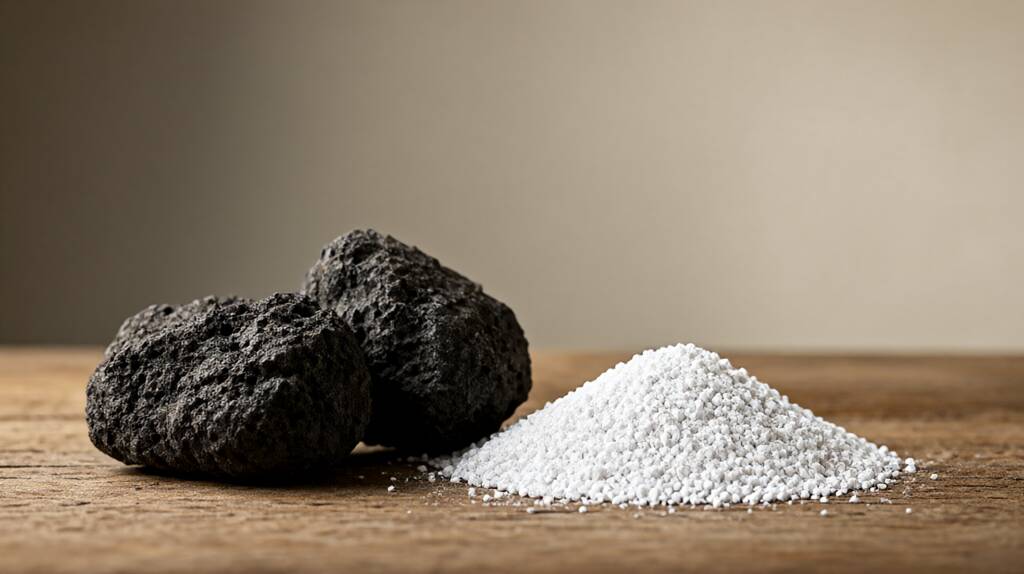
Perlite begins as a dense, obsidian-like volcanic rock. Mined ore is crushed, then heated to roughly 850 to 900 degrees Celsius. At that temperature the trapped water inside the glassy rock flashes to steam and the particle expands, much like popcorn, to 4 to 20 times its original volume. The result is expanded perlite: white, lightweight, and filled with sealed and semi-sealed air cells.
Raw perlite and expanded perlite are different materials in practice. Raw ore is heavy and non-porous. Expanded perlite is the gardening product. If a bag is heavy for its volume, it is either unexpanded ore or a very coarse grade; expanded horticultural perlite should feel almost weightless in the hand.
The source rock is mined in several countries, with large deposits in Greece, Turkey, the United States, and Japan. The mineral composition is broadly similar across sources, but particle size distribution and expansion quality vary by manufacturer, which is why grade labels like “coarse” are not standardized across brands.
Raw vs Expanded Perlite
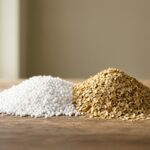
Raw perlite ore is dense volcanic glass. Expanded perlite is the same material after heat treatment. Only expanded perlite is used in growing media. The expansion creates the porosity that makes the material useful, and it is the reason perlite is sold by volume rather than by weight.

Physical Properties That Matter for Plants
Three properties define how perlite behaves in a mix: porosity, particle size, and surface chemistry. Porosity is high, typically 90 to 95 percent air space by volume in the particle itself. That high porosity is why perlite lightens a mix so dramatically. Particle size controls how much of that porosity becomes air space versus water film in the mix. Surface chemistry is nearly neutral, with a pH around 7.0 to 7.5 and very low cation exchange capacity, usually 1 to 5 meq per 100 grams.
The low cation exchange capacity matters more than most guides admit. Perlite does not hold nutrients. It holds almost no nutrient reserve, which means a perlite-heavy mix requires more frequent feeding than a peat or coco coir mix. Treating perlite as a growing medium on its own, without a nutrient program, is a common failure mode in hydroponics.
Aeration vs Water Retention
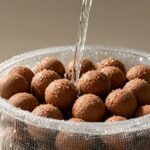
Perlite is often described as a drainage amendment, but the particle itself retains water. A thin film of water clings to the glass surface and inside the open pores. Coarser grades hold less of that film and leave more air space. Finer grades hold more water and less air. The trade-off is direct: more aeration means less water retention, and vice versa.
This is the mechanism that connects particle size to growing conditions. A mix for a succulent wants coarse perlite and a low ratio, because the plant needs air around the roots and cannot tolerate wet feet. A mix for a moisture-loving tropical wants finer perlite or a higher ratio of water-holding components, because the plant needs consistent moisture and the perlite is there to prevent compaction, not to dry the mix out.
Why Perlite Is Used in Gardening
Perlite earns its place in four distinct ways. It lightens heavy mixes, which reduces compaction and improves root penetration. It creates air space, which supplies oxygen to roots and reduces the risk of anaerobic conditions. It improves drainage, which reduces waterlogging after heavy watering. And it stays stable over time, because perlite does not decompose the way peat and bark do.
That stability is a real advantage. A peat-based mix breaks down over 12 to 24 months and the structure collapses. Perlite does not. A mix amended with perlite keeps its structure for years, which is why it is popular in long-term container plantings and in hydroponic systems that run for multiple seasons.
What Perlite Does Not Do
Perlite does not feed plants. It contains no nitrogen, phosphorus, potassium, or micronutrients in usable form. Perlite does not acidify or alkalinize a mix in any meaningful way, because its pH is near neutral and its buffering capacity is negligible. Perlite does not prevent disease on its own, though better aeration can reduce the conditions that favor root rot. And perlite does not replace water-holding components like peat, coco coir, or vermiculite. A mix of pure perlite dries out within hours in a warm room.
Advantages and Limitations
The advantages are real but bounded. Perlite is lightweight, sterile when purchased, pH-neutral, stable, and inexpensive. It improves aeration and drainage in almost any mix. The limitations are equally real. It generates dust that irritates lungs and eyes during handling. It floats to the surface of pots when watered from above. It can dry out too fast in hot climates. And it provides no nutrition, so a perlite-heavy mix demands a feeding program.
The dust issue is not a minor inconvenience. Dry perlite contains respirable particles. Wetting the material before handling, wearing a mask, and working in a ventilated space are basic precautions. This matters most when mixing large batches.
When Perlite Is Unnecessary
Perlite is unnecessary in mixes that already drain well and hold structure. A sandy loam garden soil in a large raised bed rarely needs amendment. A mix heavy in bark and pumice for an orchid may not benefit from additional perlite. And plants that prefer consistently moist, dense media, such as some bog plants, are harmed by perlite’s aeration. The test is the plant’s root oxygen requirement, not a universal rule.
Perlite vs Other Growing Media
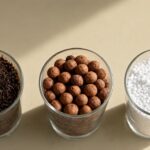
Compared to vermiculite, perlite is coarser, drains faster, holds less water, and has lower cation exchange capacity. For a detailed comparison, see perlite vs vermiculite and perlite vs pumice. Vermiculite holds more water and more nutrients. The two are not interchangeable. Compared to pumice, perlite is lighter and cheaper but less durable and more prone to floating. Pumice does not float and does not break down, but it is heavier and more expensive. Compared to coco coir and peat, perlite is the air-space component; the organic components are the water and nutrient reservoirs.
The common mistake is treating perlite and vermiculite as a binary choice. They solve different problems. A mix can use both, and many commercial mixes do, with perlite providing structure and vermiculite providing moisture retention.
Major Horticultural Applications
Perlite appears in four main horticultural contexts. In potting mixes it is the standard aeration amendment. In hydroponics it serves as a standalone growing medium or as a component in blended media. In propagation it provides the aeration and moisture balance needed for root development. And in seed starting it prevents compaction in fine seed mixes.
Each application has different requirements for particle size and ratio. The pillar page establishes the material; the application pages cover the specifics. Mixing perlite into potting soil, selecting the right perlite grade, using perlite in hydroponics, and using perlite for propagation are covered in their own articles.
How Particle Size Connects to Growing Conditions
This relationship is the central mechanism of the cluster. Coarser perlite, typically particles above 3 millimeters, creates more air space and less water retention. Medium grades, around 1 to 3 millimeters, balance aeration and moisture. Fine grades, below 1 millimeter, hold more water and less air but can compact and reduce drainage if overused.
The practical consequence is that grade selection should follow the plant and the system, not habit. A hydroponic bucket with frequent irrigation can use coarse perlite because the water supply is constant. A houseplant in a warm apartment with weekly watering benefits from medium grade, because the mix must hold enough moisture between waterings without staying saturated.
Last reviewed on November 9, 2026
Sources and further reading: Perlite Institute, horticultural applications and particle grades; Oklahoma State University Extension, soilless growing media; University of Florida IFAS Extension, commercial crop production in perlite media; USGS, perlite statistics and information.