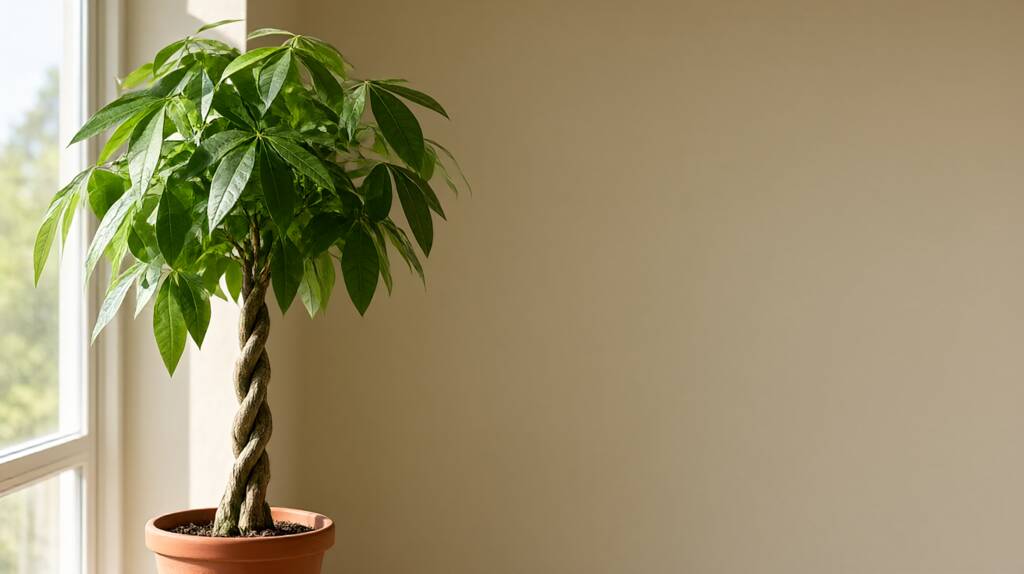

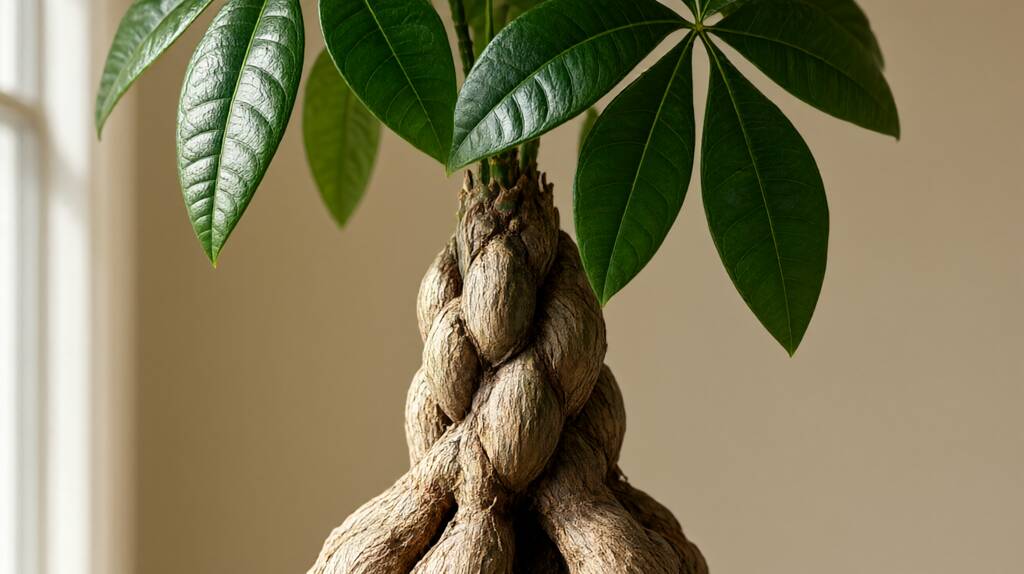
Pachira aquatica is sold under a dozen names. Money tree, Guiana chestnut, water chestnut, Malabar chestnut, Saba nut. The botanical name is the one constant, and it tells you what the plant is: a tropical wetland tree from Central and South America that stores water in its swollen trunk base and tolerates the low light of a living room because its native range is the shaded understory of riverbanks. That one fact explains almost every care rule that follows.
Two failure modes follow from it. The first is rot: a plant built for wet soils but not for sitting water will rot at the trunk if the pot holds moisture with no drainage. The second is leaf drop: a plant that evolved to shed leaves when water is scarce will protest root disturbance, cold drafts, or a sudden light change by dropping its leaves within days. Both look like emergencies. Neither is, if you read the signal correctly.
Most growers get one thing wrong: they treat Pachira aquatica like a succulent because of the swollen trunk. The trunk is a reservoir, not a license to underwater. The roots still need consistent moisture, and the gap between “trunk looks plump” and “roots are dry” is where most money trees die.
Light: Bright Indirect, Six Hours Minimum
Money trees need at least six hours of bright, indirect light per day to maintain the dense, dark-green whorl of compound leaves that makes the plant worth growing. A south- or east-facing window is ideal. Direct midday sun scorches the leaflets and turns them papery brown at the edges. Too little light and the plant stretches toward the source, the internodes lengthen, and the trunk thins.
The test is simple. Hold your hand where the plant sits at noon. If you can read a book comfortably in that light, the plant can grow there. If the shadow of your hand is sharp and dark, the light is too direct. If you cannot read at all, the plant is in a slow decline that will show up as yellow lower leaves within a month.
Water: Moist, Not Wet, and Never Standing
Water thoroughly until water runs from the drainage hole, then empty the saucer within fifteen minutes. The potting mix should feel moist an inch below the surface the day after watering and nearly dry by the time you water again. In practice that means roughly once a week in a warm, bright room and every ten to fourteen days in winter.
The native habitat explains the rule. Pachira aquatica grows along rivers where the soil floods and then drains. The roots tolerate saturation briefly but not standing water. A pot with no drainage hole, or a saucer left full, creates anaerobic conditions at the root zone within days, and the rot shows up as soft, dark tissue at the trunk base that smells of decay.
Two signals tell you the plant is underwatered rather than overwatered. First, the leaves droop and curl inward, and they recover within hours of watering. Second, the trunk base wrinkles slightly and feels soft to the touch. Overwatered leaves, by contrast, turn yellow from the bottom up and fall without recovering, and the trunk stays firm until the rot is advanced.
Humidity and Temperature: The 50% and 65 F Floors
Money trees want relative humidity around 50% and temperatures between 65 and 85 F (18 to 29 C). Below 50% RH the leaflets develop crispy brown tips and edges, starting at the oldest leaves. A pebble tray, a humidifier, or grouping the plant with other tropicals raises the local humidity without changing the room.
Cold is the silent killer. Drafts from air conditioning vents, open windows in winter, or a spot near an exterior door drop the temperature below 60 F (15 C) and trigger leaf drop within days. The plant does not die, but it looks dead, and most growers throw it out before the next flush of growth appears in spring.
Soil and Repotting: Drainage Over Everything
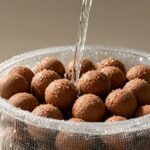
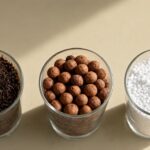
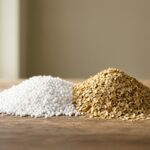
Use a well-draining potting mix: roughly equal parts peat or coco coir, perlite, and a coarse component like orchid bark or horticultural sand. The mix should drain in seconds, not minutes. A standard houseplant mix with added perlite works, but the ratio matters more than the brand.
Repot every two to three years in spring, moving up only one pot size. Pachira aquatica dislikes root disturbance and will drop leaves in protest. When you repot, keep the root ball intact, fill around it with fresh mix, and water once. Do not fertilize for four to six weeks while the roots re-establish.
Fertilizer: Half Strength, Growing Season Only
Feed with a balanced liquid fertilizer at half the label rate every two weeks from March through September. Stop entirely from October through February. Overfertilizing produces soft, weak growth that attracts pests and splits the trunk bark.
Common Problems and What They Mean
Leaf drop after moving the plant
Pachira aquatica reads a change in light direction, temperature, or airflow as a threat and sheds leaves to reduce transpiration. The leaves do not come back on the same stem, but new growth appears at the top within two to four weeks if the plant is left in its new spot and not moved again. The mistake is moving it a second time to “help” it recover.
Yellow lower leaves
Overwatering or low light. Check the soil moisture first: if it is wet an inch down, skip the next watering and improve drainage. If the soil is dry, move the plant to a brighter spot. Yellowing that starts at the tips and moves inward suggests salt buildup from fertilizer; flush the pot with three times its volume in water and skip feeding for a month.
Brown, crispy leaf edges
Low humidity, underwatering, or fertilizer burn. Raise humidity first, since it is the most common cause in heated homes in winter. If the tips are brown and the soil is dry, increase watering frequency. If the tips are brown and the soil is wet, leach the pot and reduce feeding.
Soft, dark trunk base
Rot, almost always from standing water. Cut away the soft tissue with a sterile knife, let the cut dry for twenty-four hours, and repot into fresh, dry mix. If the rot has reached the roots, propagate from a healthy cutting instead. Pachira aquatica roots easily from stem cuttings in water or moist perlite.
Scale and mealybugs
Check the leaf axils and undersides weekly. A strong jet of water dislodges most scale. For persistent infestations, wipe with a cotton swab dipped in 70% isopropyl alcohol and repeat weekly until no new insects appear for three weeks.
Propagation: Cuttings and Air Layering
Take a six-inch tip cutting with at least two leaf nodes, remove the lower leaves, and root it in water or a mix of perlite and peat. Roots appear in three to six weeks at 70 to 75 F. Air layering works on mature stems and is the better choice for a plant that has grown too tall and leggy.
What to Expect in the First Two Weeks
A newly purchased money tree will often drop one or two leaves in the first week. That is transplant shock, not failure. Leave it in its spot, water when the top inch is dry, and wait. New growth at the top of the trunk within three weeks means the plant has settled. If no new growth appears after six weeks and the leaves continue to yellow, check the drainage and the light before doing anything else.
Your Pachira aquatica is not fragile. It is a wetland tree that learned to live in a pot, and it tells you what it needs in leaves, not in words. Read the leaves.
Sources and further reading: New York Botanical Garden, “Money tree (Pachira aquatica)” research guide (libguides.nybg.org); The Spruce, “How to Grow and Care for a Money Tree” (thespruce.com); University of Florida IFAS Extension, tropical plant care publications; Oklahoma State University Extension, houseplant care guidelines.
Last reviewed on 2026-11-21