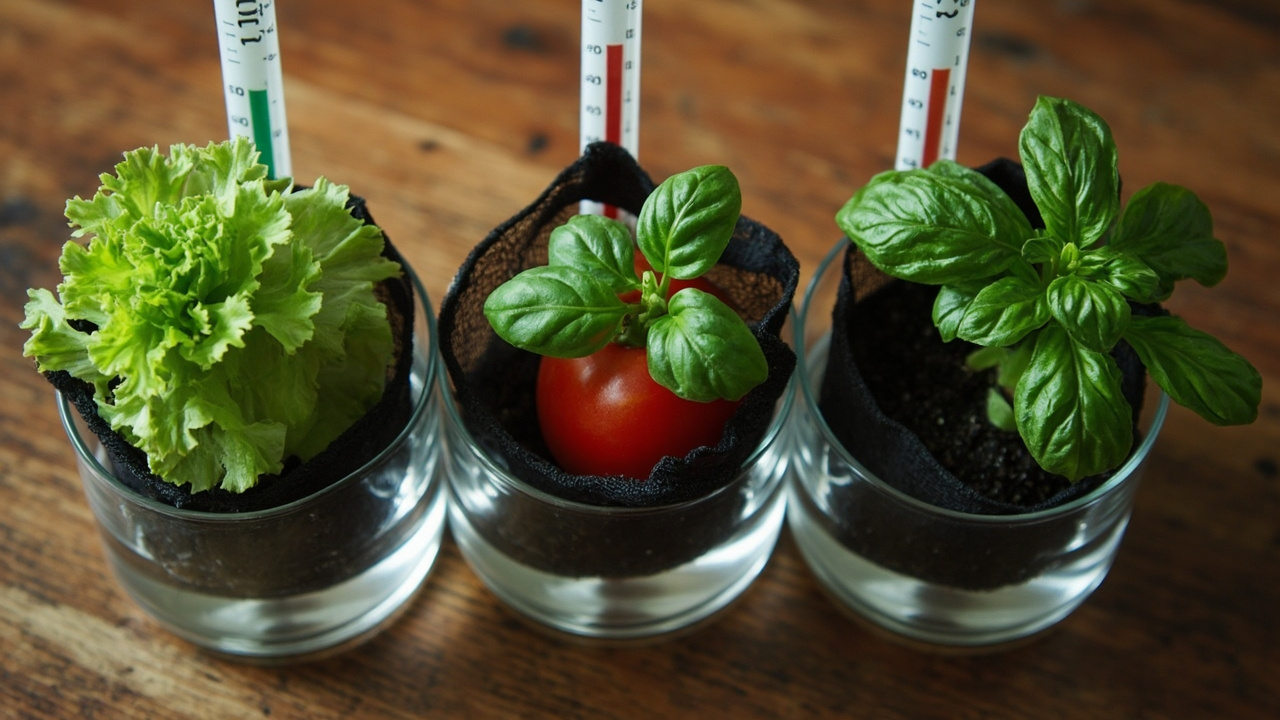
One water temperature range does not fit every crop you grow hydroponically. Lettuce, tomatoes, basil, and strawberries each evolved under different climates and have different root-zone temperature thresholds. A reservoir that thrives lettuce for six weeks can rot a tomato’s roots in three days.
The split runs on dissolved oxygen. Cooler water holds more of it, which is why cool-season crops tolerate low temperatures but punish you with bolting above 75 °F. Warm-season fruiting crops evolved roots that demand more warmth as a signal that oxygen stress is acceptable. A root zone at 60 to 70 (16 to 21 °C) gives lettuce the cool, oxygen-rich water it needs and stresses basil into Pythium rot; at 70 to 75 the basil thrives while the lettuce bolts.
This article walks the per-crop optimum band for the four crops most home growers attempt — lettuce, tomatoes, basil, and cucumbers — and the failure mode when the band is wrong. For reservoir fundamentals, see the reservoir water temperature range guide that this page builds on.
The Two-Tier Truth: Cool-Season and Warm-Season Crops Want Different Bands
The cleanest framing is two tiers. Cool-season crops want root-zone temperatures in the 60 to 70 °F (16 to 21 °C) band; warm-season fruiting crops want 68 to 78 °F (20 to 26 °C). Overlap exists between 68 and 70, but the failure modes at each end are not symmetric: cool-season crops tolerate the warm end badly but recover in days; warm-season crops tolerate the cool end badly and stall for weeks.
The mechanism is dissolved oxygen. At 65 °F (18 °C), a well-aerated reservoir holds about 9.5 mg/L; at 78 °F (26 °C), the same water holds closer to 8.2 mg/L. Root oxygen demand rises with temperature at the same time, so the gap between supply and demand widens faster than the numbers suggest.
The reservoir water temperature range guide covers the full mechanism. The summary here is that cool-season crops chose climates where cool water satisfied their modest oxygen demand, while warm-season crops evolved roots that demand more warmth and accept the higher oxygen demand.
The practical cost: a single reservoir set to 72 °F (22 °C) for tomatoes visibly stresses lettuce within seven to ten days, and a reservoir set to 65 °F (18 °C) for cucumbers halves their vegetative growth rate. Most home growers work around this by grouping crops into one of two reservoir temperatures and accepting that one tier’s tolerance is the other tier’s failure mode. The next four sections walk what each crop wants and what happens when it does not get it.
Lettuce, Spinach, and Other Cool-Season Leafy Crops: 60 to 70 °F
Lettuce roots thrive between 60 and 70 °F (16 to 21 °C), with the most vigorous growth clustered at 64 to 68 (18 to 20). Spinach, arugula, kale, and bok choy sit in the same band — all cool-season leaf crops selected for fast vegetative growth under temperate spring and fall conditions.
The warm-end failure mode is bolting. Once the root zone passes 75 °F (24 °C) for more than seven to fourteen days, lettuce switches from leaf production to seed production. The signals: elongated central stalk, bitter flavor, milky sap in the leaves.
Once visible, bolting does not reverse. The crop is done.
The cool end is slower and recoverable. Root metabolism drops below 55 °F (13 °C), growth visibly stalls, and the crop holds without dying for two to three weeks. Warming the reservoir reverses most of the stall within five to seven days, so a brief cold snap costs growth but not the crop.
Lettuce and other leafy greens in deep water culture are the forgiving end of the spectrum. Hold 60 to 70, watch for bolting above 72, and warm-season crops elsewhere.
Tomatoes, Peppers, and Warm-Season Fruiting Crops: 68 to 78 °F
Tomato roots want 68 to 78 °F (20 to 26 °C), with the optimum at 72 to 75 (22 to 24). Peppers, eggplant, and okra sit in the same band — all warm-season fruiting crops that evolved in subtropical soils. Below 65, root activity slows visibly; above 80, the same warmth that drove fruiting triggers a different failure mode.
The warm-end failure mode is blossom-end rot: a calcium lockout at the fruit tip that shows up as a brown-black leathery patch on the blossom end of the developing fruit. The mechanism is that warm water accelerates transpiration faster than the plant can move calcium into the fruit cells, even when calcium is at sufficient parts per million in the solution.
Blossom-end rot appears within ten to fourteen days of sustained warm root zones and does not reverse once set in the fruit. Cooling the reservoir is the only fix, and the reservoir water temperature range guide covers the cheapest cooling moves first.
Below 60 °F (15 °C), tomato and pepper vegetative growth stalls, phosphorus uptake drops sharply, and the crop holds but produces little. Warming to 68 within seven days reverses the stall without fruit loss if the cold snap was short. The single biggest mistake with warm-season crops is treating them like lettuce and holding the reservoir at 65 degrees to save on heating; the resulting four-week growth stall costs more energy in lost yield than any heater would.
Basil, Cucumbers, and Strawberries: The Middle-Band Crops That Punish Mistakes Fastest
Three crops sit between the two tiers and respond to mistake fastest: basil at 65 to 70 °F (18 to 21 °C), cucumbers at 70 to 75 (21 to 24), strawberries at 65 to 72 (18 to 22). All three tolerate a narrow band — three to five degrees of margin on each side before failure mode sets in.
Basil is the most punishing. Above 72 °F (22 °C) with low dissolved oxygen, Pythium root rot sets in within forty-eight hours. The signal is wilting despite wet roots; the fix is immediate reservoir cooling plus aggressive air-stone use.
Affected plants rarely recover. The common hydroponic problems guide covers the diagnostic steps in detail.
Cucumbers drop yield fifteen to twenty-five percent within two weeks if the root zone falls below 65 °F (18 °C) — the inverse of lettuce, where cold slows but does not kill. Strawberries punish in the other direction: above 75 °F (24 °C), flower set drops sharply and runner production replaces fruit production. Both crops reward growers who keep the reservoir within a tight three-degree band and check it daily; both punish the set-and-walk-away grower.
Building a Per-Crop Rotation Schedule Without Buying More Equipment
One reservoir can serve two crops if they share a tier. Choose cool-season OR warm-season; do not mix across tiers in one reservoir and expect the cooler-tier crop to survive. The practical setup for most home growers is one reservoir at 65 to 68 °F (18 to 20) for leaf crops, one at 72 to 75 (22 to 24) for fruiting crops, and acceptance that basil rides with the warm-season reservoir because its tolerance band overlaps warm-season much better than cool-season.
The trade-off: dual reservoirs cost more in hardware but cut crop loss to near zero. A single reservoir across tiers costs less but loses roughly one crop per year to a temperature event that one tier tolerates and the other does not. For growers with one reservoir, the cleanest move is to commit to one tier and rotate crops within it — lettuce, spinach, and bok choy in spring and fall, basil as the only warm-season exception because its tolerance band is the narrowest.
Daily checks at the same hour, with a 30-second log, are what separate the growers who keep a single reservoir across seasons from the ones who lose a crop to a forgotten heat wave. The nutrient mix that goes into that reservoir should be dialed for the active crop each week, not the dormant one. Reservoir temperature and nutrient mix are the two levers that change with the crop; lock both weekly and the rotation becomes reliable.
Sources: the per-crop optimum bands in this article draw on University of Florida IFAS Extension’s Controlled Environment Hydroponic Crop Production notes, the Royal Horticultural Society’s hydroponic growing guidance, Cornell CEA’s lettuce and basil temperature thresholds, Resh’s Hydroponic Food Production (7th edition), and USDA-ARS Greenhouse Production Research on heat stress and bolting thresholds. Heritage and heirloom cultivars may sit two to three °F outside these bands in either direction; the ranges above are population-level optima, not cultivar-specific.
Turn PDF Bank Statements Into Workable Spreadsheets
Your bank statement is a mess of numbers, but your books shouldn't be. Use our converter to get Excel, CSV, or QBO files — ready for QuickBooks.
Try It Free Now