
A homemade hydroponic nutrient solution can match a commercial one for a quarter of the cost, but only if you pick the right DIY path for your system and your tolerance for measuring. Three paths actually work: mineral salts, organic amendments, and compost tea. Each one solves a different problem, each one fails in a different way, and the path you choose determines what equipment you need, what crops it suits, and how much time you will spend monitoring each week.
Mineral salts are the precision path: 0.1 gram accuracy, two-part mixing, ppm targets per element. Organic amendments are the slow-release path: compost, fish emulsion, kelp meal, rock phosphate, wood ash, steeped or top-dressed, filtered before use. Compost tea is the microbial path: mature compost aerated for 24 to 48 hours, rich in beneficial bacteria and fungi, but incompatible with NFT channels because particulates clog the pump.
This guide walks through all three paths with complete recipes, the equipment each one needs, the system types it fits, the crops it suits, and the monitoring that keeps the reservoir stable through a full grow cycle.
What Homemade Hydroponic Nutrients Actually Replace
Commercial hydroponic nutrient solutions cost roughly $0.10 to $0.20 per liter at retail. A DIY mix using individual nutrient salts costs closer to $0.02 per liter. A 2019 study in the Journal of Plant Nutrition found comparable growth and yields between DIY and commercial nutrient solutions when the DIY formula matched the target NPK ratio, so the cost saving is not a trade-off against plant performance.
The trade-off is precision. Commercial solutions are pre-balanced with exact ratios in a lab; DIY puts the mixing and measuring in your hands. That is also the upside: you can adjust the recipe for your crop, your water source, and your system, instead of buying a one-size-fits-all bottle.
Before picking a path, you need to understand what plants actually pull out of a nutrient solution. Then the choice between mineral salts, organic amendments, and compost tea becomes a question of equipment, system type, and how much monitoring time you can commit each week.
The 14 Essential Elements Plants Need from the Solution
Plants need 16 essential elements for growth. Three, carbon, hydrogen, and oxygen, come from air and water. The remaining 14 must be supplied in the nutrient solution, and missing any one of them causes a specific deficiency symptom because in hydroponics there is no soil buffer to hide the mistake.
The 14 divide into macronutrients, needed in larger quantities, and micronutrients, needed in trace amounts. Macronutrients are nitrogen, phosphorus, potassium, calcium, magnesium, and sulfur. Micronutrients are iron, manganese, zinc, copper, boron, molybdenum, and chlorine. The standard target bands for most hydroponic crops sit at 100 to 200 ppm nitrogen, 50 to 80 ppm phosphorus, 150 to 300 ppm potassium, 150 to 200 ppm calcium, 50 to 75 ppm magnesium, 50 to 100 ppm sulfur, and 0.1 to 5 ppm for each micronutrient.
Of those 14 elements, only nitrogen, phosphorus, and potassium are the headline NPK on a fertilizer label. The other 11 are equally essential. Calcium deficiency shows up as blossom end rot on tomatoes and tip burn on lettuce; iron deficiency shows up as interveinal chlorosis, yellow leaves with green veins; magnesium deficiency shows up as yellowing between veins on older leaves first. Each symptom maps to one missing element, which is why hydroponic growers learn to read leaves before they learn to read meters.
Path A: Mineral Salts for Precision Mixing
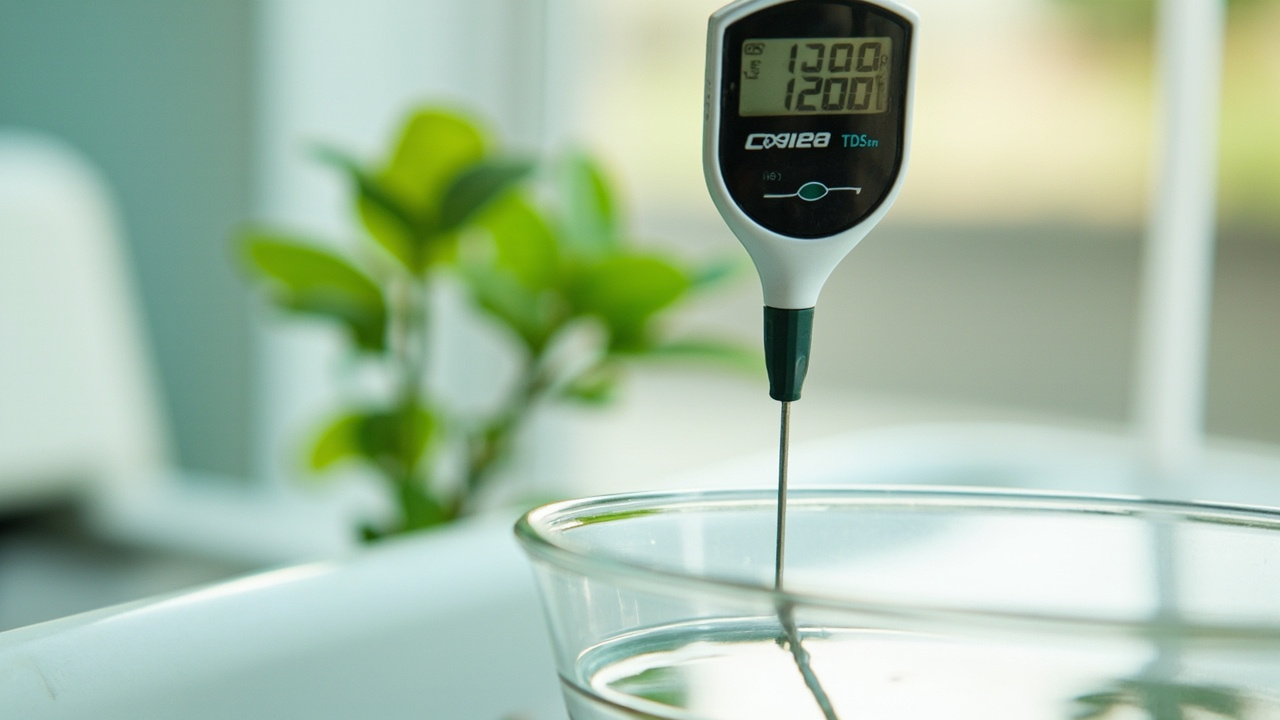
This path is the most controllable. You dissolve individual nutrient salts in two separate stock solutions, then dilute them into the reservoir. It requires a 0.1 gram precision scale, a pH meter, an EC meter, and roughly 20 minutes per mix. In return, you get a fully tunable solution that hits target ppm bands for any crop at any growth stage.
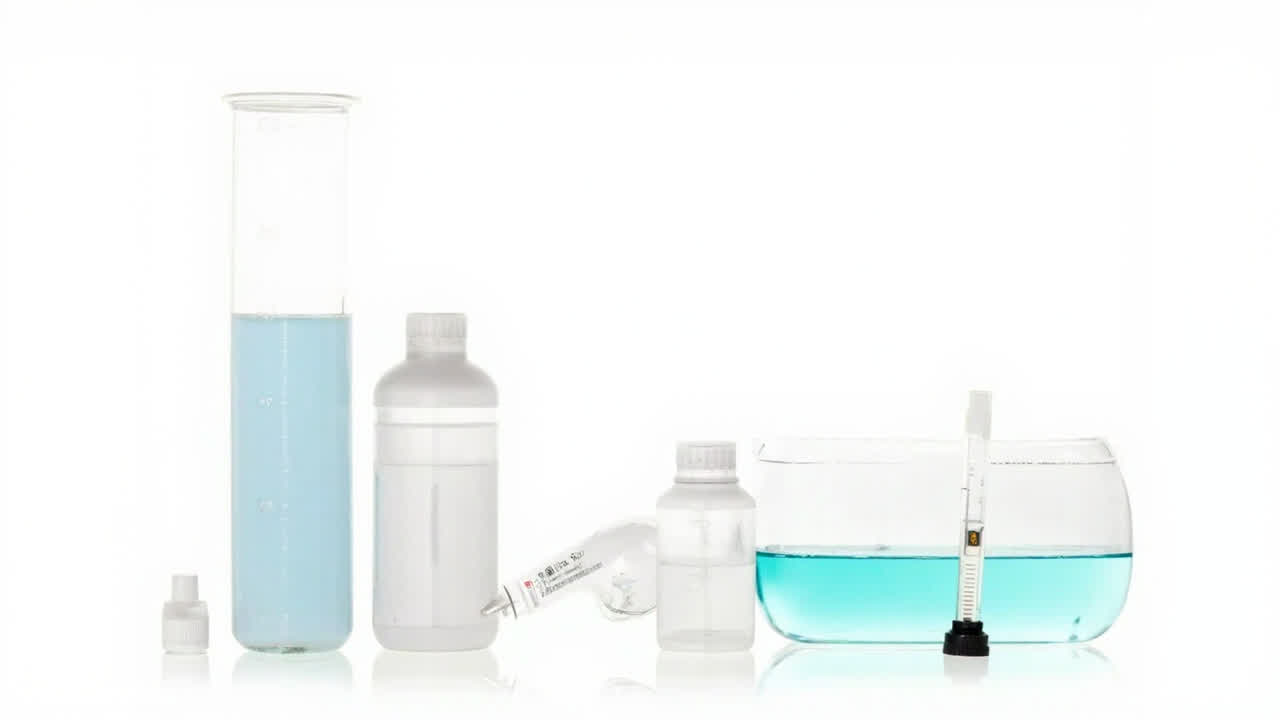
The core ingredients and the element they supply: calcium nitrate supplies nitrogen and calcium; monopotassium phosphate supplies phosphorus and potassium; potassium nitrate supplies nitrogen and potassium; magnesium sulfate (Epsom salt) supplies magnesium and sulfur; iron chelate (Fe-DTPA or Fe-EDDHA) supplies iron; a pre-mixed hydroponic micronutrient blend supplies manganese, zinc, copper, boron, and molybdenum.
The recipe below produces 10 liters of nutrient solution suitable for lettuce, basil, spinach, and other leafy greens at the seedling-to-harvest stage. All quantities are in grams per 10 liters of water.
Part A, dissolve separately in 2 liters of water: 90 grams calcium nitrate, supplies 140 ppm nitrogen and 180 ppm calcium; 2 grams iron chelate, supplies 3 ppm iron. Part B, dissolve separately in 2 liters of water: 25 grams monopotassium phosphate, supplies 50 ppm phosphorus and 70 ppm potassium; 60 grams potassium nitrate, supplies 80 ppm nitrogen and 230 ppm potassium; 50 grams magnesium sulfate, supplies 50 ppm magnesium and 70 ppm sulfur; 5 grams hydroponic-grade micronutrient mix.
Mixing order: fill a 10 liter container with 6 liters of water. Slowly add Part A while stirring, then add Part B while stirring. Top up to 10 liters. Check pH, it should land between 5.8 and 6.5; adjust with phosphoric acid to lower or potassium hydroxide to raise. Check EC, it should read 1.2 to 1.8 mS/cm for leafy greens.
The two-part system is not optional. Calcium nitrate reacts with magnesium sulfate in concentrated solution to form calcium sulfate, which is gypsum, and it precipitates out of solution as a white sludge that plants cannot absorb. Skip the two-part system and you will see white precipitate forming in your reservoir within 24 hours and your plants will develop calcium deficiency within 7 to 10 days. This single mistake ruins more first batches than any other.
Path B: Organic Amendments for Slow-Release Nutrition
This path trades precision for inputs that feel closer to soil gardening. You build a nutrient solution from compost, fish emulsion, kelp meal, rock phosphate, wood ash, Epsom salt, and seaweed extract, all naturally derived, all slower to release than mineral salts. It suits media-based systems like Dutch buckets, coco coir, or perlite, where the growing medium buffers the release and supports microbial life.
The ingredients map to nutrients the same way mineral salts do. Compost and fish emulsion supply nitrogen, with fish emulsion as the faster-release component. Kelp meal supplies potassium and a broad micronutrient trace. Rock phosphate supplies phosphorus slowly over weeks. Wood ash supplies potassium and raises pH, useful when your water source runs acidic. Epsom salt supplies magnesium and sulfur. Seaweed extract supplies micronutrients and natural growth hormones.
A working recipe for 10 liters of organic nutrient solution suitable for leafy greens: start with 2 liters of well-decomposed compost steeped in 8 liters of water for 24 hours, then strain through a fine mesh or 200-micron filter. Add 30 milliliters of fish emulsion, 15 grams of kelp meal, 10 grams of rock phosphate, 5 grams of wood ash, 20 grams of Epsom salt, and 10 milliliters of seaweed extract. Stir thoroughly, let settle for 2 hours, filter again before adding to the reservoir.
The honest trade-off: organic amendments release nutrients over days and weeks rather than minutes, so deficiency symptoms show up later and recovery is slower. The solution also carries particulates that clog pumps, drip emitters, and NFT channels. If you run a recirculating deep water culture (DWC) or NFT system, this path is the wrong choice. If you run a media-based system with a fresh-drain reservoir or a top-feed drip, this path works and produces crops with a flavor profile many growers prefer over mineral-salt-fed crops.
Path C: Compost Tea for Microbial-Driven Nutrition
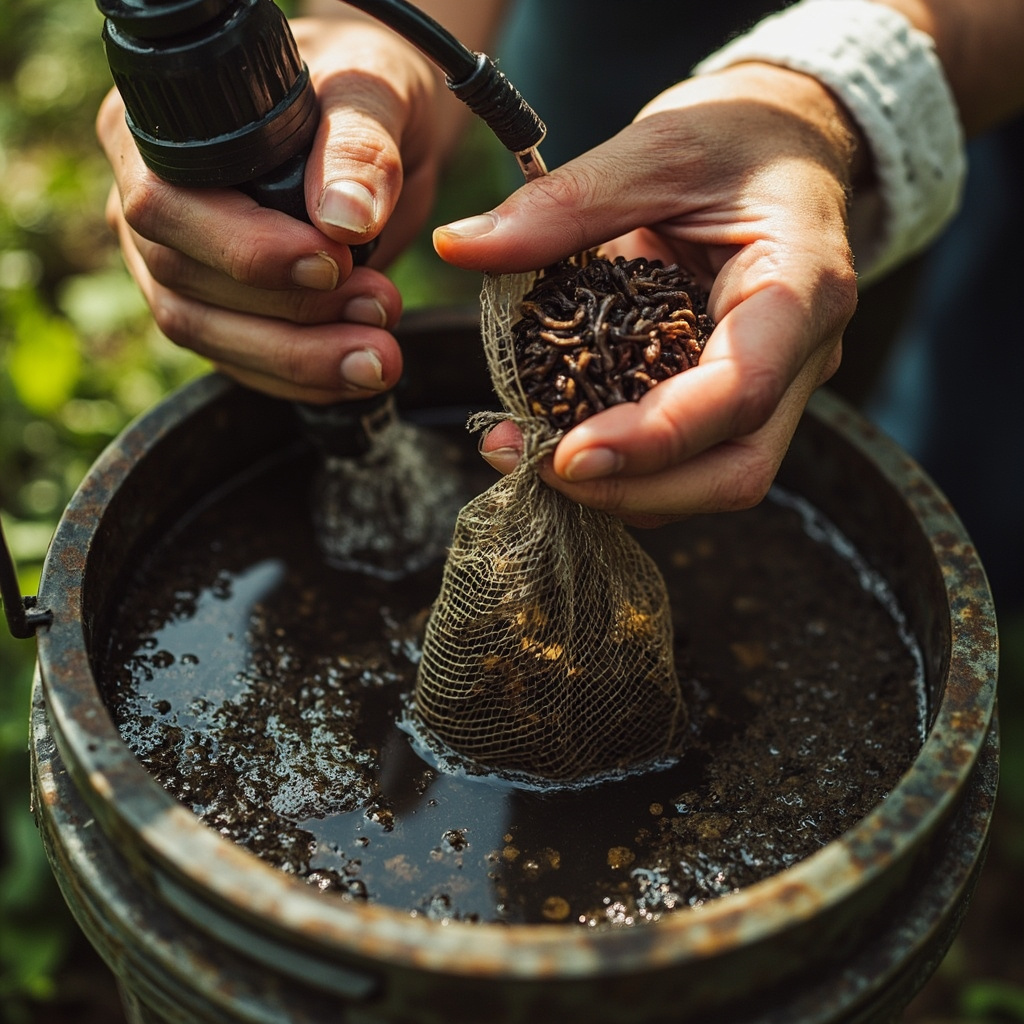
Compost tea is brewed, not mixed. You steep mature compost in aerated water for 24 to 48 hours, which extracts soluble nutrients and multiplies the beneficial bacteria and fungi already living in the compost. The result is a living solution, microbes plus dissolved nutrients, that brings soil-style biology into a soilless system.
The brew ratio is roughly 1 part mature compost to 5 parts water by volume, placed in a clean container with an aquarium air pump running continuously. The aeration is not optional: without it, the brew turns anaerobic within 8 hours, the microbial population shifts toward non-beneficial species, and the tea smells sour instead of earthy. A 24-hour brew favors bacteria; a 48-hour brew favors fungi. Most hydroponic applications use the 24-hour bacterial-dominant brew.
To use: strain the tea through a 100-micron filter or finer before adding to the reservoir, then dilute 1 part tea to 4 parts fresh water. The diluted tea supplies nitrogen, phosphorus, potassium, and a microbial population that colonizes the root zone and improves nutrient uptake. It is particularly effective in media-based systems where the roots have somewhere to host the microbial life.
The honest limits: compost tea clogs NFT and aero channels within 2 to 3 weeks, even when filtered, because biofilm builds on the channel walls and the pump impeller. It is also a slow-release solution: do not expect to fix a nitrogen deficiency overnight with compost tea. Use it as a baseline feed in a media-based system, not as a rescue treatment in a recirculating channel system.
Adjusting the Recipe for Crop and Growth Stage
Leafy greens, lettuce, basil, spinach, kale, want higher nitrogen and lower phosphorus. The Path A recipe above already targets this. Target EC sits at 1.2 to 1.8 mS/cm through vegetative growth.
Fruiting crops, tomatoes, peppers, cucumbers, want lower nitrogen and higher phosphorus and potassium once flowers set. Adjust Path A by increasing monopotassium phosphate to 35 grams and potassium nitrate to 80 grams per 10 liters, then reducing calcium nitrate to 70 grams during flowering to limit vegetative growth. Target EC rises to 2.0 to 2.5 mS/cm during fruiting. When flowers first appear, add 10 grams of calcium nitrate directly to the root zone, not the reservoir, to prevent blossom end rot on the first fruit trusses.
Seedlings and clones have limited root systems and cannot process full-strength nutrients. Reduce all Path A quantities by 50 percent and target EC 0.6 to 0.8 mS/cm. Too much fertilizer at this stage causes salt burn on the delicate root tips and stunts growth for 7 to 14 days, a common beginner mistake when the urge is to give seedlings everything the mature plant will eventually need.
Herbs, basil, cilantro, parsley, mint, are sensitive to excess potassium, which causes leaf tip burn and reduces essential oil production. Use the leafy-green Path A recipe but reduce potassium nitrate to 40 grams per 10 liters and target EC 1.0 to 1.4 mS/cm.
Monitoring pH, EC, and PPM
Check pH every 1 to 2 days. In a recirculating system, pH drifts upward as plants absorb nitrate, which releases hydroxide ions into the solution. Below 5.5, calcium and magnesium become unavailable; above 6.5, iron and manganese lock out. The optimal band is 5.5 to 6.5 for most crops.
Check EC every 3 to 4 days. EC rises as plants absorb water faster than nutrients, common in hot and dry conditions, and falls as plants absorb nutrients faster than water, common in cool and humid conditions. If EC rises above target, add plain water to dilute; if EC falls below target, add concentrated nutrient solution to bring it back up. Detailed EC meter reading is covered in our EC meter guide, and the PPM-to-EC conversion is covered in our PPM levels guide.
Replace the entire reservoir every 7 to 14 days. In a recirculating system, nutrient imbalances accumulate over time as plants selectively absorb some elements and leave others behind, so a full reset prevents the slow drift that causes deficiency symptoms in week 3 to 4 of a cycle. Reservoir refresh protocol and biofilm control are covered in our reservoir maintenance guide.
For broader NPK ratio theory, including the vegetative-versus-fruiting transition in detail, see our NPK nutrients guide. For pH chemistry and adjustment, including how to handle chloramine in tap water, see our pH levels guide.
Common Mistakes and When to Switch Back to Commercial
The four most common DIY mistakes, in order of how often they ruin a first batch: skipping the two-part mix and watching calcium sulfate precipitate out; mixing at full strength for seedlings and burning root tips; ignoring pH drift past 6.5 and locking out iron; brewing compost tea past 48 hours and shifting the brew anaerobic. Each of these has a visible symptom within 7 to 14 days, and each has a fix.
The calcium sulfate mistake shows as white sludge in the reservoir and blossom end rot or tip burn on the crop. Fix: switch to the two-part mixing order; the precipitate disappears within one reservoir cycle. The seedling burn shows as brown root tips and stunted growth. Fix: dilute to 50 percent of target EC and resume normal strength after 10 to 14 days of new root growth. The pH drift shows as interveinal chlorosis on new leaves. Fix: re-check pH daily, adjust with phosphoric acid or potassium hydroxide, and consider whether your water source has high alkalinity pushing pH upward. The anaerobic compost tea shows as sour smell and dark color. Fix: discard the brew, restart with fresh compost, and run the air pump continuously.
The honest break-even: the DIY mineral-salt path saves money above roughly 50 liters of nutrient solution per month. Below that volume, commercial concentrates cost less once you factor in the upfront cost of salts, micronutrient mix, pH adjustment chemicals, and the precision scale. A two-part commercial kit like General Hydroponics Flora Series costs more per liter but saves time and reduces the risk of a mixing error.
The organic-amendment and compost-tea paths do not save money in the same way, because the labor cost of brewing, filtering, and managing particulates is real. Choose them for the inputs they offer, the microbial life they bring, or the flavor profile they produce, not for the line-item cost.
For crop-specific troubleshooting when something looks off in week 2 to 3, including deficiency symptom charts and rescue treatments, see our hydroponic problems and solutions guide. For recipe variations beyond the three paths covered here, see our nutrient solution recipe guide. For a deeper dive into compost tea brewing ratios and microbial targets, see our compost tea guide. For system type selection when you are still choosing between DWC, NFT, Kratky, and media-based setups, see our hydroponic systems for beginners overview.
Turn any PDF statement into a clean sheet
Skip the typos and the hours of copying. Our converter handles any bank statement format and outputs Excel, CSV, or QBO for QuickBooks. No file retention, free to try.
Convert your statement