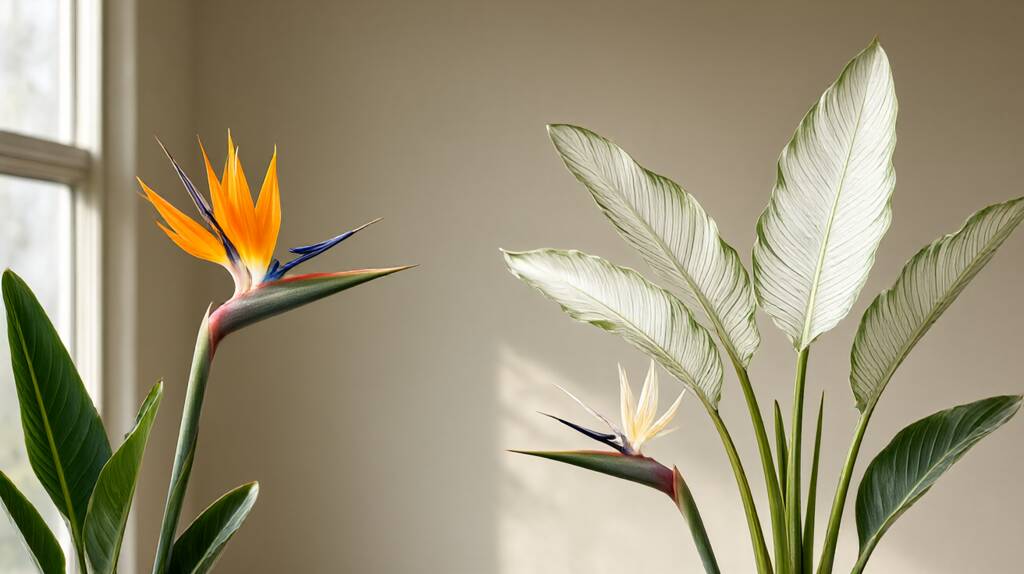

Strelitzia is not one plant. It is a genus of five species, and they do not all behave the same way. The orange flowering bird of paradise that most people grow indoors is Strelitzia reginae. The giant white form that towers in hotel lobbies is Strelitzia nicolai. The crane flower with no leaves is Strelitzia juncea. And there are two others that most growers have never seen. Treating them as the same plant is the first mistake, and it leads to every other mistake that follows.
Two failure modes follow. The first is growing S. nicolai in a small pot and expecting it to flower, when it needs a fifteen-year head start and a garden. The second is growing S. reginae in a dark corner and wondering why it never blooms, when it needs full sun and a tight pot. Both come from assuming that all bird of paradise plants want the same thing.
Most growers also get the name wrong. They call any large tropical plant with banana-like leaves a bird of paradise, including Heliconia, which is a different genus entirely. The confusion matters because the care is different, and the wrong care on the wrong plant produces the wrong result.
The Five Strelitzia Species
The genus Strelitzia contains five species, all native to southern Africa. They share the distinctive flower shape that gives the plant its common name, the beak and crest of a bird of paradise, but they differ in size, leaf form, cold tolerance, and growing requirements.
Strelitzia reginae is the classic orange flowering bird of paradise. It is the most widely cultivated species, the one most often grown indoors, and the one most likely to flower in a pot. It stays compact at 1.5 to 2 meters indoors and flowers once it has six to eight mature leaves in full sun.
Strelitzia nicolai is the giant white bird of paradise. It grows to 3 meters or more indoors and 10 meters outdoors. It rarely flowers inside a home. It is grown for its foliage, which is large, glossy, and dramatic. It needs more space, more light, and more water than S. reginae.
Strelitzia juncea is the rush or reed bird of paradise. It has no true leaves, only cylindrical petioles that look like reeds. It flowers like S. reginae but is more drought-tolerant and more cold-hardy. It is rare in cultivation and often mislabeled.
Strelitzia alba is the white or Cape wild banana. It grows to 5 to 10 meters and has white flowers. It is the least common in cultivation and the most cold-sensitive. Strelitzia caudata is the mountain or tree bird of paradise, native to high elevations. It is the hardiest species and can tolerate light frost, but it is rarely grown outside botanical gardens.
Which species you probably have
If you bought a bird of paradise from a garden center, it is almost certainly S. reginae or S. nicolai. S. reginae is the smaller one, with orange and blue flowers and a compact habit. S. nicolai is the larger one, with white and blue flowers and banana-like leaves. If your plant has no leaves at all, only reed-like stalks, it is S. juncea. For the full comparison of the two most common species, see our guide to strelitzia reginae vs nicolai.
Strelitzia is five species, not one. They need different care.
Growing Requirements by Species
The care differences between species are significant, and they start with size. S. reginae fits in a 30 centimeter pot and stays under 2 meters. S. nicolai needs a 60 centimeter pot or a garden bed and reaches 3 meters indoors. S. juncea stays compact like S. reginae but needs full sun and excellent drainage. S. alba and S. caudata are garden plants, not houseplants.
Light requirements are similar across species. All Strelitzia prefer full sun, meaning six or more hours of direct light. S. nicolai tolerates bright indirect light better than S. reginae, which is why it is more commonly grown indoors despite its size. S. juncea needs full sun and will not grow well in shade.
Cold tolerance varies. S. reginae tolerates brief exposure to 0 degrees but is damaged below 5. S. nicolai is less cold-tolerant and is damaged below 10. S. caudata is the hardiest and can survive light frost. S. alba is the most sensitive and is damaged below 12. For the full temperature tolerance breakdown, see our guide to bird of paradise temperature tolerance.
Water and soil by species
All Strelitzia prefer well-draining soil and moderate water. S. nicolai is the thirstiest, because of its large leaf area, and needs more frequent watering than S. reginae. S. juncea is the most drought-tolerant, because of its reduced leaf surface. For the full watering method, see our guide on how often to water bird of paradise, and for the soil mix, see our guide to bird of paradise soil and repotting.
S. reginae is compact and flowers indoors; S. nicolai is giant and rarely does.
Flowering: Which Species Bloom Indoors
Only S. reginae flowers reliably indoors. It needs six to eight mature leaves, full sun, a tight pot, and a cool winter rest of four to eight weeks at 10 to 15 degrees. Under these conditions, it can flower annually from its third or fourth year.
S. nicolai flowers rarely indoors. It needs to be at least five years old, in a large pot or in the ground, and in full sun. Even then, flowering is sporadic. Most indoor S. nicolai never flower, and the plant is grown for its foliage.
S. juncea flowers like S. reginae, but it is rarely grown indoors because of its need for full sun and excellent drainage. S. alba and S. caudata rarely flower in cultivation outside their native range. For the full diagnosis of a non-flowering plant, see our guide to bird of paradise not flowering.
How to tell if your plant is mature enough to flower
Count the leaves. A plant with fewer than six mature leaves is not mature enough to flower, regardless of age or conditions. A plant with six to eight leaves in full sun and a tight pot is ready. The missing ingredient is usually light or the winter rest, not age. For the full cultivation method, see our growing guide for bird of paradise.
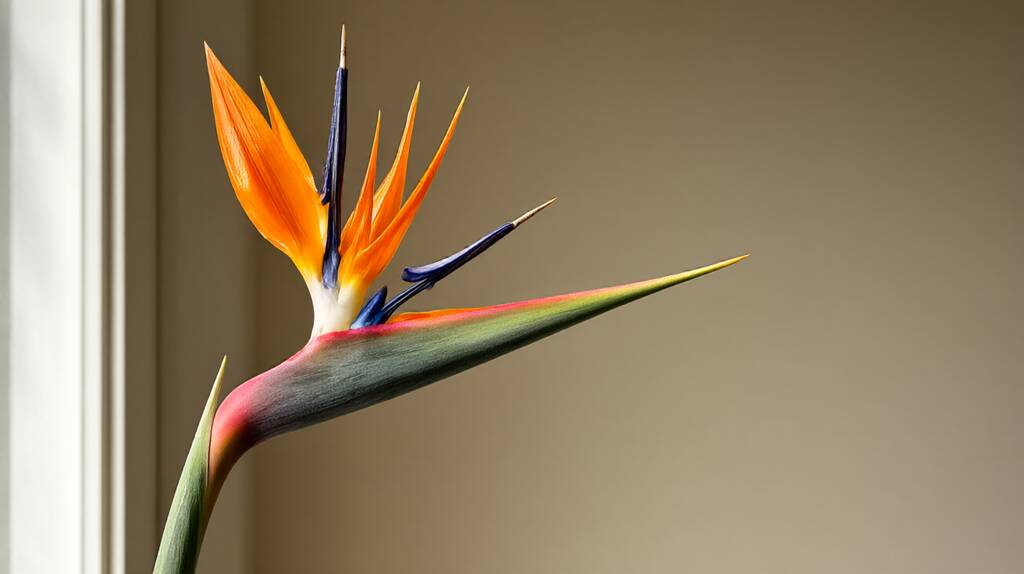
S. juncea has no leaves, only reeds, and is drought-tolerant.
Choosing the Right Species for Your Space
The choice of species should be driven by space, light, and expectations. A small apartment with a bright window suits S. reginae. A large room with high ceilings suits S. nicolai. A sunny patio or garden in a warm climate suits any species, but S. nicolai and S. caudata are the most dramatic outdoors.
Do not buy S. nicolai for a small space. It will outgrow the room within two to three years, and moving a 3 meter plant is a project. Do not buy S. reginae for a dark corner. It will survive but never flower, and the grower will conclude the plant is broken. Match the species to the space and the light, and both will be happy.
For the full indoor versus outdoor comparison, including which species suit which environment, see our guide to bird of paradise indoor vs outdoor. For the full outdoor care method, see our guide to bird of paradise outdoor care.
The mislabeled plant problem
Nursery labels are often wrong. A plant labeled S. reginae may turn out to be S. nicolai, and vice versa. The difference becomes obvious as the plant grows: S. nicolai produces larger leaves and grows faster. If your plant is growing faster than expected and the leaves are getting larger, it is probably S. nicolai. Adjust your expectations and your pot size accordingly.
Only S. reginae flowers reliably indoors with full sun and a tight pot.
From Species to the Rest of the Cluster
Species selection is the first decision, and it shapes every other decision in this cluster. Light, water, pot size, flowering expectations, and winter care all depend on which species you have. Start here, then move to the care guide that matches your species. The plant remembers the rain forest. Your apartment just needs to remind it.
Match the species to the space and the light.
Key thresholds: 1.5-2 m S. reginae height, 3-10 m S. nicolai height, 6 h sun minimum, 0 C S. reginae floor, 10 C S. nicolai floor, 5-10 m S. alba height, 5 leaf minimum for flowering.
| Species | Height | Flowers indoors? | Cold tolerance |
|---|---|---|---|
| S. reginae | 1.5-2 m | Yes | 0 C brief |
| S. nicolai | 3-10 m | Rarely | 10 C |
| S. juncea | 1.5-2 m | Yes | 5 C |
| S. alba | 5-10 m | No | 12 C |
| S. caudata | 5-10 m | Rarely | Light frost |
Key thresholds: 1.5-2 m S. reginae, 3-10 m S. nicolai, 6 h sun, 0 C S. reginae floor, 10 C S. nicolai floor, 5 leaf minimum, 10-15 C winter rest, 5-10 m S. alba, 12 C S. alba floor.
Sources and further reading
- Royal Botanic Gardens, Kew, Strelitzia: species profiles and distribution.
- University of Florida IFAS Extension, Strelitzia reginae and Strelitzia nicolai: culture notes.
- South African National Biodiversity Institute, Strelitzia: species descriptions.
Last reviewed on 2026-11-24.
Species selection shapes every other decision in the cluster.