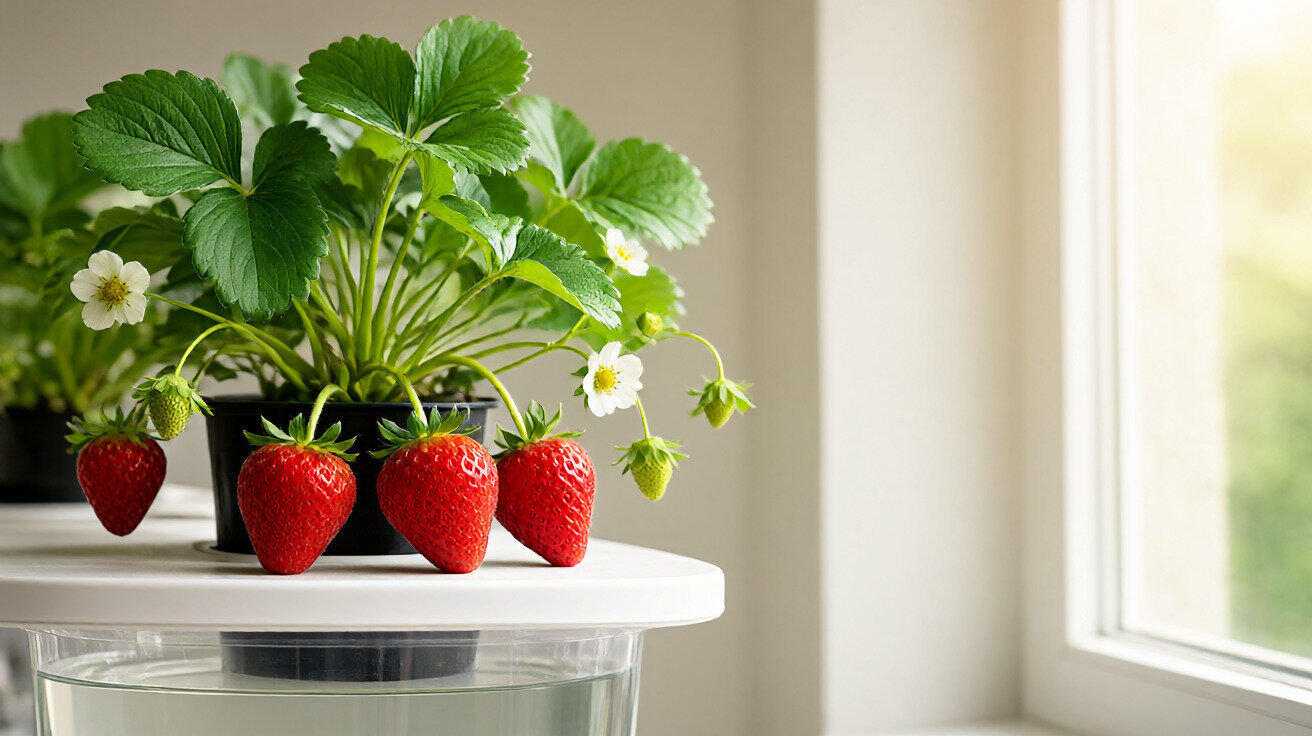

Hydroponic strawberries need three numbers right before they need anything else: nutrient solution at EC 1.6 to 1.8 mS/cm, pH between 5.6 and 6.0, and a reservoir held between 65 and 72 F (18 to 22 C). Get those right and a strawberry plant will fruit continuously for months inside a closet. Get the pH wrong and the plant does not die. It stalls, yellows, and stops setting fruit while the water still looks clear, which is why most home hydroponic strawberry growers lose the crop in the second month rather than the first week.
The reason is that a strawberry is a demanding guest in a recirculating reservoir. Unlike lettuce, which can tolerate a nutrient solution that drifts for a few days, Fragaria × ananassa pulls nitrogen out of the water faster than it replaces it, and the pH falls with every day of uptake. The fix is not more fertilizer or a better pump. It is a specific nitrogen ratio, a buffer you dissolve into the solution yourself, and a pH check every two days. What follows is the numbers in the order they matter, then the one mechanism that explains most of the failures.
What Hydroponic Strawberries Ask of a System
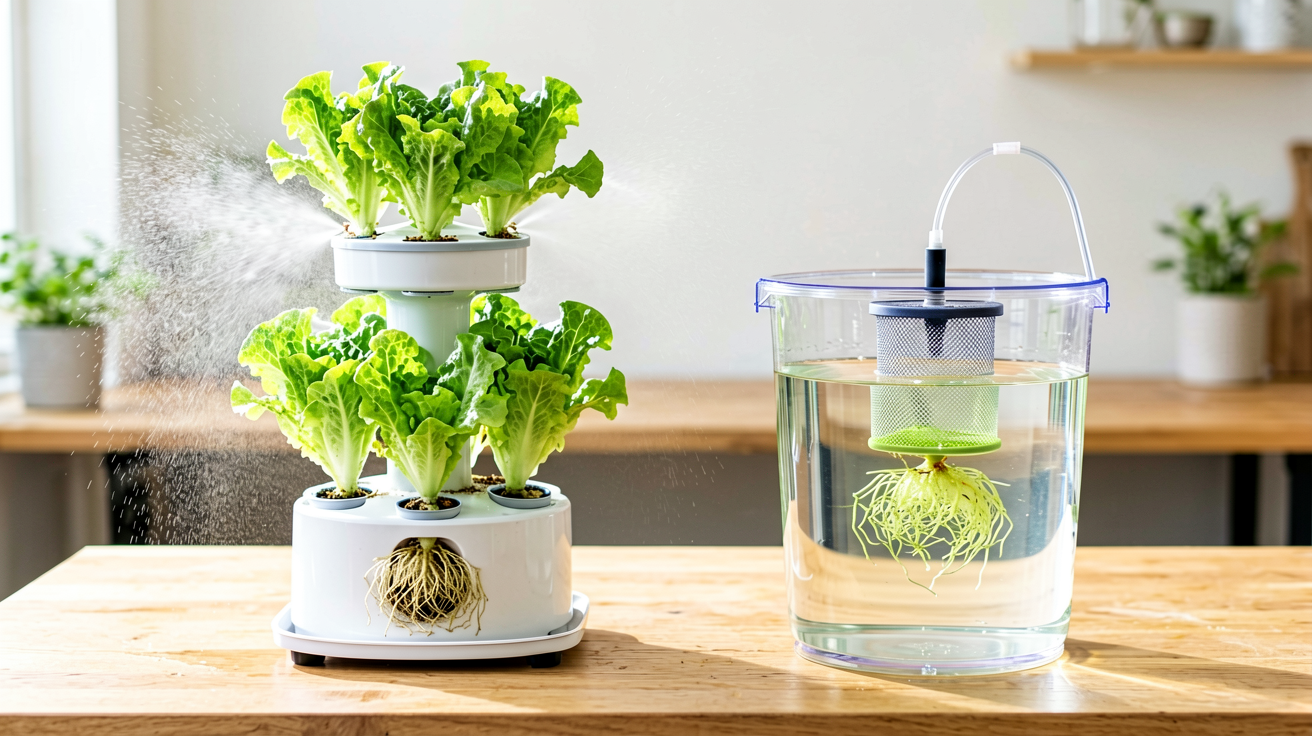
A strawberry is a fruiting crop with a shallow root system and a long appetite, so it suits the middle tier of home systems. Ebb and flow, drip, and Dutch bucket all work. Deep water culture works if the crown stays above the solution line and the water gets aerated, which is why the comparison of the seven hydroponic systems puts strawberries and other compact fruiting crops in the ebb and flow and drip column rather than the leafy greens column.
Nutrient film technique is the one many home growers try first and abandon. A strawberry root ball in an NFT channel is exposed to air on top and a thin film below, and the plant is heavy enough to pull water faster than the channel can resupply it. The system type guide makes the same point from the flow side: a channel that serves lettuce will dry a strawberry root in hours. If a strawberry is your first fruiting crop in hydroponics, start with drip or ebb and flow, where the irrigation cycle is a dial you set rather than a flow rate you hope is enough.
Two numbers define the physical space you need. Root volume per plant should be at least 1.5 litres of wet medium, which in practice means a net pot of 5 litres or larger, and the plant itself needs room to send runners out of the crown. A strawberry in a small net pot runs out of root volume weeks before it runs out of light. The spacing that follows from that is 8 to 12 inches (20 to 30 cm) between centres for drip systems, which is the same figure the hydroponic plant spacing guide lists for drip irrigation at 1 to 2 plants per square foot.
Starting With Day-Neutral Plants
Variety choice decides half of your harvest before you mix a single litre of nutrients. Day-neutral varieties flower regardless of day length, as long as temperature stays between 35 F and 85 F (2 C to 29 C), which makes them the only reliable choice under a fixed grow light schedule. June-bearing plants set their flower buds in response to shortening autumn days, so under a 14 hour indoor cycle they will grow leaves and runners and never commit to a crop. The strawberry varieties guide makes the same call for indoor and hydroponic setups, with Albion and Seascape as the standard day-neutral picks.
Buy crowns rather than seeds. A bare-root crown is already a year of establishment done for you, and it is the difference between fruit in 60 to 90 days and fruit in six months. The crop table in the best plants for hydroponics guide puts strawberries at 60 to 90 days to first fruit, which assumes crowns. Seed-grown day-neutral plants typically need 4 to 6 weeks before the first flower buds even appear, and the strawberry light requirements guide puts the first buds at 4 to 6 weeks after planting bare-root crowns under a properly positioned grow light.

What to Look for in the Crown Itself
A healthy crown is firm, pale green to white at the base, and slightly moist. Reject anything with a brown or black base, a soft neck, or visible white fungus on the root plate. The crown is a compact mass of meristematic tissue, and the same crown depth rule that keeps a soil crown from rotting applies in a net pot: the crown sits at the surface of the medium, and only the roots hang down into the wet zone.
Planting Crowns and Setting the Root Zone
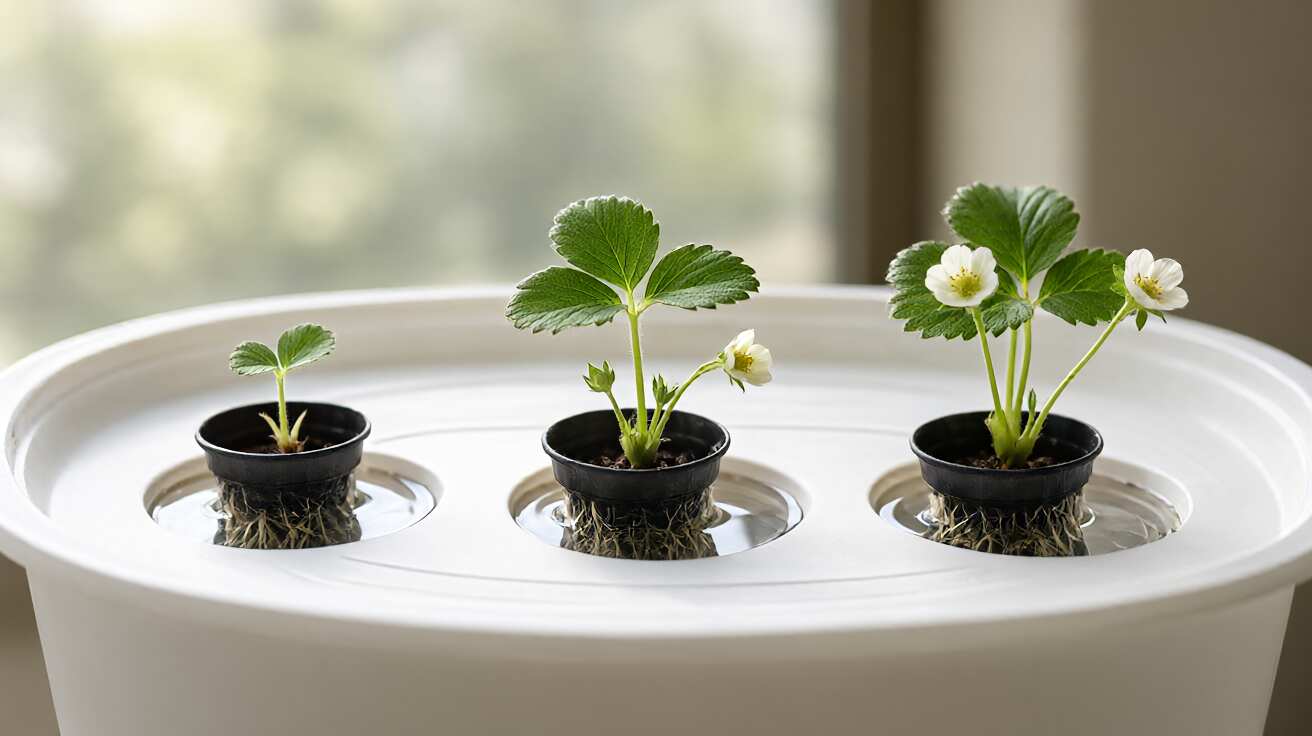
Set the crown at medium level, firm the medium around the sides, and let the bottom third of the root plate reach the solution. This is the single most common structural error in home hydroponic strawberries. A crown buried to its base stays wet, breathes badly, and rots within two to three weeks, which is the same failure mode described for over-deep soil planting.
Fill the reservoir so that the solution touches the bottom of the net pot, not the crown. In drip and ebb and flow systems, set the irrigation cycle to 3 to 5 minutes on, then 30 to 45 minutes off during the first two weeks while roots establish. Once you see new root growth at the sides of the net pot, extend the interval to 60 to 90 minutes off. A strawberry root that stays continuously wet develops an anaerobic layer and invites the crown rot that ends the crop.
Run the light at 14 to 16 hours on, 8 hours off, from day one, and do not wait for the plant to look stretched before you act. Day-neutral berries are smaller than June-bearing berries and they need the light to load sugar into each fruit. A panel delivering 200 to 400 micromoles per square metre per second at the leaf surface is the working range, positioned 6 to 12 inches above the canopy.
Setting EC and pH by Growth Stage
EC rises and falls with what the plant is doing, and the target shifts as the crop moves from establishing roots to setting fruit. The table below is the working schedule for a home recirculating reservoir, built from the crop bands in the hydroponic nutrient schedule and the plant response data in the field trials cited at the end of this page.
| Stage | EC (mS/cm) | pH | Reservoir | Light per day |
|---|---|---|---|---|
| Establishment, weeks 0 to 4 | 1.4 to 1.6 | 5.8 to 6.2 | 68 to 72 F (20 to 22 C) | 14 to 16 h |
| Vegetative growth, weeks 4 to 8 | 1.6 | 5.8 to 6.0 | 65 to 72 F (18 to 22 C) | 14 to 16 h |
| First flowers, weeks 6 to 10 | 1.6 to 1.8 | 5.6 to 6.0 | 65 to 70 F (18 to 21 C) | 14 to 16 h |
| Fruiting and harvest | 1.8 | 5.6 to 6.0 | 65 to 70 F (18 to 21 C) | 14 to 16 h |
Two of these numbers look inconsistent with other guides, and the difference is the method rather than the science. The EC of a solution you recirculate is not the EC of a solution you feed once through a substrate, because the substrate holds most of the salt and only the runoff is measured. Greenhouse strawberry fertigation typically runs a solution at 0.8 to 1.0 dS/cm with source water below 0.5 dS/cm, while a recirculating home reservoir has no substrate to hold anything and needs the full strength in the water itself.
The strawberry-specific research is unambiguous about the upper end. In deep tank trials on Elsanta, EC 1.8 produced 18.86 percent more marketable fruit than EC 2.5 and 37.40 percent more than EC 4.0, and the higher concentrations shrank average fruit weight. Stronger is not better here. EC sets the osmotic gradient the root has to pull water across, and past the optimum the plant spends energy on osmotic work instead of filling a berry.
Why the Solution Keeps Turning Acid
Here is the mechanism that ends most home hydroponic strawberry crops. It is not evaporation, and it is not a dirty filter. It is the form of the nitrogen you dissolve in the water.
Strawberry roots take up nitrate and ammonium at different rates, and they release hydrogen ions to keep the inside of the root electrically balanced. A plant pulling more nitrate than ammonium leaves the solution increasingly acidic, because the hydrogen it gives off has nowhere to go. In deep water culture trials with a modified strawberry nutrient solution at an 80:20 nitrate to ammonium ratio, the pH fell to 4.0 plus or minus 0.1. At 50:50 and 60:40 ratios it fell by roughly 1.5 pH units every two to three days.
That chain is the whole failure mode: nitrogen form sets the pH drift rate, the pH drift rate sets micronutrient solubility, and solubility sets the leaf symptoms you can see. Iron and manganese lock out in the low pH range, so the newest leaves go pale with sharp green veins, growth stalls at the growing point, and fruit set drops while the plant still looks like it is alive. The berry does not fall off because the plant is starved of everything, it falls off because the plant is chemically confused.
What Happens If You Skip the pH Check
Check every two days from the day the plants go in. The drift rate of about 1.5 pH units every two to three days means a solution left alone for a week lands near 4.0, where the root zone loses function and leaves show manganese and aluminium toxicity within days. By then the correction is not a pH adjustment, it is a full reservoir change and a month of lost growth. Five minutes twice a week is the entire insurance policy.
Choosing a Buffer, and Why the Cheap One Fails
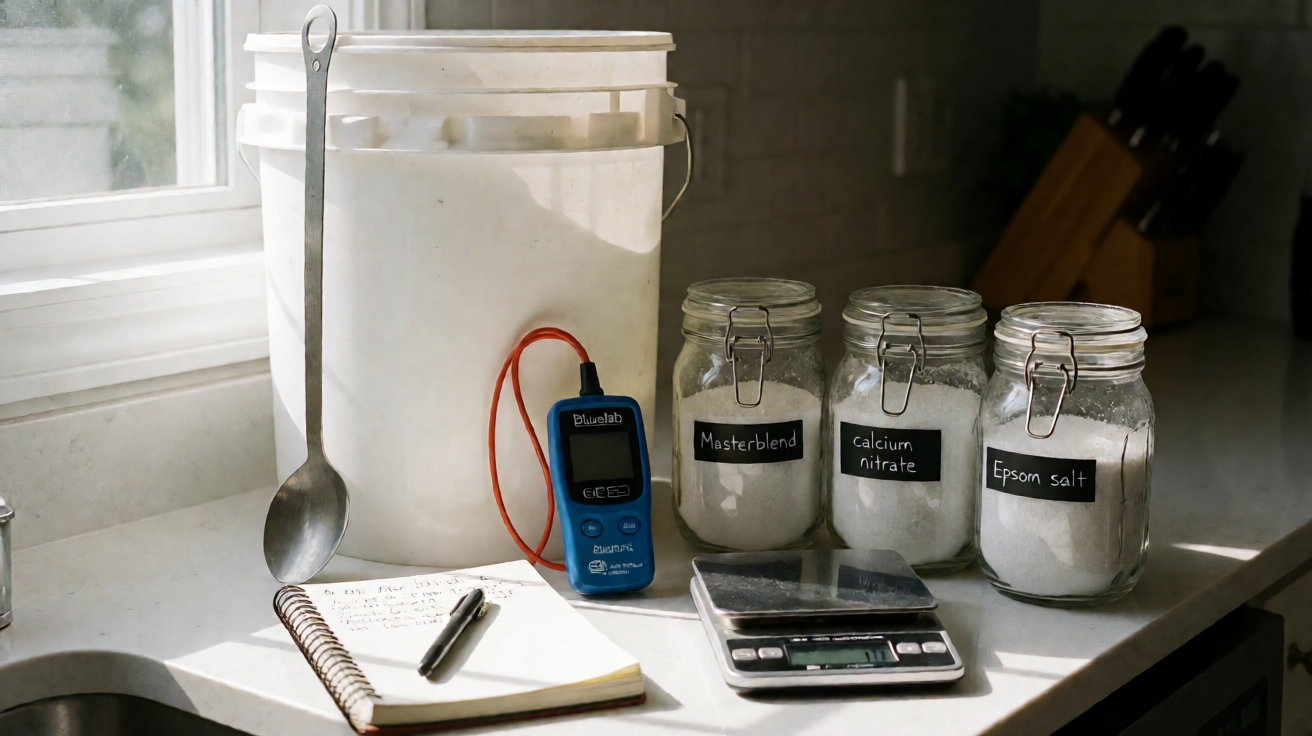
Buffering the solution is what buys you the two-day check instead of the same-day check. Potassium bicarbonate looked like the obvious choice and it failed: up to 2.6 mM of KHCO3 did not provide adequate buffering in any solution containing ammonium. What did work was a 100 percent nitrate solution with 0.8 mM KHCO3, which held pH at 5.9 plus or minus 0.1 for the length of the trial.
The counter-intuitive part is the second result. MES buffer, a compound sold as a laboratory reagent, outperformed the agricultural salt by a wide margin, and 5 mM held the solution at 5.6 plus or minus 0.2 for four weeks while the plant grew large enough to need more buffer than it had at the start. The catch is cost: 5 mM MES runs about 50 times the price of 2 mM KHCO3. The cheapest buffer is the wrong one, and paying for the right one is cheaper than replacing the solution.
Temperature: One Band, No Drift
Strawberry has the narrowest acceptable reservoir band of the common fruiting crops. The reservoir temperature guide by crop puts strawberry at 65 to 72 F (18 to 22 C), and the penalties sit right at the edges. Below 60 F, berry size and sweetness fall. Above 75 F, flower set drops sharply and the plant diverts energy into runners instead of fruit.
Why the Reservoir Temperature and the pH Drift Are One Problem
Reservoir temperature also feeds back into pH drift, which is the connection growers miss. A warmer solution accelerates root metabolism, and faster metabolism means faster nitrate uptake, which means faster acidification. Warm reservoir plus ammonium nitrogen is the combination that drives pH down fastest. If your reservoir runs warm in a heated room, either cool the reservoir or move to a nitrate-dominant mix.
Light and Pollination: The Two Things Fruit Needs
Strawberries will not set fruit in the dark, and they will not set fruit without pollen moving. Both are separate requirements and both are commonly skipped.
For light, 14 to 16 hours of full-spectrum white light in the 5,000 to 6,500 kelvin range is the working window, positioned 6 to 12 inches above the canopy. The reason is energy, not photoperiod: Cornell research found yield falls by roughly 40 percent when daily light drops from 8 hours to 5, which means a strawberry plant under a weak 8 hour cycle is spending its photosynthetic budget on leaves and runners. The indoor grow light guide puts the same 14 to 16 hour window at the top of its range and warns that a windowsill delivers 3 to 4 usable hours in winter.
For pollination, there are no bees and no meaningful air movement inside a house, so flowers go unpollinated and drop. A daily hand-pollination pass during peak bloom moves fruit set from 10 to 20 percent up to 60 to 80 percent. Use a small soft brush or a cotton swab on each open flower, and run the pass in the middle of the day when the anthers are shedding the most pollen.
The Numbers That Decide a Hydroponic Strawberry Harvest
If you keep one page in the room with the system, keep these on it.
- EC 1.6 to 1.8 mS/cm in a recirculating reservoir, with 1.8 at fruiting
- pH 5.6 to 6.0, checked every two days, buffered with 5 mM MES or a nitrate-dominant mix
- Reservoir 65 to 72 F (18 to 22 C), and no warmer than 70 F once flowers open
- Light 14 to 16 hours a day at 200 to 400 micromoles per square metre per second
- Day-neutral varieties only, so flower initiation never depends on day length
- Crown at medium level with only the lower roots in the wet zone
- Spacing 8 to 12 inches (20 to 30 cm) between centres in drip systems
- Hand pollination daily at peak bloom, for 60 to 80 percent fruit set instead of 10 to 20
- First fruit at 60 to 90 days from a crown, not from seed
- A buffer that holds the band, because the drift is about 1.5 pH units every two to three days
The last one is the whole article in a sentence. The strawberry will not tell you that the nitrogen ratio is wrong. It will simply stop making fruit, and by then the pH has already run away from you.
Last reviewed on November 16, 2026.
Sources and further reading
Every number on this page traces to one of the sources listed below. The pH drift figures and buffer comparisons come from peer-reviewed hydroponic strawberry trials published in HortScience by the USDA Agricultural Research Service (Yafuso and Boldt, 2024). The EC response data come from a deep tank hydroponic study of Elsanta strawberries published in the Journal of Pharmacognosy and Phytochemistry (Bagale, 2018).
Crop bands and the reservoir temperature ranges follow Oklahoma State University Extension guidance for hydroponic EC and pH, plus University of Florida Institute of Food and Agricultural Sciences production guidance for greenhouse strawberries. Light dose and the yield response to reduced hours follow Cornell Cooperative Extension research, as summarised in the site’s own strawberry light guidance.
- Yafuso and Boldt, 2024, Development of a hydroponic growing protocol for vegetative strawberry production, HortScience 59(3), USDA Agricultural Research Service (USDA, peer-reviewed)
- Bagale, 2018, The effect of electrical conductivity on growth and development of strawberries grown in deep tank hydroponic systems, Journal of Pharmacognosy and Phytochemistry 7(1S) (peer-reviewed)
- Oklahoma State University Extension, Electrical Conductivity and pH Guide for Hydroponics (Extension)
- University of Florida Institute of Food and Agricultural Sciences, greenhouse strawberry production and fertigation guidance (University)
- Cornell Cooperative Extension research on strawberry light and yield response (University)