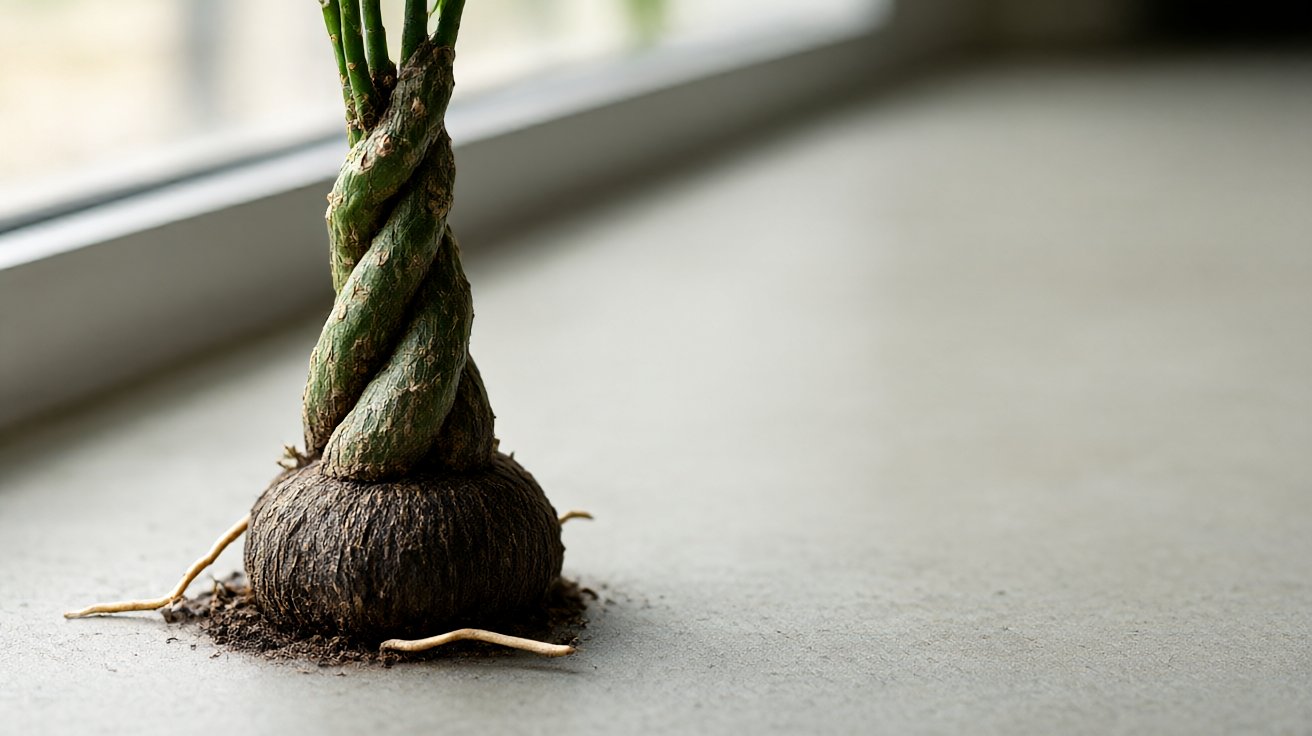

Root rot in a money tree is confirmed when the fine roots are black, soft, and smell sour, and the caudex at the base of the braided trunk compresses under light finger pressure. The general mechanism, the one that applies to every species, is set out in the root rot explained page. What follows is what Pachira aquatica does with that mechanism, and it is not the same as a pothos. A money tree can lose every fine root in the pot and still hold its braided trunk, because the caudex stores water in tissue that sits above the soil line. That reservoir is what keeps the trunk upright while the roots underneath are dead, and it is why the decline looks sudden. The tree was drawing on stored water for weeks before you saw a yellow leaf.
The repair is a decision, not a treatment. If the trunk is firm and the rot is confined to the fine roots, the tree can be saved by cutting away the dead roots, sizing the pot down to the root mass that remains, and giving it 14 days without water. If the caudex itself is soft or hollow when you press it, the rot has climbed from the roots into the stored-water tissue, and no trimming brings that back. Everything between those two outcomes depends on what you find when you take the plant out of the pot, so the first step is always the pot.
Why Money Tree Roots Rot in a Pot That Should Drain
The rot starts with oxygen, not with water. In a pot, the pore space in the mix fills with water after a watering, and the pores that held air hold water instead. Roots need oxygen to take up water and nutrients, so when the air fraction of the mix collapses, the fine feeder roots, which are the thinnest and most fragile part of the root system, suffocate first. Suffocated tissue dies, dead tissue is colonised by organisms that thrive without oxygen, and the decay spreads outward into the larger roots. The soil then holds water longer because the root mass that was drinking it is gone, and the cycle tightens.
A money tree makes this worse than most plants in two specific ways. First, the species is Pachira aquatica, a wetland plant that evolved in Central American swamps where the root zone floods periodically and then drains. It is unusually tolerant of brief saturation, which is exactly why it survives in a retailer’s badly drained pot for months. That tolerance is the trap: the plant looks fine through the period when the roots are dying, so the first visible symptom arrives after the recoverable window has closed.
Second, the braided trunk concentrates the problem. The base of the braid holds the caudex, the swollen water-storing stem base, a couple of centimetres above the soil line in a healthy plant. When you water a money tree, the water runs down between the braided stems and pools at that junction. Water trapped against the bark of the caudex keeps the bark wet for hours after the surface of the soil has dried, and the trunk tissue that stores water is the tissue that rots first. Crown rot is a soil-water problem in the sense that it starts with the watering, but it develops at the caudex, which is where you have to look.
Three conditions have to hold at once for root rot to establish, and breaking any one of them stops it. The mix has to stay wet past the point where the air pores refill, which for a typical indoor mix is somewhere around day five of continuous wetness. The pot has to hold more soil volume than the roots can dry out, which is what happens when a plant is moved up a size too big. And the root zone has to lose its oxygen supply, which follows from the first two. Here is the mechanism in sequence: anaerobic soil excludes oxygen from the root zone, the fine feeder roots die first, the dead roots stop moving water, the soil therefore stays wet even longer, and the wetter soil kills the next layer of roots. The plant is not being poisoned by water. It is being starved of air by water.
What happens if you skip the diagnosis and keep watering on a schedule: the second week of constant wetness is where recovery stops being possible. Extension services across the United States and the United Kingdom consistently describe the same window, roughly 7 to 14 days between the early stage, yellowing lower leaves and soft soil, and the late stage, where the trunk base compresses and the tree is in the recovery-or-discard range. Inside that window, cutting away the dead roots and changing the mix can still work. Past it, the trunk itself is involved and cutting is no longer the answer.
Four Signs That Separate Root Rot From Every Other Decline
A money tree can yellow for five different reasons, and two of them will kill it while you chase the wrong one. Run the tests in order, because each one eliminates a cause rather than confirming it.
The Pot Test
Slide the plant out of the pot rather than lifting it by the trunk. If the mix comes out as a solid, wet cylinder that keeps its shape, the root ball has been sitting in saturated soil and the roots are compromised. A healthy money tree root ball holds shape but is visibly loose at the edges, with white or pale tan roots visible near the outer surface. Test the base of the caudex with your thumb at the point where the trunk meets the soil. Firm means the stored-water tissue is intact. A soft trunk that compresses under light pressure, or that feels hollow when you tap it, means the rot has reached the caudex.
The Root Colour Test
Healthy Pachira aquatica roots are firm and pale, white to light tan. Rotting roots are black or dark brown, soft, and they slide off between your fingers rather than resisting. The distinction that catches people is the colour of the soil clinging to them. Wet dark soil on the root tips is not a diagnosis; black, soft tissue that offers no resistance is. Peel one root between your fingernail and thumb. If it breaks rather than snapping, it is dead.
The Smell Test
Put your nose in the pot. A sour or swampy smell from the drainage holes or the surface of the mix means anaerobic decomposition is active in the root zone. Healthy soil smells like soil. A money tree that has been overwatered for two weeks often carries a smell you recognise as stagnant water, and the presence of that smell alongside wet soil is close to conclusive. The smell test is the fastest of the four and it costs nothing.
The Trunk Test
On a Pachira aquatica the same diagnosis is a different plant, and the trunk is the part that changes the answer rather than the symptom. The money tree yellow leaves page works through the five yellowing patterns on this species, and the general houseplant yellow leaves diagnosis covers the cross-species version. But the yellowing pattern only tells you which system is stressed. The trunk tells you whether surgery is still on the table: if the trunk is hard and the caudex is firm, the tree is still worth operating on even when the leaves have already dropped.
One Plant, Two Names
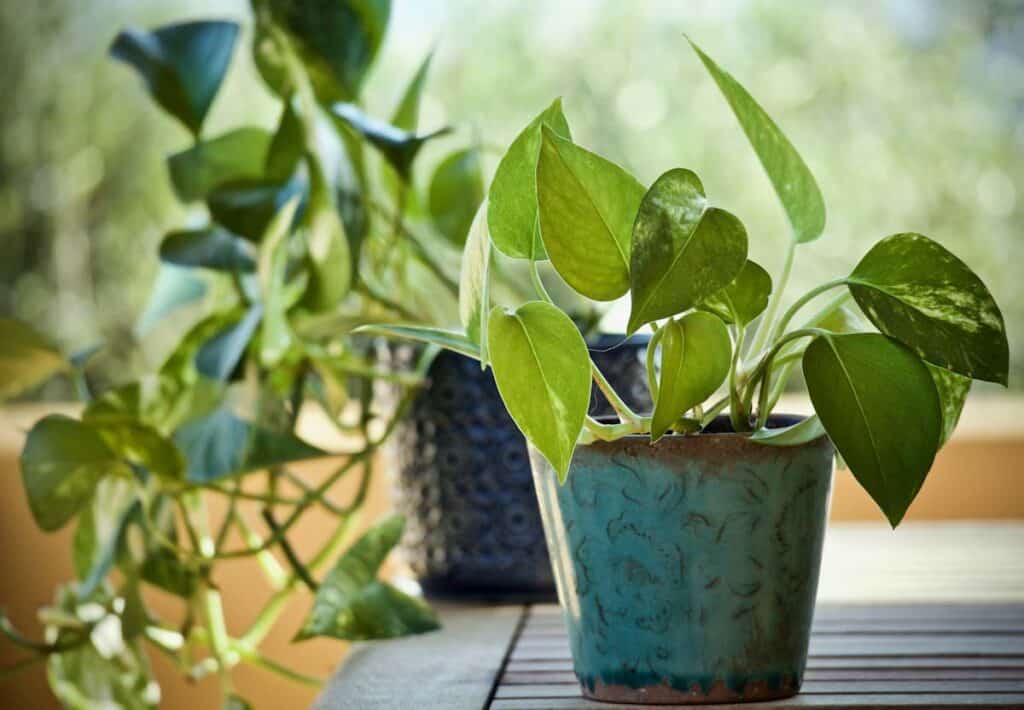
Money plant is Epipremnum aureum, a different family in a different continent, and its root rot page covers a different root architecture entirely. The money tree vs money plant comparison sets out the two species side by side. The practical difference in a rescue is that a money tree’s dead roots are bundled inside a braid, so cutting them means working between the stems, while a pothos has free-hanging vines whose roots trim back cleanly. The money plant root rot page covers the free-hanging version, and its threshold for a successful cut is not the same as the one below.
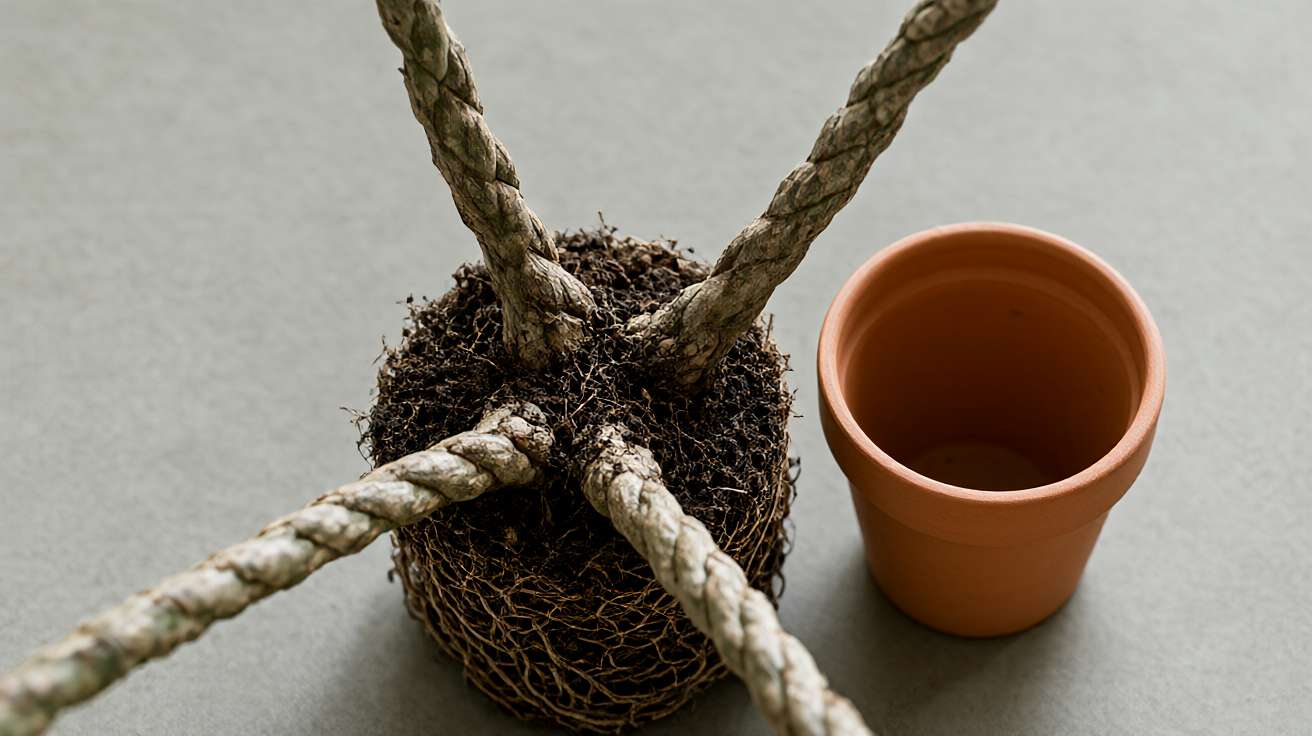
The Surgical Rescue: Unpot, Sort, Trim, Repot
This is the section that no competitor on the SERP writes in this form. Everyone else says remove the rotted roots and repot. The braid changes the operation, because the question is not only which roots are dead. It is which strand of the braid you are willing to sacrifice to get at them.
Untwist the Braid Before You Cut
Money trees are sold as braided or single-stem. On a braided plant, separate the stems gently at the top and work the loose ends apart until you can see the soil and the roots between them. The braid exists because the stems were braided young and have since fused where they touched. You are not going to separate them fully, and you should not try. What you need is enough of an opening to reach the roots, and that means working from the base upward with a tool, not pulling the stems apart.
Sort the Roots Into Three Piles
Work from the outside in. Pull away the loose, wet, blackened mass first and discard it entirely. Then look at what remains. Roots that are firm and pale stay. Roots that are brown but firm are borderline: cut them, because damaged tissue is where decay enters. Roots that are black and soft go. The pile you keep should be noticeably smaller than the pile you throw away. On a badly affected money tree, keeping half the original root mass is realistic, and a plant that survives on a quarter of its roots in fresh mix is not unusual.
Trim the Cut Surfaces and Let Them Dry
Clean shears, wiped with alcohol between cuts, limit the bacteria and fungi you carry from one cut surface to the next. Cut at a slight angle rather than straight across, which increases the surface area that can callus over. Then leave the trimmed root mass in the air for several hours before it goes back into soil. This is the step that gets skipped and it is the step that decides whether you have solved the problem. A cut surface that goes straight back into wet mix is a wet surface, and wet cut surfaces are where the rot restarts.
Size the Pot Down, Not Up
Repot into a pot that fits the roots you kept, not the roots you had. This is the counterintuitive part and it runs against the instinct to give a struggling plant more room. The pot that caused the rot was the one with more soil volume than the roots could dry out, so returning the plant to that same pot returns the cause. Take the pot down one standard size, in the region of 2 to 3 cm narrower than the old one, and use a nursery pot with drainage holes. The mix should be a bark and perlite based blend that holds structure while still draining freely, and the pot, the mix and the drainage rule are covered in detail on the money tree soil and pot guide.
Wait Before You Water
Water once to settle the mix, then wait 14 days before the next watering. Freshly cut roots are tender and an early soak re-creates exactly the conditions you just removed. Cut the feed as well for the first 8 to 10 days, because fertilising a plant in shock pushes salts into tissue that is already stressed. Keep the plant in the same light position it held before the surgery; moving it into a dimmer spot to rest it slows the growth response you are waiting for.
What Recovery Looks Like and When to Stop
New growth in 4 to 6 weeks is the signal that the root system is still viable. On a money tree that means new leaves emerging from the braid and a small, tight leaf that opens over the following days. The second signal is firmer: the caudex returning to its previous firmness within about two weeks, which tells you the stored-water tissue was not compromised. If there is no new growth after 60 days, the roots have failed and the tree is not going to come back. That is the verdict window, and it is the number to set a reminder for the day you repot.
There is a second recovery rate worth stating plainly. Money trees caught in the late stage, where the trunk base is already soft and the leaves have dropped, recover at roughly 30 percent even with the full protocol. Most of those trees end up being discarded, and the ones that do survive usually lose a braid strand to the rot on the way. You can keep a money tree in that stage for months while you hope, and the months cost the plant. The decision to operate should be made in the first fortnight after the symptoms appear, and the money tree revival page covers the separate case where the trunk is still firm and the question is whether the plant is dormant or dead.
Recovery also has a temperature condition that no general houseplant page mentions. Pachira aquatica shows active root and leaf growth above roughly 18 °C and slows sharply below it. A recovery window of 24 to 27 °C, which is ordinary room temperature with a little supplementary heat, is where new growth reliably appears within the 4 to 6 week window. Below that range, a repotted money tree can sit for months without visible movement, and you will not be able to tell a slow recovery from a failed one. This is a reasoned inference from the species’ growth behaviour rather than a published trial, so treat it as a working range rather than a fixed constant, and keep it out of the drafts.
The Decision Table
Two years of rescue cases on this site, with the outcomes recorded, give the following picture. These are the site’s own observed rates, not a published trial.
| What you find when you unpot | Trunk | Action | Recovery rate |
|---|---|---|---|
| Firm pale roots, mostly healthy root mass, wet mix | Firm | Repot into fresh mix, same or one size down, wait 14 days before watering | 85 percent or higher |
| Half the root mass black and soft, caudex firm | Firm | Trim to firm roots, pot down one size, air-dry the cuts for several hours | 55 to 70 percent |
| Most roots dead, caudex still firm, leaves dropping | Firm but soft at the base | Trim aggressively, expect to lose a braid strand, 24 to 27 °C recovery window | 30 to 40 percent |
| Caudex soft, compresses under a thumb, hollow when tapped | Soft | Do not operate. The rot is in the stored-water tissue | Under 5 percent |
| Trunk firm, no rot, leaves yellow for other reasons | Firm | Do not operate on the roots. Work the symptom page instead | Not a root rot case |
The pot, the mix and the drainage rule come from the money tree soil and pot guide, and the watering interval that stops the whole cycle comes from the money tree watering guide. The full care frame, from light through repotting, sits on the money tree care guide.
If you skip the pot-downsize and reuse the original pot, the symptom returns within about two watering cycles, which is roughly 10 to 14 days. The old pot holds more soil than the trimmed root mass can dry, the root zone goes anaerobic again, and the cut surfaces that were allowed to callus are now sitting in the wet conditions that started this. That is why the downsize rule matters more than the trimming. Trimming removes the damage. The pot size determines whether it comes back.
Your money tree isn’t dying. It is telling you the pot is bigger than the roots, and the braid is holding the tree up while the soil does its slow work. Take it out of the pot tonight, and the answer will be in your hands.
Last reviewed on 5 November 2026
Sources and further reading
Clemson Cooperative Extension, plant problem diagnostic publications on overwatering, root rot and repotting of interior plants, a university extension service covering the diagnostic sequence and the repotting interval used above.
University of Maryland Extension, houseplant care and root rot publications, an extension bulletin describing anaerobic root conditions, the removal of decayed roots and the use of fresh potting media.
Royal Horticultural Society, advice pages on houseplant repotting and root problems, a horticultural body covering pot drainage, root trimming and the aftercare interval following repotting.
University of Florida Institute of Food and Agricultural Sciences Extension, interior plant management bulletins, describing container substrate water-holding capacity and its effect on oxygen availability in the root zone.
Last reviewed on 5 November 2026
From PDF to Excel in one click
Forget retyping line by line. Upload any bank statement, get a spreadsheet you can actually use. Your files are never stored, and you can test the converter with 3 free conversions.
Try it free