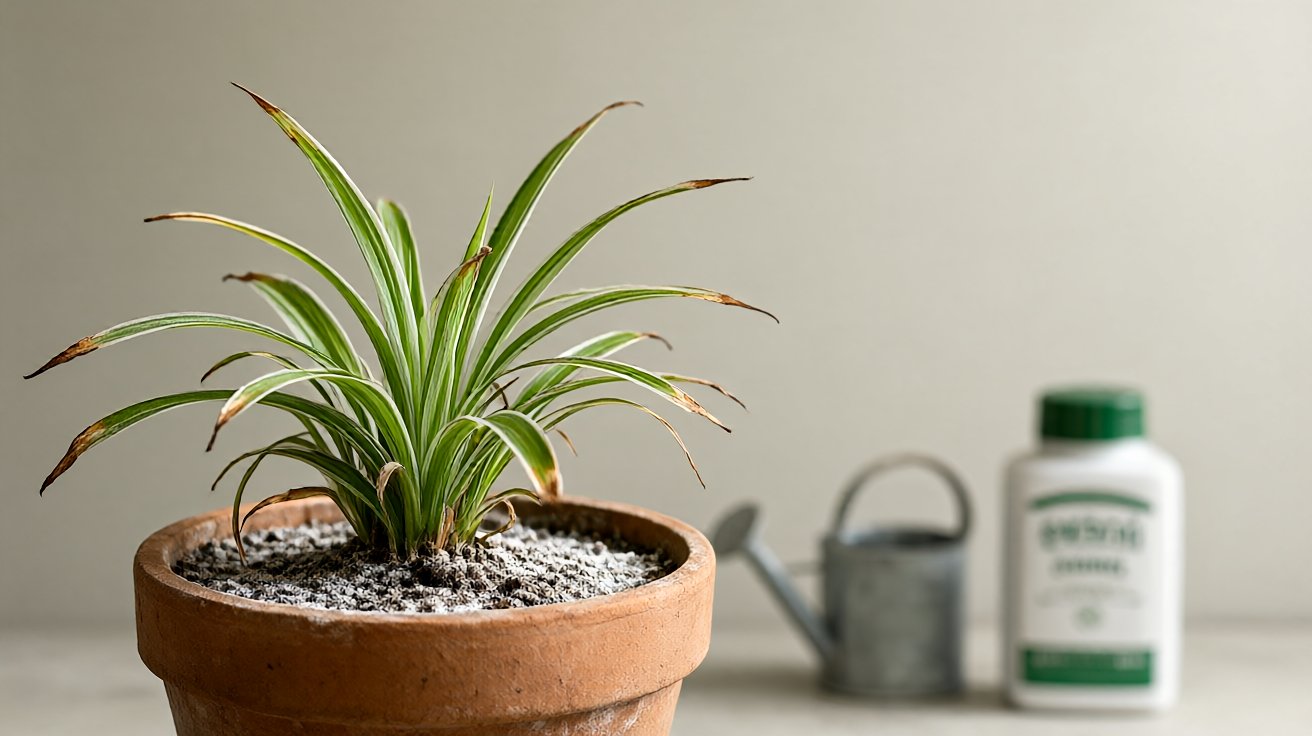

Fertilizer burn on a spider plant looks like a watering problem at first: brown tips, yellowing, curling. The difference is the cause. Too much fertilizer, or fertilizer applied to dry soil, scorches roots and leaves. The salt buildup stays in the pot and keeps damaging the plant long after the last feeding. Recognising it early saves the plant; treating it like a watering issue makes it worse.
This guide explains how fertilizer burn happens, how to distinguish it from other brown-tip causes, and how to flush and recover.
What Fertilizer Burn Actually Is
Fertilizer is salt. When you apply more than the plant can use, or apply it to dry soil where roots are already stressed, the salt concentration in the root zone rises. Roots lose water to the salty soil through osmosis, and tissue dehydrates and dies. The damage shows at the leaf tips first, because they are the last point water reaches.
Spider plants are not heavy feeders. They grow well in modest nutrient levels, and excess nitrogen in particular produces lush but weak growth that is more prone to burn. The risk is higher in containers than in the ground, because salts have nowhere to leach.
Signs of Fertilizer Burn
Brown, crispy tips that appear within days to a week of feeding are the hallmark. The browning is dry and papery, not soft. It often affects many leaves at once, starting at the tips and moving inward.
White crust on the soil surface or on the pot rim is salt accumulation. This is visible evidence that salts are building up faster than they are being flushed.
Yellowing of older leaves can follow as roots are damaged and cannot supply nitrogen. The plant may also wilt despite moist soil, because damaged roots cannot take up water.
Stunted or distorted new growth appears in severe cases. The growing point may blacken.
How to Distinguish It From Other Brown-Tip Causes
Brown tips have several causes, and fertilizer burn is only one. The others are fluoride and salts in tap water, low humidity, and root rot from overwatering. The timing and context tell them apart.
If brown tips appeared within a week of fertilizing, and you used a concentrated solution or fed a dry plant, fertilizer burn is likely. If you use tap water regularly and have never fertilized heavily, fluoride is more likely. If the air is dry and watering is correct, humidity is the suspect. If the soil stays wet and the base is soft, root rot is the cause.
Our guide on spider plant brown tips covers the full differential, and spider plant tap water covers the fluoride mechanism.
How to Flush and Recover
1. Stop fertilizing immediately
No more fertilizer until the plant recovers, which can take weeks. Continuing to feed a burned plant compounds the damage.
2. Flush the soil
Water thoroughly with clean, low-mineral water, letting it run freely from the drainage hole. The goal is to dissolve and wash out accumulated salts. Use at least twice the pot volume in water. Empty the saucer completely. Repeat once after an hour.
If the pot has no drainage hole, repot into fresh mix instead. Flushing is not possible without drainage.
3. Remove damaged tissue
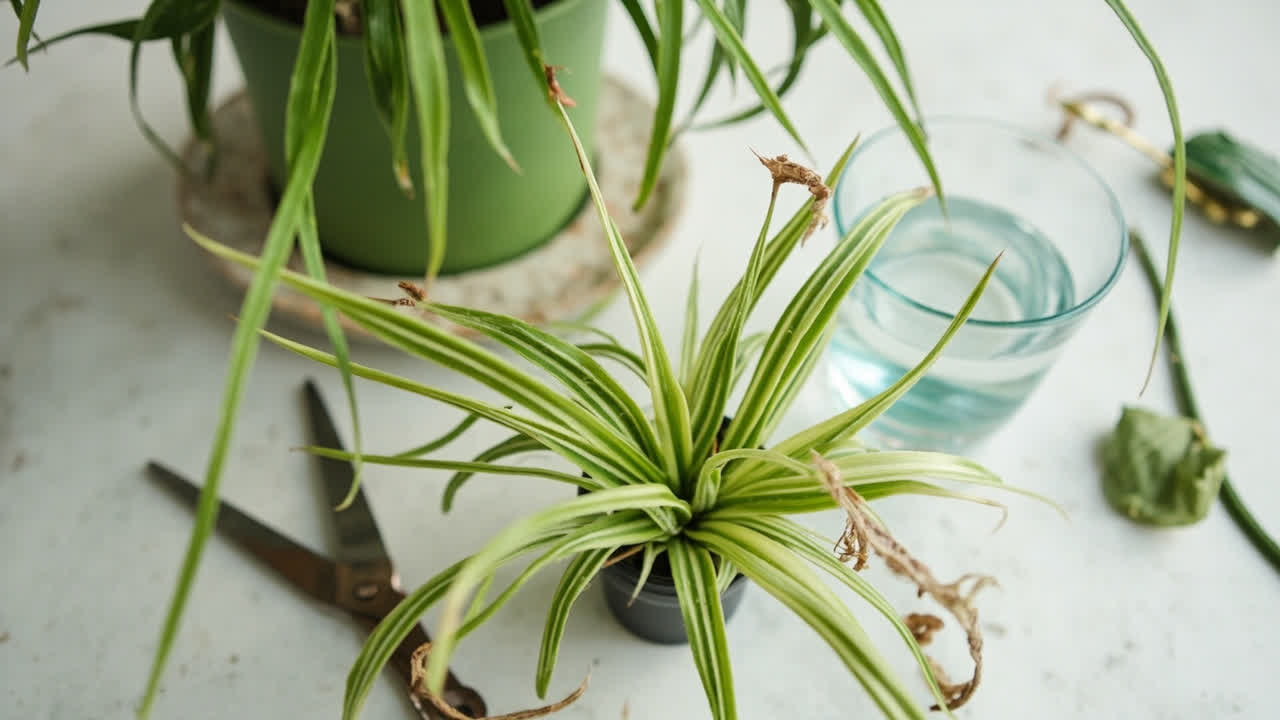
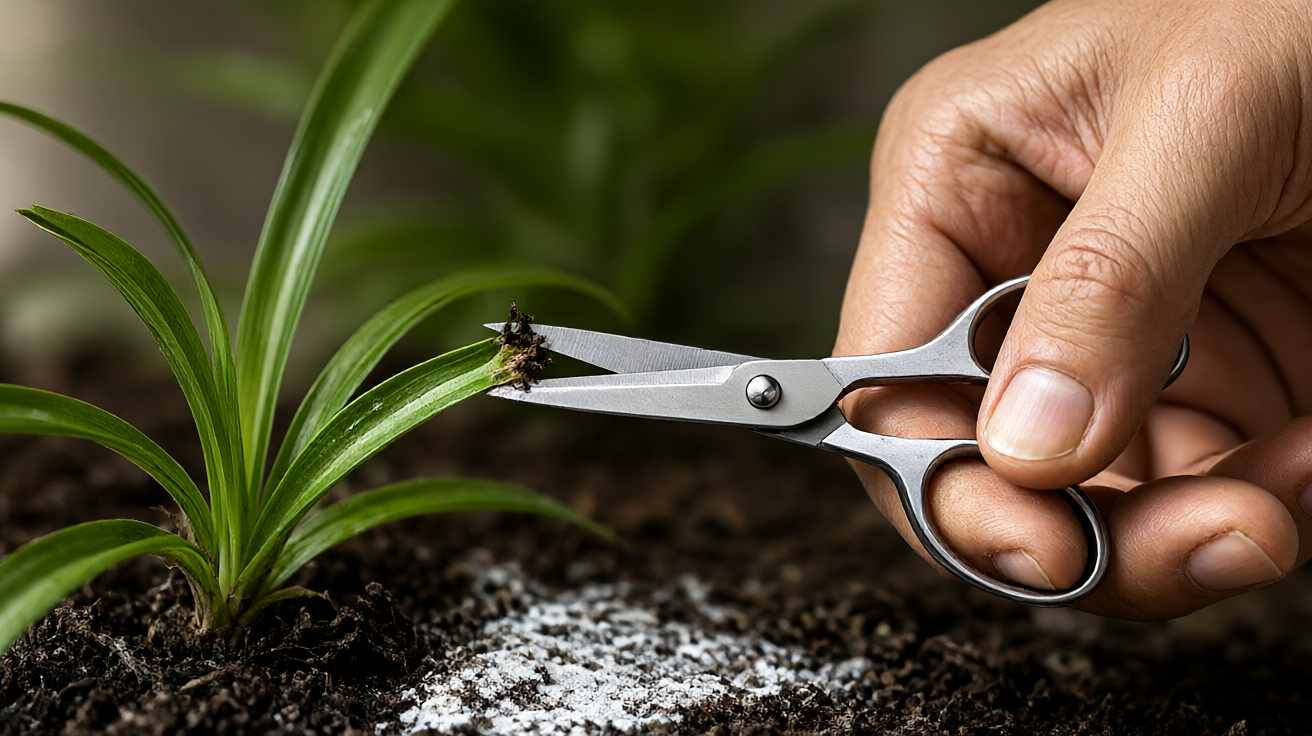
Trim brown tips with clean scissors, cutting just into green tissue at an angle. Do not remove entire leaves unless they are fully dead. The remaining green tissue still photosynthesises.
4. Adjust watering
Keep the soil evenly moist but not wet while roots recover. Damaged roots take up water poorly, so the plant is more drought-sensitive for two to four weeks. Check the top two centimetres before watering.
5. Repot if severe
If salts have crusted heavily or roots are mushy, repot into fresh mix. Shake out old soil, trim dead roots, and step up one pot size if the plant was root bound. Our how to repot a spider plant guide covers the procedure.
Prevention
Feed only during active growth, spring and summer, and at half the label strength. Spider plants need less than most houseplants. A balanced, water-soluble fertilizer at quarter to half strength every four to six weeks is plenty.
Always water before fertilizing. Never apply fertilizer to dry soil. Pre-watering dilutes the solution and protects roots.
Flush the soil every few months with plain water to prevent salt buildup, especially if you use tap water. If you use a slow-release granular fertilizer, apply less than the label suggests and avoid double-dosing.
Use low-mineral water for both feeding and flushing. Tap water adds salts on top of fertilizer salts, which accelerates buildup. Our spider plant tap water guide explains the water-quality interaction.
Recovery Timeline
Mild burn: new growth appears within two to three weeks after flushing, and tips stop browning. Moderate burn: recovery takes four to six weeks, and some leaves may be lost. Severe burn: the plant may lose most foliage but can resprout from the crown if roots survive. If the crown is soft and black, the plant is likely lost, but healthy spiderettes can be propagated. Our spider plant propagation guide covers that fallback.
For the full feeding baseline, see our how to fertilize spider plants guide, and if fertilizer burn is only one of several symptoms, our spider plant problems index helps sort the picture.
Turn any PDF statement into a clean sheet
Skip the typos and the hours of copying. Our converter handles any bank statement format and outputs Excel, CSV, or QBO for QuickBooks. No file retention, free to try.
Convert your statement