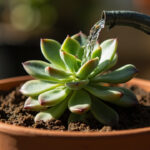
Echeveria needs more light than almost any other common houseplant succulent. The baseline is six hours of bright light per day — at least 10,000 lux for the full duration. Below this threshold, the rosette begins to stretch within two weeks.
By the time etiolation is visible, the stem has already elongated and the damage is irreversible without beheading. This guide covers the exact light requirements for every common Echeveria species, indoors and out. For companion care including soak and dry watering and soil mix ratios, the cluster Pillar covers the full genus.
The complete Echeveria care guide covers soil mix, watering, propagation, and the full genus overview. For the broader succulent family context, the succulent light requirements guide covers Crassulaceae-level needs. This guide drills into Echeveria-specific thresholds, species variations, and the practical setup that keeps rosettes tight year-round.
How Much Light Does an Echeveria Need?
The minimum for compact growth is 10,000 lux for six hours, or 20,000 lux for four hours. An east facing window with four hours of morning sun plus two hours of bright indirect light meets the baseline. A west-facing window with three hours of afternoon sun plus three hours indirect also works but carries higher sunburn risk for unacclimated plants.
A north facing window in the Northern Hemisphere does not provide enough light for any Echeveria species. The plant will survive for weeks in low light, but it will be slowly etiolating the entire time. If your only option is low light, a grow light is the only way to grow Echeveria successfully.
Species matters. Echeveria laui and Echeveria elegans are the most light-demanding — they begin stretching within 10 days of sub-optimal light. Echeveria pulidonis tolerates five hours before etiolation begins. Echeveria gibbiflora maintains form at five hours of bright indirect light without direct sun, likely because its larger leaf surface captures more total photons per hour.
Best Indoor and Outdoor Placement
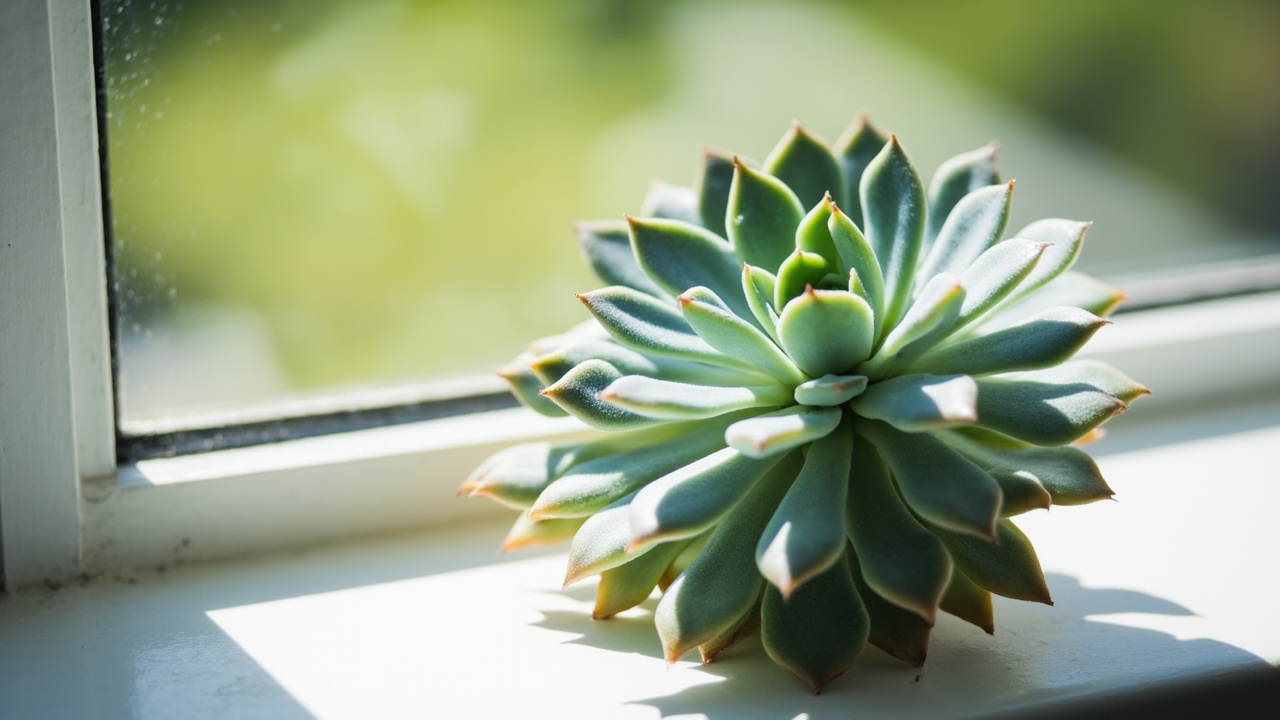
In the Northern Hemisphere, a south facing window is the best indoor location. Place the plant within 30 cm of the glass — even a meter back reduces light by 50% or more. Rotate a quarter turn every three to four days to prevent phototropic leaning. The same south facing position works for any windowsill setup, from a single specimen to a row of terracotta pots.
Outdoor summer placement provides the highest light levels and best color development. Morning direct sun with afternoon shade is ideal — the morning sun is less intense and less likely to cause sunburn. If full-day direct sun is unavoidable, use 30% shade cloth for the first two weeks, then remove it gradually. Plants grown outdoors develop thicker farina, tighter rosettes, and more vivid leaf color than any indoor setup.
In the Southern Hemisphere, reverse the orientation: north facing windows provide direct sun, south facing windows are the low light option. Outdoor placement should prioritize morning sun from the east or northeast, with afternoon shade from the west.
Etiolation: Detecting and Fixing Stretched Rosettes
Etiolation follows a predictable three-stage progression. Stage one: the rosette lifts on its stem and the lowest leaves angle downward. Stage two: internode spacing increases — you see distinct gaps between leaf attachment points. Stage three: the rosette flattens and leaves spread apart like an open hand. By stage three, the plant has been light-starved for at least three weeks.
The only fix is beheading. Cut the stem 2 to 3 cm below the rosette with a clean blade. Remove the lower leaves, callus the cutting for three to five days, and re-root in fresh gritty mix. The bare stem left in the pot will usually produce one to two pups within four to six weeks, giving you two plants from one stretched specimen.
Do not bury the stretched stem deeper to hide the elongation. Echeveria stems rot when buried in moist growing medium, and the plant declines within weeks. If you catch etiolation at stage one and move the plant immediately, new growth will be compact and the shape normalizes within two months.
Grow Light Setup for Indoor Echeveria
A full-spectrum LED grow light is the most reliable solution when natural light is insufficient. Target 40 to 60 watts of actual power draw for a single rosette, positioned 15 to 25 cm above the plant. Use full-spectrum white (4000K to 6500K) rather than purple blurple — same photosynthetically active radiation, far more pleasant in a home environment.
Run the lights 12 to 14 hours per day on an outlet timer. Do not run 24 hours — Echeveria needs a dark period for its CAM metabolic cycle. In summer, 7 AM to 9 PM works well. In winter, reduce to 10 to 12 hours to support natural dormancy and reduce water stress.
Panel-style LEDs distribute light more evenly across the rosette than bulb-style. A single 45-watt panel covers two to three small plants at 20 cm distance. Increase to 30 cm if leaves show bleach or heat stress. Decrease to 15 cm if the plant is still stretching after two weeks.
Sunburn: Prevention and the 7-Day Acclimation Protocol
Sunburn appears as brown or white dead patches on the upper leaf surface. It happens when indoor-grown plants are suddenly exposed to direct outdoor sun. The damage is permanent on affected leaves — the dead tissue never heals. The plant survives and produces new healthy leaves, but the cosmetic scarring remains until old leaves are naturally shed.
The 7-day protocol prevents almost every case. Day one: one hour of morning sun, then shade. Day two: two hours. Add one hour per day until the plant tolerates full morning sun by day seven. If any scorch appears, drop back to the previous day’s exposure and hold for two more days before increasing again.
The farina coating provides natural UV protection. A plant with intact farina handles 30% more direct sun than one with damaged coating. This is why handling the leaves increases sunburn risk — and why you should never apply neem oil or leaf-shine products that strip the farina.
Seasonal Light Adjustments by Hemisphere
In the Northern Hemisphere, March through September provides sufficient natural light through a south facing window. October through February requires a grow light supplement or acceptance of slight winter stretching. This seasonal drift is normal and corrects itself when day length increases in spring.
In the Southern Hemisphere, September through March is the high-light season. June through August is the low-light period. Outdoor Echeveria in the Southern Hemisphere may need partial shade during peak summer when UV intensity exceeds what acclimated plants can handle. A 20% shade cloth during the hottest two hours prevents sunburn without significantly reducing total daily light.
Monitor the plant, not the calendar. If the rosette stays compact and leaves stay firm, the light is adequate. If the stem elongates or leaves spread apart, increase light immediately. Waiting for the next seasonal shift means weeks of additional stretching that requires beheading to fix.
A light meter app on your phone is a worthwhile investment for indoor growers. Most free apps measure lux within 10% of a dedicated meter — enough to confirm whether your windowsill actually delivers the 10,000 lux you need. Test at the plant’s leaf height, at the same time of day, in each season. You may find that your south facing window drops below the threshold in December and January, which is the most common cause of winter etiolation.
Combining natural and artificial light works well for east facing and west facing windows that fall short of the six-hour target. Run a grow light for the first four hours of the day, then let the window provide the rest. This hybrid approach uses less electricity than a full 14-hour artificial photoperiod and produces more compact growth than either source alone. For watering and soil practices that complete the light-care cycle, the Echeveria care guide ties everything together.