
Flowering plants almost always need more light than foliage plants. The reason is in the carbon budget. A leaf running steady-state photosynthesis at 25 foot-candles can keep the chloroplasts turning over enough to hold a green color and grow a new shoot every few months. But bud initiation costs three to four times that energy budget, and a plant in deep shade simply does not accumulate enough fixed carbon over a six-to-eight week window to set a flower. The corner eight feet from a north window that grows a healthy snake plant will not bloom a peace lily. Not because the peace lily is fragile. Because the light is not.
Honest limit up front. Almost no houseplant “blooms in low light.” The species sold as low-light flowering plants (Saintpaulia, Spathiphyllum, Phalaenopsis) tolerate low light for the months they are not in bloom. They set buds under direct sun or bright indirect light, often in a greenhouse window before they reach the retailer. The label on the pot is a half-truth, and the half it skips is the half that decides whether you get flowers.
Most growers try to fix this by moving the plant closer to the window when it does not bloom. That can work for some species. For others, the gap is not light intensity but day length, or nighttime temperature drop, or the age of the plant. Three failure modes follow, and only one of them is a light problem.
The Foot-Candles Behind “Low Light”
“Low light” indoors is not a single number. It is a range, and the range varies by an order of magnitude across the room.
Here is how the labels map, measured at the leaf with a handheld light meter:
- Low light: 25 to 75 fc (270 to 810 lux). A spot eight to ten feet from an unobstructed north-facing window, or beside a window with sheer curtains during winter.
- Medium light / bright indirect: 75 to 250 fc (810 to 2,700 lux). Two to four feet from an east-facing window, or beside a north window with a white reflector behind the plant.
- High light / direct sun indoors: 250 to 1,000+ fc (2,700 to 10,800+ lux). Right against a south- or west-facing window, or under a 20-watt LED panel six inches above the canopy.
For comparison, full summer sun outdoors at noon in temperate latitudes measures 8,000 to 10,000 fc. A flowering plant evolved under that radiation inherits a bud-set threshold calibrated to its native light environment. The peace lily Spathiphyllum evolved in the understory of Central American rainforests where dappled sun at the leaf can briefly hit 200 fc. Its bud threshold sits near 75 fc sustained. Below that, it grows leaves indefinitely and skips flowering.
The African violet Saintpaulia ionantha, native to the cloud forests of Tanzania, evolved under filtered mountain light between 500 and 1,000 fc. The MU Extension’s indoor houseplant lighting reference places its flowering range at exactly that window. So “African violet blooms in low light” is true if and only if your north window has a grow-light supplement running 14 to 16 hours per day. In a true 25 fc corner, it will not flower. It will also not die. That is the trap.
What “Low Light Flowering” Actually Means
Three distinct mechanisms move a plant from leaf-growing to bud-setting. A species may use any combination, and which one matters decides whether your apartment will ever see a flower.
Light duration. Short-day plants, including Schlumbergera (Christmas cactus), Poinsettia, and Kalanchoe, need 12+ hours of uninterrupted darkness per day for four to six weeks to set buds. They evolved where day length reliably signals season. Indoors, a living-room lamp left on past 10 pm can suppress blooming entirely. This is not a light-intensity problem. It is a dark-period problem.
Light intensity. Long-day plants and the foliage flowering plants above (Spathiphyllum, Saintpaulia, Anthurium, Bromeliaceae) set buds when integrated daily light crosses roughly 6 to 12 mol m⁻² day⁻¹. A north window in winter delivers 1 to 3. A south window in summer delivers 12 to 20. The bud threshold is met on bright days and missed on dim ones. Grow lights close it year-round.
Nighttime temperature drop. Phalaenopsis orchids initiate spikes after a 10 to 15°F (5 to 8°C) drop between day and night for two to three weeks in autumn. The plant reads the drop as a seasonal signal, not a heat problem. In a climate-controlled apartment set to 72°F day and night, the orchid never gets the signal. Dropping a window by 1 inch in autumn solves it without buying anything.
The mechanism matters because the fix is different for each. A reader with a Phalaenopsis that has not bloomed in two years is most often missing the temperature drop, not the light. A reader with an African violet in a north window is missing the intensity. A reader with a Christmas cactus by a lamp is missing the dark.
The Realistic List: Species Ranked by Probability Under Low Light
Below, each species is graded on what it actually needs to bloom (measured in foot-candles sustained at the leaf over a 6-to-12 week window) and how forgiving the species is when the conditions fall short. The honest answer for almost all of them is “you will get leaves first, and possibly flowers in two years if you add one element.”
Plants That Bloom in Genuine Low Light (25 to 75 fc)
This category is almost empty. Most species in the standard “low light flowering” lists need 75 to 250 fc to set buds and are miscategorized on the retail label.
Aglaonema (Chinese evergreen). A foliage plant that flowers in low light. The bloom is a spathe-and-spadix structure similar to the peace lily, white to greenish, emerging from the lower leaf axils. It is not showy. It is honest. It blooms in a north window after the plant is mature, often unnoticed. If your goal is a beautiful flower, choose a different species. If your goal is a low-light plant that occasionally surprises you, Aglaonema is reliable.
Plants That Bloom in Bright Indirect Light (75 to 250 fc)
This is the realistic category for most apartments with east-facing windows or south windows with sheer curtains.
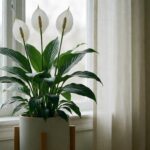
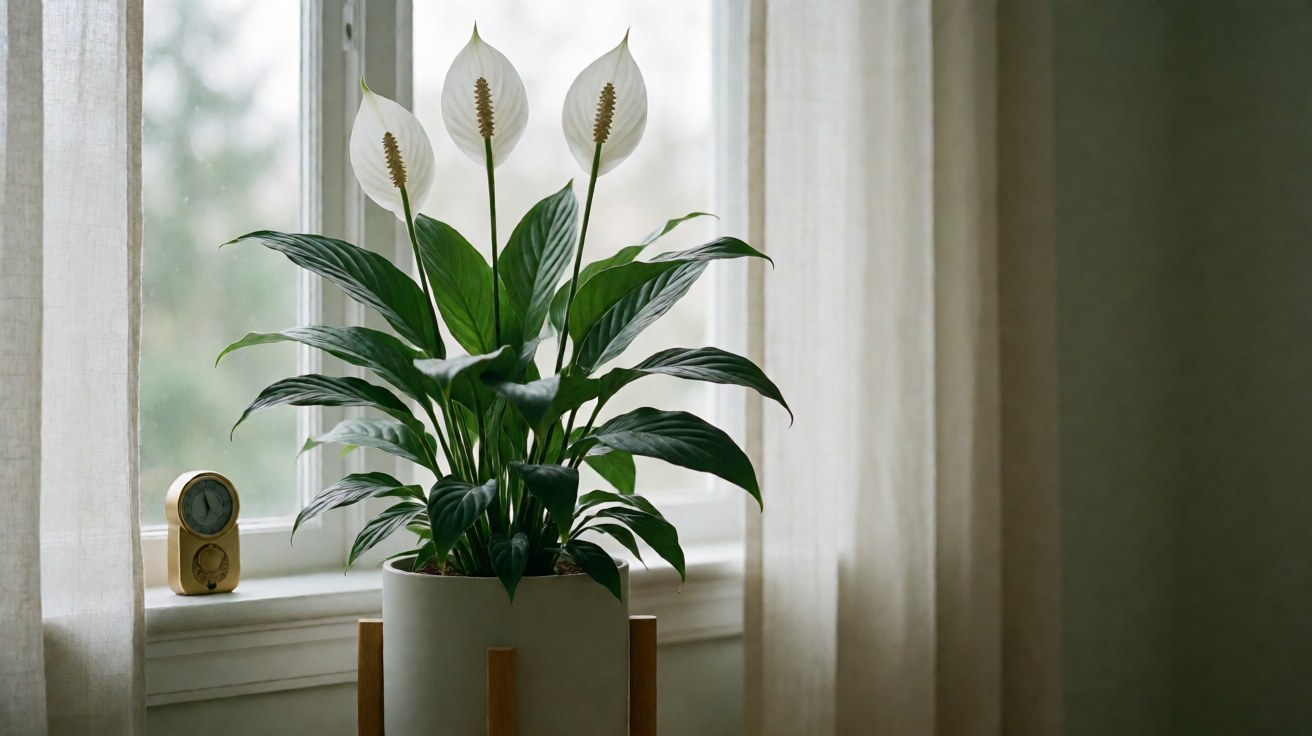
Spathiphyllum (peace lily). Bud threshold 75 to 150 fc over six to eight weeks. Blooms reliably in an east-facing window or beside a south window with a sheer curtain. The white spathes last six to ten weeks per bloom cycle. The plant will skip bloom cycles in deep corners and resume them when moved closer to the window. Mature plants (3+ years old) bloom more reliably than newly divided ones. This is the closest thing to a true “low light flowering” plant in standard retail, and even it wants the brighter end of the range to set buds.
Saintpaulia ionantha (African violet). Bud threshold 500 to 1,000 fc per MU Extension reference, but the plant survives in 50 fc indefinitely. This is the species most likely to disappoint readers who bought it on the “blooms in low light” label. The honest framing: African violet blooms in bright indirect light, tolerates low light between bloom cycles, and refuses to flower in true low light. If you have a north window only, plan on a $20 LED panel running 14 to 16 hours per day, or treat the plant as a foliage plant and skip the expectation.
Anthurium andraeanum. Bud threshold 100 to 200 fc sustained over eight weeks. Blooms reliably in bright indirect light. The red, pink, or white spathes last six to twelve weeks per bloom. In low light, the spathes come in pale and the plant rarely re-blooms. This is a bright-indirect plant sold in the low-light section. Read the label skeptically.
Phalaenopsis (moth orchid). Bud threshold 100 to 200 fc sustained, plus a 10-15°F day/night temperature drop in autumn. The drop matters more than the absolute light. A moth orchid in a constant 72°F apartment with 150 fc of light will grow leaves for years and never spike. Move it beside a window that drops to 60°F at night in October, and the same plant spikes within a month. The species is genuinely low-light-tolerant between bloom cycles; it is not a low-light bloomer.
Plants That Need Direct Sun to Bloom (250 to 1,000+ fc)
Schlumbergera (Christmas cactus). Bud threshold 250+ fc sustained, plus 12+ hours of uninterrupted darkness per day for six weeks starting in late September. The dark period is the harder constraint. The plant evolved in Brazilian cloud forest epiphytic niches with high humidity and filtered but bright light. A living-room lamp on a timer to the breaker that bleeds light past 10 pm suppresses bloom. Move the plant to a room you do not use at night in October. Buds set by November. Flowers by Christmas.
Clivia miniata. Bud threshold 250+ fc. A South African understory species that takes five to seven years from seed to first bloom. Mature plants bloom reliably in a south-facing window in late winter. In low light, mature plants skip bloom cycles indefinitely. The plant is evergreen and tolerates low light between bloom cycles, but it needs bright light to initiate the spike.
Begonia (Rieger and Rex-flowering hybrids). Bud threshold 200+ fc. Blooms in a south or east window with morning direct light. Tolerates lower light between cycles. The flowers are small and the plant is often grown for foliage. Bloom is a bonus, not the main event.
Bromeliaceae (Aechmea, Guzmania, Neoregelia). Bud threshold varies; most bloom reliably in 200+ fc. Many species are sold in bloom and the inflorescence lasts two to six months. After bloom, the parent rosette dies and pups form at the base. Pups take two to three years to reach bloom size. Low light between bloom cycles is fine. Bright light to initiate the next generation of bloom is required.
Aeschynanthus (lipstick plant). Bud threshold 200+ fc. Trailing epiphyte with bright red tubular flowers. Blooms in bright indirect light. Tolerates lower light between cycles but skips bloom in deep shade.
Plants Where Bloom Is Rare Indoors Regardless of Light
Impatiens. Marketed as a low-light annual outdoors, but indoors the bloom cycle collapses without strong light. The plants get leggy, skip bloom, and decline within six months. Treat as an annual or skip it indoors.
Sansevieria (snake plant). Blooms occasionally in low light, but the bloom is rare and the plant will go years without one even in optimal conditions. The flowers are fragrant and nocturnal but not visually showy. Do not buy expecting blooms.
How to Measure Before You Buy
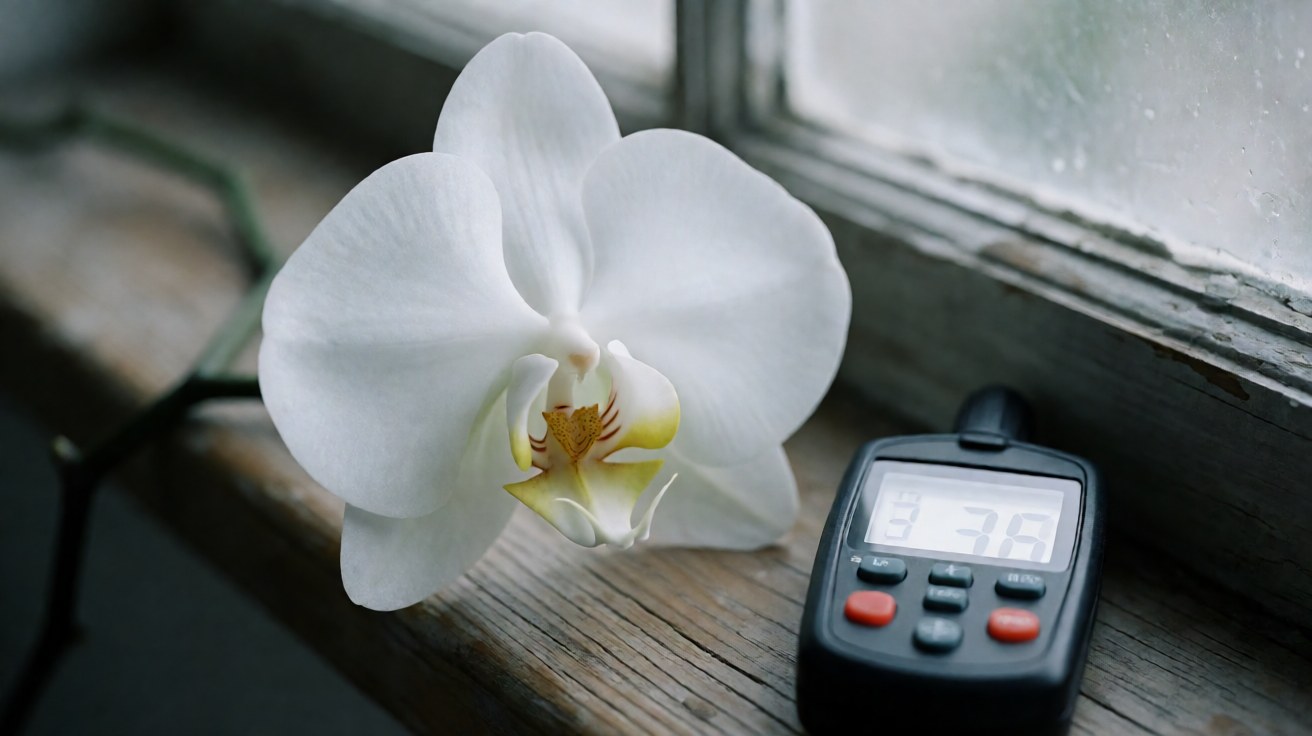
A $15 light meter removes the guesswork in five minutes. Take five measurements across the room where you plan to put the plant: at the windowsill, at one meter from the window, at three meters, at the corner, and at the spot where the plant will spend the dormant months. Multiply the lowest reading by 0.7 to estimate sustained light (since the meter reads peak, not average). Anything under 50 fc sustained is true low light. Anything 75 to 200 fc is bright indirect. Anything over 250 fc is direct sun.
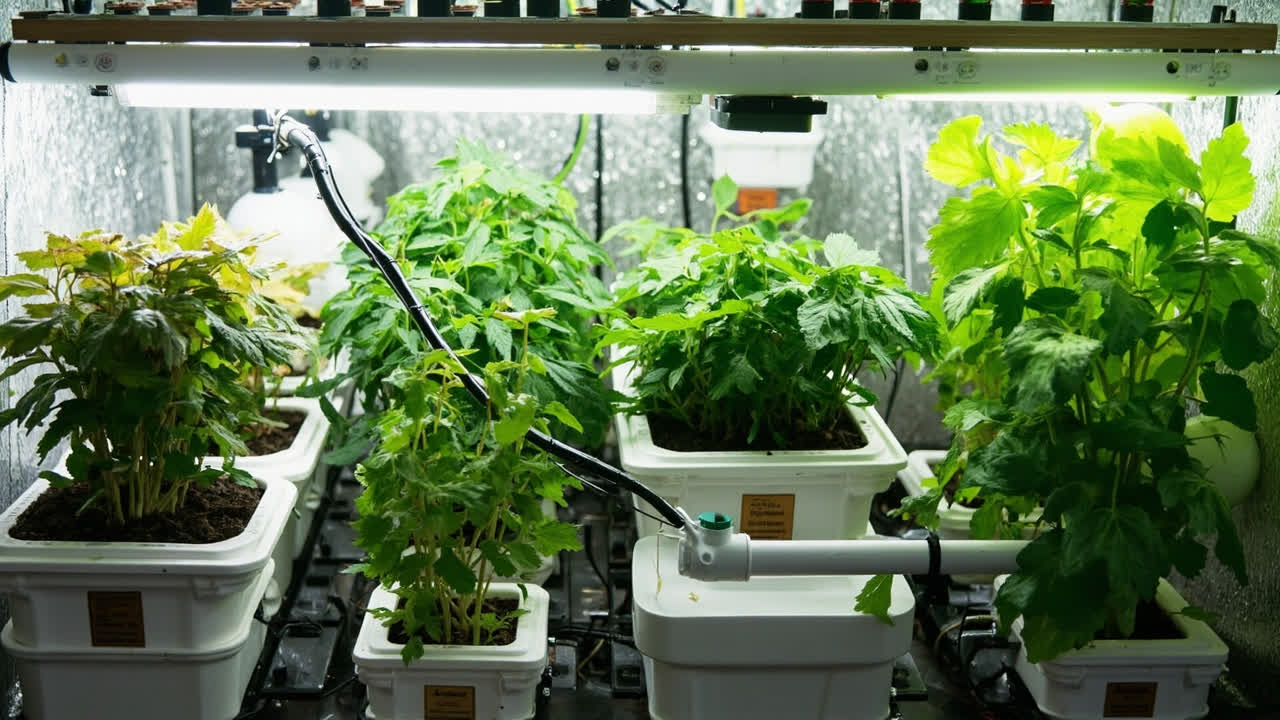
For grow light supplementation, the metric to look for is PPF (photosynthetic photon flux), measured in µmol m⁻² s⁻¹ at the canopy. A flowering plant needs 150 to 300 µmol m⁻² s⁻¹ for 12 to 16 hours per day to set buds. A 20-watt LED panel at 6 inches above the canopy delivers 200 to 250 µmol m⁻² s⁻¹, which is within range. A $30 grow bulb from a hardware store delivers 30 to 50 µmol at the same distance, which is insufficient. Read the PPF specification, not the watt equivalent.
What to Expect Over the First Six Months
If you buy a peace lily in a 6-inch pot and place it in 100 fc sustained light (a bright indirect spot), expect the first bloom in three to six months from a mature plant. New plants from a 4-inch pot may take a year. African violets bought in bloom will continue blooming for two to three months under the same light, then enter a four-to-six week vegetative pause before the next bloom cycle. Moth orchids bought in spike bloom within two months; the next spike requires the autumn temperature drop, which arrives on its own if you have an unheated room. Christmas cactus needs the dark period starting in late September, so plan the room move now, in October, not in November.
The honest summary, in one sentence: flowering houseplants do not bloom in low light. They bloom in bright light, then rest in low light. The label on the pot describes the rest period. The greenhouse window before the retailer is where the bloom began.
The flower remembers the equator. A north window is honest as far as it goes: most of the way, but not all of it.
Related reading on the site: best plants for low light covers the broader species list for foliage plants, indoor plant light levels guide explains the foot-candle framework for every room in a typical apartment, and houseplant watering schedule, save a dying houseplant 7 day rescue, indoor plant care complete guide ties light, water, and humidity into one decision framework.
From Bank Statement to QuickBooks-Ready File
That manual cleanup you just read about? This tool skips it. Turn your PDF into QBO for QuickBooks without storing your data anywhere.
Start Converting