Your Hoya has not flowered in over a year. The leaves look healthy, but no peduncles appear.
You moved it to a brighter spot. A week later, the leaves turned bronze. Wrong kind of bright.
The Hoya light paradox: the plant needs high light to bloom, but direct afternoon sun destroys the waxy leaf tissue in under an hour. The waxy cuticle that evolved to trap moisture also traps heat behind window glass. When direct sun hits the Hoya through a south window, the underlying cells cook from the inside out. Bright indirect light gives the Hoya the energy it craves without the heat tax.
This article covers placement for each window direction, the grow-light rules that actually help Hoya peduncle formation, seasonal shifts, and the warning signs that tell you the light is wrong before the Hoya suffers permanent damage.
Why Hoya Leaves Burn in Direct Sun: The Waxy Cuticle Limit
A direct sunbeam hitting a Hoya leaf through window glass is a trap. The waxy cuticle, brilliant at sealing moisture into the leaf, also seals heat in. In a natural canopy, air movement carries the heat away in seconds. Against a still windowsill, the heat accumulates.
The underlying mesophyll cells reach lethal temperature within 30 minutes. The first symptom is a bronze patch that never turns green again. The damage is permanent; the Hoya leaf does not repair itself.
The University of Florida IFAS Extension notes that tropical epiphytes behind glass regularly experience leaf temperatures 10-15°F above ambient because the glass traps longwave radiation. This is why a Hoya that thrives on an east sill will burn on a south sill just five feet away. The direction matters more than the room.
The East and South Window Decision: Where to Place a Hoya
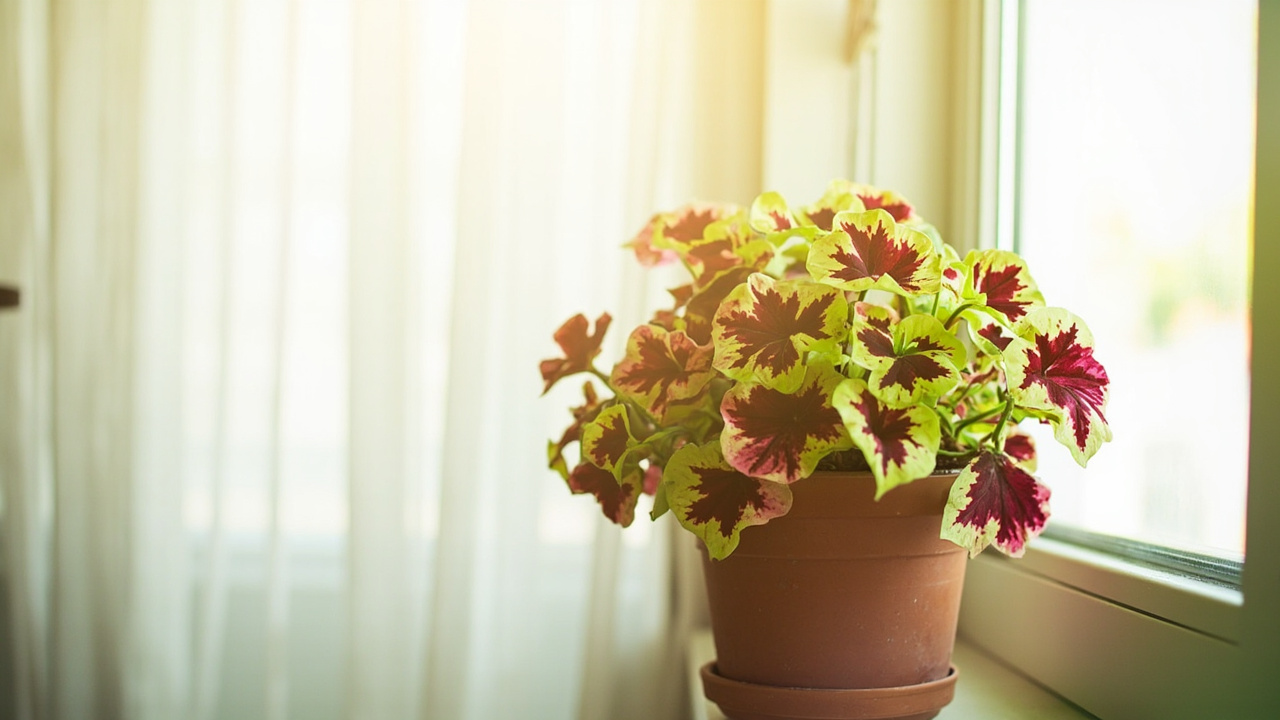
An east-facing windowsill is the most reliable Hoya position. It delivers 2-4 hours of gentle morning direct sun when the solar angle is low and atmospheric diffusion is high. A mature Hoya carnosa on an east sill typically initiates peduncles within 12-18 months of placement.
The south window trade-off: southern exposure delivers twice the daily light integral of an east window, but the noon sun arrives at a steep angle that drives heat buildup behind glass. Pull the Hoya back at least 6 feet from the glass or hang a sheer curtain to diffuse the beam.
The RHS recommends that any tropical epiphyte placed within 3 feet of an unfiltered south window requires diffusion to prevent chronic photoinhibition — a state where the photosynthetic machinery downshifts to protect itself, and net growth stalls despite abundant light.
West windows are Hoya traps. The afternoon sun arrives hot and low, and the waxy cuticle traps more heat at that angle than at any other time of day. North windows almost never deliver enough intensity for peduncle initiation. The simplest rule: give the Hoya morning sun first, diffuse midday sun second, and avoid afternoon sun entirely. For the full breakdown of all five Hoya care dimensions, the Hoya plant care complete guide covers placement within the broader watering-and-soil framework.
Reading Hoya Leaf Signals: What Bleaching, Bronze, and Slow Unfurl Mean
The Hoya tells you when the light is wrong if you know what to look for. Bronze or reddish patches on the upper leaf surface are sunburn; the damaged tissue never recovers. Pale bleaching on leaves closest to the glass is a sign the photosynthetic apparatus has downshifted into self-protection.
Slow leaf unfurl — a new leaf that takes more than 3 weeks to open — signals chronic underexposure, because the Hoya is starved of the ATP it needs to drive cell expansion.
The components of light stress are distinct: heat accumulation damages cells permanently, photo-oxidative stress bleaches pigments reversibly, and energy starvation slows growth. The fix for each one is different because each mode responds to a different intervention.
The conditional rule is simple: when you see bronze, move the Hoya further from the glass today. When you see bleaching, add diffusion immediately. When you see slow unfurl, add a grow light within the week.
Grow Lights for Hoya: Placement, Duration, and Spectral Quality
Grow lights help a Hoya only when placed at the right distance, run for the right duration, and emitting the right spectral bands. A standard white LED panel placed 12 inches above the Hoya canopy and run for 12-14 hours a day during fall and winter reliably maintains the lux threshold that prevents peduncle abortion.
Farther than 24 inches and the intensity drops below the Hoya’s photosynthetic saturation point. Closer than 6 inches and the leaf surface overheats even from LED output because the waxy cuticle traps heat against the epidermis.
The peer-reviewed photobiology literature suggests that Hoya peduncle initiation is most responsive to blue-light wavelengths in the 430-450 nm range because those wavelengths control the phototropin receptors that regulate reproductive branching. A full-spectrum white LED includes that band, but narrow-band pink LEDs often under-deliver it. If the grow light does not specify the blue-band output, the Hoya may grow foliage without ever initiating peduncles. The best grow lights indoor plants guide compares spectral delivery and identifies the specific panel types that test well for peduncle induction.
Seasonal Light Shifts: How the Hoya Responds to Shorter Winter Days
Day length drops below 10 hours somewhere between late October and early February for most North American indoor growers. The Hoya responds with a metabolic slowdown: photosynthetic rate drops, new leaf initiation pauses, and developing peduncles may abort.
This is normal. It is not a light crisis requiring immediate grow-light intervention. The Hoya evolved in monsoonal Southeast Asia, where dry-season short days signal a rest period, and the genetics follow that programming.
The honest limit: grow lights can maintain a Hoya through winter, but the plant still benefits from a 6-8 week rest period below 70°F (21°C) with reduced water and no supplemental light. Many growers who push a Hoya under lights all winter find that the plant skips the next spring bloom cycle because it never received the rest signal its circadian clock requires. A house plant care calendar shows the month-by-month shift and flags where supplemental light helps versus where it disrupts the Hoya’s rest cycle.
The practical rule of thumb: if the Hoya receives fewer than 8 hours of natural or supplemental light for more than 3 consecutive weeks, expect peduncle abortion within the following month. Match the duration to the season and the plant responds predictably.
When No Window Works: The Hoya That Cannot Get Enough Light Indoors
Some rooms cannot grow a blooming Hoya. A north-facing room with a building opposite the window, a basement apartment with small cellar windows, or a windowless office with fluorescent ceiling panels — all three fail to deliver the minimum intensity the Hoya needs to initiate peduncles. You can keep the Hoya alive with a grow light, but no artificial setup fully reproduces the spectral balance of morning sun for Hoya reproductive development.
In our experience with indoor Hoya collections, the winter heating season causes more stress than summer heat because dry cold near windows creates a double bind. In one case study, a grower in a north-facing Chicago apartment successfully maintained a Hoya kerrii vegetatively for 4 years under a full-spectrum LED but never saw a peduncle until the plant was moved to an east windowsill in a new home.
The solution is a rethinking of expectations. If you also water correctly — the indoor plant watering schedule covers moisture timing — the Hoya thrives vegetatively for years in marginal light. But if flowering is the goal, the room needs a grow light or a sill that catches at least 2 hours of morning sun.
No amount of fertilizer or root restriction compensates for chronic light starvation in Hoya care. That is the hardest limit, and the one most indoor growers learn last.
When the right light still does not produce a bloom, the seven-reason checklist at Aqualogi walks through maturity, peduncle damage, and dormancy signals. See the Hoya not flowering guide.
Turn any PDF statement into a clean sheet
Skip the typos and the hours of copying. Our converter handles any bank statement format and outputs Excel, CSV, or QBO for QuickBooks. No file retention, free to try.
Convert your statement