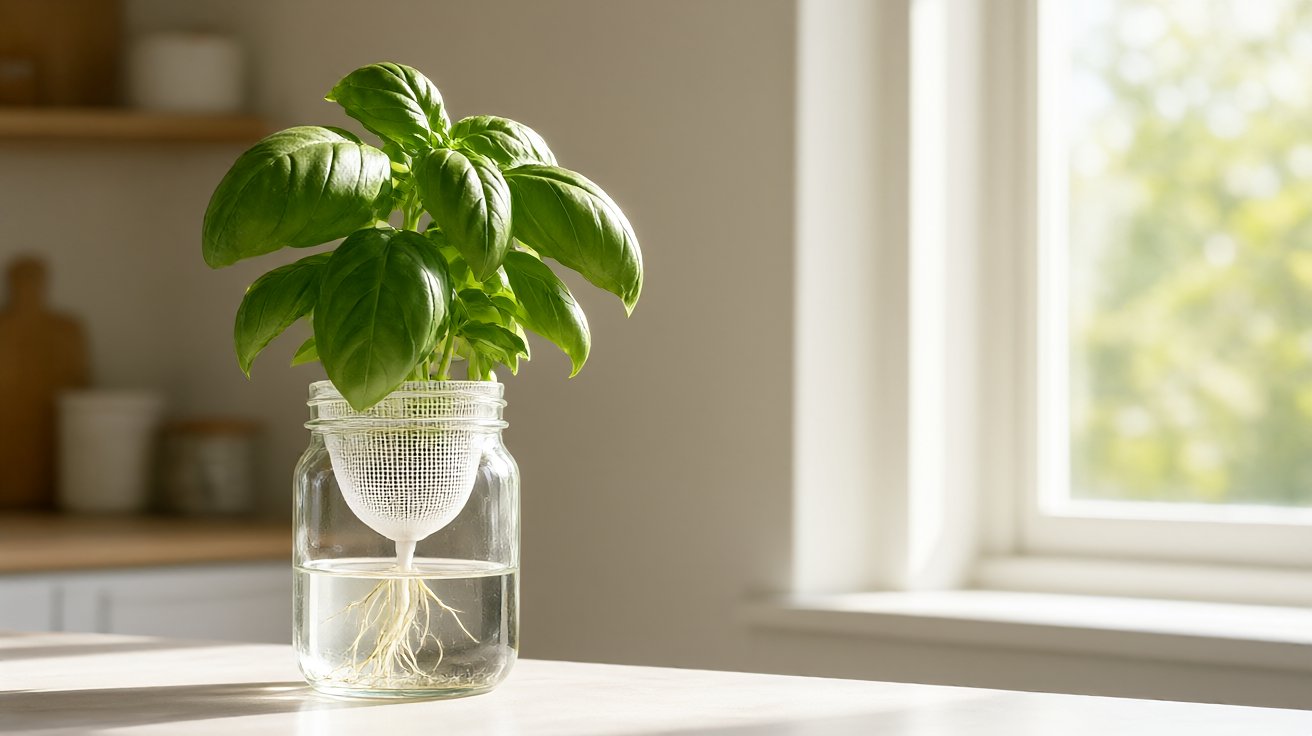

Hydroponic basil is the most forgiving herb a beginner can grow, and the most rewarding one to get right. The difference between a leggy, bitter plant and a dense, aromatic one comes down to four numbers: pH 5.5 to 6.5, EC 1.0 to 1.6 mS/cm, water temperature 18 to 24 C, and 14 to 16 hours of strong light. Hold those and basil will outgrow your kitchen.
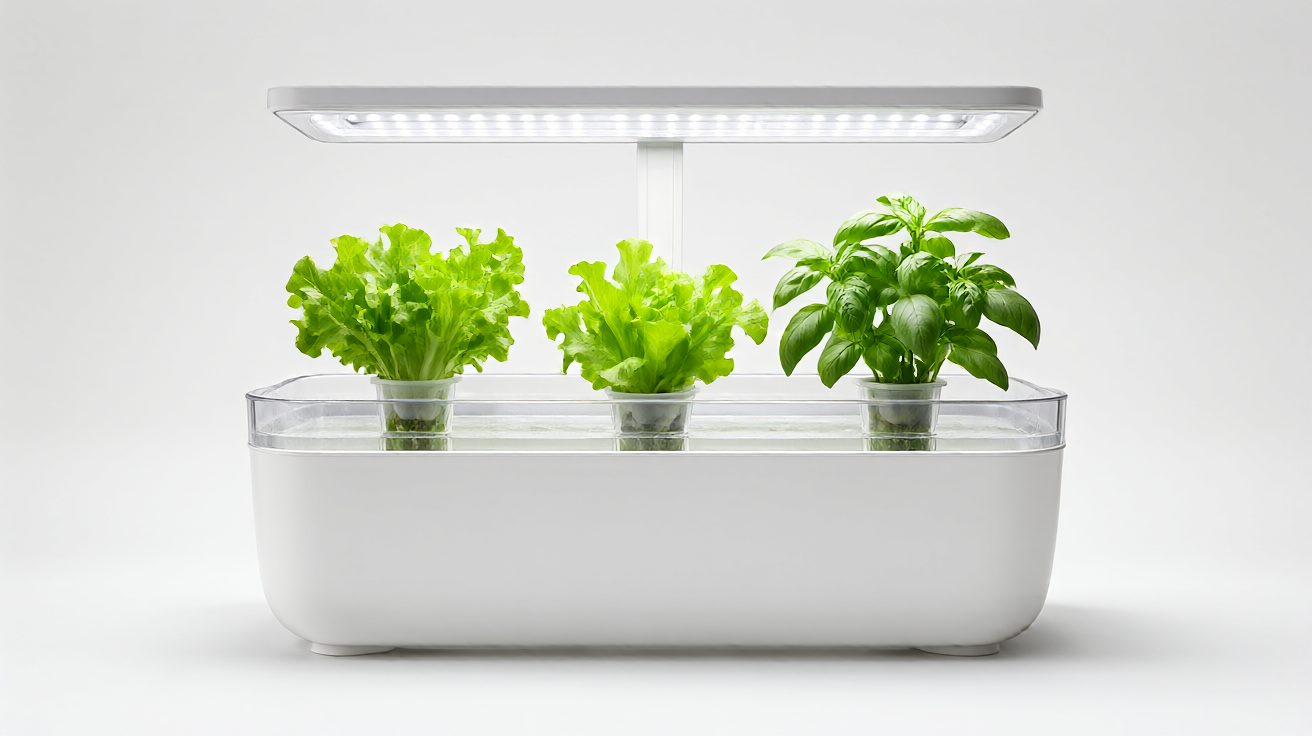
This guide is written for a home reservoir, a Kratky jar, or a small NFT channel. It gives the target ranges, the reason each one matters, a nutrient recipe that works, a harvest method that keeps the plant producing for months, and a troubleshooting table for the three problems that actually show up.
What Basil Needs From a Hydroponic Solution
Basil is a medium feeder. It wants a complete, balanced nutrient at roughly half to two-thirds the strength you would give a tomato, with nitrogen tilted slightly toward vegetative growth. The two numbers that decide everything are pH and EC.
| Parameter | Seedling (week 1-2) | Vegetative (week 2-5) | Mature / harvest (week 5+) |
|---|---|---|---|
| EC (mS/cm) | 0.5 – 0.8 | 1.0 – 1.4 | 1.2 – 1.6 |
| pH | 5.5 – 6.0 | 5.5 – 6.5 | 5.5 – 6.5 |
| Nitrogen (ppm) | 80 – 100 | 120 – 150 | 120 – 150 |
| Phosphorus (ppm) | 20 – 30 | 30 – 40 | 30 – 40 |
| Potassium (ppm) | 60 – 80 | 90 – 100 | 90 – 100 |
| Water temp (C) | 20 – 24 | 18 – 24 | 18 – 24 |
These targets come from extension and research data: Oklahoma State University Extension sets pH 5.5 to 6.0 and EC 1.0 to 1.6 mS/cm as the home baseline, while Clade et al. (2025, HortScience) found 150 mg/L nitrogen, 40 mg/L phosphorus, and 96 mg/L potassium optimal for visually healthy basil. Walters (2016) found no significant growth difference between EC 0.5, 1, 2, 3, and 4 mS/cm in NFT basil, which is why the home target sits in the comfortable middle rather than at the top.
pH: Aim for 5.5, Check It Weekly
Basil takes up iron and nitrogen efficiently between pH 5.5 and 6.5. Below 5.5, iron becomes too available and can burn the roots; above 6.5, iron locks out and new leaves turn pale yellow between the veins. The practical fix is to check pH every few days in a small reservoir and adjust with pH Down or pH Up a little at a time.
Oklahoma State University Extension sets the optimum at 5.5 with a workable range of 4.5 to 6.5, and Kramer, Currey, and Boldt (2025) found shoot growth of Nufar basil unaffected from pH 4.5 to 7.0, with shorter roots only at the extremes. In other words, basil is not fussy, but 5.5 to 6.0 is where it is happiest.
EC: 1.0 to 1.6 mS/cm, Lower in Summer
EC measures how much dissolved salt is in the water. Basil is a medium feeder, so 1.0 to 1.6 mS/cm is the sweet spot. Johnny’s Selected Seeds recommends 1.0 to 1.4 mS/cm, higher in winter when the plant drinks less, lower in summer when it drinks more. Urban Hydro Space suggests starting seedlings at 1.0 to 1.2 and easing toward 1.6 once established, never past 2.2 in a small jar.
The reason for the seasonal shift is evaporation. In a hot week the plant transpires faster, water leaves the reservoir, and the salts stay behind, so EC climbs even though you added no fertilizer. Top up with plain pH-adjusted water, never more nutrients, and check EC before you add anything.
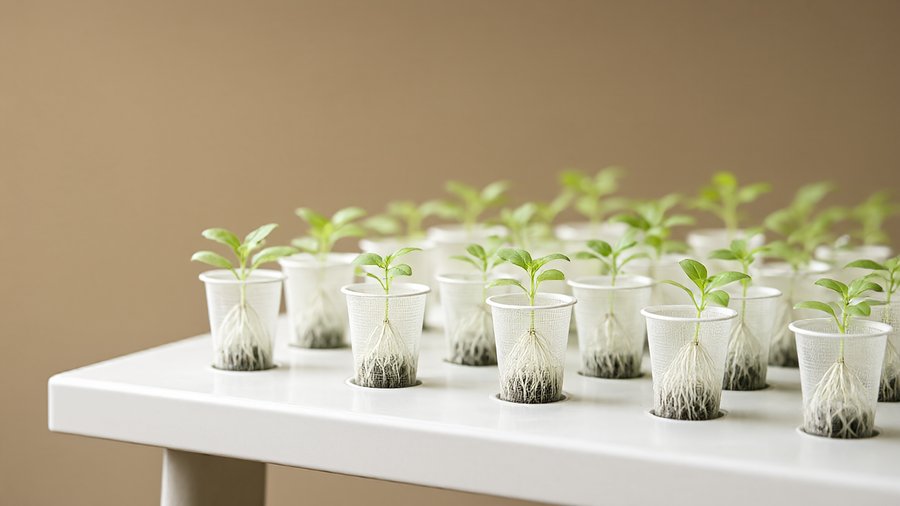
Light: 14 to 16 Hours and Close
Basil is a sun plant. Give it 14 to 16 hours of light a day at 200 to 400 micromol per square metre per second, measured 15 to 20 cm above the canopy. Walters (2016) found growth higher at a daily light integral of about 15 mol per square metre than at about 7 in every species tested, and flavor tracks intensity more than anything else.
Two practical rules. First, distance: keep the light 15 to 20 cm above the canopy, closer than most guides say, to stop legginess. Second, schedule: 14 hours on, 10 off. Basil does not need a dark period to flower, but the off time lets the plant respire and keeps the leaves from getting soft.
Water and Air Temperature
Basil likes warm air and cool roots. Air temperature 18 to 24 C produces steady growth; growth rises in a straight line from 11 C to 29 C and dips slightly at 35 C. Water temperature 18 to 24 C keeps roots white and oxygenated. Above 27 C the water holds less dissolved oxygen and roots turn brown, which is the most common cause of a healthy-looking top wilting in a hot week.
If your reservoir runs warm, add a small aquarium bubbler or move the reservoir out of direct sun. A white or insulated bucket helps more than a dark one.
Nutrient Recipe for a Home Reservoir
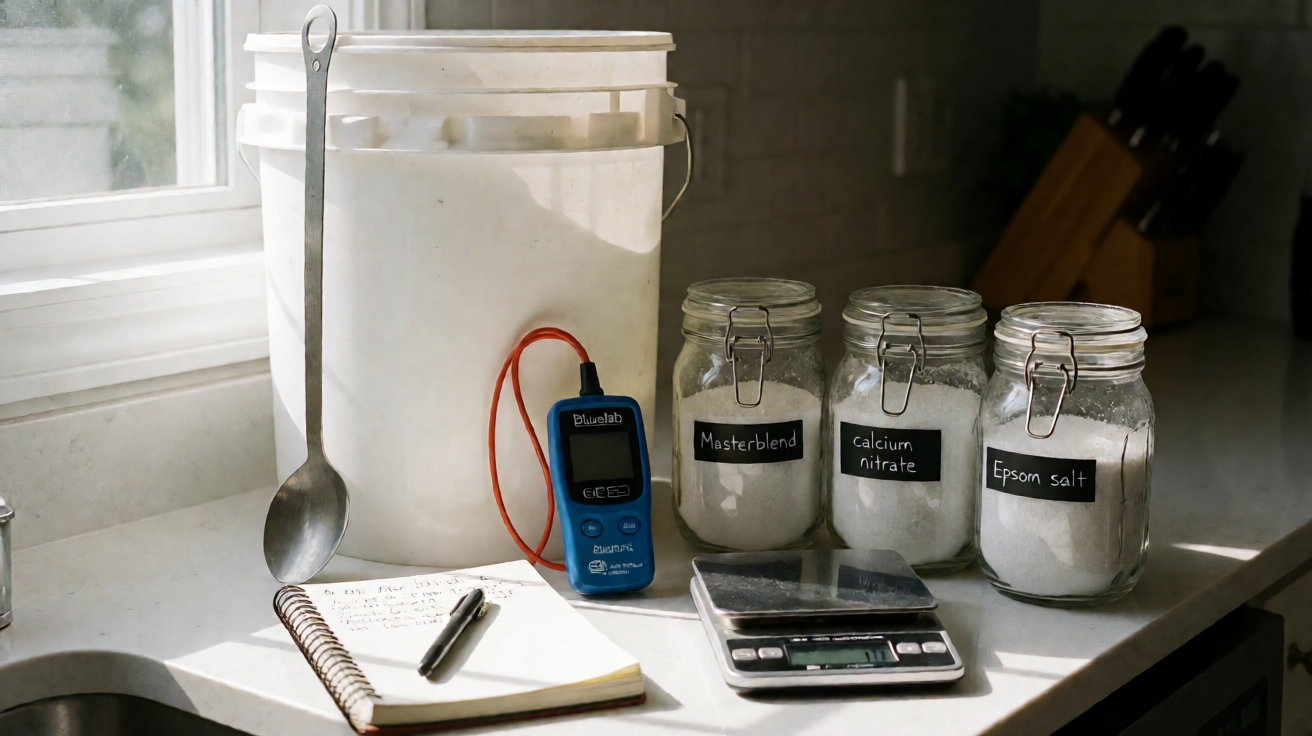
Use a general-purpose two-part liquid hydroponic nutrient made for herbs or leafy greens, mixed to three-quarter strength. Avoid bloom-specific formulas, because you want to prevent flowering, not encourage it. MasterBlend, General Hydroponics Flora, and any house-brand herb nutrient all work.
Mixing order matters. Fill the reservoir with water first, then add part A, stir, then part B, stir, then pH adjust. Adding both parts together can precipitate calcium and lock up nutrients. Check EC after mixing; it should land near 1.0. Adjust to pH 5.5 to 6.0 last.
How to Harvest Basil So It Keeps Producing
The single most important technique is the pinch. Once the plant has three or four true leaf pairs, pinch the growing tip just above a pair of leaves. Two new shoots emerge from that node, and the plant becomes bushy instead of tall. Repeat every time a shoot reaches three leaf pairs.
Harvest rules:
- Cut stems, never individual leaves. A stem cut above a node regrows; a plucked leaf leaves a wound that invites disease.
- Never take more than one third of the plant at a time.
- Pinch flower buds the moment they appear. Once basil flowers, leaf production stops and the leaves turn bitter.
- Harvest in the morning, when essential oil content is highest.
A well-managed plant produces for three to six months, then stems go woody. Take cuttings from the soft tips before that happens and you have an endless supply.
Common Problems and Fixes
| Symptom | Likely cause | Fix |
|---|---|---|
| Pale yellow new leaves | pH too high, iron locked out | Lower pH to 5.5 to 6.0 |
| Uniform yellow on old leaves | EC too low, nitrogen shortage | Raise EC toward 1.4 |
| Leggy, tall stems | Light too weak or too far | Move light to 15 to 20 cm, 14+ hours |
| Bitter leaves | Plant flowering or heat stress | Pinch buds, keep air below 29 C |
| Brown, slimy roots | Water too warm, low oxygen | Cool reservoir, add air stone |
| Downy mildew (grey fuzz under leaves) | Humidity above 85 percent | Increase airflow, lower canopy humidity |
Downy mildew deserves a special note. The pathogen needs wet leaves or at least 85 percent humidity in the canopy to infect, according to McGrath (Cornell, 2021). Good airflow and not wetting the foliage are the cheapest prevention.

When to Plant and How Long Until Harvest
Basil germinates in 5 to 10 days at 20 to 25 C. Transplant seedlings into the system at the first true leaf pair, about two weeks after sowing. First harvest comes 5 to 6 weeks from seed, or about 3 weeks after transplanting. A single plant in a one-litre Kratky jar will keep a kitchen supplied with fresh basil for most of a season.
If you start from a cutting instead of seed, root it in plain water for 7 to 10 days, then move it into the system at EC 0.8 and raise to 1.2 once new growth appears.
Sources and Further Reading
- Oklahoma State University Extension, hydroponic herb production guidelines (pH 5.5 to 6.0, EC 1.0 to 1.6 mS/cm, water temperature 22 to 24 C).
- Clade, T. et al. (2025), “Nutrient Solution Formulation for Hydroponic Basil,” HortScience 60(4).
- Kramer, Currey, and Boldt (2025), pH effects on Nufar basil shoot and root growth.
- Walters, K. J. (2016), DLI and EC responses in hydroponic basil, Greenhouse Grower series.
- McGrath, M. T. (2021), basil downy mildew, Cornell University.
- Johnny’s Selected Seeds, hydroponic basil cultural information (pH 5.8 to 6.2, EC 1.0 to 1.4 mS/cm).
Last reviewed on November 26, 2026.
Pinch early, feed lightly, and the leaves will tell you the rest.
See also: Hydroponic Herbs · Hydroponic Lettuce · Hydroponic Nutrient Solution Recipe
See also: Hydroponic Plant Spacing · Hydroponic Kale