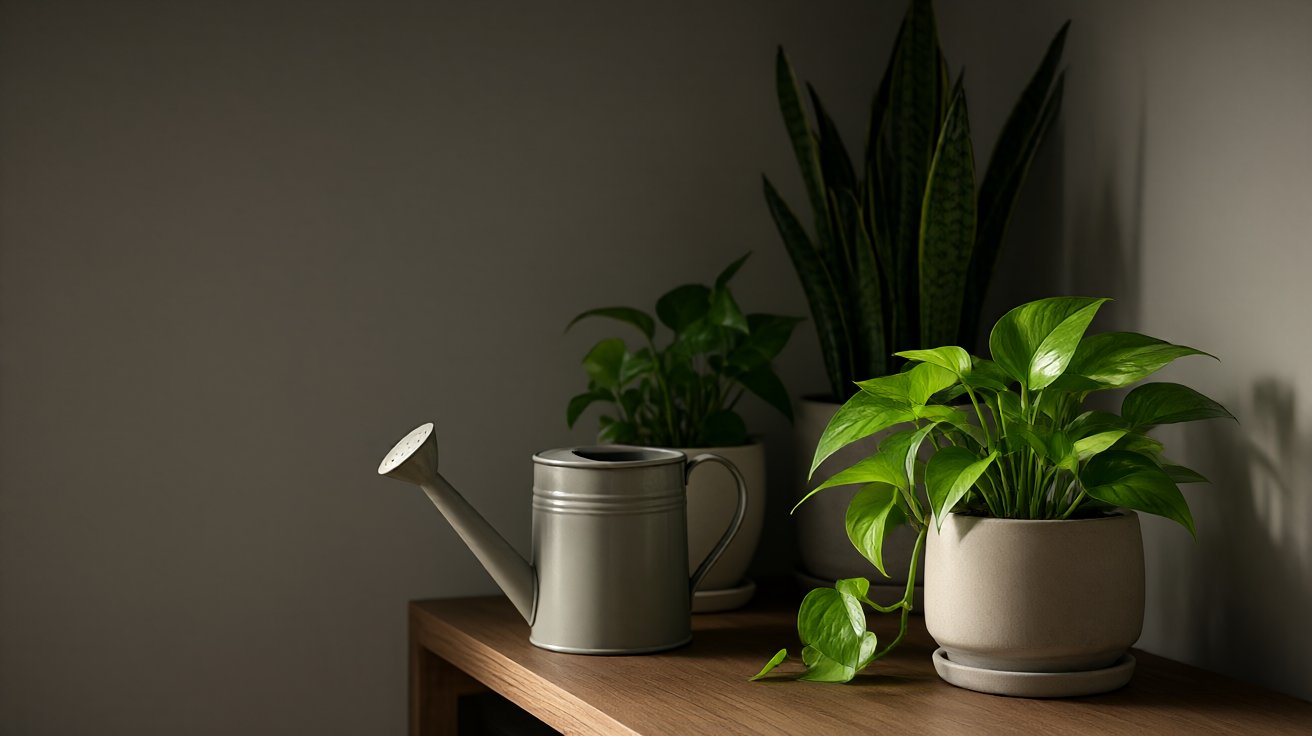

Low light means less water, and the reason runs through the leaf. Light drives photosynthesis, photosynthesis opens the stomata on the underside of each leaf, and open stomata let water vapour escape. Less light means fewer open stomata, which means less transpiration, which means the pot stays wet longer. A plant in a dim corner on a bright-window schedule is being watered for a demand it no longer has, and the surplus does not drain away. It sits in the root zone, displaces air, and rots.
Two failure modes follow. The first is a schedule copied from a sunnier home: yellowing lower leaves, soft stems, and a sour smell from the drainage holes weeks after the damage started. The second is the opposite error, watering less by reflex and letting a thirsty plant collapse in a hot week. The real skill is not watering less. It is converting light exposure into an interval, then verifying it against the pot in front of you.
Why Low Light Changes the Watering Interval
The link between light and water loss is a chain of four physical steps, and each one matters because every watering decision sits at the end of it.
Light availability determines the rate of photosynthesis, and photosynthesis determines how much water the plant pulls from the substrate to replace what it transpires. Transpiration rate therefore tracks light exposure closely. In a window with 10,000 lux, a plant such as Epipremnum aureum can lose water through its leaves several times faster than the same plant at 800 lux a few meters away.
Because transpiration is the dominant route of water loss in container plants, light sets the demand side of the equation. Substrate water-holding capacity and pot volume set the supply side, because they determine how long a given volume of water remains available to the roots. When you move a plant from a bright window into a dim corner, the demand side drops sharply while the supply side stays exactly the same.
That is the whole reason low light plants need a longer interval. The substrate does not change. The plant simply stops drinking at the old rate.
One honest limit up front. No published trial compares watering multipliers across light bands for common houseplant species. The multipliers below are reasoned starting points derived from the transpiration mechanism, not measured constants, and they need checking against your own pot. That check is the subject of the next section.
If you want the light classification behind the bands, the four-tier light framework sets out how the readings are taken. For the baseline intervals that this page adjusts, the watering schedule by species gives you the starting number for your particular plant.
From Light Band to Interval: The Multiplier Table
Start from the base interval for your species, read the multiplier for the light band the plant sits in, and multiply. The base comes from the plant’s own characteristics: a succulent-backed Crassula ovata dries far faster than a soft-stemmed Chlorophytum comosum in the same pot and room.
Here is the adjustment in one place, with the observable check that tells you the band is right.
| Light band | Approximate reading | Base interval | Multiplier | Starting interval | Observable check |
|---|---|---|---|---|---|
| Bright window | above 10,000 lux | 5 to 7 days | 1.0 | 5 to 7 days | Soil dry to 2 cm below the surface, pot light in weight |
| Medium light | 2,500 to 10,000 lux | 8 to 10 days | 1.5 | 12 to 15 days | Soil dry to 3 cm, slight weight loss |
| Low light | 500 to 2,500 lux | 10 to 14 days | 2.0 | 20 to 28 days | Top 4 cm dry, lower layer slightly damp |
| Dim corner | 100 to 500 lux | 14 to 21 days | 3.0 | 42 to 63 days | Pot still damp at 5 cm, no condensation inside |
Notice how the multipliers stack rather than replace. A dim plant in a small terracotta pot does not get a flat 3.0. It gets the light multiplier and then the pot correction on top.
The reading numbers are a guide, not a promise. A lux meter gives you the light landing on the leaf at one moment, and a corner plant can sit at 300 lux in the morning and 150 lux at night. Without a meter, use proxies: a window you can read a headline at during the day is bright, one you can read only in early evening is medium, and a wall with no direct sun is low.
Checking the Plant Instead of the Calendar
Calendar watering assumes every pot in the room behaves the same on the same day. They never do. Two checks replace the calendar, and both cost nothing.
The pot weight test
Pick up the pot and note the weight. Water until it runs from the drainage holes, empty the saucer, then pick it up again the next day. That second weight is your baseline. Feel the pot every few days and water when it reaches roughly 60 to 70 percent of the watered weight. The threshold is not magic. It is the point at which a meaningful fraction of the pore water has been taken up and the plant starts drawing on the reserve in the lower half of the pot.
In a dim corner the weight changes more slowly than in a window, which is the whole point. The test stretches to match the light band instead of fighting it. If the pot is plastic and hard to judge by hand, weigh it on a kitchen scale. A 15 cm nursery pot losing 40 grams over 20 days tells you far more than a vague memory of last Sunday.
The soil state test
Push a finger or a wooden chopstick into the substrate before you water. In a low light band you want the top 4 cm dry and the layer below only slightly damp. If the chopstick comes out wet at 6 cm, you are watering early, even if the surface looks dry. The dry crust misleads in dim conditions because surface evaporation is slow while the middle of the pot holds water for weeks.
Run both checks for a month and write down what you find. You are not looking for a perfect number, but for the interval your plant and pot actually settle into, which may differ from the table by several days.
For species that are commonly sold as low light but have a documented preference for something brighter, the low light plants guide separates tolerance from thriving. A tolerant plant survives a dim corner. It does not grow faster there, and it does not drink faster either.
What Happens If You Keep the Old Schedule
Nothing dramatic happens on day one. That is why the habit survives. The sequence is slow, cumulative, and easy to misattribute.
Days 1 to 10: the substrate never fully dries. The pot stays heavier than your baseline and the surface stays cool and damp. Nothing visible happens above the soil line, which is what makes this stage dangerous.
Days 10 to 25: root oxygen falls as the pore space stays filled with water. Roots need oxygen for active uptake, so saturated substrate excludes air and the root tips die back. The plant may still push new growth, drawing on stored reserves while the outer roots fail.
Days 25 to 45: root rot organisms move in, and the plant can no longer draw water even when the soil is wet. This is the point where a caretaker sees wet soil and waters again, reasoning that the plant must be thirsty. The evidence used to make the decision is now inverted. From here, more water accelerates the loss.
Days 45 and beyond: lower leaves yellow and drop, usually starting from the oldest leaf. Stems soften near the base. The soil smells sour or faintly swampy. Recovery is possible but slow, and the fastest way to improve the odds is to unpot the plant, cut away dark soft roots with a sterile blade, and let the remaining roots sit in air for a few hours before repotting into fresh, airier medium.
The takeaway is the timeline, not the symptom list. Overwatering does not announce itself. The window between the first missed cycle and real root damage is roughly two to three weeks in a low light position, and most of that window is silent.
Two Cases Where the Light Rule Breaks
The multiplier works because it adjusts demand. Both exceptions below change supply or demand in a way that swamps the light term, and both are common.
The small terracotta pot on a windowsill
Unglazed terracotta is porous and evaporates water through its walls, so a 10 cm pot can lose a surprising amount of moisture through the clay itself. Put that pot on a windowsill where the temperature swings 15 degrees between day and night, and the water-holding capacity of the substrate is no longer the controlling variable. The pot is small, the wall is evaporating, and the air is moving.
Here a 2.0 low light multiplier applied to a bright windowsill plant will kill it. The trade-off runs in both directions, though. A small terracotta pot in a dim corner is the fastest-drying arrangement you can own, because the low light cuts transpiration while the clay keeps pulling water out. The light multiplier then overestimates how long the water lasts, and you risk drought stress instead.
The way out is to check the pot, not argue with the multiplier. If it feels light at 5 cm depth, water it, whatever the band says.
The plant moved from a bright window to a dim corner
This is the counterintuitive case, and the reason this page exists. A plant watered every 7 days on a sunny sill does not adjust its demand when you carry it to a corner. Demand drops by half overnight, but the habit, the saucer and the watering can stay where they were.
Here is the trade-off: the plant that suffers most from this error is usually the one that looks healthiest in its new spot. Pachira aquatica keeps its leaves for weeks after the roots have begun to fail, because it stores water in its caudex. The plant looks fine right up until the rot reaches the trunk base, and then it collapses in a week rather than a day.
The practical rule is to treat a move as a fresh start. After relocating, set the interval from the new light band and run the pot weight test from day one, rather than assuming the old rhythm carries over. Expect the first two months to look too dry and the roots to rebuild into the new, slower rhythm.
If leaves are already soft and hanging at this point, the drooping leaves diagnostic separates drought wilting from root rot wilting, and the two look similar from across the room but need opposite responses.
Working Out Your Own Interval
Do the arithmetic once, then let the plant update it. Find the base interval for your species, multiply by the band multiplier, set a first trial, then run the two checks and write down the result. Most people land within a week of the table estimate by day 40, and that number is the right one for that pot in that spot.
Adjust for second-order variables once the light band is handled. A freshly repotted plant in a larger pot of water-retentive mix holds moisture far longer than the mix it came from. A ceramic cachepot with no drainage hole dries differently again. A heated winter room raises evaporation while lowering humidity, pulling water from the substrate faster even though transpiration falls with the light.
And remember the direction of travel. As days lengthen in spring, the same plant starts drinking more, and an interval set in January will start to fail in April. A plant that was safe at 42 days in a dim corner may need 30 days by June if you move it two feet closer to the glass. Watering in low light is a moving target, not a permanent setting.
Light sets the demand. Pot volume, wall material, and substrate set the supply. Your job is to keep the two in balance, and the pot in your hand tells you more than any chart. Pick it up tonight. It will tell you more than last Sunday’s calendar did.
Your pothos isn’t dying. It’s telling you the light changed and the interval did not, and a pot in your hand settles the question in one second.
Last reviewed on 4 November 2026
Sources and further reading
Oregon State University Extension Service, Care of Houseplants, a horticultural publication covering light requirements, watering practice and substrate management for indoor plants.
University of Florida Institute of Food and Agricultural Sciences Extension, Light Levels for Interior Plants, an extension bulletin describing interior light classifications and their relationship to plant performance.
Taiz, L., Zeiger, E., Møller, I.M. and Murphy, A., Plant Physiology and Development, 6th edition, Sinauer Associates, an undergraduate reference covering photosynthesis, stomatal conductance and transpiration physiology.
United States Department of Agriculture, Agricultural Research Service, plant water relations publications covering container substrate water-holding capacity and root-zone oxygen dynamics.
Last reviewed on 4 November 2026
Turn PDF Bank Statements Into Workable Spreadsheets
Your bank statement is a mess of numbers, but your books shouldn't be. Use our converter to get Excel, CSV, or QBO files — ready for QuickBooks.
Try It Free Now