
Strawberry pruning is not a one-size process. June-bearing, everbearing, and day-neutral varieties each require different cuts at different times. The core principle is simple: remove what is not producing fruit and direct the plant’s energy toward the structures that will.
The Pruning Decision Tree: Which Method Matches Your Strawberry Type
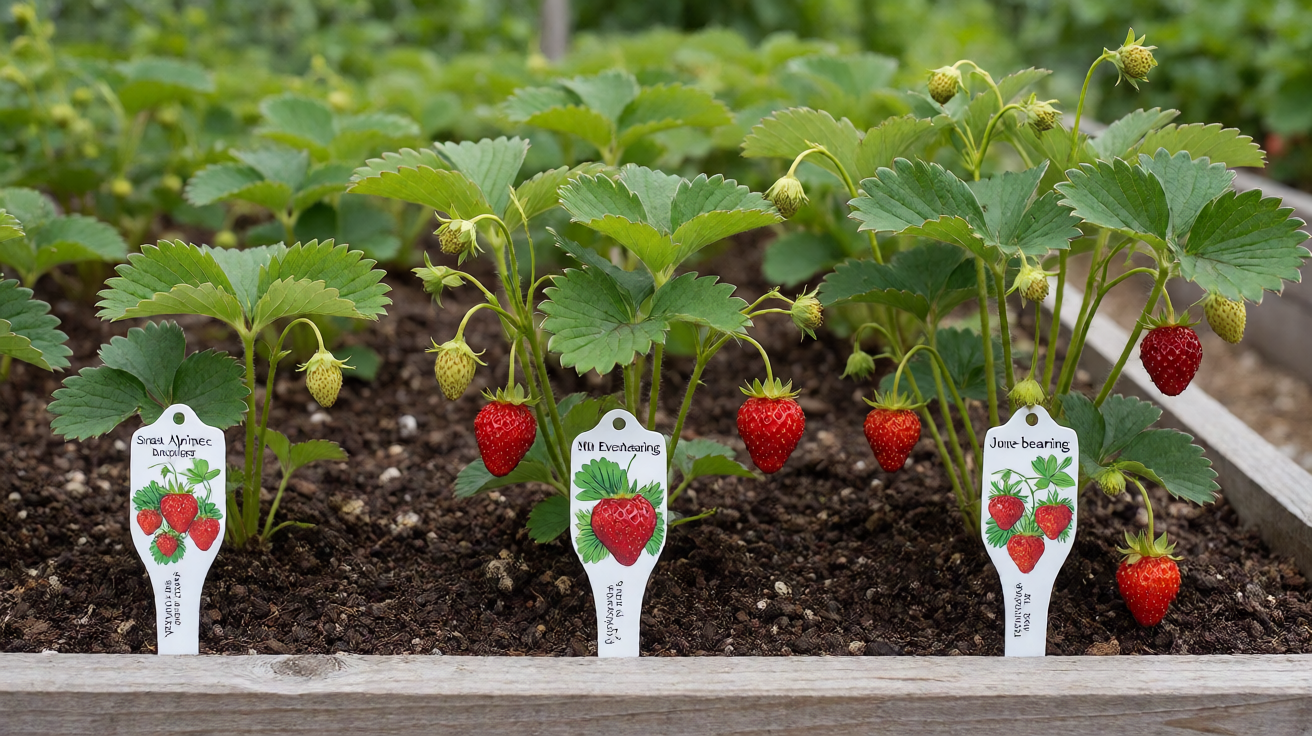
June-bearing strawberries produce one large crop in early summer on flower spikes that form the previous fall. Everbearing strawberries produce two crops, one in early summer and a smaller one in late summer. Day-neutral strawberries fruit continuously from spring to fall as long as temperatures stay between 35 and 85 degrees Fahrenheit.
If you are growing June-bearing strawberries, you need a two-phase pruning system: light maintenance pruning in spring to remove damaged leaves and control spacing, followed by aggressive renovation pruning in late summer after the harvest ends. If you are growing everbearing or day-neutral strawberries, you need ongoing maintenance pruning throughout the season to remove spent fruit and damaged leaves while preserving the plant’s fruiting capacity.
To identify your strawberry type, check the variety name on your bare-root tag or plant label. June-bearing varieties include Allstar, Jewel, Chandler, and Honeoye. Everbearing varieties include Ozark Beauty and Quinault. Day-neutral varieties include Albion, Seascape, San Andreas, and Tristar. For variety profiles, see our strawberry varieties guide.
June-Bearing Strawberry Pruning
June-bearing strawberries require the most structured pruning cycle because they concentrate all their reproductive effort into a single early-summer crop. The pruning system has two phases: spring maintenance pruning and late-summer renovation pruning.
Spring maintenance pruning begins as soon as the plant shows new green growth in early spring. Cut away any brown, mushy, or moldy leaves that survived winter. Do not cut into the crown itself. After removing damaged leaves, thin the planting so that plants are spaced 8 to 12 inches apart within the row. This spacing improves air flow, reduces fungal disease pressure, and gives each plant enough direct sun to maximize fruit size. For planting depth guidance, see our strawberry care guide.
The critical window for June-bearing pruning is after the harvest ends. Once the June crop is finished, immediately prune the entire planting. Cut all leaves back to about 2 inches above the crown. This renovation cut removes old, disease-prone foliage and signals the plant to produce fresh leaves for the next season. Cornell Cooperative Extension recommends renovation pruning within 7 to 10 days after the last harvest.
After renovation pruning, side-dress the planting with a balanced fertilizer to support the flush of new leaf growth. Keep the soil consistently moist but not waterlogged. Good drainage is essential for preventing root rot, which thrives in waterlogged conditions. Watering deeply but infrequently promotes strong root development, while frequent shallow watering encourages surface roots that are more susceptible to drought stress. If the planting is in a matted-row system, trim the outer edges to maintain the 12-to-18-inch row width.
Everbearing and Day-Neutral Strawberry Pruning
Everbearing and day-neutral strawberries follow a simpler pruning philosophy because they fruit continuously rather than in a single burst. The goal is to keep the plant healthy and productive by removing spent fruit, damaged leaves, and excess runners on an ongoing basis.
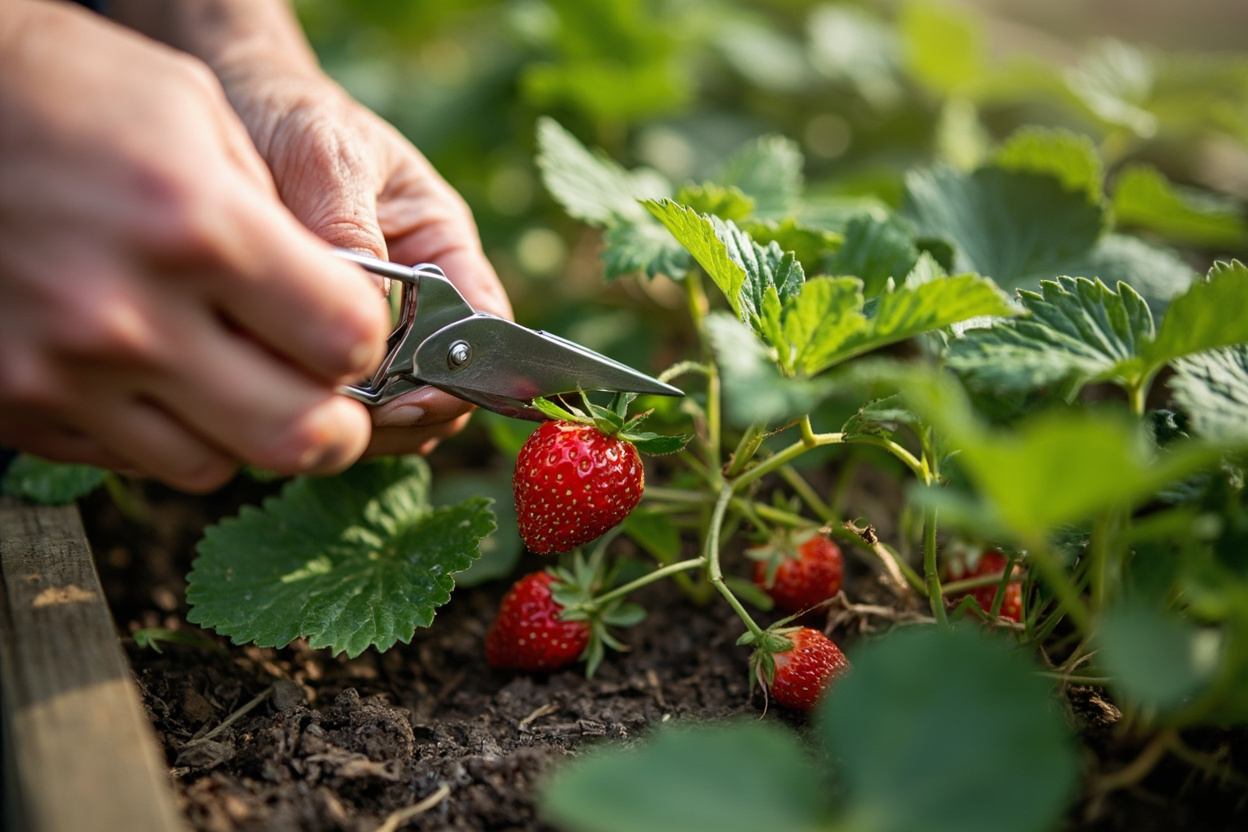
Throughout the growing season, remove spent fruit as soon as you notice it. A spent fruit is a berry that has turned pale, soft, or shriveled, or a flower spike that has finished blooming. Pinch them off at the base of the petiole or stem with your fingers or clean pruning shears. This habit prevents mummified fruit from becoming a source of fungal disease.
Remove damaged or diseased leaves whenever you notice them. For everbearing and day-neutral varieties, do not make a blanket renovation cut like you would for June-bearing strawberries. These varieties need their leaf canopy to photosynthesize and support continuous fruit production. Mulch with straw around the base of plants to reduce soil splash and disease spread.
Runner management for everbearing and day-neutral varieties is less aggressive than for June-bearing. Allow a few runners to root at spaced intervals if you want to propagate new plants, but remove excess runners to prevent the planting from becoming overcrowded. For container-grown everbearing or day-neutral strawberries, remove all runners consistently because runners compete with fruit production. For propagation methods, see our strawberry runner propagation guide.
Runner Management: When to Remove and When to Keep
Runners, also called stolons, are the horizontal stems that strawberry plants produce to create new offspring. Each runner grows outward from the crown, roots at nodes along its length, and produces a new plantlet. Managing runners is one of the most important pruning decisions you make each season.
Remove runners aggressively during the fruiting season if your priority is fruit size and yield. Runners compete with fruit production for carbohydrates and nitrogen. For June-bearing strawberries, remove runners as soon as they appear from late spring through the end of the harvest. For everbearing and day-neutral strawberries, remove runners throughout the entire growing season unless you are intentionally propagating new plants.
Keep runners during the propagation window if your goal is to increase your planting. The best time to propagate June-bearing strawberries is in late summer, immediately after renovation pruning. The new plantlets that root from runners during this window have the entire fall and winter to establish roots before spring fruiting. For everbearing and day-neutral varieties, propagate in early spring before fruiting begins or in early fall after the last harvest.
To propagate from runners, anchor a healthy plantlet to the soil using a U-shaped wire or a small stone. Keep the anchored plantlet moist until roots form, usually 14 to 21 days, then cut the connecting stolon to separate the new plant from the parent. Always propagate from the first or second generation of runners, which are the most vigorous.
Common Pruning Mistakes That Reduce Strawberry Yield
The most damaging mistake is pruning June-bearing strawberries at the wrong time. Pruning in late fall or winter removes the protective leaf canopy and exposes the crown to freeze damage. Pruning during active fruiting removes the leaves that are powering berry development. The safe pruning windows for June-bearing are spring (after new growth appears) and late summer (within 7 to 10 days after harvest).
The second most common mistake is pruning day-neutral strawberries like June-bearing strawberries. A blanket renovation cut on a day-neutral plant during the fruiting season removes the leaves that are currently supporting fruit development. Day-neutral and everbearing strawberries need maintenance pruning, not renovation pruning. Remove only what is damaged, spent, or diseased.
The third common mistake is failing to thin the planting sufficiently. A dense strawberry patch shades itself, creating a humid microclimate that favors fungal disease. The fix is to thin to 8 to 12 inches between plants within the row and 12 to 18 inches between rows. Proper spacing ensures each plant receives full sun and has adequate drainage.
The fourth mistake is using dull or dirty pruning tools. Dull shears crush plant tissue rather than cutting it cleanly, creating entry points for pathogens. Use sharp bypass pruners or clean scissors, and wipe the blades with rubbing alcohol between plants. For routine removal of spent fruit and small runners, hand-picking is sufficient. For a deeper look at how pruning fits into the broader care calendar, see our strawberry watering guide.
Pruning Tools, Sanitation, and Timing at a Glance
You do not need much to prune strawberries well, but the tools you do use matter. A sharp pair of bypass pruners handles renovation cuts and thick runners. Clean scissors or floral snips work for spent fruit and small stems. A small bowl or bucket keeps debris off the soil, and a rag with 70 percent isopropyl alcohol lets you wipe blades between plants to avoid spreading fungal spores from one plant to the next.
Sanitation is the most underappreciated part of strawberry pruning. Botrytis cinerea, the fungus that causes gray mold on berries, overwinters on infected leaves and fruit left in the patch. When you prune, bag and remove all cut material rather than leaving it as mulch in the row. Diseased material composted cold does not reach temperatures high enough to kill the spores, so it stays infectious. Hot composting at 140 degrees Fahrenheit or disposing of it off-site is the safer move.
Timing your cuts to the right window matters more than tool choice. For June-bearing strawberries, the two safe windows are early spring (after new growth appears, before flowering) and late summer (within 7 to 10 days after the final harvest). For everbearing and day-neutral varieties, the window is continuous: prune lightly throughout the growing season and avoid any blanket renovation cut. Pinching the first-year flower spikes on June-bearing plants in the spring of planting does not count as pruning but accomplishes the same goal: redirect energy to crown and root development instead of fruit.
The Science Behind Pruning
Strawberry plants respond to pruning because removing old foliage stimulates new growth. The timing matters because June-bearing varieties set fruit on old wood, while everbearing and day-neutral varieties produce on both old and new growth. This is why a blanket renovation cut works for June-bearing but devastates a day-neutral planting mid-season.
Removing leaves also removes the fungal spores, mite eggs, and aphid colonies that overwinter on foliage. Cornell University research on June-bearing strawberry production has shown that renovation pruning within 10 days of final harvest reduces the carryover of Botrytis and leaf spot pathogens into the next season by 40 to 60 percent compared to unpruned controls. The cut itself triggers a hormonal shift: lower auxin levels in the crown release dormant buds, which push out the fresh leaf canopy that powers next year’s photosynthesis.
Runner removal is the other half of the science. A mother plant supporting three or more runners diverts roughly 30 percent of its photosynthate into those new plantlets. Cut the runners early and the same energy goes into crown size, flower bud initiation, and fruit sugar accumulation. The trade-off is clear: more runners means more plants next year but smaller berries this year. Decide which one matters more for your planting before you start cutting.
Turn any PDF statement into a clean sheet
Skip the typos and the hours of copying. Our converter handles any bank statement format and outputs Excel, CSV, or QBO for QuickBooks. No file retention, free to try.
Convert your statement