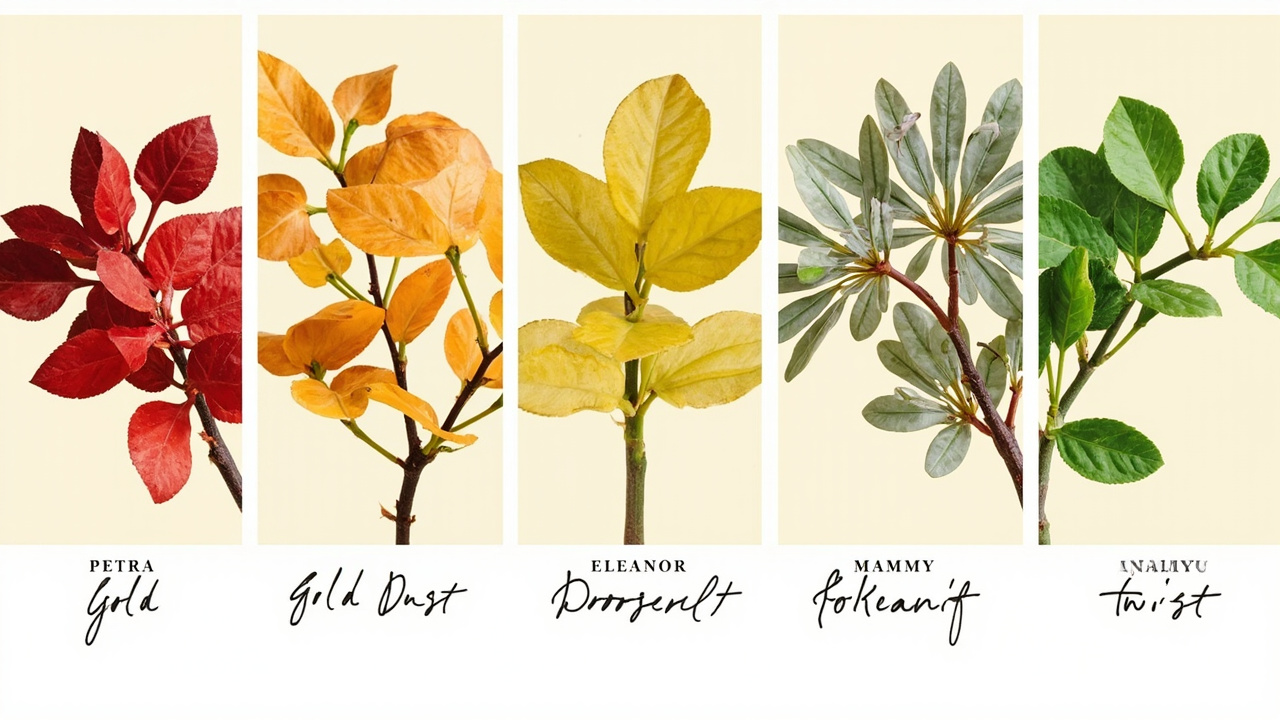
Five named croton cultivars dominate the indoor market: Petra, Gold Dust, Eleanor Roosevelt, Mammy, and Twisty. Each keeps the signature Codiaeum variegatum multicolored leaf pattern but splits on three key traits — mature height, leaf shape, and light requirement.
Petra is the forgiving entry cultivar for east-facing windows; Mammy is the demanding showpiece for south-facing glass or grow lights. The cultivation literature (RHS, Costa Farms, Mast Young Plants) ranks these five as the only named cultivars widely available through standard retail in 2025–2026.
Matching cultivar to room light is the predicate for long-term color. The matching rule: broad leathery leaves = lower lux tolerance (Petra 1500+), thin satiny leaves = higher lux need (Mammy, Twisty 2500-3000+). This guide breaks down the ID markers, mature size, and light threshold for each named cultivar.
Petra: The Color-Intensity Workhorse
Petra is the most widely sold croton cultivar globally. Leaves are broad, shield-shaped, and thick-leathery with pronounced midribs. The variegation pattern is green-yellow-orange-red in irregular vertical bands radiating from the midrib.
Individual leaves reach 6-8 inches (15-20 cm) long and 3-4 inches (7-10 cm) wide.
Mature height: 3-4 feet (90-120 cm) indoors in a 6-8 inch pot. Petra bushes outward with dense branching rather than climbing. Light requirement: 1500+ lux; the most forgiving named cultivar and the only one that holds full color at 1500 lux year-round with supplemental light in winter.
Petra tolerates east-facing windows better than any other named cultivar. Its broad leaves integrate lower light efficiently, so partial shading causes a slower green-reversion rate than for thinner-leaved cultivars. This is why Petra remains the default first croton for beginners.
A mature Petra in a 7-inch pot produces 30-40 leaves at any one time, and a healthy plant pushes 2-3 new leaves per month during the growing season. Older lower leaves naturally yellow and drop every 4-6 weeks; this is normal senescence, not a failure signal.
Gold Dust: The Compact Speckled One
Gold Dust has medium-sized, elliptical leaves deeply speckled with bright yellow spots over a dark green base. The speckled pattern is pointillist — more uniform than Petra’s vertical bands — and under partial greening, Gold Dust is the least obvious of the five to detect visually because the 50/50 green-yellow split looks intentional.
Mature height: 12-18 inches (30-45 cm). The most compact named cultivar and the only one reliably suited to small shelves and desk-top spots. Gold Dust branches densely from the base and does not climb, so it fills space horizontally rather than vertically.
Light requirement: 1500-2000 lux. Below 1500 lux, greening is hard to spot until the whole leaf shifts solid gold-on-green. Gold Dust is the better choice over Petra only when shelf height is under 24 inches (60 cm) — otherwise Petra wins on color visibility.
Gold Dust grows slowly. A newly purchased 4-inch pot plant takes 8-12 months to fill a 6-inch pot. For this reason, buying a larger specimen (6-inch pot or bigger) is usually worth the small premium if you want immediate visual impact on a shelf.
Eleanor Roosevelt: The Tall Narrow One
Eleanor Roosevelt produces long, narrow, strap-like leaves that climb upward rather than bush outward. Leaves are mid-green flushed with yellow-orange-red in irregular stippled blotches.
Individual leaves reach 10-14 inches (25-35 cm) long and only 1.5-2 inches (4-5 cm) wide — the most elongated leaf in the named-cultivar lineup.
The plant can reach 4-6 feet (1.2-1.8 m) indoors if staked — by far the tallest named cultivar. Without staking, Eleanor Roosevelt bends and leans toward the light source, which is visually distinctive but structurally unstable in standard nursery pots.
Light requirement: 2500+ lux. Below 2000 lux, Eleanor Roosevelt produces half-red, half-green leaves and etiolates visibly. It is the second-most forgiving cultivar after Petra, but only in rooms that clear 2500+ lux for 12+ hours.
A mature Eleanor Roosevelt is a statement plant: its vertical habit makes it well suited to floor placement in a bright corner. Staking with a thin bamboo pole at 12-inch intervals keeps the stem upright and the leaf display symmetrical.
Mammy: The Twisted Blood-Red One
Mammy is the showpiece cultivar. Narrow, twisted, corkscrew-shaped leaves in saturated blood-red with thin orange-yellow margins. The leaf shape is unlike any other named cultivar — narrow 1-2 inches wide, 6-12 inches long, curling along the longitudinal axis in a spiral.
Mature height: 3-5 feet (90-150 cm). Mammy’s twisted stem-and-leaf structure is heavier than it looks; mature plants need a 7-10 inch pot with a wide base to prevent toppling.
Light requirement: 3000+ lux. Below 2500 lux, Mammy produces muddy brown-green streaks instead of clean blood-red. Mammy is the least forgiving named cultivar and demands a south window or 400 µmol/m²/s grow light. It is not a beginner’s first croton.
The corkscrew leaf structure catches light from multiple angles and creates a shimmering, almost metallic visual effect in bright indirect light. This makes Mammy a focal-point plant when positioned near a reading chair or entryway where the angular leaf display catches peripheral vision.
Twisty: The Corkscrew Contortionist
Twisty produces twisted, ribbon-like leaves in green-yellow-orange-red — similar saturation to Petra but a dramatically different leaf shape. The corkscrew shape is irregular; some leaves twist 180°, others 360°. Individual leaves are 6-10 inches (15-25 cm) long and 1-2 inches (2.5-5 cm) wide.
Mature height: 3-4 feet (90-120 cm). Twisty does not climb naturally but produces dense, heavy foliage that benefits from staking once it clears 30 inches (75 cm). The twisted leaf structure catches light from multiple angles, giving the plant a shimmering appearance in bright indirect light.
Light requirement: 2000-2500 lux. Twisty holds shape only above 2000 lux; at lower light, the corkscrew structure collapses and leaves emerge nearly flat. This cultivar bridges the gap between Petra’s tolerance and Mammy’s demand.
Twisty is the most sensitive of the five to sudden leaf drop when moved. If you move a Twisty from a bright nursery to a darker home environment, expect 30-50% leaf drop within 2 weeks. This is a light-acclimation response, not a sign of poor health — new growth will match the lower light within 6-8 weeks.
Quick-Reference Comparison Table
| Cultivar | Leaf Shape | Mature Height | Lux Requirement | Best Window |
|---|---|---|---|---|
| Petra | Broad shield, thick leathery | 3-4 ft (90-120 cm) | 1500+ | East, south |
| Gold Dust | Elliptical speckled | 12-18 in (30-45 cm) | 1500-2000 | East, south |
| Eleanor Roosevelt | Narrow strap, climbing | 4-6 ft (1.2-1.8 m) | 2500+ | South, west |
| Mammy | Twisted corkscrew | 3-5 ft (90-150 cm) | 3000+ | South + grow light |
| Twisty | Twisted ribbon | 3-4 ft (90-120 cm) | 2000-2500 | South, east (summer) |
The croton plant care guide walks the full light-water-humidity stack. The croton light requirements guide breaks down the lux-per-cultivar thresholds. If you are deciding between croton and another colorful foliage option, the coleus care guide covers the closest sibling species.
From Bank Statement to QuickBooks-Ready File
That manual cleanup you just read about? This tool skips it. Turn your PDF into QBO for QuickBooks without storing your data anywhere.
Start Converting