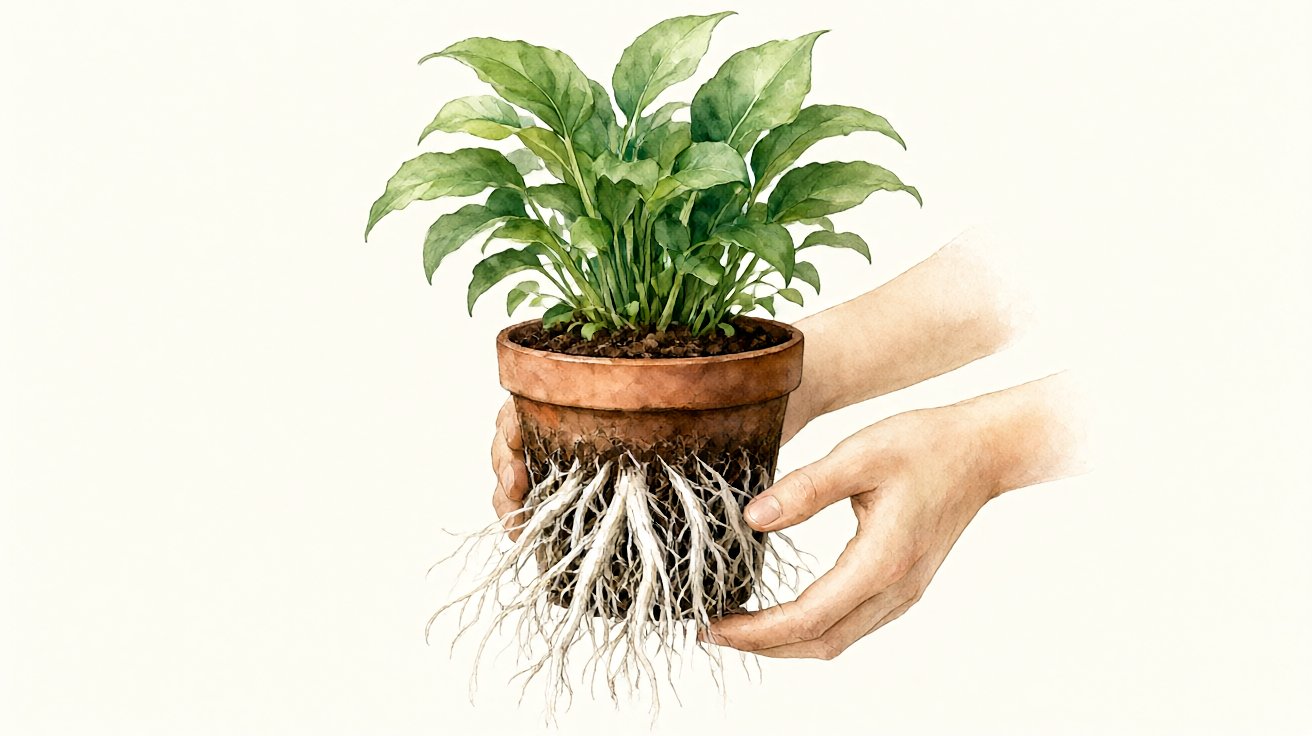

Root rot is not a disease you catch. It is a condition you create, usually by accident, when the soil around a root system stays saturated long enough that the oxygen in the pore spaces is replaced by water. The root stops respiring. Within 48 to 72 hours the cortex begins to break down, and the plant above ground starts to wilt, yellow, or drop leaves even though the soil is still wet. The yellow leaf is the message. The root is the real problem.
Two failure modes dominate indoor root rot. The first is chronic overwatering on a schedule that ignores soil moisture, often in a pot without drainage or in a soil mix that holds water too long. The second is a single catastrophic soak, usually after a vacation or a repotting accident, where the root ball sits in standing water for two or more days. The fix for both is the same: get the roots out of the water, cut away the dead tissue, and repot into a mix that breathes. The plant’s odds of recovery depend on how much healthy root remains, not on how sick the leaves look.
Root Rot Diagnostic Decision Tree
Use these three checks in order before you decide anything. They take five minutes and they separate root rot from overwatering, underwatering, and nutrient deficiency, all of which produce yellow leaves.
Check 1: The Smell Test
Lift the pot and smell the drainage hole. Healthy soil smells like fresh earth or compost. Root rot smells like sulfur, rotting eggs, or sour milk. That odor is anaerobic bacteria breaking down dead root tissue in the absence of oxygen. If you smell it, root rot is confirmed regardless of what the leaves look like.

Check 2: The Soil Moisture Test
Insert a wooden chopstick or moisture meter probe to the bottom third of the pot. If the soil is wet at depth but the top inch is dry, the pot has poor drainage and the lower root zone has been waterlogged for days. If the soil is uniformly dry, the plant is underwatered, not rotting. Root rot requires saturated soil; dry soil rules it out.
Check 3: The Root Color Test
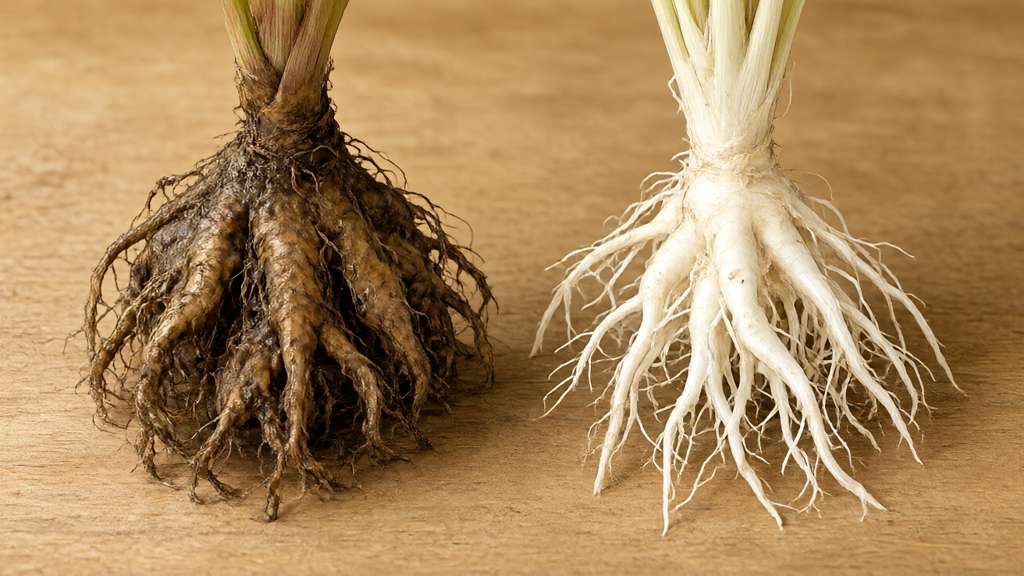
Slide the plant out of the pot. Healthy roots are white or tan, firm, and smell like soil. Rotted roots are brown or black, mushy, and slide off the root when you gently tug. A plant can lose 30 to 40 percent of its root mass and still recover if the remaining roots are white and firm. Above 60 percent loss, recovery is unlikely and propagation is the better use of the remaining tissue.
How Root Rot Differs From Other Causes
Yellow leaves and wilting are symptoms, not diagnoses. Three other conditions mimic root rot and lead to the wrong fix if you skip the checks above.
| Symptom | Likely cause if soil is dry | Likely cause if soil is wet | First fix |
|---|---|---|---|
| Yellow lower leaves, wilting | Underwatering | Root rot or overwatering | Soil moisture test, then root inspection |
| Brown crispy tips, firm soil | Low humidity or salt buildup | Overwatering with salt accumulation | Flush soil, check humidity |
| Yellow new growth, pale leaves | Nitrogen deficiency | Nitrogen deficiency (waterlogged roots cannot uptake) | Check roots first, then fertilize |
| Sudden collapse, mushy stem base | Stem rot (fungal) | Stem rot with root rot | Cut stem above rot line, propagate |
The counterintuitive point: a plant with root rot often looks underwatered because the dead roots cannot absorb water, so the leaves wilt and yellow even though the soil is soaked. Watering more kills it faster. The fix is to stop watering and inspect the roots.
Fix Protocols by Cause
Once you have confirmed root rot, the rescue protocol depends on severity. Severity is measured by the percentage of root mass that is dead, not by how bad the foliage looks.
Mild Root Rot (Under 30 Percent Root Loss)
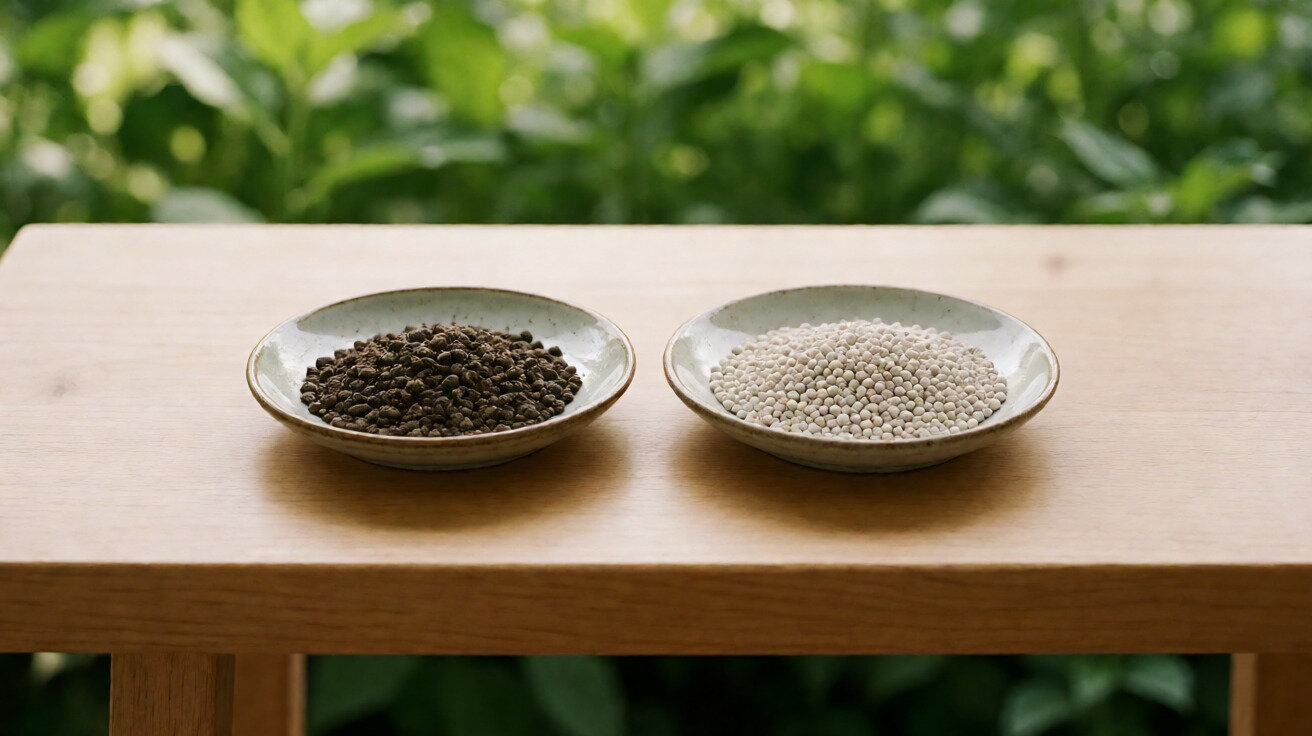
Unpot the plant. Gently rinse the root ball under lukewarm water to remove old soil. Cut away every brown or black root with sterilized scissors, cutting back to white tissue. Dust the cut surfaces with cinnamon or a fungicide powder. Repot into a pot one size smaller with fresh well-draining mix: 50 percent potting soil, 25 percent perlite, 25 percent orchid bark. Water lightly once and do not water again until the top two inches of soil are dry. Recovery signs, new white root tips visible at drainage holes, appear in 10 to 14 days.
Moderate Root Rot (30 to 60 Percent Root Loss)
Follow the mild protocol but expect a slower recovery. Remove up to half the foliage to reduce transpiration demand on the remaining root system. A plant that has lost half its roots cannot support a full canopy. Cut the oldest, lowest leaves first. Repot into a pot two sizes smaller than the original to match the reduced root volume. Place in bright indirect light, not direct sun, and keep humidity above 50 percent. Recovery takes 3 to 6 weeks. New growth from the center is the sign that the rescue worked.
Severe Root Rot (Over 60 Percent Root Loss)
The plant is unlikely to recover as a whole. Propagate instead. Take stem cuttings from the healthiest upper growth, remove all lower leaves, and root them in water or moist perlite. Discard the original root ball. This is not a failure; it is the correct decision when the root system is gone. A cutting from a plant with severe root rot will root in 2 to 4 weeks if the stem tissue above the rot line is still firm and green.
Species-Specific Root Rot Notes
Root rot behaves differently across species because root anatomy and watering tolerance vary.
Money Tree (Pachira aquatica)
Money trees store water in their trunk and tolerate dry soil better than wet. Root rot on a money tree usually starts at the base of the trunk where the soil stays wettest. Inspect the trunk base for soft, dark tissue. If the rot has reached the trunk, cut the trunk above the rot line and propagate the top. The lower trunk will not regrow.
Corn Plant / Mass Cane (Dracaena fragrans)
Corn plants have thick, fleshy roots that rot slowly but recover slowly. Unpot and check for orange-brown discoloration at the root tips. Trim aggressively. Repot into a mix with extra perlite, 40 percent, because corn plant roots are sensitive to waterlogging. Expect 4 to 8 weeks before new growth appears.
Peace Lily (Spathiphyllum wallisii)
Peace lilies wilt dramatically when dry but recover within hours of watering. If a peace lily wilts and does NOT recover within 4 hours of watering, suspect root rot. Their roots are fine and fibrous, so rot spreads fast. Act within 24 hours of diagnosis or the plant is lost.
Snake Plant (Sansevieria trifasciata)
Snake plants have rhizomes that rot from the center outward. If the leaves are soft and falling over, the rhizome is likely gone. Remove the plant, cut away all soft tissue, and check for any firm rhizome sections with attached roots. Repot only the firm sections. Snake plants propagate easily from leaf cuttings if the rhizome is fully lost.
Prevention: 5 Habits That Stop Root Rot
Root rot is preventable. These five habits address the two failure modes, chronic overwatering and catastrophic soaking.
- Drainage holes are non-negotiable. No pot without a hole. If you love a decorative pot without drainage, use it as a cachepot and keep the plant in a nursery pot inside it. Empty the cachepot within 30 minutes of watering.
- Soil mix must breathe. Standard potting soil alone holds too much water for most houseplants. Add 20 to 30 percent perlite or pumice to every mix. For moisture-sensitive plants like succulents and snake plants, use 40 percent perlite.
- Water by soil moisture, not by calendar. Check the top two inches of soil before every watering. If it is still damp, wait. A moisture meter or chopstick test takes 10 seconds and prevents 90 percent of root rot cases.
- Pot size must match root volume. A pot that is too large holds water the roots cannot reach, creating a waterlogged zone at the bottom. Repot only when roots circle the bottom of the pot, and move up one size, never two.
- Empty saucers and cachepots. Standing water in a saucer wicks back into the soil through capillary action. Empty within 30 minutes of watering. This single habit prevents more root rot than any other.
Recovery Timeline and What to Expect
Root rot recovery is slow because roots grow slowly. Expect 2 to 3 weeks before you see new growth, and 6 to 8 weeks before the plant looks fully recovered. During recovery, the plant may drop more leaves as it reallocates resources to root regrowth. This is normal and not a sign that the rescue failed. The sign that matters is new white root tips at the drainage holes and new growth from the center or stem tips.
If no new growth appears after 6 weeks, the root system did not regenerate enough to support the canopy. At that point, take cuttings from the healthiest growth and start a new plant. The original root ball goes in the compost.
After the Rescue: When to Resume Normal Care
Resume normal watering only when the plant shows new growth and the soil dries between waterings. Resume fertilizing at half strength after 4 weeks. Do not fertilize a recovering plant before that; damaged roots cannot process nutrients and fertilizer salts will burn them. Return to full light gradually over 2 weeks to avoid sun shock on a weakened plant.
Root Rot and the Bigger Picture
Root rot is the most common cause of indoor plant death, and it is almost always preventable. The plant is not dying from neglect. It is dying from a specific, identifiable, and fixable condition. The yellow leaf is the message. The root is the real problem. Do the three checks tonight, and the plant will answer by Thursday.
Last reviewed on November 9, 2026.
Sources and further reading
University of Minnesota Extension, “Root Rot of Houseplants: Causes and Management.” University of California Agriculture and Natural Resources, “Houseplant Care: Watering and Drainage.” Royal Horticultural Society, “How to Recognize and Treat Root Rot in Container Plants.” ASPCA, “Toxic and Non-Toxic Plants” (for species-specific safety notes referenced in the prevention section).