“Bright indirect light” is the most-repeated phrase in houseplant care and the least-measured. Most readers cannot tell 80 lux from 800 lux by looking at a window. The prayer plant tells the reader instead — its leaves unfold every morning in a 5-minute window that runs only when the light is right.
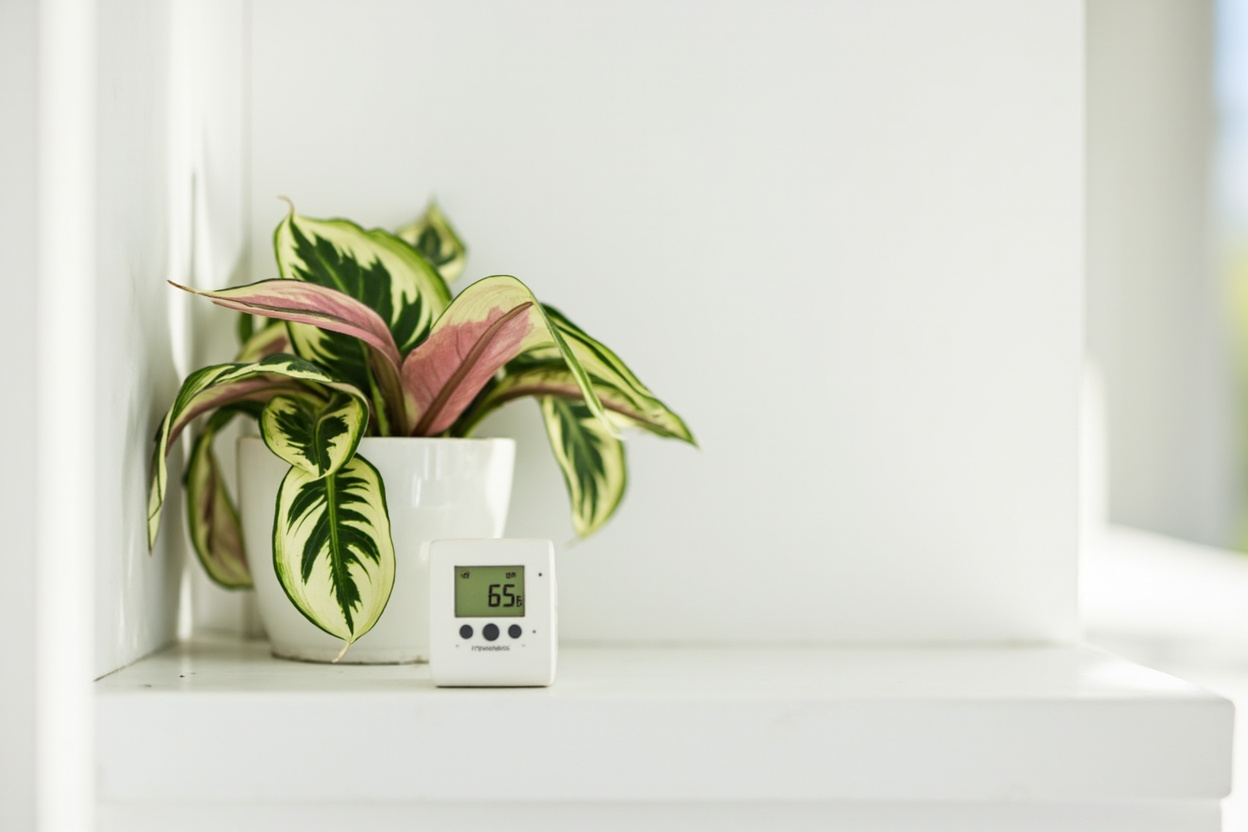
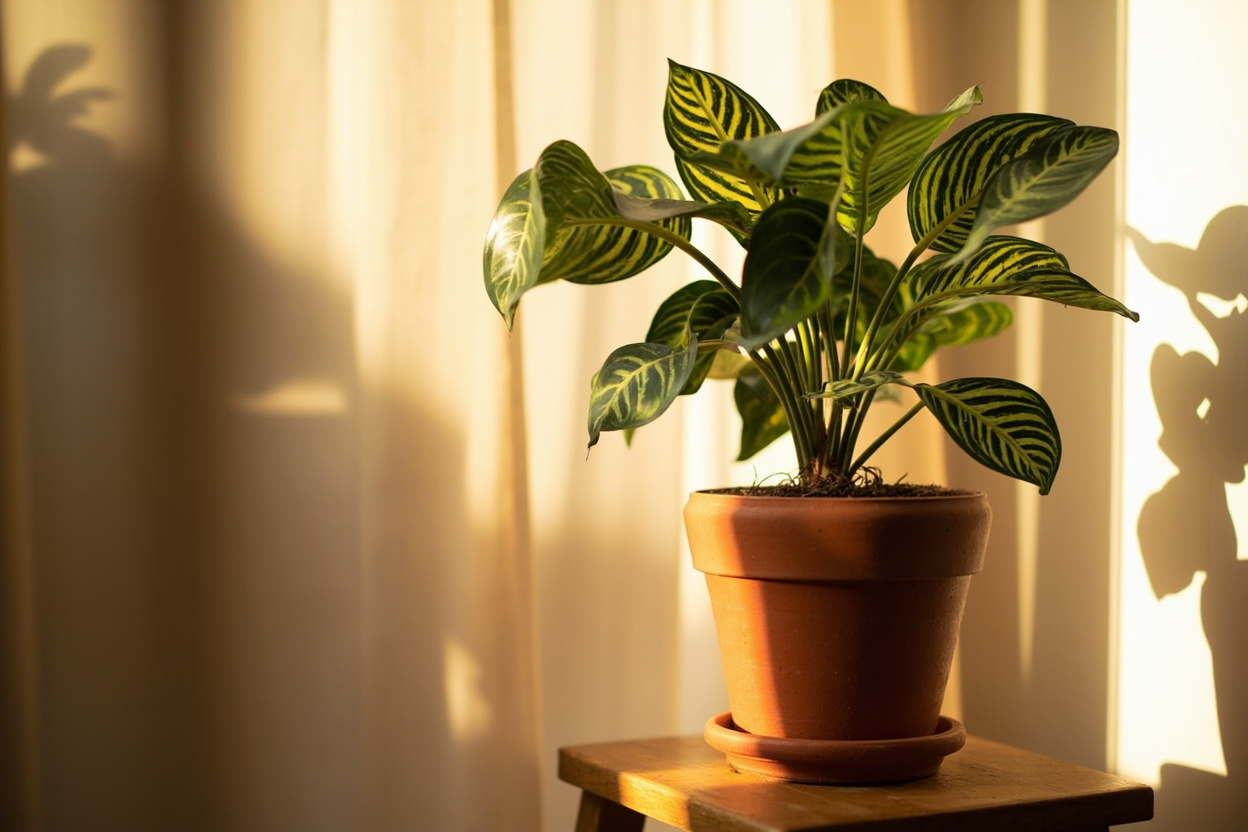
The prayer plant’s leaf-folding is a live light meter. The pulvinus swells with potassium ions within 5 minutes of indirect light reaching 50–80 lux, swinging the leaf 30–60 degrees flat.
The prayer plant unfolds on time every morning and folds at dusk when the light is right. The rhythm slows to 30 minutes when the light is too low.
This article gives the lux bands, ranks the four real window directions, gives the grow-light setup, and names the four light-problem signals. Read it once, place the prayer plant, and watch it unfold.
The prayer plant shares the bright-indirect-light prescription with the calathea. The cluster prayer plant care guide covers the full Maranta routine; for the sibling genus, see calathea plant care.
What “Bright Indirect” Actually Means in Lux, Not Vibes
Three lux bands matter for the prayer plant. The reader measures each in 30 seconds with a free phone lux meter held at the leaf surface.
Below 50 lux the prayer plant stops unfolding — the pulvinus never gets the trigger. Between 50 and 200 lux the prayer plant survives but does not push new leaves.
Between 250 and 500 lux the prayer plant grows, producing a new leaf every 4–6 weeks in active season. Above 1000 lux the prayer plant bleaches and curls within 48 hours.
The IFAS Extension rule for the prayer plant: the lit leaf surface should read like the light on a north-facing windowsill on a cloudy day — bright enough to read a book, not warm enough to feel on the skin. If the reader squints in the leaf-light, the prayer plant is in scorch range. If the phone reads below 50, the prayer plant is in survival range.
The trick: the lux at the leaf surface, not at the window. A south-facing window delivers 50,000 lux at the glass and 2,000 lux 30 cm back. The prayer plant reader cares about the leaf.
Move the prayer plant to within 1–1.5 m of a north window, or 60–90 cm back from an east or south window. The prayer plant care guide covers what to do when the light is wrong.
The Four Real Windows, Ranked for the Prayer Plant
East is the strongest window for the prayer plant. Direct morning sun (7–10 AM) gives the prayer plant 4,000–6,000 lux at the leaf but only for 2–3 hours.
The indirect level drops to 200–400 lux for the rest of the day. The prayer plant pushes the most new leaves in an east window. The bleached-leaf problem almost never appears because the harsh angle ends before the pulvinus can over-react.
North is the safest window for the prayer plant. A north-facing window with no curtain delivers 150–300 lux indirect all day, the growth band.
The trade-off: north-window prayer plants grow slower — expect a new leaf every 6–8 weeks, not every 4–6. For a north-window bedroom, the prayer plant is one of 8 species on the cluster low light plants for bedroom list.
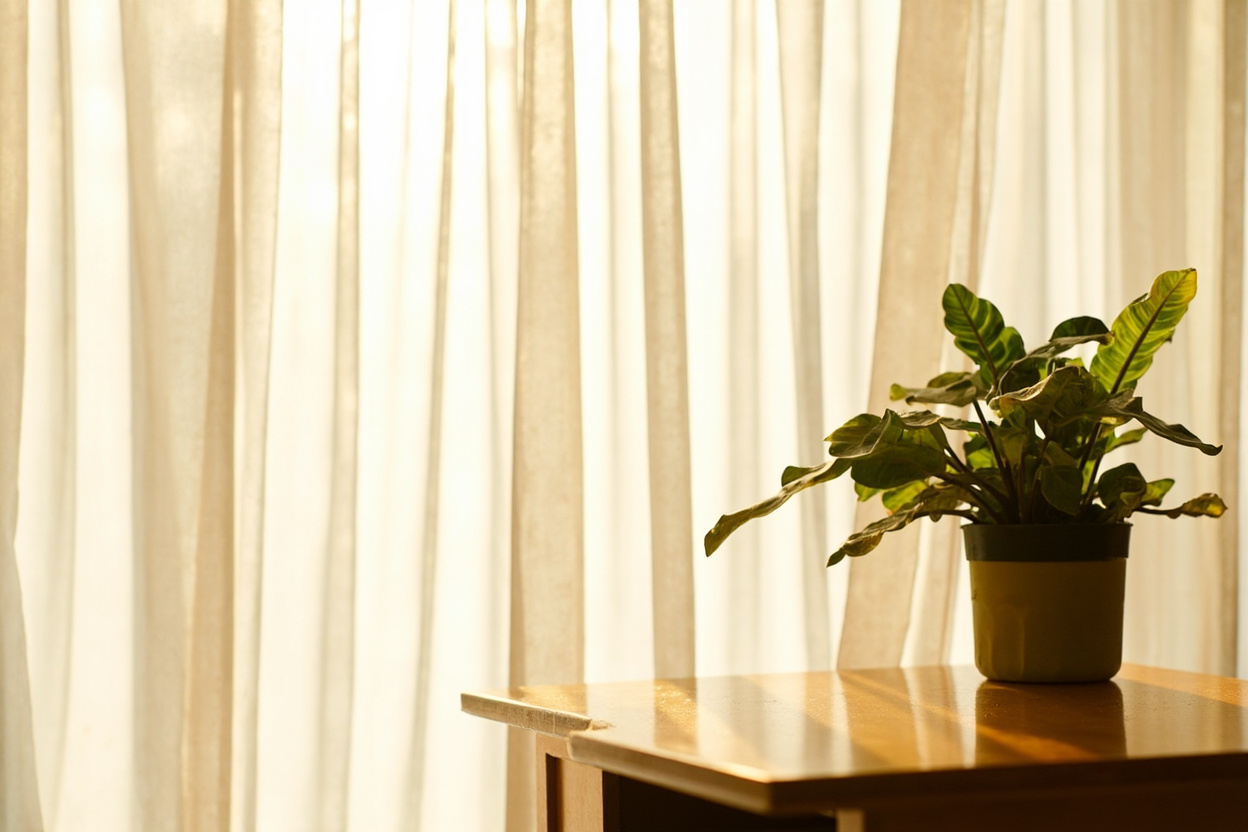
South and west need a sheer curtain for the prayer plant. Direct south or west afternoon sun delivers 5,000–20,000 lux at the leaf, which bleaches the variegation and curls the leaf edges downward within 48 hours.
A single layer of sheer cotton reduces the leaf-lux to 800–1,500 — still too bright for the prayer plant. The prayer plant needs 2.5–3 m back from south or west glass plus a sheer curtain, or the light needs to fall on the curtain before reaching the plant. Without the curtain, the prayer plant scorches; with the curtain and the distance, the prayer plant thrives.
Grow Lights: When the Prayer Plant Reader Has No Window
A windowless room is the hardest lighting problem for the prayer plant, but a grow light makes it work. The right setup: a full-spectrum LED at 5000–6500K color temperature, 30–45 cm above the prayer plant canopy, on a 12-hour daily timer.
The prayer plant unfolds within 5 minutes of the lamp turning on and folds within the same window after it turns off. The grower can watch the nyctinastic rhythm in real time — a control that window light does not give.
The most common mistake with grow lights is distance. A grow light within 15 cm of the prayer plant leaf delivers 5,000+ lux at the leaf — bleach range. The same light at 30–45 cm delivers 400–600 lux at the leaf, the growth band for the prayer plant.
The $15–$30 LED panels from hardware stores work. The $80+ full-spectrum panels are slightly better but not required. The prayer plant does not need flowering-spectrum light — it grows under foliage-rated Kelvin.
The honest limit: no grow light fully substitutes for a real window. The prayer plant in a windowless room loses variegation within 6–8 weeks even with a perfect grow-light setup, because the rhythm is part of what the prayer plant uses to maintain leaf green. Missouri Botanical Garden lists this as the leading cause of faded foliage in indoor prayer plants — the grow light delivers the photons, but the daily rhythm is a separate signal the lamp cannot fully replicate.
The Four Light-Problem Signals and What They Mean
The prayer plant sends four named visual signals when the light is wrong, and each one points to a different fix. The reader watches the leaves — no lux meter needed once the prayer plant starts showing the symptom.
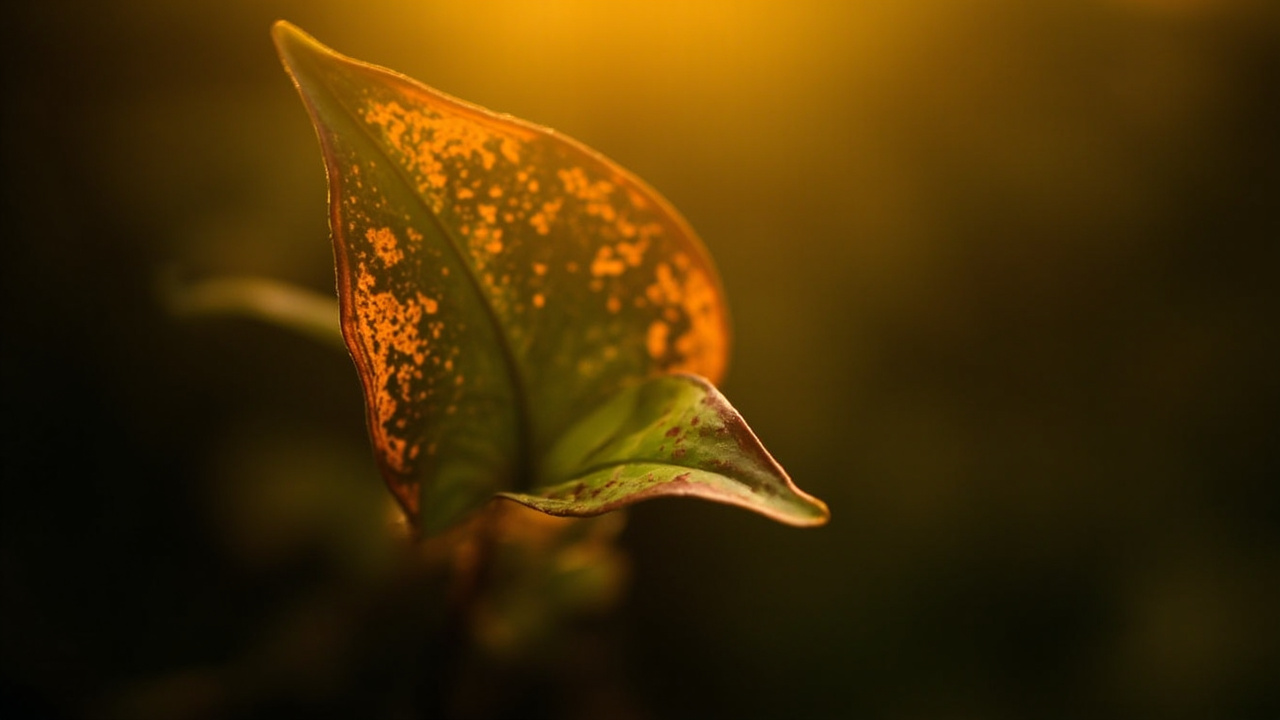
Bleached or pale leaves. Cause: direct sun or grow light too close. First action: move the prayer plant 60–90 cm further from the window, or 15 cm further from the grow light.
The new growth comes in green; existing bleached leaves do not recover their original color but stay functional for 8–12 weeks before dropping.
Faded variegation. Cause: too little light, or grow light in a windowless room. The dark-green pigment overrules the lighter variegation when the prayer plant compensates for low light.
First action: move the prayer plant closer to the brightest indirect source in the home. Expect variegation recovery in 4–6 weeks if the prayer plant is moved to 250–500 lux.
Stretched internodes. Cause: too little light for too many weeks. The prayer plant lengthens the stem between leaves because it is searching for more photons.
First action: prune the stretched stems back to a node and move the prayer plant closer to light. Expect compact regrowth in 4–6 weeks from the new growth point.
Slowed nyctinasty. Cause: light below 50 lux. The pulvinus gets the trigger to swell but takes longer to complete the fold.
First action: if the reader sees the rhythm slowing to 30 minutes or more, the prayer plant is starved for light. Move within 1 m of a north or east window. The rhythm returns to the 5-minute window within 3–7 days once the lux hits 80.
The Royal Botanic Gardens Kew Marantaceae monograph notes that the prayer plant’s pulvinus responds to light within minutes, while the leaf green responds within weeks. The rhythm is the early-warning signal and the color change is the late signal — by the time the variegation has faded, the nyctinasty has been slow for 3–4 weeks already.
Where the Prayer Plant Wins for Sleep, Bathrooms, and Rentals
The prayer plant is one of the few houseplants ranked by IFAS Extension in its top-10 indoor foliage plants for low-light performance plus pet safety. The cluster pet safe low light plants page names 8 species total — prayer plant and calathea are the only Marantaceae family members on it. The ASPCA confirms the prayer plant is non-toxic to cats and dogs, which lets the prayer plant live in homes where pothos or philodendron would not.
The honest trade-off for the prayer plant: it asks the reader to glance at the leaves every day. A reader who forgets to look at the prayer plant until it has dropped six leaves is a reader who would do better with a ZZ plant or a snake plant. The reader who notices the prayer plant folded flat at 11 PM and unfolded by 8 AM every morning will keep the prayer plant for years.
For the Marantaceae sibling comparison, the cluster calathea light requirements page applies the same lux bands and window rankings to Calathea rounds. The two genera share humidity and light prescription. The prayer plant’s daily rhythm is the reason the reader gets a built-in light meter, and that signal is why the prayer plant deserves the east or north window over a darker corner.
Turn any PDF statement into a clean sheet
Skip the typos and the hours of copying. Our converter handles any bank statement format and outputs Excel, CSV, or QBO for QuickBooks. No file retention, free to try.